

Eco-paving is defined as the use of permeable surfaces and recycled-material pavements in municipal infrastructure that cuts long-term maintenance expenses by reducing stormwater fees, extending pavement lifespan, and lowering repair frequency. Understanding how eco-paving reduces city maintenance budgets is now a priority for city planners facing tighter capital allocations and aging road networks. Technologies like permeable asphalt, rubber-modified asphalt, and the Rubberway® system from Ecotecrubber convert what was once a recurring cost center into a depreciating asset with measurable returns. Permeable paving systems reduce total ownership costs by 19 to 33 percent over 20 years, a figure that reframes the entire procurement conversation from upfront price to total value delivered.
How does eco-paving lower stormwater utility fees and operational costs?
Permeable asphalt and concrete pavers allow rainwater to infiltrate directly through the surface rather than sheet-flowing into municipal storm drains, and that single physical difference translates into direct line-item savings on utility bills. Permeable asphalt cuts stormwater fees by up to 85 percent, with some commercial and municipal properties recording up to $4,800 in annual fee reductions per site. That is not a rounding error in a public works budget. It is a recurring annual credit that compounds over the life of the pavement.
The savings extend beyond utility fees. When a surface absorbs runoff rather than redirecting it, cities can reduce stormwater infrastructure needs by 30 to 50 percent, cutting drain system construction costs by $15 to $30 per linear foot. For a mid-size municipality repaving several miles of collector roads, that reduction in parallel drainage infrastructure can offset a significant portion of the paving premium. Financial strategists increasingly view permeable asphalt as a fiscal asset, converting operational expenses into long-term value rather than treating them as sunk costs.
The mechanism works in three stages:
- Surface infiltration absorbs the first flush of rainfall, the most pollutant-laden portion, before it enters the storm system.
- Sub-base storage holds excess water in aggregate layers, releasing it slowly and reducing peak flow demands on downstream infrastructure.
- Reduced runoff volume directly lowers the impervious surface calculations that most municipal stormwater utilities use to set fee schedules.
Pro Tip: When designing a permeable pavement project, specify sediment traps at inflow points and confirm that vacuum sweeping equipment can physically access every section of the installation. A surface that cannot be maintained will clog within three to five years and lose most of its infiltration benefit.
How do recycled materials extend pavement lifespan and cut repair costs?
Recycled rubber and tire-derived materials change the structural behavior of a pavement base in ways that conventional aggregate cannot replicate. Rubber absorbs impact energy, flexes under freeze-thaw cycling, and resists root intrusion, three failure modes that account for the majority of pothole formation in northern and subtropical climates alike. The result is a pavement that stays intact longer between repair cycles, which is where the real budget savings accumulate.
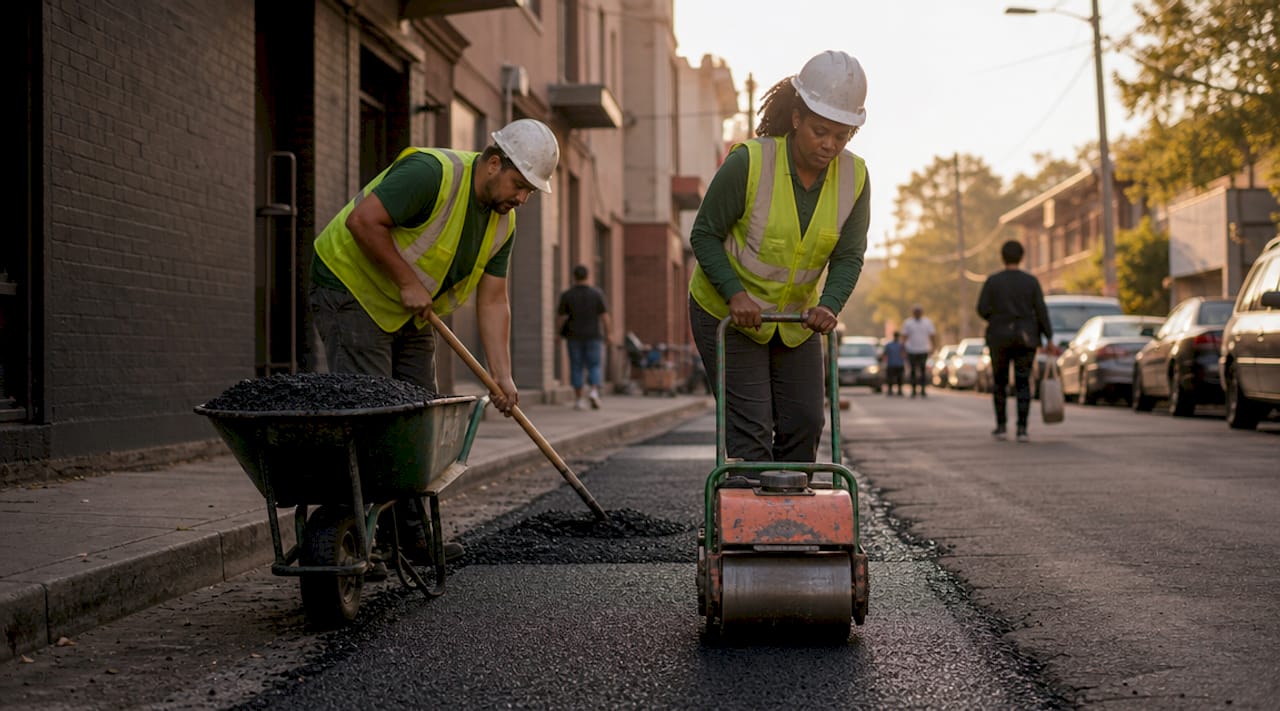
The numbers from Harris County, Texas, make the case concretely. A pilot program using recycled tires for street repairs projected $63,000 in savings per site over 10 years, compared to conventional patching methods that required intervention every six months. That shift from a six-month repair cycle to a multi-decade performance window is not incremental improvement. It is a structural change in how public works departments allocate labor and materials budgets.
Key advantages of recycled rubber and tire-reinforced pavements include:
- Pothole resistance: Rubber-filled tire casings stabilize the sub-base, preventing the void formation that leads to surface failure.
- Freeze-thaw tolerance: Flexible rubber layers absorb the expansion and contraction that cracks rigid asphalt, particularly relevant in Florida's wet-dry seasonal cycles.
- Root damage mitigation: Rubber sub-base layers deflect tree root pressure rather than fracturing under it, reducing sidewalk and pathway repair costs.
- Recycling credits: Municipalities using scrap tire materials often qualify for state recycling grants and credits, aligning sustainability with budget savings and making the business case easier to present to elected officials.
"Recycled tire reinforcements offer flexible, long-lasting pavements by negating freeze-thaw and root cracking, and they are often easier to fund under traditional infrastructure repair budget lines than new sustainability initiatives."
This last point matters more than most planners realize. Framing a rubber-modified paving project as infrastructure repair rather than a green initiative frequently unlocks existing capital budgets without requiring a new sustainability appropriation.
How do lifecycle costs of eco-paving compare with traditional methods?
The upfront cost premium for permeable and recycled-material pavements is real, and pretending otherwise undermines credibility with budget committees. Installation carries a 12 to 18 percent labor cost premium over conventional asphalt. The case for eco-paving rests entirely on what happens after installation, not during it.
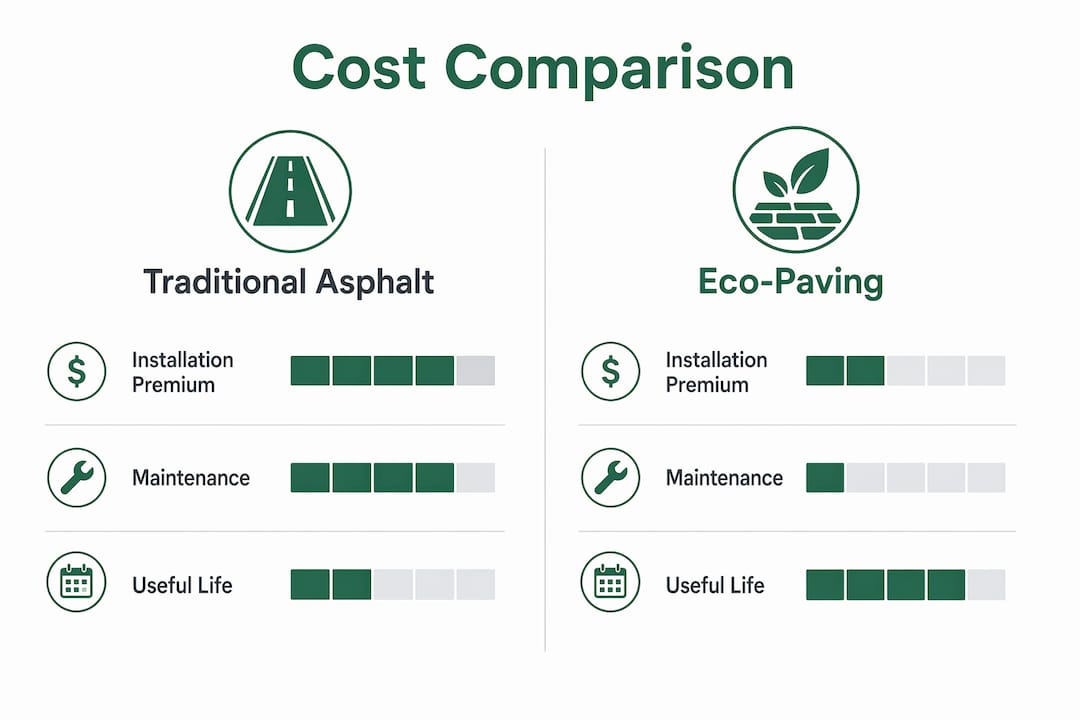
The comparison below uses data from infrastructure lifecycle analyses and reflects costs normalized per lane-mile over a 20-year period.
| Cost category | Traditional asphalt | Eco-paving (permeable/recycled) |
|---|---|---|
| Installation premium | Baseline | 12 to 18% higher |
| Pavement lifespan | 15 to 18 years | 25 or more years |
| Repair frequency | Every 6 to 18 months | Every 3 to 5 years |
| Stormwater fee reduction | None | 70 to 85% |
| Labor cost over 20 years | Baseline | 40% lower |
| Embodied energy/carbon | Baseline | 20 to 30% lower |
Alternative materials reduce construction and maintenance costs by 5 to 15 percent and cut embodied energy and carbon by 20 to 30 percent. That carbon reduction matters increasingly as municipalities face state and federal reporting requirements tied to infrastructure grants. A lower embodied carbon figure strengthens grant applications, which further offsets the upfront premium.
Cost parity between eco-paving and traditional asphalt typically arrives between years 8 and 12, depending on local stormwater fee structures and repair labor rates. After that crossover point, every additional year of service life represents pure budget savings. Municipal procurement should prioritize total ownership cost over upfront price, and the data supports that position clearly.
Pro Tip: When presenting lifecycle cost models to a budget committee, anchor the comparison at year 15, not year 1. At year 15, traditional asphalt typically requires full reconstruction while eco-paving is still in its primary service life. That single slide wins more approvals than any sustainability argument.
What maintenance practices protect eco-paving's budget advantages?
Eco-paving delivers its cost savings only when maintained correctly. The most common reason permeable systems underperform is not material failure. It is sediment clogging that goes unaddressed because no one budgeted for vacuum sweeping at the design stage. Vacuum sweeping every 6 to 12 months preserves infiltration rates above 85 percent after five years of service. Skip that schedule and the surface behaves like impervious pavement within three years, eliminating the stormwater savings entirely.
Effective maintenance for eco-paving follows a clear sequence:
- Schedule vacuum sweeping twice per year at minimum, timed before and after the heaviest rainfall season to clear accumulated sediment before it compacts into the aggregate base.
- Inspect sediment traps quarterly and clear them after major storm events. A blocked trap forces sediment directly into the pavement structure.
- Document infiltration rates annually using a simple field test. A declining rate is an early warning that cleaning frequency needs to increase before clogging becomes irreversible.
- Confirm equipment access at design stage by specifying turning radii and overhead clearances for vacuum sweeping trucks in the project drawings. A surface that cannot be reached by maintenance equipment is a surface that will fail.
- Train public works staff on the difference between eco-paving maintenance and traditional pothole patching. The tools, schedules, and failure modes are fundamentally different.
The contrast with traditional asphalt maintenance is instructive. Conventional pavement management is reactive: crews respond to visible failures with crack sealing, patching, and eventual overlay. Eco-paving maintenance is preventive: scheduled cleaning preserves function before failure occurs. Preventive maintenance costs less per year and avoids the large capital expenditures that reactive repair cycles generate. Integrated maintenance plans are not optional add-ons for eco-paving. They are the mechanism through which the budget savings actually materialize.
Key takeaways
Eco-paving reduces city maintenance budgets through lower stormwater fees, longer pavement life, and preventive maintenance that replaces costly reactive repair cycles.
| Point | Details |
|---|---|
| Stormwater fee savings | Permeable surfaces cut stormwater utility fees by up to 85%, generating recurring annual savings. |
| Lifecycle cost advantage | Eco-paving reaches cost parity with traditional asphalt between years 8 and 12, then delivers pure savings. |
| Recycled materials extend lifespan | Rubber-modified pavements can save an estimated $63,000 per site over 10 years by eliminating frequent repair cycles. |
| Maintenance is non-negotiable | Vacuum sweeping every 6 to 12 months preserves infiltration rates and protects the financial case for eco-paving. |
| Frame it as infrastructure repair | Recycled-material paving projects funded under repair budgets face fewer political barriers than new sustainability line items. |
Why the budget argument for eco-paving is stronger than most planners present it
Most presentations I have seen on sustainable pavement solutions lead with environmental benefits and bury the financial data in an appendix. That sequencing is backwards, and it costs projects their approval. Budget committees respond to numbers, not principles. The environmental case for permeable asphalt and rubber-modified pavements is real, but it closes after the financial case opens the door.
What I have observed in municipalities that successfully adopt eco-paving at scale is a consistent pattern: the project champion frames the proposal as a maintenance cost reduction initiative, not a sustainability initiative. The stormwater fee savings are presented as a recurring budget line. The extended repair cycle is quantified in labor hours avoided. The recycling credits are listed as revenue. By the time environmental benefits appear in the presentation, the committee has already approved the numbers.
The harder lesson is on maintenance integration. Cities that specify permeable asphalt without budgeting for vacuum sweeping equipment or service contracts are setting themselves up for a failure that discredits the entire approach. I have seen this happen, and the political fallout makes the next eco-paving proposal twice as difficult to advance. Maintainability as a design feature is not a technical detail. It is a political protection for the decision-makers who approved the project.
The role of eco-paving in municipal sustainability policy is growing, but the cities making the most progress are the ones treating it as a financial tool first. That reframe is available to any planner willing to lead with the spreadsheet.
— Gm
Explore Ecotecrubber's Rubberway® solutions for Florida municipalities
Florida's climate creates specific paving challenges: intense rainfall, heat-induced surface cracking, and standing water that accelerates pavement degradation. Ecotecrubber addresses all three through the Rubberway® installation system, which uses recycled rubber materials to create ADA-compliant, crack-resistant surfaces with superior drainage performance. Municipal projects benefit from extended pavement life, reduced repair frequency, and surfaces that hold up through Florida's wet season without the pothole cycles that drain public works budgets.
Ecotecrubber is licensed, insured, and focused exclusively on rubber paving solutions, which means every project receives the full attention of specialists rather than a generalist contractor. If your municipality is evaluating sustainable paving products for parks, pathways, parking areas, or public access surfaces, contact Ecotecrubber to discuss your project requirements and get a consultation aligned with your budget and timeline.
FAQ
What is eco-paving and how does it differ from standard asphalt?
Eco-paving refers to pavement systems that use permeable surfaces or recycled materials, such as rubber-modified asphalt or permeable concrete pavers, to reduce runoff and extend road life. Standard asphalt is impervious and requires more frequent repairs, while eco-paving systems are designed for lower total ownership costs over a 20-year period.
How much can a city save on stormwater fees with permeable pavement?
Permeable asphalt reduces stormwater utility fees by up to 85 percent, with individual sites recording up to $4,800 in annual savings. Cities that reduce impervious surface coverage also qualify for lower stormwater infrastructure investment, saving $15 to $30 per linear foot on drain system construction.
How long does eco-paving last compared to traditional asphalt?
Eco-paving systems with recycled rubber or permeable construction last 25 or more years, compared to 15 to 18 years for traditional asphalt. That extended lifespan, combined with a 40 percent reduction in labor costs over 20 years, is the primary driver of long-term budget savings.
What maintenance does permeable pavement require?
Permeable pavement requires vacuum sweeping every 6 to 12 months to prevent sediment clogging and maintain infiltration rates above 85 percent. Skipping this schedule causes the surface to behave like impervious pavement within three years, eliminating the stormwater and maintenance savings.
Can recycled rubber paving qualify for municipal grants or credits?
Yes. Municipalities using scrap tire materials in pavement projects often qualify for state recycling grants and credits. These programs align sustainability goals with budget savings and can partially offset the 12 to 18 percent installation premium associated with eco-paving systems.