
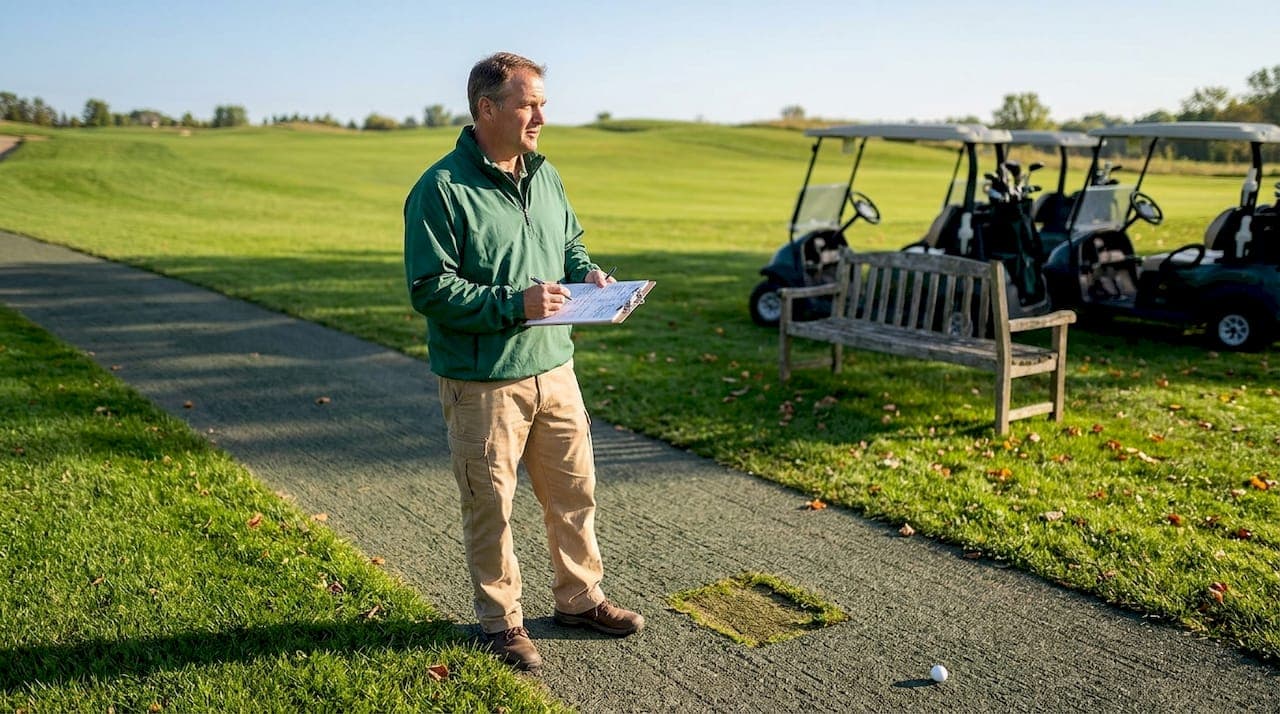
Rubber paving is defined as a surface material incorporating crumb rubber from recycled tires, engineered to absorb vibrational energy and reduce structure-borne noise at the source. Understanding how rubber paving reduces golf course noise matters because cart paths, maintenance corridors, and staging areas generate the kind of repetitive impact noise that degrades player focus and irritates neighboring communities. The science behind this is specific and measurable. Rubberized surfaces can reduce noise by 3 to 7 dB compared to conventional asphalt, a reduction perceived by the human ear as roughly halving the loudness. This article covers the acoustic mechanics, material design variables, durability factors, sustainability advantages, and practical steps for specifying rubber paving on your course.
How rubber paving reduces golf course noise
The technical term for what rubber paving does acoustically is viscoelastic damping. Rubber particles embedded in the pavement matrix flex under load, converting mechanical vibration into low-level heat rather than radiating it as sound. This is fundamentally different from how conventional asphalt behaves. Standard pavement is rigid and reflects vibrational energy back into the surface and surrounding air. Rubber-modified pavement absorbs it.
The primary noise pathway on a golf course is tire-pavement interaction. Golf cart tires rolling over hard surfaces generate a continuous vibration cycle that transmits through the cart frame, the pavement slab, and ultimately into the air as audible noise. Rubber paving interrupts this cycle at the pavement level. The viscoelastic damping mechanism works through two microstructural features: void phases that trap and dissipate air pressure fluctuations, and interfacial phases where rubber particles meet the binder matrix and convert strain energy into heat.
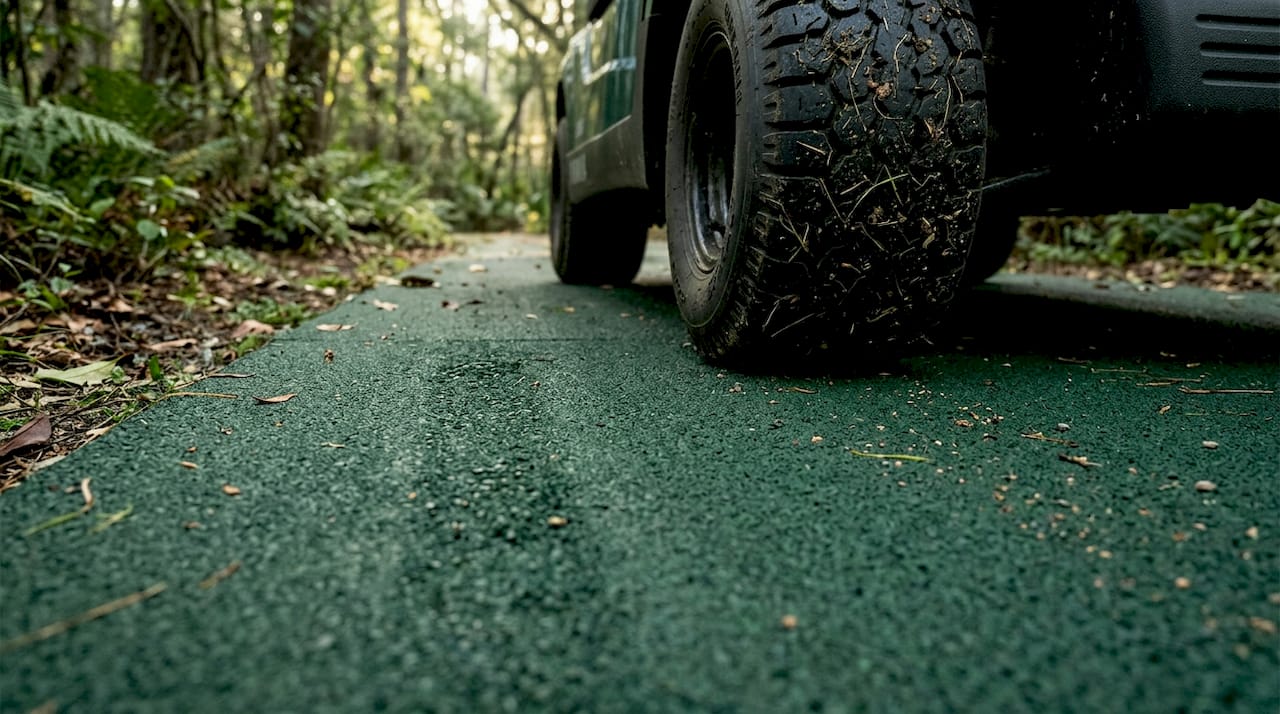
The quantitative result is significant for course management. A 3 to 7 dB reduction translates to a perceived halving of loudness for most listeners, meaning a cart path that currently registers as intrusive becomes noticeably quieter without any change to cart speed or traffic volume. For courses adjacent to residential areas, that difference can shift community perception from complaint to acceptance.
Key acoustic mechanisms at work in rubber paving:
- Viscoelastic energy absorption: Rubber particles flex under load and dissipate vibrational energy as heat rather than sound.
- Void phase damping: Micro-voids in the pavement matrix trap and attenuate air pressure waves generated by tire contact.
- Interfacial phase dissipation: The boundary between rubber particles and asphalt binder creates additional energy loss zones.
- Reduced surface stiffness: Lower overall stiffness means less energy is reflected back as structure-borne vibration.
Pro Tip: When evaluating rubber paving proposals, ask contractors to specify which noise pathway their product targets. Viscoelastic damping addresses structure-borne vibration. If your primary noise source is airborne sound from maintenance equipment, you will need supplemental controls alongside rubber paving.
What mix design variables actually control noise performance?
Not all rubberized paving performs equally. The acoustic gains depend on crumb rubber particle size, content percentage, binder modification, and surface gradation. Generic claims about "rubberized asphalt" without these specifics tell you almost nothing about expected noise reduction.
Crumb rubber content follows a curve of diminishing returns. Performance improves meaningfully up to approximately 20 to 25% rubber content by weight, then levels off. Pushing beyond that threshold does not deliver proportional noise reduction and can compromise mechanical strength. A 2026 MDPI study confirmed this relationship, correlating damping performance with crumb content across a range of temperatures and particle sizes.
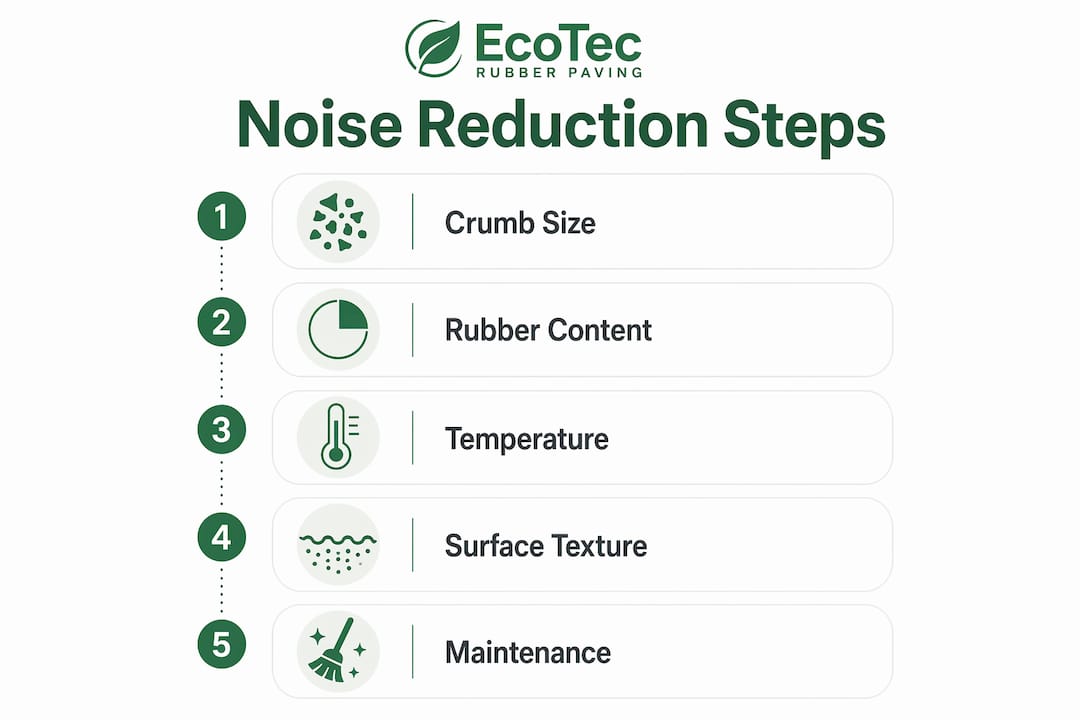
Particle size affects how energy is distributed through the mix. Finer crumb rubber particles create more interfacial surface area, which increases energy dissipation per unit volume. Coarser particles contribute more to void phase damping. The optimal choice depends on the dominant noise frequency you are targeting. Cart path noise peaks in the mid-frequency range, where finer particles tend to perform better.
| Variable | Effect on noise reduction | Practical implication |
|---|---|---|
| Crumb rubber content (up to 20-25%) | Increases damping proportionally | Specify minimum 18% content for meaningful noise control |
| Particle size (fine vs. coarse) | Fine particles improve mid-frequency absorption | Request particle size data, not just rubber percentage |
| Temperature (hot vs. cold) | Damping efficiency drops at low temperatures | Florida courses benefit year-round; northern climates need seasonal validation |
| Surface gradation | Open-graded surfaces add void phase benefits | Consider open-graded mixes for cart paths with high traffic volume |
Temperature is the variable most often ignored in procurement conversations. Rubber's viscoelastic properties are temperature-dependent. In Florida's climate, where Ecotecrubber operates, high ambient temperatures actually keep rubber particles in a more flexible state year-round, which sustains damping performance consistently. In colder climates, rubber stiffens, and the acoustic benefit can diminish during winter months.
Pro Tip: Request a temperature-performance data sheet from any supplier before signing a contract. If they cannot provide one, that is a signal they have not tested their mix under real-world conditions.
How does rubber paving hold up over time and through seasonal stress?
Durability is the legitimate concern that follows every acoustic performance conversation. A surface that reduces noise in year one but degrades by year three is not a solution. The research on this is encouraging. A 2026 Scientific Reports study found that frictional and damping energy dissipation actually increased after 15 freeze-thaw cycles in rubber-modified mixtures, outperforming conventional asphalt under the same stress conditions. This means the noise control properties do not simply survive seasonal cycling. In some cases, they improve.
For Florida-based courses managed through Ecotecrubber's service area, freeze-thaw stress is largely irrelevant. The more relevant durability stressors are UV exposure, heat-induced softening, and heavy cart traffic. Rubber-modified surfaces handle heat-induced stress better than standard asphalt because the rubber component maintains flexibility at high temperatures rather than becoming brittle.
Practical durability considerations for golf course managers:
- Pilot test before full installation: Install rubber paving on one high-traffic cart path segment and monitor noise levels and surface condition over 12 months before committing to a full course rollout.
- Establish a noise baseline: Record decibel readings on existing surfaces before installation so you have objective data to compare against post-installation measurements.
- Schedule annual visual inspections: Look for surface raveling, which indicates binder degradation, and address it before it compromises the rubber particle matrix.
- Compare maintenance costs directly: Rubber paving typically requires less crack-sealing than conventional asphalt because the rubber component resists thermal cracking, reducing long-term maintenance spend.
The maintenance profile of rubber paving is generally lower than conventional asphalt over a five-year horizon, primarily because thermal cracking is the most common failure mode for standard cart paths and rubber paving resists it structurally.
Beyond acoustics: sustainability and community relations benefits
Rubber paving's noise reduction properties are the primary reason golf course managers consider it. The sustainability story is what makes the decision easier to defend to boards, neighbors, and local governments. Ann Arbor's 2026 rubberized roads pilot used over 3,700 tons of rubberized asphalt and recycled more than 2,000 tires in a single project. That circular economy narrative resonates with community stakeholders in ways that pure acoustic data does not.
For golf courses specifically, the sustainability angle addresses a persistent public relations challenge. Courses already face scrutiny over water use, chemical applications, and land use. Demonstrating that your cart path infrastructure diverts waste tires from landfills and reduces noise for neighboring residents simultaneously reframes the course as a community asset rather than a nuisance.
The combination of noise control and sustainability messaging measurably improves stakeholder acceptance for infrastructure projects. This is not a soft benefit. It translates into fewer noise complaints, smoother permit processes for future improvements, and stronger relationships with adjacent property owners.
Additional operational benefits worth noting:
- Rubber paving provides sound absorption improvements of approximately 43% in composite applications, with the most significant gains in the 100 to 1,250 Hz frequency range where cart and foot traffic noise concentrates.
- ADA compliance is built into properly specified rubber paving installations, reducing liability exposure on accessible pathways.
- Drainage performance in rubber-modified open-graded surfaces reduces standing water on cart paths, which is a safety and maintenance benefit independent of acoustics.
How to specify and implement rubber paving for noise reduction
The gap between a good rubber paving outcome and a disappointing one almost always comes down to specification quality. Here is a practical sequence for golf course managers approaching this decision.
- Define your noise problem precisely. Walk the course with a sound level meter app and identify the three highest-noise locations. Note whether the dominant source is cart traffic, foot traffic, or maintenance equipment. Rubber paving addresses the first two most directly.
- Request detailed mix specifications from every supplier. Ask for crumb rubber content percentage, particle size distribution, binder modification type, and temperature-performance data. Reject any proposal that cannot provide all four.
- Specify a minimum rubber content of 18%. This sits below the diminishing-returns threshold of 20 to 25% while ensuring meaningful damping performance. It also gives you a contractual baseline to enforce.
- Run a pilot installation before full commitment. Select a 200 to 300 linear foot section of your busiest cart path. Install rubber paving, measure noise levels at 30, 90, and 180 days, and compare against your baseline readings.
- Integrate rubber paving with complementary controls. Rubber paving addresses structure-borne vibration noise effectively but does not mitigate airborne noise from maintenance equipment or nearby roads. Pair it with vegetation buffers, equipment scheduling policies, or acoustic barriers where those sources are significant. For broader facility noise control strategies, resources like office soundproofing principles illustrate how layered approaches outperform single-material solutions.
- Document outcomes and share them. Post-installation noise data gives you credible material for community communications, board presentations, and future procurement decisions.
Pro Tip: Never accept a noise reduction guarantee stated only in decibels without knowing the measurement conditions. A 5 dB reduction measured at 1 meter from the surface is very different from a 5 dB reduction measured at the property line. Specify the measurement distance and methodology in your contract.
Key takeaways
Rubber paving reduces golf course noise by converting tire-pavement vibration into heat through viscoelastic damping, with performance determined by mix design specifics rather than rubber presence alone.
| Point | Details |
|---|---|
| Quantified noise reduction | Rubber paving delivers 3 to 7 dB reductions, perceived as roughly halving loudness for listeners. |
| Mix design controls outcomes | Crumb rubber content, particle size, and temperature data must be specified in contracts, not assumed. |
| Durability holds under stress | Damping performance persists and can improve after freeze-thaw cycling, supporting long-term noise control. |
| Sustainability amplifies acceptance | Recycled tire content strengthens community relations alongside acoustic performance. |
| Pilot testing validates local results | A 200 to 300 foot test section with baseline measurements is the most reliable procurement tool available. |
Why I think most golf courses are solving the wrong noise problem
I have reviewed enough rubber paving proposals to recognize a pattern. Suppliers lead with the decibel reduction headline, managers approve the project, and six months later the noise complaints from the neighboring subdivision have not changed. The reason is almost always the same: the cart paths got quieter, but the 6 AM mowing schedule and the diesel maintenance vehicles were the actual community irritants all along.
Rubber paving is a genuine acoustic tool. The science is solid and the durability data is credible. But it works on a specific noise pathway, which is structure-borne vibration from rolling contact. If you have not mapped your actual noise sources before specifying materials, you are solving a problem you may not have at the scale you think you do.
The courses that get this right treat rubber paving as one layer of a noise management strategy, not the whole answer. They combine surface material changes with operational scheduling, vegetation buffers, and direct community communication. The material investment is the same either way. The outcome is dramatically different.
The other thing I would push back on is the tendency to treat any rubberized product as equivalent. The specification details matter dramatically for actual performance. A mix with 12% rubber content and no temperature validation is not the same product as a properly engineered 20% crumb rubber mix with documented damping curves. Ask for the data. If a contractor cannot provide it, find one who can.
— Gm
Ecotecrubber's Rubberway® system for golf course noise control
Ecotecrubber's Rubberway® rubber paving system is built specifically for Florida's climate conditions, where heat, UV exposure, and heavy cart traffic are the primary stressors on paved surfaces. Every installation uses recycled tire rubber, diverting waste from landfills while delivering the viscoelastic damping properties that reduce cart path and foot traffic noise at the source. Ecotecrubber is licensed and insured, and their projects are coordinated exclusively around rubber paving, which means you are working with specialists rather than generalists.
For golf course managers evaluating noise control options, Ecotecrubber offers consultation on mix specifications, pilot project design, and full installation across Sarasota, Tampa Bay, and surrounding Florida markets. Their Rubberway® product line includes options suited for cart paths, staging areas, and accessible walkways, with ADA-compliant surface profiles and drainage-optimized gradations. If you are ready to move from noise complaints to documented noise reduction, Ecotecrubber is the starting point.
FAQ
How much noise can rubber paving remove from a golf course?
Rubber paving typically reduces surface noise by 3 to 7 dB compared to conventional asphalt, which the human ear perceives as roughly halving the loudness of cart and foot traffic on paved surfaces.
Does rubber paving work in hot climates like Florida?
Yes. Florida's consistently high temperatures keep rubber particles in a flexible, high-damping state year-round, which sustains acoustic performance better than in climates with significant seasonal temperature swings.
What crumb rubber content should I specify for noise reduction?
Specify a minimum of 18% crumb rubber content by weight. Performance improves up to approximately 20 to 25%, after which returns diminish and mechanical strength can be compromised.
Will rubber paving eliminate all noise complaints from neighbors?
Rubber paving addresses structure-borne vibration noise from cart and foot traffic effectively. Airborne noise from maintenance equipment or nearby roads requires supplemental controls such as vegetation buffers or scheduling policies.
How long does rubber paving's noise reduction last?
Research shows that damping and frictional energy dissipation in rubber-modified mixtures persists and can increase after repeated freeze-thaw cycles, indicating that noise control properties are durable over the surface's operational life when properly specified and installed.