

Evaluating eco-friendly paving vendor bids is the process of comparing standardized proposals across scope compliance, sustainability verification, pricing structure, contractor qualifications, and lifecycle cost to identify the best overall value for your project. Without a structured approach, you risk selecting a bid that looks affordable on paper but hides missing drainage components, unverified recycled content claims, or a contractor who has never set foot on your site. This guide walks you through every layer of a sound green paving contractor evaluation, from bid leveling and material verification to long-term cost modeling and regulatory compliance, so you make a decision backed by evidence rather than marketing language.
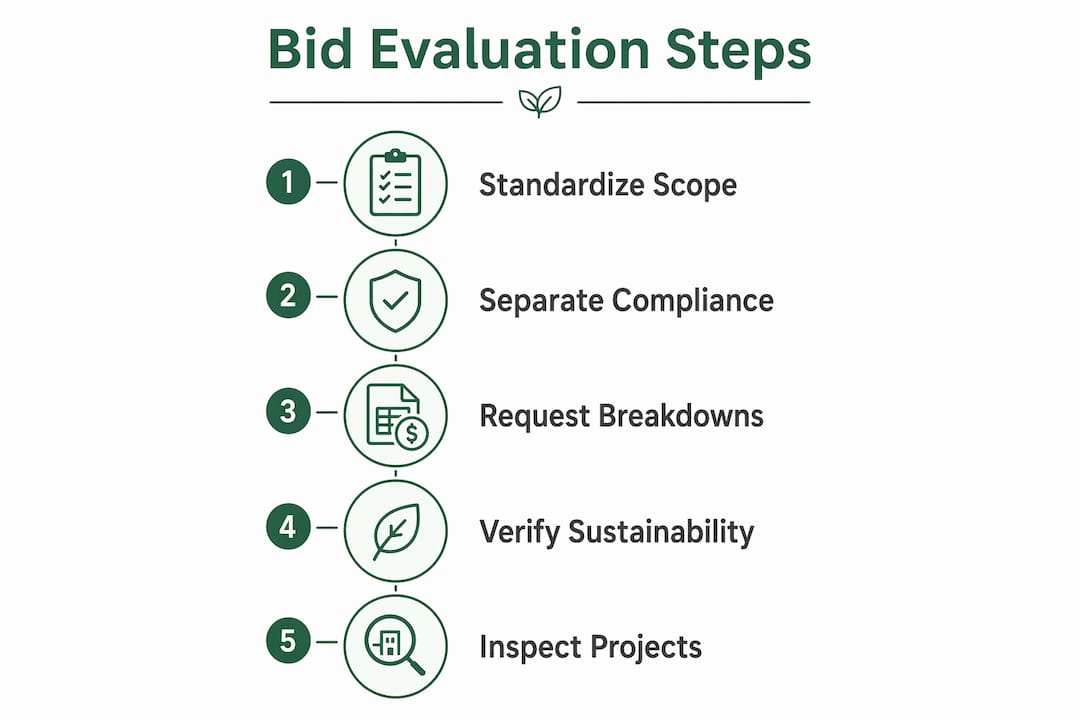
How to evaluate eco-friendly paving vendor bids with standardized scopes
The single most common mistake in sustainable paving bid assessment is comparing bids that were never built on the same foundation. One contractor prices a full permeable base system. Another prices only the surface layer. The numbers look similar, but the scopes are miles apart.
Bid leveling solves this by requiring every contractor to price against an identical, detailed scope document before you review a single dollar figure. That document should specify:
- Total square footage and site boundaries
- Pavement section design, including surface units, bedding layer, aggregate base depth, and subgrade treatment
- Drainage intent, including underdrain placement, overflow pathways, and connection to existing infrastructure
- Project phasing, traffic management, and site access requirements
- Payment schedule structure and markup caps
Once bids arrive, normalize the pricing format. A lump sum bid and a unit price bid cannot be compared directly. Convert both to a cost-per-square-foot basis so the numbers reflect the same unit of value. Do the same for contract terms: warranty duration, timeline commitments, and change order triggers should all be aligned before you score any bid.
Separating scope compliance from sustainability claims is equally critical. A bid that excludes the drainage base may appear 20% cheaper while delivering none of the stormwater performance you are paying for. Flag every exclusion and price it back in before drawing conclusions.

Pro Tip: Request line-item breakdowns rather than aggregate sums. A single lump-sum number tells you nothing about where costs are concentrated or what a contractor has quietly left out.
How do you verify sustainability claims in paving bids?
Green claims in paving bids range from genuinely verifiable to pure marketing. Your job is to tell the difference before you sign a contract.
-
Request product data sheets and safety data sheets. Every material in the bid should have a manufacturer-issued data sheet that lists composition, recycled content percentage, and performance ratings. If a contractor cannot produce these, the claim is unverified.
-
Demand third-party test reports. Third-party documentation should confirm slip resistance ratings, freeze-thaw durability cycles, permeability rates, and load-bearing capacity. Internal testing by the manufacturer does not carry the same weight.
-
Verify recycled content documentation. Recycled content claims must trace back to a specific source, such as post-consumer rubber from tires or reclaimed aggregate. Ask for chain-of-custody records, not just a percentage on a brochure.
-
Scrutinize warranty coverage in detail. A warranty that covers surface delamination but excludes color fading or subsidence is not a full warranty. Confirm that the warranty specifies the failure inspection process, who conducts it, color matching for replacement panels, and whether spare stock is held.
-
Evaluate end-of-life recyclability. A material that cannot be recycled or reused at the end of its service life carries a hidden environmental cost. Ask whether the product can be returned to the manufacturer or repurposed, and get that answer in writing.
The entire permeable paving system requires evaluation, not just the surface layer. Joints, bedding, base stone, subgrade preparation, underdrain, and overflow pathway all determine whether the system actually drains as promised. A surface with a 90% permeability rating sitting on an improperly graded base will pond water just as badly as conventional asphalt.
Pro Tip: Ask each bidder to show you a completed project with the same material system, then visit it after a rain event. Real-world drainage performance is more informative than any data sheet.
What contractor qualifications actually predict project success?
Price and sustainability credentials matter, but contractor process discipline is the strongest predictor of whether your project will hold up over time. Most project failures trace directly to omissions or shortcuts in the installation process, not to material quality.
Look for these indicators when reviewing contractor qualifications:
- Site inspection before quoting. A contractor who quotes from photos or square footage alone cannot account for soil conditions, drainage grades, or utility conflicts. Firm refusal to quote without a site visit is a positive signal, not an inconvenience.
- Written, line-item estimates. Vague estimates create gaps that become change orders. A detailed written scope protects both parties and signals that the contractor understands the full scope of work.
- Defined project stages. A disciplined contractor follows a multi-stage process: site visit, design and material selection, permitting, construction, and post-installation walkthrough. Ask each bidder to describe their process and compare the answers.
- Communication standards. Ask how often you will receive project updates and through what channel. Contractors who cannot answer this question clearly tend to go quiet once work begins.
- License and insurance verification. Confirm that the contractor holds a current state license and carries general liability and workers' compensation insurance. Request certificates, not verbal assurances.
Contractor evaluation is more predictive when you focus on process discipline than on marketing materials or price. A contractor with a lower bid who skips the site inspection and provides a one-page quote is a higher risk than a higher-priced bidder with a detailed written scope and a portfolio of completed projects you can visit.
Benchmarking long-term costs across paving bids
Upfront installation price is the least useful number in a paving bid comparison. The number that matters is total cost of ownership across the realistic service life of the pavement, typically 10 to 30 years depending on the material and climate.
Benchmark at least three cost scenarios for each bid: upfront installation, 10-year maintenance, and 15 to 30-year replacement risk. A bid that is 15% higher upfront may cost significantly less overall if it reduces repair frequency and eliminates stormwater infrastructure demands. The table below illustrates how this comparison works in practice.
| Cost category | Lower upfront bid | Higher upfront bid |
|---|---|---|
| Installation cost | Lower | Higher by 10-15% |
| Annual maintenance | Higher (more repairs) | Lower (durable material) |
| 10-year repair cost | Significant | Minimal |
| Replacement timeline | 10-15 years | 20-30 years |
| Stormwater savings | None | Reduces runoff infrastructure |
| Total 20-year cost | Higher overall | Lower overall |
Warranty duration and service provisions belong in this model. A 10-year warranty with a clear failure inspection process and spare stock availability reduces your replacement risk in a way that a 5-year warranty with vague terms does not. Factor the gap in warranty value as a cost differential when comparing bids.
Drainage system functionality also carries infrastructure value. A properly installed permeable system reduces runoff volume, which can lower stormwater utility fees for municipalities and businesses and reduce the cost of managing standing water on residential properties. Request projected drainage performance data from each bidder and include it in your cost model.
How do bids align with stormwater and green infrastructure regulations?
Regulatory compliance is not optional, and bids that ignore local environmental standards create permitting risk that can halt your project entirely. Local stormwater BMP manuals, such as the NJDEP Stormwater Best Management Practices Manual, set mandatory performance standards for groundwater recharge, runoff quality, and runoff quantity. Your bid evaluation should treat these standards as a baseline, not a bonus.
When reviewing bids for regulatory alignment, check for the following:
- Does the proposed drainage system meet the groundwater recharge volume requirements in your local BMP manual?
- Does the bid address runoff quality, including sediment and pollutant filtration, not just runoff quantity?
- Has the contractor demonstrated familiarity with your jurisdiction's permitting requirements for permeable pavement systems?
- Does the bid include a maintenance plan that satisfies inspection and reporting obligations tied to regulatory compliance?
- Are the proposed materials on the approved products list for your local or state stormwater program?
Bids that rely on generic green claims without referencing specific regulatory criteria are a warning sign. A contractor who cannot name the applicable BMP standard for your project has likely not designed the system to meet it. Aligning bid criteria with mandatory stormwater frameworks rather than vague sustainability language protects your permit approval and guarantees functional performance.
Key takeaways
Selecting the right eco-friendly paving vendor requires standardized scope comparison, verified sustainability documentation, and lifecycle cost modeling rather than price comparison alone.
| Point | Details |
|---|---|
| Standardize before comparing | Require identical scope documents from all bidders to prevent misleading cost differences. |
| Verify every green claim | Request third-party test reports and recycled content documentation, not just manufacturer brochures. |
| Evaluate contractor process | Prioritize bidders who inspect the site before quoting and provide detailed written estimates. |
| Model lifecycle costs | Compare 10 to 30-year total cost scenarios, not just upfront installation price. |
| Check regulatory alignment | Confirm bids meet local stormwater BMP standards to avoid permitting failures. |
What I've learned from watching bids go wrong
After reviewing dozens of paving projects, the pattern I see most often is this: the buyer focuses on the bottom line, skips the bid leveling step, and awards the contract to the lowest number. Six months later, they are dealing with standing water, a contractor who has gone quiet, and a warranty that covers almost nothing relevant to the actual failure.
The uncomfortable truth about green paving contractor evaluations is that sustainability claims are the easiest part of a bid to fake and the hardest part to verify without a structured process. Any contractor can print "recycled content" on a proposal. Very few can produce a chain-of-custody record, a third-party permeability test, and a completed project you can visit after a rainstorm.
What I have found actually works is treating the bid evaluation as a document audit before it becomes a contractor selection. Pull every data sheet. Map every exclusion. Price every gap. The contractor who makes that process easy, who hands you the documentation without being asked twice, is almost always the one whose installation holds up. The one who resists documentation requests is telling you something important about how they will handle a warranty claim two years from now.
I also think the lifecycle cost model is underused by homeowners and overused incorrectly by municipalities. Homeowners tend to ignore it entirely and pay for it later. Municipalities sometimes build elaborate 30-year models on assumptions that have no basis in the actual bid. The right approach is a simple three-scenario model: best case, expected case, and worst case for maintenance and replacement. That range tells you more than a single projected number ever will.
Use a structured bid comparison tool to keep your evaluation objective. Gut instinct has its place, but not when you are comparing four bids with different scopes, different warranty terms, and different sustainability credentials.
— Gm
See how Ecotecrubber approaches sustainable paving
If you are evaluating eco-friendly paving options in Florida and want a vendor who makes the documentation process straightforward, Ecotecrubber is worth a close look. Their Rubberway® installations use recycled rubber materials with verified drainage performance, crack resistance, and ADA compliance, built specifically for Florida's heat and humidity challenges.
Ecotecrubber operates as a licensed and insured contractor focused exclusively on rubber paving solutions, which means their process is disciplined and their scope documents are detailed. You can review their rubber paving products to understand material specifications before your first conversation with them. For municipalities, businesses, and homeowners who want a vendor that holds up under a rigorous bid evaluation, Ecotecrubber is a strong starting point.
FAQ
What does bid leveling mean in paving contractor evaluation?
Bid leveling is the process of adjusting all received bids to reflect an identical scope before comparing prices. It exposes missing inclusions or exclusions that distort cost comparisons and prevent fair evaluation.
How do I verify recycled content claims in a paving bid?
Request chain-of-custody records and manufacturer data sheets that identify the specific source of recycled material. Third-party certification or test reports carry more weight than percentage claims printed on a proposal.
What is the most important contractor qualification to check?
Process discipline is the strongest predictor of project success. Confirm that the contractor performs a site inspection before quoting and provides a detailed, written, line-item estimate rather than a rough figure.
Why does lifecycle cost matter more than upfront price?
A bid that costs 15% more upfront can deliver lower total cost over 20 years if it reduces maintenance frequency, extends replacement timelines, and eliminates stormwater infrastructure expenses. First cost alone does not capture this value.
What regulations apply to eco-friendly paving bids?
Requirements vary by jurisdiction, but most regions use stormwater BMP manuals to set mandatory performance standards for permeable pavement systems. Confirm that your bid references the applicable local standard and meets its groundwater recharge and runoff quality criteria.