

Paving sustainability certification is the formal verification that paving materials and installation methods meet specific environmental, quality, and performance standards designed to reduce ecological impact and extend infrastructure life. For homeowners planning a driveway, businesses upgrading a parking lot, or municipal planners managing public infrastructure, understanding what does paving sustainability certification mean is the difference between a project that delivers long-term value and one that simply looks good on paper. Recognized bodies like the Interlocking Concrete Pavement Institute (ICPI) and the California Asphalt Pavement Association (CalAPA) set the benchmarks that separate verified performance from marketing language.
What does paving sustainability certification mean for your project?
Paving sustainability certification is a structured process. It evaluates whether a contractor, product, or project meets defined standards across materials, installation, drainage, and environmental impact. The industry term most professionals use is "green paving certification," though sustainability certification covers a broader set of criteria beyond just material composition.
Certification matters because the paving industry generates significant construction waste and contributes to urban heat and stormwater runoff. A certified project addresses those problems through verified methods, not just claims. Third-party certifications serve as filters that distinguish measurable sustainability from marketing language, giving buyers and planners an objective basis for comparison.
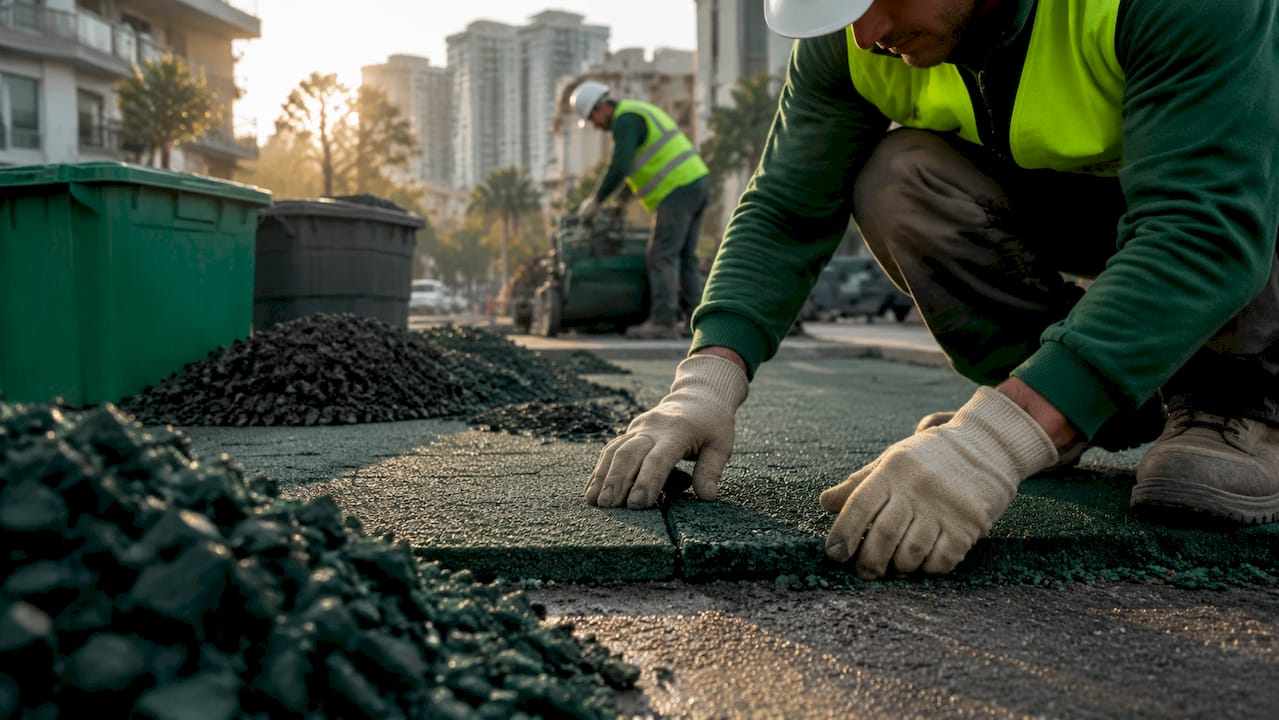
The core value is accountability. When a contractor holds a recognized certification, you can request documentation proving their methods meet published standards. That documentation is the foundation of every credible sustainable paving project.
What criteria do certifications actually evaluate?
Certification programs assess paving projects across several measurable categories. Each category ties directly to real-world performance outcomes.
- Recycled and alternative material content: Programs evaluate the percentage of recycled aggregates, ground-granulated blast furnace slag (GGBS), or reclaimed rubber used in the mix. Integrating up to 50% GGBS and 30% recycled aggregates reduces embodied energy and carbon by 20–30%. That reduction translates to a smaller carbon footprint on every project where certified materials are specified.
- Permeability and stormwater management: Permeable paving systems are evaluated for their ability to filter pollutants and reduce runoff. The U.S. EPA confirms that permeable pavements reduce flood risk and lower long-term maintenance costs. This criterion is especially relevant for Florida properties where standing water is a persistent problem.
- Durability and longevity standards: Certified materials must meet minimum performance thresholds for load-bearing capacity, crack resistance, and surface stability over time.
- Energy and carbon footprint metrics: Some programs require lifecycle analysis documentation showing how a project's carbon output compares to conventional paving methods.
- Installation workmanship: Certification evaluates whether contractors follow established procedures for base preparation, drainage integration, and surface finishing.
Pro Tip: Ask any contractor for their certification number and verify it directly with the issuing body before signing a contract. A legitimate certification is always traceable.
Recycled aggregate pervious concrete is one of the most studied materials in this space. Research shows that recycled aggregates in pervious concrete enhance pollutant retention and improve runoff water quality. That finding reinforces why material verification is a core part of any credible certification process.
Which organizations certify sustainable paving contractors?
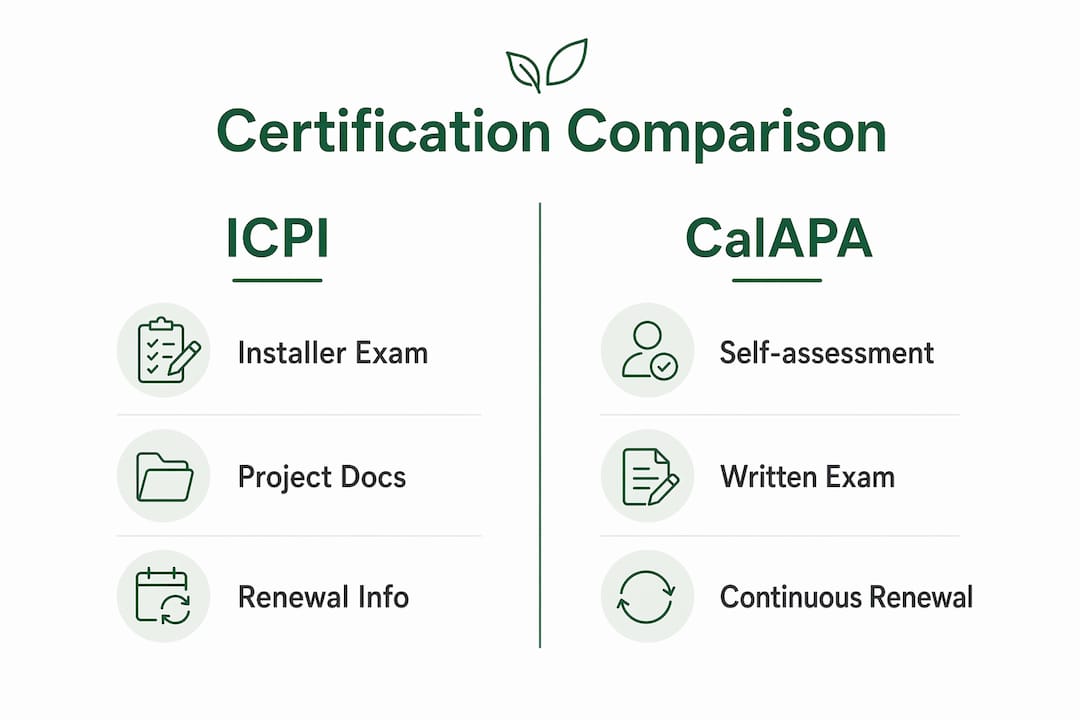
Several recognized bodies issue paving certifications, each with distinct requirements and scopes. The table below compares the most relevant programs for homeowners, businesses, and municipal planners.
| Certification | Issuing Body | Key Requirements | Renewal |
|---|---|---|---|
| ICPI Installer Certification | Interlocking Concrete Pavement Institute | 75% passing score, 5 projects/10,000 sq. ft. documented | 8 continuing education credits every 2 years |
| CalAPA Quality Paving Certificate | California Asphalt Pavement Association | 80% grade on 100-question exam | Ongoing education required |
| LEED Credit Contributions | U.S. Green Building Council | Project-level documentation of sustainable materials and site management | Per-project basis |
| Sustainable Drainage Accreditation | Various regional bodies | Integrated SuDS design compliance | Site-specific verification |
ICPI certification requires a minimum 75% passing score on the installer exam, documentation of at least 5 projects covering 10,000 square feet, and 8 continuing education credits every two years for renewal. That structure means an ICPI-certified contractor has both proven field experience and a commitment to staying current with industry standards.
CalAPA's Quality Paving Certificate requires an 80% passing grade on a 100-question self-assessment and written exam. The exam tests knowledge of mix design, compaction standards, and quality control procedures. Passing that threshold confirms a contractor understands best practices, not just basic installation.
Pro Tip: For municipal projects, request LEED documentation alongside contractor certifications. The two together give you material-level and contractor-level verification in one package.
Third-party verification is what gives these credentials weight. Certification programs provide verified benchmarks that distinguish genuinely sustainable paving from unverifiable claims. Without that independent layer, any contractor could call their work "eco-friendly" without accountability.
How does certification affect environmental and financial outcomes?
Certified sustainable paving delivers measurable results in two areas: environmental performance and project economics. The data on both is clear.
| Outcome Category | Certified Approach | Conventional Approach |
|---|---|---|
| Embodied carbon | 20–30% lower with GGBS/recycled aggregates | Baseline |
| Project cost savings | 5–15% reduction possible | Baseline |
| Stormwater runoff | Significantly reduced with permeable systems | High runoff, higher maintenance |
| Pavement lifespan | Extended through certified installation standards | Variable, often shorter |
The cost savings figure deserves context. Sustainable material use cuts project costs by 5–15% primarily through reduced raw material demand and lower long-term maintenance. For a municipal parking lot or a commercial property with thousands of square feet of paving, that percentage represents real budget relief over a 10-to-20-year horizon.
Environmental benefits extend beyond carbon. Permeable systems certified for stormwater management filter pollutants before they reach groundwater, reduce peak flood flows, and lower the urban heat island effect. In Florida's climate, those benefits are not theoretical. They directly affect property drainage, neighborhood flooding, and surface temperatures during summer months.
"Certified paving professionals understand soil analysis, climate-appropriate material selection, and site drainage requirements that ensure longer-lasting infrastructure." — Paving Company Quality Standards
That expertise gap between certified and uncertified contractors is where most project failures originate. A contractor who cannot read a drainage plan or specify the correct base depth will produce a surface that fails within five years, regardless of what materials were used.
What are the most common misconceptions about paving certification?
Misunderstanding certification is common, and those misunderstandings lead to poor purchasing decisions. Here are the most frequent ones worth correcting.
- "Eco-friendly" labeling equals certification. It does not. Marketing language like "green," "sustainable," or "eco-conscious" carries no legal or technical weight without a third-party certification number attached. Verifiable documentation such as recycled content percentages, permeability test reports, and independent certifications is the only reliable proof.
- Certification is a one-time achievement. Maintaining certification requires documenting installation experience and earning continuing education credits every 24 months. A contractor whose certification lapsed two years ago is no longer operating under verified current standards.
- Drainage can be addressed after installation. Treating drainage as an afterthought leads to failure and non-compliance. Sustainable paving requires integrated design of pavement materials and drainage systems from the first planning meeting. Sustainable Drainage Systems (SuDS) must be part of the original project scope, not a retrofit.
- Certification only matters for large commercial projects. Residential driveways and small commercial lots benefit equally from certified installation. Proper base preparation, drainage integration, and material selection affect every project regardless of scale.
- All recycled materials perform equally. Recycled content percentages matter, but so does material type and testing. A product with 30% recycled aggregate that has passed permeability and durability testing is fundamentally different from one that has not been tested at all.
The practical takeaway is straightforward. Ask for documentation. A certified contractor or supplier will provide it without hesitation.
Key takeaways
Paving sustainability certification is the only reliable method for verifying that a project's materials, installation, and drainage performance meet recognized environmental and quality standards.
| Point | Details |
|---|---|
| Certification means verified standards | Recognized bodies like ICPI and CalAPA confirm contractors meet tested environmental and quality benchmarks. |
| Material choices drive real savings | Using GGBS and recycled aggregates cuts embodied carbon by 20–30% and project costs by 5–15%. |
| Drainage must be designed in early | Integrated SuDS planning from project inception prevents costly failures and non-compliance. |
| Certification requires ongoing effort | ICPI renewal demands 8 continuing education credits every 2 years; lapsed credentials mean unverified standards. |
| Documentation separates fact from marketing | Demand recycled content percentages, permeability test reports, and third-party certification numbers before approving any project. |
Why i think most people ask the wrong question about paving certification
Most homeowners and project managers ask, "Is this contractor certified?" That is the right starting point, but it is the wrong ending point. The better question is, "What does their certification actually require them to prove?"
After working closely with sustainable paving projects across Florida, the pattern I see repeatedly is this: clients accept a certificate number as the finish line. They do not ask when it was last renewed, what exam it required, or whether the contractor has documented experience with permeable systems specifically. Those details are where the real quality gap lives.
The certification bodies worth trusting, ICPI and CalAPA chief among them, build renewal requirements into their programs for a reason. Paving science evolves. New recycled materials enter the market. Drainage standards get updated. A contractor who earned a certification in 2018 and never renewed it is working from a knowledge base that is nearly a decade old.
My honest recommendation: treat certification as a starting credential, not a final answer. Pair it with a request for project references on work similar to yours, documentation of the specific materials used, and a drainage plan that was designed before the first shovel hit the ground. That combination gives you what a certificate number alone cannot: evidence of real-world performance.
For Florida properties specifically, the permeable paving and drainage criteria matter more than almost anywhere else in the country. The combination of heavy rainfall, sandy soils, and heat-induced surface expansion makes certified installation practices not just preferable but necessary for long-term durability.
— Gm
How Ecotecrubber supports certified sustainable paving goals
Ecotecrubber's Rubberway® paving system is built around the same principles that certified sustainable paving standards require: recycled material content, superior drainage performance, crack resistance, and ADA-compliant surfaces designed for Florida's climate.
Every Ecotecrubber installation uses recycled rubber materials that directly address the embodied carbon and waste reduction criteria evaluated in sustainability certification programs. Their team is licensed and insured, and their installations are coordinated specifically around rubber paving solutions, not split across multiple unrelated services. If you are a homeowner, business, or municipal planner looking for a certified rubber paving solution that meets documented sustainability standards, Ecotecrubber is the place to start.
FAQ
What does paving sustainability certification mean exactly?
Paving sustainability certification is formal, third-party verification that paving materials and installation methods meet defined environmental and quality standards. It covers material content, drainage performance, durability, and contractor competency.
How do i verify a contractor's paving certification is current?
Request the contractor's certification number and contact the issuing body directly, such as ICPI or CalAPA, to confirm active status. Certifications require renewal every two years, so a lapsed credential is not a valid current standard.
Does sustainable paving certification reduce project costs?
Using certified sustainable materials like recycled aggregates and GGBS cuts project costs by 5–15% compared to conventional methods, primarily through reduced raw material demand and lower long-term maintenance.
Are permeable pavements required for sustainability certification?
Permeable systems are evaluated as part of most sustainability certification criteria because they reduce flood risk and filter pollutants. The U.S. EPA recognizes permeable pavement as a proven stormwater management tool, making it a key factor in certified sustainable paving projects.
What documentation should i request before approving a paving project?
Request recycled content percentages, permeability test reports, durability test results, and the contractor's active certification number from a recognized body. That combination of documents is the standard for verifying genuine sustainable paving claims.