

Rubber paving grant funding consists of publicly available programs designed to subsidize municipal projects that use recycled tire materials for pavement enhancement, with environmental and safety incentives built into eligibility criteria. The best rubber paving grant funding examples span state environmental agencies, federal infrastructure acts, and regional programs, each offering different award sizes, match requirements, and project scopes. Georgia EPD, Kentucky's Rubber-Modified Asphalt program, and the Rebuild Alabama Act represent three distinct funding tracks that local officials can pursue in 2026. Understanding how each program works, and how successful applicants framed their proposals, gives your municipality a concrete roadmap for securing funding.
1. Leading state and federal grant programs for rubber paving
State environmental agencies and federal infrastructure programs are the two primary funding sources for rubber surfacing projects. Each operates with different priorities, award ceilings, and eligibility rules.
State environmental grant programs:
- Georgia EPD Tire Grant: The Georgia EPD awarded $2,636,387 across 16 funded projects in its FY26 cycle, covering rubber-modified asphalt, pour-in-place surfacing, and tire-derived aggregate. The average award was approximately $164,774 per project, making this program well-suited for targeted road segments or playground surfaces rather than large-scale resurfacing.
- Kentucky Rubber-Modified Asphalt (RMA) Program: Kentucky's Department of Environmental Protection has allocated approximately $4.9 million over 11 years for RMA projects, with 2026 awards totaling $475,224 across multiple counties. The program targets road resurfacing and documents pavement life extensions of 7 to 10 years compared to conventional asphalt.
- Rebuild Alabama Act Grants: Pell City secured a $206,073 Rebuild Alabama Act grant for repaving a critical school bus route with no local matching funds required. That award came from a competitive pool of 212 submissions requesting a combined $62 million, which illustrates both the demand and the selectivity of this program.
Federal infrastructure grants:
Federal grants through programs tied to the Infrastructure Investment and Jobs Act can reach seven figures, but most require local match contributions. Clinton, Alabama's project shows the typical structure: a $1.08 million federal grant required approximately $464,000 in local funds, a roughly 30% match. Some federal acts do provide 100% funding for designated key connectors, so checking the specific program rules before budgeting is critical.
2. Successful rubber paving grant-funded projects and their community impact
Real project examples reveal how grant dollars translate into measurable outcomes. Three 2026 projects illustrate the range of approaches and benefits.
Bulloch County, Georgia: Tire cylinder road stabilization
Bulloch County used a $250,000 state grant to pilot a tire cylinder stabilization method on a 0.58-mile dirt road. Conventional paving costs approximately $1 million per mile, so the pilot's projected cost of roughly $500,000 per mile represents a significant reduction while also repurposing approximately 20,000 scrap tires. The project demonstrates that funding eligibility extends beyond asphalt top coats to tire-derived base stabilization products, which broadens the scope of what your municipality can propose.
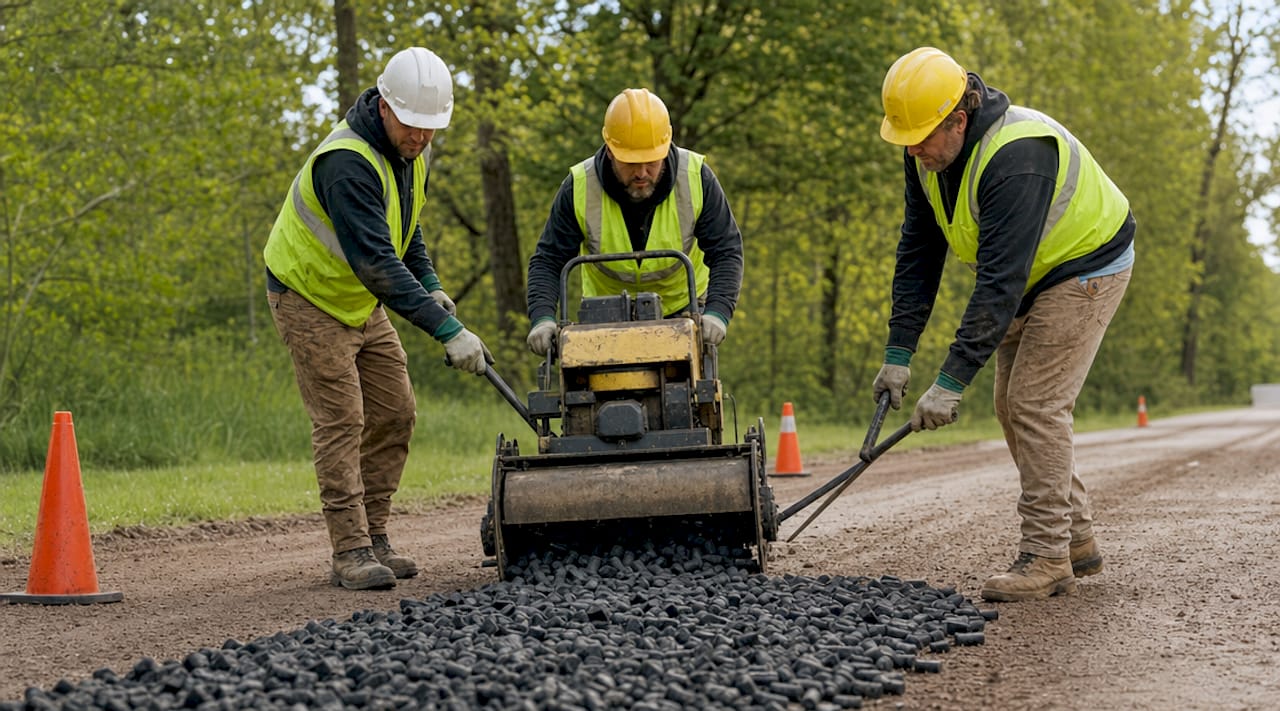
Ann Arbor, Michigan: Rubberized asphalt pilot on Oakbrook Drive
Ann Arbor's approach to managing the cost premium of rubberized asphalt was straightforward. The city secured a $61,000 grant covering only the incremental cost difference between conventional and rubberized asphalt on Oakbrook Drive, partnering with a local university to track environmental performance. This incremental cost strategy is one of the most replicable models for budget-conscious municipalities because it frames the grant as covering the "innovation premium" rather than the full project cost.
Pell City, Alabama: School transit safety focus
Pell City's successful Rebuild Alabama Act application centered on a school bus route, directly connecting the paving project to child safety outcomes. That framing helped the city stand out in a pool of 212 competing submissions. Prioritizing safety and school transit access dramatically improves grant award likelihood by aligning with the community needs grant reviewers are mandated to address.
Pro Tip: When writing your grant narrative, lead with the safety or environmental outcome, not the material specification. Reviewers fund problems solved, not products installed.
3. How to maximize your rubber paving grant application
Winning a grant for rubber surfacing is less about the material and more about how you frame the project's value to reviewers. Four strategies consistently appear in successful applications.
- Target the incremental cost, not the full project. Ann Arbor's $61,000 grant covered only the price difference between standard and rubberized asphalt. This framing reduces the ask, increases competitiveness, and signals fiscal responsibility to reviewers.
- Include a conventional control section. Kentucky's RMA program requires a side-by-side control road resurfaced with conventional materials for long-term performance comparison. Proposing this voluntarily in other grant applications signals scientific rigor and gives the funding agency data it can use to justify future awards.
- Demonstrate multifaceted benefits. Demonstrating environmental, safety, and durability benefits in a single proposal strengthens competitive positioning. Quantify scrap tire diversion, projected maintenance savings, and any ADA compliance improvements in the same narrative.
- Secure local buy-in before applying. Federal grants often require a 30% local match, as seen in Clinton, Alabama's project. Having a council resolution or budget line item committed before submission removes a common reviewer concern about project viability.
Pro Tip: Contact your state environmental protection agency before drafting the application. Program officers often share scoring rubrics or past award summaries that reveal exactly what language and metrics reviewers prioritize.
Pairing grant funding with a long-term infrastructure asset protection strategy also strengthens the economic case in your proposal, since reviewers respond to lifecycle cost arguments rather than one-time installation figures.
4. Comparison of key rubber paving funding options
The table below compares the four most active grant programs for local governments pursuing rubber surfacing projects in 2026. Use it to identify which programs align with your project type, budget, and geographic location before investing time in a full application.
| Program | Typical award range | Match required | Geographic scope | Eligible project types |
|---|---|---|---|---|
| Georgia EPD Tire Grant | Up to ~$164,774 avg. | Varies by project | Georgia only | Rubber-modified asphalt, pour-in-place, tire aggregate |
| Kentucky RMA Program | Varies; $475,224 total in 2026 | Typically partial | Kentucky only | Road resurfacing with rubber-modified asphalt |
| Rebuild Alabama Act | ~$206,073 example | None required | Alabama only | Road repaving, transit safety corridors |
| Federal Infrastructure Grants | $1M+ possible | ~30% local match typical | Nationwide | Road paving, key connectors, infrastructure corridors |
The Kentucky and Georgia programs are the most accessible for smaller municipalities because award sizes match typical county road budgets. Federal grants offer larger sums but demand more administrative capacity and matching funds. No-match programs like the Rebuild Alabama Act are rare and highly competitive, so applications must be exceptionally well-documented.
Key takeaways
Securing rubber paving grant funding requires targeting the right program for your project type, framing proposals around measurable community outcomes, and understanding match requirements before committing to an application.
| Point | Details |
|---|---|
| State programs lead in accessibility | Georgia EPD and Kentucky RMA offer targeted awards averaging $164,774 and $475,224 total respectively, suited to county-scale projects. |
| Incremental cost framing wins | Applying for only the cost difference between conventional and rubber paving, as Ann Arbor did, increases competitiveness and reduces the funding ask. |
| No-match grants exist but are competitive | Rebuild Alabama Act awarded Pell City $206,073 with no local match from a pool of 212 applicants requesting $62 million combined. |
| Control sections strengthen proposals | Voluntarily including a conventional paving control section signals scientific credibility and improves scoring with environmental agencies. |
| Multi-benefit narratives outperform single-focus ones | Proposals combining scrap tire diversion, safety improvements, and lifecycle cost savings consistently outperform single-issue applications. |
Why grant strategy matters more than grant hunting
Local government officials often spend more time searching for grants than refining how they apply for them. That is a costly mistake. The Pell City example is instructive: 212 applicants competed for the same pool of Rebuild Alabama Act funds, and the winning applications were not necessarily the largest or most technically complex projects. They were the ones that most clearly connected pavement work to a community outcome a reviewer could defend to a legislative committee.
The Kentucky RMA program's requirement for a conventional control section is another signal worth reading carefully. State agencies are not just funding roads. They are building a performance dataset that justifies continued program funding. Municipalities that understand this dynamic and propose projects that generate useful comparative data become preferred partners, not just one-time grantees.
Rubber-modified pavement's long-term cost savings from reduced maintenance and extended pavement life are real, but they only appear in your budget three to five years after installation. Grant proposals that include a monitoring plan with defined checkpoints give reviewers confidence that the claimed savings will actually be documented and reported. That commitment to accountability is what separates funded applications from unfunded ones in my experience reviewing municipal infrastructure proposals.
— Gm
How Ecotecrubber can help you turn grants into completed projects
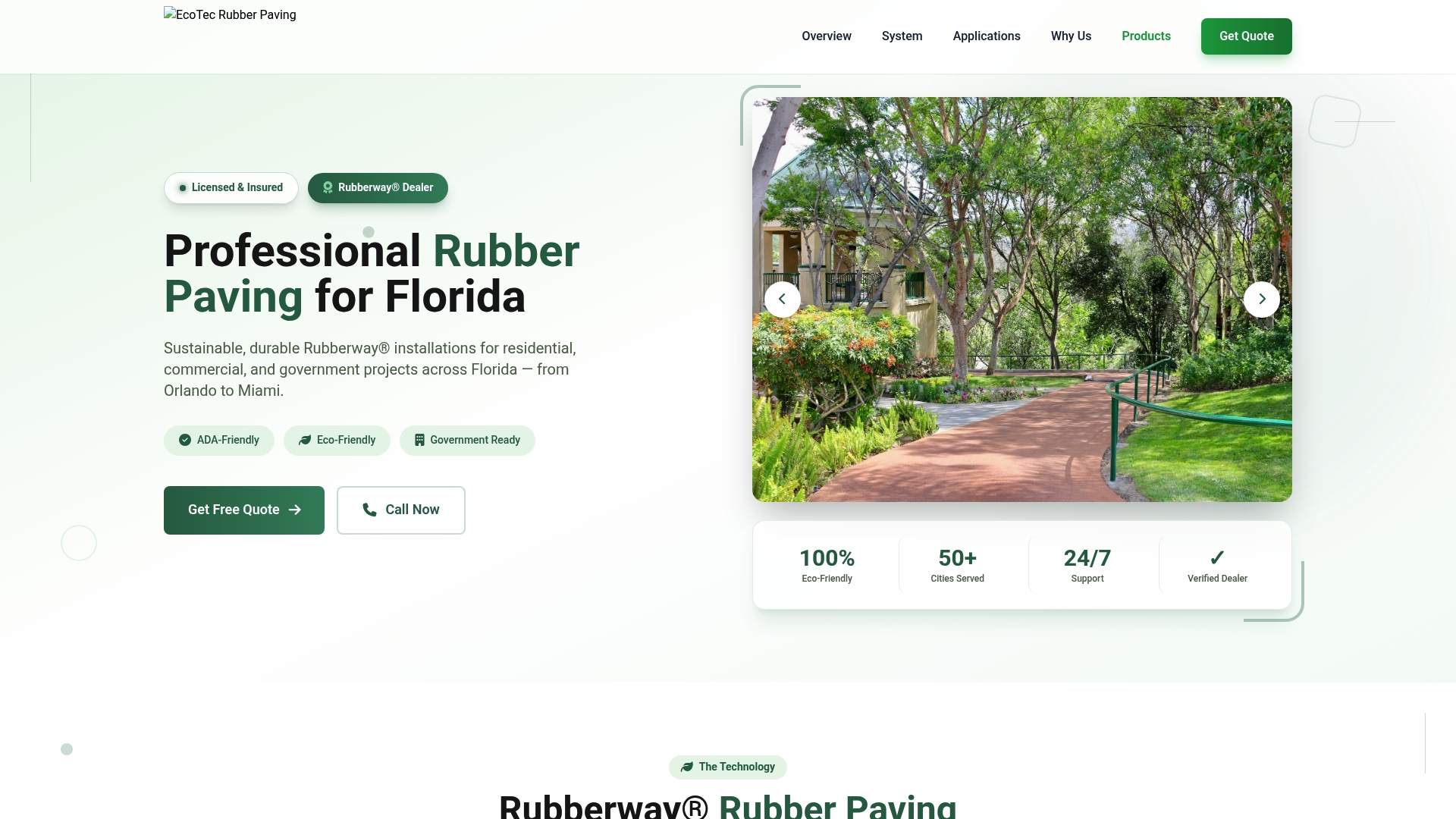
Securing grant funding is only half the work. Executing a rubber paving project that meets grant reporting requirements, ADA compliance standards, and long-term performance expectations requires a contractor who specializes in exactly this type of installation. Ecotecrubber installs the Rubberway® system across Florida municipalities, using recycled materials that qualify for the environmental and sustainability criteria most grant programs require. Their installations address standing water, heat-induced cracking, and surface durability, which are the same performance metrics grant agencies track post-award. If your municipality is planning a grant-supported project, explore Ecotecrubber's rubber paving solutions or review their available Rubberway® products to assess fit before your next application cycle.
FAQ
What are the best grant programs for rubber paving projects?
The Georgia EPD Tire Grant, Kentucky RMA Program, and Rebuild Alabama Act are three of the most active programs in 2026, offering awards ranging from $61,000 for incremental cost pilots to over $1 million for federal infrastructure projects.
Do rubber paving grants require local matching funds?
Match requirements vary by program. The Rebuild Alabama Act required no local match for Pell City's $206,073 award, while federal infrastructure grants typically require around 30% local contribution.
How should a grant proposal for rubber paving be framed?
Lead with measurable community outcomes such as scrap tire diversion, school transit safety, or maintenance cost reduction. Proposals that combine environmental, safety, and durability benefits consistently score higher than single-focus applications.
Can dirt road stabilization projects qualify for rubber paving grants?
Yes. Bulloch County's $250,000 state grant funded a tire cylinder stabilization method on a dirt road, confirming that funding eligibility extends beyond asphalt resurfacing to tire-derived base stabilization products.
What is the average award size for state rubber paving grants?
Georgia EPD's FY26 cycle averaged approximately $164,774 per project across 16 funded awards, while Kentucky's 2026 RMA allocations totaled $475,224 distributed across multiple county road projects.