

Eco-friendly paving is a tangible sustainability signal that builds consumer trust and directly influences green purchase intention when claims are specific and credible. The role of eco-friendly paving in branding goes well beyond aesthetics. It functions as physical proof of a company's environmental values, and consumers increasingly use that proof to decide where they spend money. A 2026 study on label credibility found that credible sustainability claims increase environmental trust and green purchase intention, while greenwashing awareness actively weakens that effect. For business owners and marketing professionals, this means the Pinellas Park Performing Arts Center model of measurable, verifiable eco-paving outcomes is the standard to reach, not a green color palette.
How does eco-friendly paving build brand trust and green purchase intention?
Consumer trust in sustainability claims follows a specific psychological pathway. Research models it as a proof chain: credibility leads to environmental trust, which then drives purchase intention. Sustainability label credibility is the entry point. If your eco-paving claim lacks specificity or third-party verification, the chain breaks before it reaches the consumer's wallet.
The moderating role of greenwashing awareness is the factor most brands underestimate. Consumers who are already skeptical of green marketing read vague claims as confirmation of their suspicion. A parking lot described as "environmentally responsible" without documented drainage performance, material sourcing, or lifecycle data does not build trust. It triggers doubt. The same parking lot described with specific stormwater diversion figures, recycled material percentages, and an Environmental Product Declaration (EPD) does the opposite.
"Packaging sustainability claims as a credible proof chain addressing consumer psychology is the key mechanism for building trust and purchase intention." — 2026 green purchase intention research
Transparency is the practical tool here. Brands that publish installation specs, material certifications, and measurable environmental outcomes give consumers something to verify. Verification converts skeptics into advocates. For marketing professionals, this means the documentation your paving contractor provides is not just a project record. It is brand content.
What sustainable paving materials and design features most strengthen branding?
Material choice is where eco-paving branding either earns or loses credibility. Life cycle assessment research shows that material production and manufacturing contribute over 50% of total pavement emissions, with transportation accounting for roughly one-third. This means the environmental story of any paving project lives primarily in what the material is made from, not how it looks on the surface.
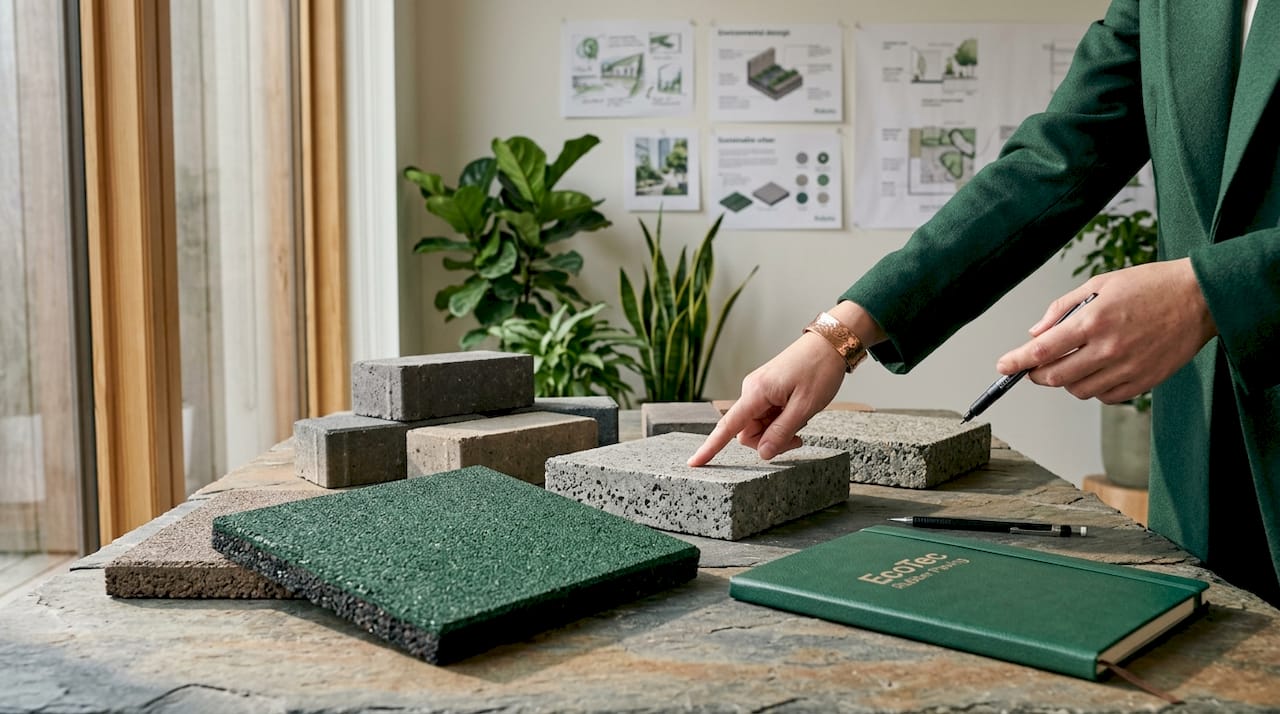
Brands that choose lower embodied-carbon materials, recycled rubber, or permeable concrete systems can make procurement-level claims that hold up to scrutiny. Environmental Product Declarations provide standardized, third-party verified data on a product's lifecycle impact. Citing an EPD in your brand communications is the difference between a claim and a fact.
Permeable paving adds a second layer of measurable benefit: stormwater management. The Pinellas Park Performing Arts Center project used permeable interlocking concrete pavement to eliminate the need for retention ponds and sewer pipes entirely. That outcome is not a marketing slogan. It is a documented infrastructure result that translates directly into a brand narrative about climate resilience and responsible site design.
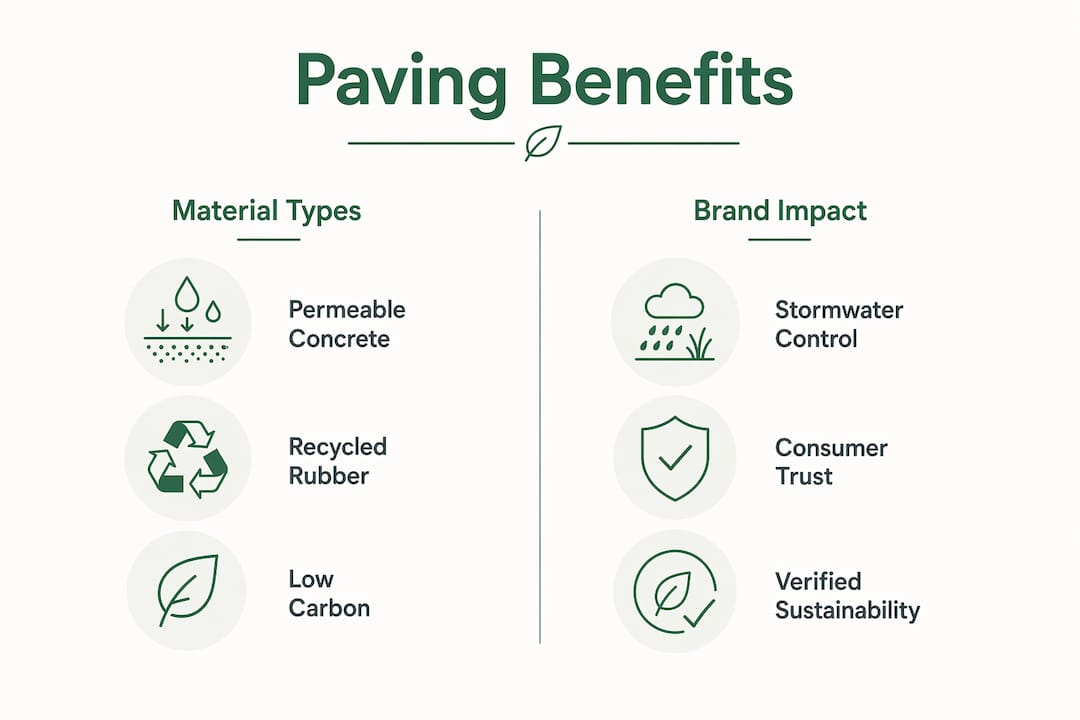
The table below compares the primary eco-paving material types on the dimensions most relevant to branding:
| Material type | Primary environmental benefit | Branding strength | Verification tool |
|---|---|---|---|
| Permeable concrete/PICP | Stormwater management, reduced runoff | High, with documented drainage data | EPD, project case study |
| Recycled rubber paving | Diverts waste, reduces virgin material use | High, with recycled content percentage | Material certifications, recycled content data |
| Porous asphalt | Infiltration, heat island reduction | Moderate, requires system-level documentation | LCA report, EPD |
| Grass/gravel grid systems | Habitat preservation, permeability | Moderate, dependent on full base specification | Site performance data |
Pro Tip: Never anchor your brand claim on surface appearance alone. A paving material that looks green but lacks documented lifecycle data or performance metrics gives skeptical consumers nothing to verify, and verification is what converts interest into trust.
How can marketers communicate eco-friendly paving benefits without greenwashing?
The 2026 shift in eco-branding strategy is away from green color palettes and leaf icons toward specific, provable sustainability actions. Calm, credible, human-centered visual identity now signals authenticity more effectively than saturated green tones and generic environmental slogans. This is a direct response to rising consumer sophistication about greenwashing.
For marketing professionals communicating eco-paving benefits, the practical framework looks like this:
- Lead with outcomes, not intentions. "Our parking lot diverts X gallons of stormwater annually" outperforms "We care about the environment" in every credibility metric.
- Name the material and its source. "Rubberway® recycled rubber paving using post-consumer tire material" is a specific claim. "Eco-friendly surface" is not.
- Cite third-party documentation. Reference EPDs, LCA reports, or compliance certifications by name in your marketing materials, not just in technical specs.
- Separate visual identity from impact claims. Your brand colors and design language can reflect sustainability values, but the environmental impact claims must stand on documented evidence, not aesthetics.
- Acknowledge system requirements honestly. Permeable paving performance depends on the full installed system including base layers. Overstating drainage benefits without specifying the complete installation is a credibility risk.
The risk of getting this wrong is not just reputational. Greenwashing awareness actively weakens purchase intention among the exact consumers you are trying to attract. Eco-conscious customers are the most likely to research your claims and the most likely to share their findings publicly.
Pro Tip: Align your paving brand story with how you align your broader physical space with your brand identity. Sustainable paving that connects to a cohesive brand environment reads as intentional rather than performative.
What case studies show eco-paving branding done right?
The Pinellas Park Performing Arts Center project is the clearest available example of eco-paving generating a defensible brand narrative. The installation of permeable interlocking concrete pavement eliminated retention ponds and sewer infrastructure entirely. The measurable stormwater outcome gave the project team a specific, verifiable claim tied to climate resilience, not just a green aesthetic. For any brand managing a public-facing facility, that kind of documented outcome is the foundation of a credible sustainability story.
The CellPave 50 installation at the HS2 car park in Coleshill demonstrates a different but equally important angle: regulatory compliance as brand proof. The CellPave 50 system met Sustainable Drainage Systems (SuDS) compliance requirements while handling heavy-use durability demands on a major infrastructure project. For brands in regulated industries or those seeking government contracts, SuDS compliance is not just a legal requirement. It is a marketing credential that signals both environmental responsibility and professional rigor.
Both case studies share a structural feature worth noting: the brand narrative combines scale, functionality, and third-party verification. Neither relies on visual cues alone. The Pinellas Park project quantifies infrastructure savings. The HS2 project cites regulatory standards. Both give audiences something concrete to evaluate.
The comparison between these two approaches also illustrates how different business contexts call for different proof types. A performing arts center benefits from community-facing environmental outcomes. An infrastructure contractor benefits from compliance credentials. Your eco-paving brand story should match the proof type your specific audience finds most credible.
Pro Tip: When documenting your eco-paving installation for marketing use, capture system-wide performance data from day one. Stormwater diversion volumes, surface temperature readings, and material recycled content percentages are the specific figures that turn a project photo into a brand asset.
Key takeaways
Eco-friendly paving builds brand trust only when sustainability claims are specific, documented, and grounded in verified environmental performance rather than visual cues or vague language.
| Point | Details |
|---|---|
| Credibility drives trust | Label credibility is the first link in the proof chain connecting eco-paving to purchase intention. |
| Material choice is the core story | Over 50% of pavement emissions come from material production, so procurement-level claims carry the most weight. |
| Greenwashing awareness is a real risk | Skeptical consumers actively discount vague green claims, making specificity non-negotiable. |
| Case studies are brand assets | Documented outcomes like stormwater diversion or SuDS compliance convert project data into credible marketing proof. |
| System-level honesty protects credibility | Permeable paving claims must reflect the full installed system or risk overclaiming benefits. |
Why the proof chain matters more than the green aesthetic
I have watched brands spend significant budget on green-toned signage, leaf logos, and sustainability taglines while their actual paving installations had no documentation, no certifications, and no measurable outcomes attached to them. The visual identity looked credible. The underlying claim was hollow. And increasingly, that gap is exactly what eco-conscious consumers are trained to find.
The research on green purchase intention confirms what I have observed in practice: greenwashing awareness does not just make consumers neutral. It makes them actively skeptical of the brand. You do not recover easily from that position once a vocal segment of your audience decides your sustainability story is performance rather than practice.
What actually works is treating your eco-paving installation as the beginning of a documentation project, not the end of a construction project. The EPD for your materials, the stormwater performance data from your first rainy season, the recycled content percentage from your contractor. These are not technical footnotes. They are the raw material of a brand story that holds up under scrutiny.
The brands I respect most in this space are the ones who lead with specifics and let the numbers do the persuasion. "We installed a Rubberway® recycled rubber system that diverts standing water and uses post-consumer tire material" is a sentence that earns trust. "We chose eco-friendly paving" is a sentence that invites doubt. The difference between those two sentences is the difference between a brand that attracts eco-conscious customers and one that loses them to a competitor who did the documentation work.
— Gm
How Ecotecrubber can support your eco-paving brand strategy
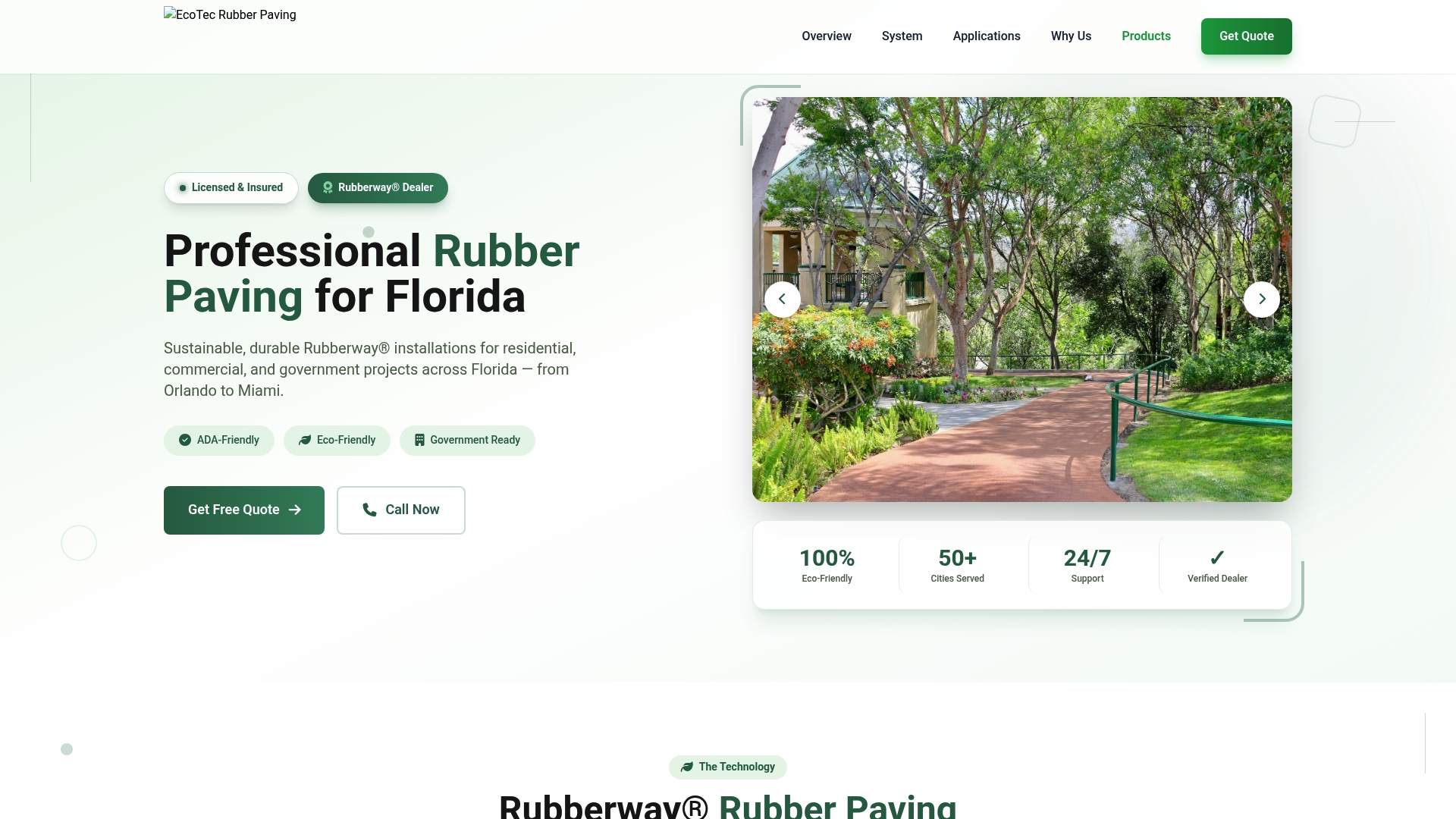
Ecotecrubber specializes in sustainable rubber paving installations across Florida using the Rubberway® system, which uses recycled materials to deliver ADA-compliant, crack-resistant, and drainage-optimized surfaces. Every installation comes with the material documentation and performance specifications your marketing team needs to build credible sustainability claims. For business owners and marketing professionals who want eco-paving that functions as both infrastructure and brand proof, Ecotecrubber's licensed and insured installations provide the verified outcomes that convert green intentions into defensible brand narratives. Explore the full range of Rubberway® paving products to find the right fit for your Florida property.
FAQ
What is the role of eco-friendly paving in branding?
Eco-friendly paving functions as a tangible sustainability signal that builds consumer trust when claims are specific and verifiable. It strengthens brand credibility by providing documented environmental outcomes rather than relying on visual cues alone.
How does greenwashing awareness affect eco-paving marketing?
Greenwashing awareness actively weakens purchase intention among eco-conscious consumers, meaning vague or unverified sustainability claims can damage brand trust rather than build it. Specific, documented claims with third-party verification are the only reliable counter to consumer skepticism.
What documentation makes eco-paving claims credible?
Environmental Product Declarations, life cycle assessment reports, recycled content certifications, and site-level performance data such as stormwater diversion volumes are the documentation types that convert eco-paving claims into verifiable brand proof.
Can permeable paving claims be overstated in marketing?
Yes. Permeable paving performance depends on the full installed system including base layers, so drainage benefit claims must reflect the complete specification. Overstating performance without system-level detail is a credibility risk that informed consumers and regulators will identify.
How does eco-friendly paving attract environmentally conscious customers?
Research shows that credible sustainability labels increase environmental trust, which then drives green purchase intention. Customers who can verify your eco-paving claims through documentation and measurable outcomes are significantly more likely to choose and advocate for your brand.