

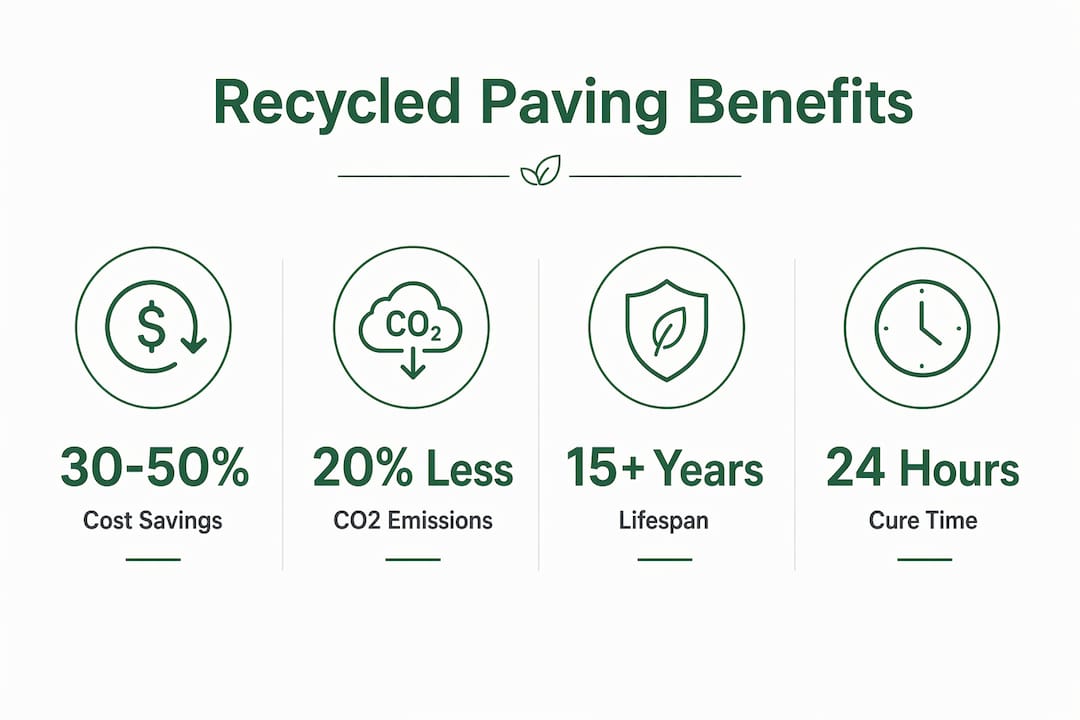
Recycled paving is defined as any surface material made from reclaimed asphalt, rubber, or aggregate that replaces virgin resources in residential and commercial installations. Recycled asphalt pavement (RAP) is the industry's standard term for the most common form, and it explains why recycled paving appeals to residents on three levels: it costs significantly less than new asphalt, it diverts millions of tons of material from landfills each year, and it performs reliably for 15 or more years when installed correctly. The U.S. recycles 90 to 100 million tons of asphalt annually, a figure that reflects both the scale of the industry and the growing demand from homeowners who want durable, eco-friendly paving options without paying premium prices.
Why recycled paving appeals to residents: the cost advantage
The single most persuasive reason homeowners choose recycled paving is price. Recycled millings cost $15 to $30 per ton compared to $50 to $80 per ton for virgin asphalt, a difference that translates directly to your project budget. Installation costs follow the same pattern: RAP runs $2 to $5 per square foot, while traditional asphalt typically lands between $4 and $7 per square foot. For a standard 1,000 square foot driveway, that gap can mean $2,000 or more in savings before you factor in labor.
Long-term maintenance costs tell an equally compelling story. Recycled asphalt driveways require sealcoating every three to five years, which is actually less frequent than the maintenance schedule for traditional asphalt. That reduced upkeep cadence lowers your total cost of ownership over the life of the surface. Recycled paving adoption also reduces exposure to supply chain volatility, since reclaimed material is locally sourced and not subject to the same price swings as petroleum-derived virgin asphalt.
There is one more financial angle that most homeowners overlook. Using RAP can earn LEED credits and qualifies projects for state tax incentives worth $500 to $2,000 depending on your location. That is real money back in your pocket for making a choice you were already leaning toward for other reasons.
| Cost Factor | Recycled Asphalt (RAP) | Virgin Asphalt |
|---|---|---|
| Material cost per ton | $15–$30 | $50–$80 |
| Installation per sq ft | $2–$5 | $4–$7 |
| Sealcoating frequency | Every 3–5 years | More frequent |
| Tax incentive potential | $500–$2,000 | Typically none |
Pro Tip: Get at least three quotes from contractors who specifically list RAP experience. Contractors unfamiliar with recycled millings sometimes price them like virgin asphalt, erasing your savings before the project starts.
How does recycled paving benefit the environment and reduce waste?
The environmental case for recycled paving is not a marketing claim. It is backed by measurable data that puts the impact in concrete terms. The U.S. diverts over 95% of reclaimed pavement from landfills through recycling, and each ton of RAP used spares one ton of fresh rock, sand, and bitumen from being extracted. That reduction in virgin aggregate demand reaches 90% when RAP replaces new material at scale.
Carbon emissions tell a similar story. Recycled asphalt production emits 20% less CO2 than virgin asphalt manufacturing, and warm-mix recycled asphalt cuts that figure even further, reducing carbon emissions by up to 36%. Lower processing temperatures also shave energy consumption by up to 21%, which means the environmental benefit starts at the plant, not just at your driveway. For homeowners who track their carbon footprint, that is a meaningful reduction tied to a single home improvement decision.
Permeable recycled-content paving adds another layer of environmental value by supporting stormwater management. Water infiltrates through the surface rather than running off into storm drains, reducing local flooding risk and improving groundwater quality. This matters especially in Florida and other states where heavy rainfall creates chronic drainage problems on residential properties.
The circular economy framing is worth understanding here. When your old driveway is milled up and recycled into the next homeowner's surface, you are participating in a closed loop that sustainable property development practitioners now treat as a baseline standard rather than a bonus feature. RAP is one of the most recycled materials in the United States, and residential adoption is a direct driver of that statistic.
What durability and performance features attract residents to recycled paving?
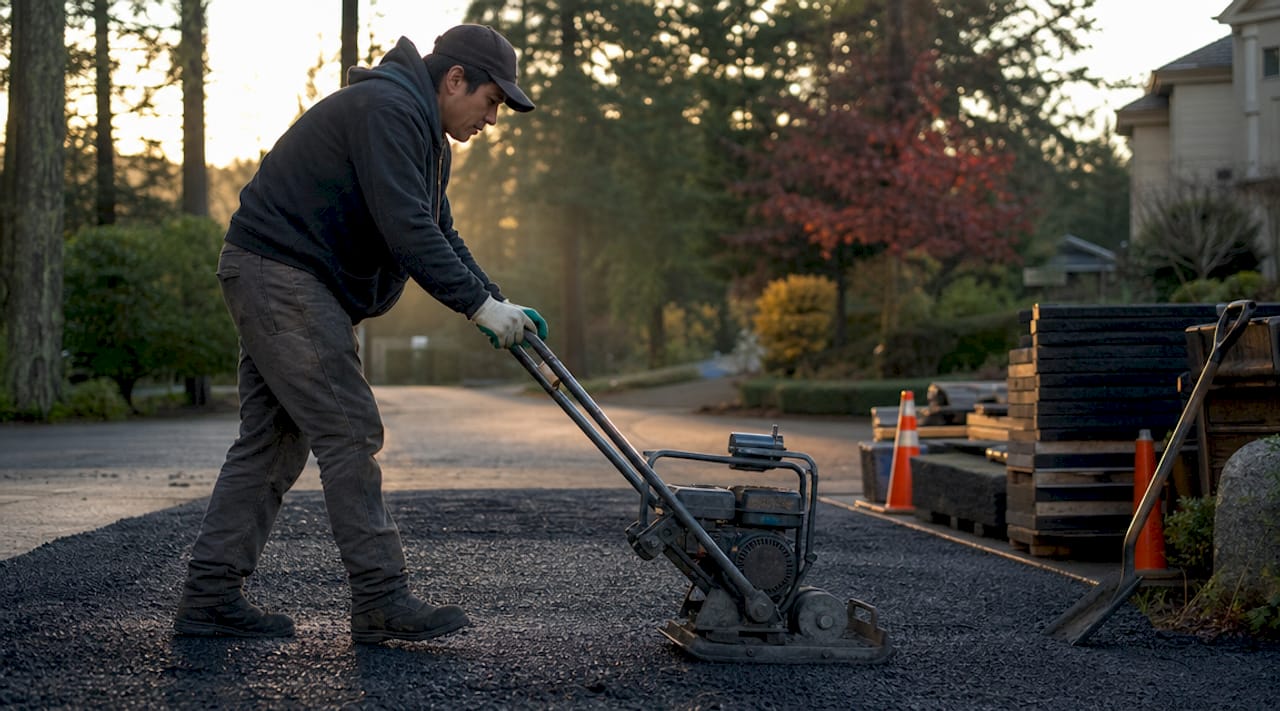
Durability is where recycled paving surprises most homeowners. The assumption that "recycled" means lower quality is wrong in this case. RAP driveways last 15 or more years when installed at the correct depth of four to six inches, which matches or exceeds the lifespan of many gravel surfaces and competes directly with standard asphalt. Specialized recycled-content resin-bound systems can extend that range to 15 to 25 years.
The chemistry behind RAP's durability is worth knowing. Residual bitumen in RAP ranges from 3 to 7% by weight, and that bitumen activates under traffic and heat, binding the surface more tightly over time. This self-binding property means a properly installed RAP driveway actually gets more stable in its first few seasons, not less. Concrete, by contrast, tends to degrade structurally as it ages.
Here is what determines whether your RAP driveway reaches that 15-year mark:
- Compaction depth. Install at four to six inches and compact with heavy machinery. Hand tamping is inadequate for long-term durability and leads to premature cracking and potholes.
- Base preparation. A stable, graded sub-base prevents shifting and uneven settling, especially in climates with freeze-thaw cycles or heavy rain.
- Sealcoating schedule. Apply a sealcoat every three to five years to protect the surface from UV degradation and moisture penetration.
- Contractor selection. Choose a contractor with documented RAP experience. Improper mixing ratios or inadequate compaction equipment are the leading causes of early failure.
Pro Tip: Ask your contractor to confirm the bitumen content of the millings they plan to use. Material with less than 3% residual bitumen will not self-bind effectively and may require a binder additive to perform well.
What aesthetic and practical factors shape homeowners' decisions?
Aesthetics are the honest limitation of recycled asphalt, and any article that skips this point is not serving you well. Recycled asphalt fades to a dull charcoal within 12 to 18 months and has a rougher texture than freshly laid virgin asphalt. If your front driveway is a focal point of your home's curb appeal, RAP may not be your best choice. That is not a dealbreaker. It is a placement decision.
The practical installation advantages, however, are significant. Recycled asphalt cures within 24 hours thanks to lower installation temperatures of around 200°F compared to 300°F for virgin hot-mix asphalt. That faster turnaround reduces labor costs and means you are back on your driveway the next day rather than waiting several days. The lower temperature installation also reduces energy intensity and shortens the disruption to your household.
The table below maps common residential applications to the most suitable paving choice:
| Application | Recycled Asphalt (RAP) | Virgin Asphalt or Concrete |
|---|---|---|
| Backyard paths and patios | Excellent fit | Overkill for most budgets |
| Rural or farm driveways | Excellent fit | Rarely cost-justified |
| Side yard or service access | Strong fit | Comparable but costlier |
| High-visibility front driveway | Limited by aesthetics | Better for curb appeal |
| Parking areas and lots | Strong fit | Comparable performance |
Choosing the right contractor matters as much as choosing the right material. Look for contractors who own or rent proper compaction equipment, can show you completed RAP projects, and are willing to discuss the bitumen content of their supply. Contractors who specialize in sustainable paving solutions treat permeable and recycled-content surfaces as core competencies, not afterthoughts.
Key takeaways
Recycled asphalt pavement delivers cost savings of 30 to 50% over virgin asphalt, lasts 15 or more years with proper installation, and diverts over 95% of reclaimed pavement from landfills, making it the most practical eco-friendly paving option for most residential applications.
| Point | Details |
|---|---|
| Cost savings are substantial | RAP costs $15–$30 per ton versus $50–$80 for virgin asphalt, cutting installation budgets by 30–50%. |
| Environmental impact is measurable | The U.S. recycles 90–100 million tons of asphalt annually, diverting over 95% from landfills. |
| Durability depends on installation | Proper compaction at 4–6 inch depth with heavy machinery is required for a 15-year service life. |
| Aesthetics limit front-yard use | RAP fades to charcoal within 12–18 months and suits utilitarian applications better than high-visibility driveways. |
| Tax incentives add financial value | LEED credits and state incentives can return $500–$2,000 to qualifying projects. |
Why I think most homeowners underestimate recycled paving
Most of the homeowners I talk to assume recycled paving is a budget compromise. They picture a rough, faded surface that signals they cut corners. That framing is outdated and it costs people real money.
What I have seen consistently is that the homeowners who research RAP carefully end up more satisfied than those who default to virgin asphalt. The cost savings are real and immediate. The environmental benefit is not abstract. When you know that your driveway diverted material from a landfill and reduced CO2 emissions by 20% compared to the alternative, that is a tangible outcome you can point to.
The one place I would push back on the conventional enthusiasm is aesthetics. I have seen RAP installations on front driveways that looked great at installation and looked tired 18 months later. If your home's exterior is a priority, be honest with yourself about that. Use RAP for the backyard, the side access, the parking pad. Save the premium surface for the front.
The other thing I would tell any homeowner is this: the material is only as good as the contractor. I have seen excellent RAP installations and terrible ones, and the difference was always the compaction equipment and the installer's experience. Vet your contractor as carefully as you vet the material.
— Gm
How Ecotecrubber takes recycled paving further in Florida
Ecotecrubber builds on the principles behind recycled paving with a system designed specifically for Florida's heat, humidity, and heavy rainfall. Using the Rubberway® system, Ecotecrubber installs recycled rubber paving that delivers ADA-compliant surfaces, superior drainage, and crack resistance that standard RAP cannot match in high-temperature climates. Every installation uses recycled materials, reducing waste while solving the standing water and heat-induced surface failure problems that Florida homeowners deal with every season. If you are ready to explore sustainable rubber paving for your driveway, pool deck, or outdoor path, Ecotecrubber's licensed and insured team handles the full project. Browse the Rubberway product options to see what fits your property.
FAQ
What is recycled asphalt pavement (RAP)?
Recycled asphalt pavement (RAP) is reclaimed asphalt milled from existing roads and driveways, then processed and reused as paving material. It retains residual bitumen that gives it self-binding properties, making it a durable and cost-effective alternative to virgin asphalt.
How much does recycled paving cost compared to regular asphalt?
Recycled asphalt costs $15 to $30 per ton versus $50 to $80 per ton for virgin asphalt, with installation running $2 to $5 per square foot compared to $4 to $7 for traditional asphalt. Most homeowners save 30 to 50% on total project costs.
How long does a recycled asphalt driveway last?
A properly installed RAP driveway lasts 15 or more years when compacted at four to six inches with heavy machinery and sealcoated every three to five years. Resin-bound recycled systems can extend that lifespan to 25 years.
Is recycled paving good for the environment?
Recycled asphalt production emits 20% less CO2 than virgin asphalt, and warm-mix versions cut emissions by up to 36%. The U.S. recycles 90 to 100 million tons of asphalt annually, diverting over 95% of reclaimed pavement from landfills.
Where is recycled asphalt paving most suitable for residential use?
RAP works best for backyards, side access paths, rural driveways, and parking areas where aesthetics are secondary to function and cost. It is less suited for high-visibility front driveways because it fades to a dull charcoal color within 12 to 18 months of installation.