
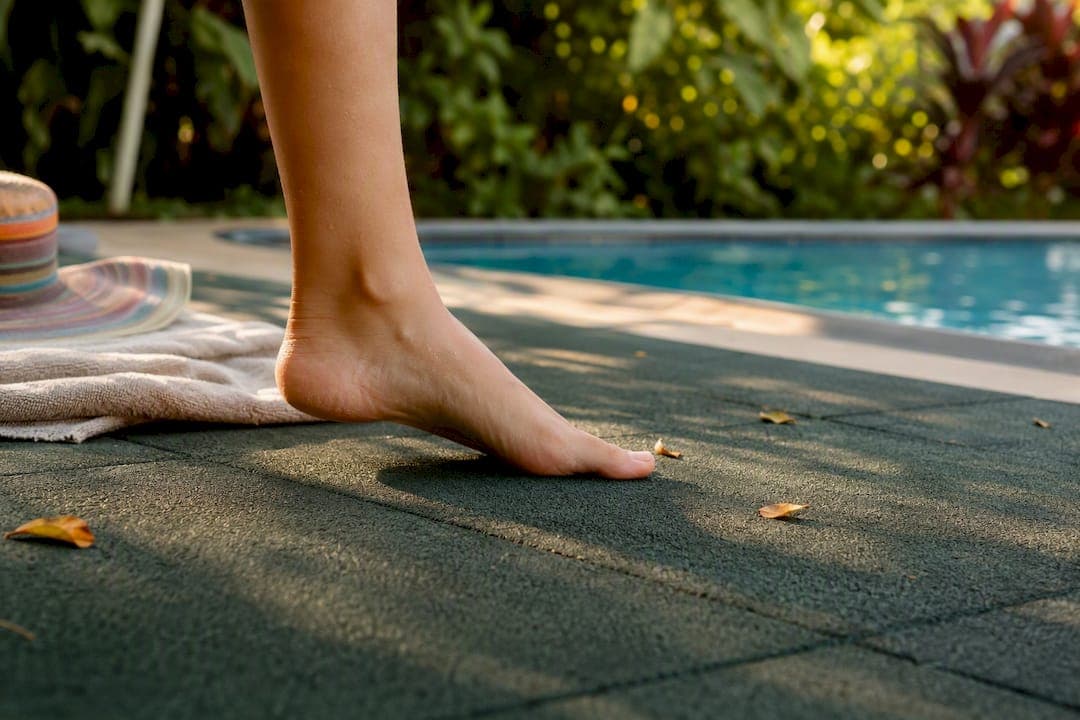
For most homeowners chasing a cooler, low-maintenance pool deck, the choice comes down to two real contenders: a textured cool-deck overlay if budget is tight, or a poured rubber surface if you want the coolest long-term result with the least upkeep. Rubber aggregate systems like EcoTec Rubberway® consistently test as the coolest option underfoot, sometimes staying near 110°F in peak sun when nearby cool-deck overlays and bare concrete run far hotter, because the rubber layer insulates rather than absorbs. Reflectance still matters. Lighter colors and higher Solar Reflectance Index ratings cut surface temperature regardless of material.
Here's the fast breakdown by goal:
- Best bang for your budget: A textured acrylic-cement overlay (cool-deck style). Lower material and labor cost, and it can cut surface temperature by 20 to 30 degrees compared with bare concrete.
- Best natural-stone pick: Travertine or coral stone. Natural porosity keeps it cool and it can last decades with minimal sealing, though it costs more upfront.
- Our recommendation for long-term comfort: EcoTec Rubberway®. Recycled rubber paving that stays cooler, drains water instead of pooling it, and resists the cracking that shortens the life of rigid overlays.
Key Takeaways
The coolest, longest-lasting pool deck surface for most homeowners is a porous rubber system, while a textured overlay remains the better entry point on a tight budget.
| Point | Details |
|---|---|
| Overlays beat paint | Textured acrylic-cement overlays bond to the slab and build in air pockets; paint just sits on top and wears faster. |
| Rubber wins on raw temperature | Rubber aggregate systems often stay far cooler than overlays in peak sun because the material insulates rather than conducts heat. |
| Reseal schedules differ sharply | Overlays often need resealing every 1 to 3 years, rubber every 3 to 4 years, and travertine only annually or biannually. |
| Substrate prep decides success | Slab drainage and crack repair account for most of what makes any resurfacing job last. |
| EcoTec Rubberway® fits long-term comfort | Its recycled rubber, porous design, and crack-bridging suit homeowners prioritizing durability and drainage over lowest upfront cost. |
Table of Contents
- Quick Shortlist: Which Pool Deck Surface Fits Your Priority?
- What Makes a Pool Deck Surface Actually "Cool"?
- How Do the Main Pool Deck Materials Compare?
- What Does DIY Installation Actually Involve?
- What Do Pool Decks Cost Over Their Lifetime?
- How Do You Choose the Right Surface for Your Deck?
- Why Rubber Paving Solves the Problems Overlays Can't
- An Honest Read on the Cool Deck Hype
- Get a Cooler, Lower-Maintenance Deck With EcoTec Rubberway®
- Frequently Asked Questions
- Sources
Quick Shortlist: Which Pool Deck Surface Fits Your Priority?
Skip the research rabbit hole. Match your top priority to the surface built for it.
- Budget first, cooler is a bonus: A cool-deck overlay wins on upfront cost per square foot, and it's still a meaningful upgrade over plain concrete.
- Barefoot comfort is non-negotiable: Rubber aggregate surfacing or travertine both minimize the ouch factor, since texture and porosity keep direct skin contact and heat transfer low.
- You want low maintenance and a long lifespan: Travertine or concrete pavers need less frequent resealing than acrylic coatings, though pavers can shift over time if the base wasn't compacted correctly.
- Drainage and standing water are a problem: Rubber paving is built porous, so water moves through the surface instead of collecting in puddles that breed algae.
- You want the coolest possible surface, period: Rubber systems generally beat overlays and stone on raw surface temperature because the material itself insulates rather than conducts heat.
The trade-off across all of them is simple: lower upfront cost usually means more frequent resealing, while higher upfront cost usually buys you fewer trips up a ladder with a paint roller.
What Makes a Pool Deck Surface Actually "Cool"?
A "cool deck" isn't a single product. It's a category: textured, cementitious overlays troweled or sprayed over existing concrete, engineered to reflect more sun and feel less scorching than bare slab. That's a meaningfully different thing from paint, and the distinction matters more than most homeowners realize before they buy.
Paint sits on top of concrete as a thin film. A true cool-deck overlay bonds to the surface and builds texture into it, creating tiny air pockets that reduce direct skin contact. That texture does double duty: it improves slip resistance when the deck is wet, and it lowers the perceived heat because less of your foot actually touches hot material at any given moment.
Three physical factors control how hot any deck surface gets:
- Solar reflectance. Lighter colors and higher SRI ratings bounce more sunlight instead of absorbing it as heat.
- Thermal conductivity. Dense concrete conducts heat quickly to the surface; rubber and porous stone conduct it slowly, so the surface doesn't reach the same peak temperature.
- Texture and air pockets. A textured, rough finish reduces the surface area actually touching your skin, which changes how hot the deck feels even when the measured temperature is similar.
Manufacturer and installer data show cool-deck overlays typically running 20 to 30 degrees cooler than bare concrete in direct sun, with some products marketed as 20 to 38 percent cooler depending on color and formulation. Those numbers assume a properly applied overlay, not a coat of exterior paint from the hardware store.
Pro Tip: Ask any contractor or manufacturer for their published SRI or lab reflectance data before you buy. "Cool deck" printed on a bucket means nothing without a number behind it.
How Do the Main Pool Deck Materials Compare?
Every option below solves the heat problem differently, and each comes with its own maintenance personality.
Cool-deck overlays are the most common upgrade from plain concrete. They're affordable, come in a wide color range, and drop surface temperature noticeably. The catch: they need resealing every one to three years in strong sun, and reflectivity fades if you skip that maintenance.
Travertine is a natural stone with built-in porosity that helps it shed heat rather than store it. It looks upscale, lasts decades, and rarely needs more than annual or biannual sealing. The downside is cost. Material and installation run well above overlays, and a honed or polished finish can get slick when wet, so a tumbled or brushed texture is worth insisting on.

Concrete pavers offer a middle ground: interlocking units that allow some drainage between joints, moderate cost, and a long lifespan if the base was compacted properly. Dark pavers get hot fast, so color choice matters as much as material here.
Rubber paving, including systems like EcoTec Rubberway®, consistently tests as the coolest surface underfoot because the rubber layer insulates against heat transfer instead of just reflecting sunlight. It's also porous, so it drains rather than pools water, and it bridges minor cracks instead of telegraphing them to the surface.

Coral stone, popular in coastal climates, behaves similarly to travertine. Its natural porosity dissipates heat well, but it demands sealing practices specific to its structure, not the generic approach used for concrete.
Color and texture swing results within every category. A light gray cool-deck overlay will always outperform a dark brown one of the same product line, and a tumbled travertine paver will feel cooler and safer than a polished slab of the identical stone.
What Does DIY Installation Actually Involve?
If you're leaning toward a DIY cool-deck kit, here's the real sequence you'll follow, not the simplified version on the bucket label.
- Inspect the slab. Check for cracks, low spots, and drainage slope. This step decides whether the rest of the project holds up.
- Repair the substrate. Fill cracks, patch pitted areas, and correct any slope issues that let water sit against the coating.
- Clean and etch. Pressure wash, then acid-etch or mechanically profile the concrete so the bond coat has something to grip.
- Apply the primer or bond coat. This layer is what keeps the topcoat from peeling within a season.
- Spray or trowel the texture coat. This is where the "cool deck" texture actually forms, using aggregate mixed into the acrylic-cement blend.
- Apply the finish coat and color. Usually a second, thinner pass for uniform color and added durability.
- Seal and cure. Sealer locks in color and reflectance; cure time before pool use typically runs a few days depending on temperature and humidity.
Before you commit to doing it yourself, run through this checklist:
- Is the existing slab structurally sound, with no major cracking or settlement?
- Does the deck already drain correctly, or will you need to correct slope first?
- Do you have access to a texture sprayer or the trowel skills to apply an even coat?
- Does your climate give you a wide enough weather window to let each coat cure properly?
- Are you comfortable resealing this surface every couple of years going forward?
Substrate problems are the single biggest reason overlays fail early. Drainage and moisture management account for roughly 80 percent of what makes a resurfacing job last, so structural cracks, standing water, or a slab with no slope are the clearest signals to call a professional instead of grabbing a kit.
What Do Pool Decks Cost Over Their Lifetime?
Sticker price only tells half the story. The real budget question is what you're paying five or ten years from now to keep the surface performing.
Cool-deck overlays sit at the low end for material and installation, but that lower entry cost comes with the shortest maintenance interval of any option here. Travertine and concrete pavers cost more upfront, and rubber paving systems land in the mid-to-upper range depending on thickness and finish, but both trade higher initial spend for far less frequent upkeep.
| Surface Type | Reseal / Recoat Interval | Typical Lifespan | Maintenance Notes |
|---|---|---|---|
| Cool-deck overlay | Needs resealing periodically | Lasts multiple years before major redo | Loses reflectance without regular resealing |
| Travertine | Annual to biannual sealing | Decades | Higher upfront cost, low replacement frequency |
| Concrete pavers | Occasional joint sand refresh | 20+ years with proper base | Minimal sealing if base was compacted well |
| Rubber paving | Needs resealing less frequently | Long service life | Crack-bridging reduces mid-life repairs |

That reseal gap is meaningful. Rubber aggregate systems typically go three to four years between reseals, while acrylic overlays in high-UV climates often need attention every one to two years to hold their reflectivity and color.
Basic maintenance across every surface type looks similar: rinse off pool chemical splash regularly, sweep debris before it grinds into the texture, and don't let standing water sit on any coated surface. Skipping resealing on schedule doesn't just shorten lifespan. It quietly erodes the exact reflectance and texture that made the surface "cool" in the first place, and most manufacturer warranties assume you're keeping to that schedule.
How Do You Choose the Right Surface for Your Deck?
Run your decision through four filters before you call anyone: climate intensity, barefoot comfort needs, budget structure (upfront versus lifecycle), and how much maintenance you're realistically willing to do.
If you're in a high-UV region, reflectance and insulation matter more than they would somewhere with milder summers. If small kids or bare feet cross that deck all day, prioritize texture and insulation over pure aesthetics. If you'd rather pay more once than reseal every other year, natural stone or rubber paving fits better than an overlay.
When you're vetting a contractor, ask these questions directly:
- How many pool decks have you installed in this climate specifically?
- What's your warranty, and does it cover recoating or just workmanship?
- Can you show SRI or measured temperature data for the colors you're proposing?
- What's your substrate prep process, step by step, before any coating goes down?
- Can I see references or before-and-after photos from jobs at least two years old?
Walk away if a contractor skips the slab inspection, won't put a maintenance schedule in writing, or can't explain cure times before you're allowed to use the pool again. No inspection means no idea whether your drainage or cracking will sabotage the coating in year one.
Pro Tip: Request the manufacturer's actual datasheet, not just a sales brochure. A real datasheet lists cure time, recoat window, and expected SRI, the numbers that actually predict how the deck will perform.
Why Rubber Paving Solves the Problems Overlays Can't
EcoTec Rubberway® uses recycled rubber to build a porous, textured surface engineered specifically for the heat and drainage problems that plague traditional pool decks. Instead of relying purely on color and reflectance the way overlays do, it works by physically insulating the surface. That combination of low thermal conductivity and a real layer of thickness between bare feet and the hot concrete slab below is what keeps rubber surfaces measurably cooler in direct comparisons.
The practical benefits stack up:
- Heat performance: The insulating layer keeps the surface noticeably cooler underfoot than overlays or dark pavers in peak sun.
- Drainage: The porous design lets water pass through instead of pooling, cutting down on slip hazards and algae growth.
- Durability: Rubber bridges minor slab cracks instead of telegraphing them, and UV-resistant binders hold up to sustained sun exposure.
- Safety: The cushioned surface reduces impact from falls and meets ADA-compliant texture standards.
- Sustainability: The system is built from recycled materials, diverting rubber that would otherwise end up in a landfill.
This surface fits homeowners who'd rather pay for long-term comfort and permeability than chase the lowest possible sticker price, especially if standing water or reseal frequency has already frustrated you with a previous overlay. Before you sign with any installer, confirm licensing, insurance, and a written warranty that spells out crack-bridging coverage, not just surface color.
An Honest Read on the Cool Deck Hype
The marketing around "cool deck" products oversells what a coat of textured cement can do and undersells what actually controls comfort: substrate prep, color choice, and maintenance discipline. Most homeowners fixate on the product name instead of the reflectance number or the reseal schedule buried in the fine print, and that's backward. A cheap overlay applied over a poorly drained slab will fail faster than an expensive one applied correctly.
The bigger blind spot is lifecycle thinking. People compare sticker prices on install day and ignore that an overlay needing yearly resealing in a hot climate can cost more over a decade than a rubber or stone surface that barely needs touching. If comfort and low hassle matter more to you than winning the lowest quote, materials that insulate rather than just reflect deserve a serious look, particularly if standing water or cracking has already burned you once. Ask for real numbers, not adjectives, before you sign anything.
Get a Cooler, Lower-Maintenance Deck With EcoTec Rubberway®
If everything above has you leaning toward rubber but you're not ready to mix acrylic overlay or chase resealing schedules yourself, Ecotecrubber installs the system for you, start to finish, using recycled rubber engineered specifically for heat, drainage, and cracking problems that plain concrete and standard overlays can't solve on their own.
Where a DIY overlay kit demands prep work, exact cure timing, and a reseal cycle every couple of years, an EcoTec Rubberway® installation gives you a permeable, crack-bridging surface built to handle Florida sun and rain without the constant touch-ups. You get ADA-compliant texture options, a color selection to match your outdoor space, and a licensed, insured team that handles the entire project instead of leaving substrate prep to guesswork. If drainage or heat has been the recurring problem with your current deck, visit EcoTec Rubber Paving to request a project estimate and see color and finish options at the Rubberway® products page.
Frequently Asked Questions
What is the coolest surface for a pool deck? Poured rubber aggregate systems generally test as the coolest option because the rubber insulates rather than absorbs heat, often staying tens of degrees cooler than bare concrete in peak sun.
How much cooler is a cool-deck coating than plain concrete? Most cool-deck overlays run roughly 20 to 30 degrees cooler than bare concrete in direct sunlight, though the exact number depends on color and product.
Is travertine cooler than a cool-deck overlay? Travertine's natural porosity helps it dissipate heat effectively, often putting it in a similar comfort range to overlays, though it costs considerably more upfront and lasts far longer.
How often do cool-deck coatings need resealing? Most cool-deck overlays need resealing every one to three years, especially in high-UV climates, to keep both their color and their reflectance intact.
Can I install a cool-deck coating myself? Yes, if your slab is structurally sound with proper drainage. If you have cracking, pooling water, or slope problems, hire a professional, since substrate prep determines most of the coating's lifespan.
Why choose rubber paving over a traditional overlay? Rubber paving stays cooler, drains instead of pooling water, bridges minor cracks instead of showing them, and needs resealing far less often than acrylic overlays in hot climates.
Sources
These sources back the temperature ranges, cost comparisons, and maintenance intervals referenced throughout this guide, and each goes deeper into installation specifics or lab-tested numbers than a single article can cover.
- Heat and slip-resistance comparison for pool decks | ConcreteNetwork
- Want a cool pool deck? Cool decking ideas | Landmark Custom Pools
- Coolest pool deck flooring for Las Vegas | ProShield Epoxy
- Cool Deck vs Travertine vs Pavers - Florida Pool Decks | Linked Concrete
- Pool deck materials that stay cool in a Knoxville summer | TNDeckworks