
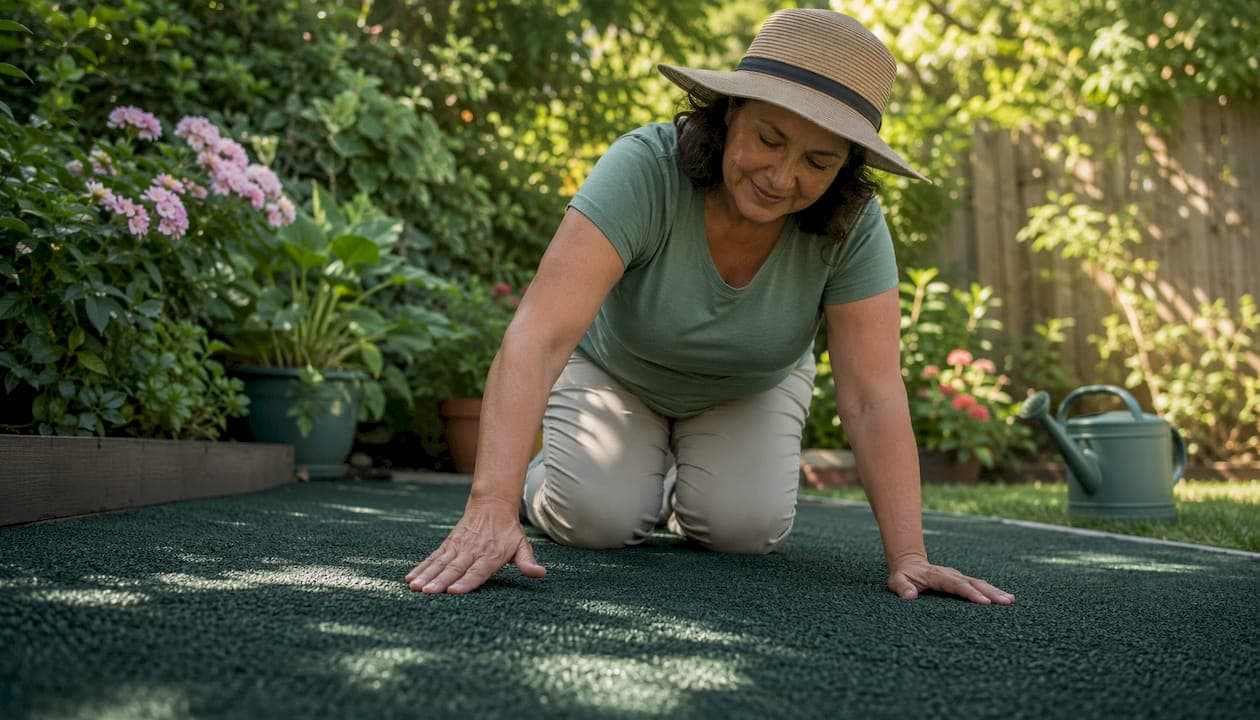
Rubber surfaces stay cool outdoors not because they resist getting warm, but because they resist transferring that warmth to you. That distinction matters more than most property owners realize. The polymer structure of vulcanized rubber gives it low thermal conductivity, meaning heat builds at the surface but moves slowly into whatever touches it. Bare feet on a rubber pool deck feel dramatically cooler than the same feet on concrete or asphalt, even when the rubber surface itself is warm to a thermometer. Here is what drives that effect, and what you can do to maximize it:
- Rubber's thermal conductivity is far lower than concrete or stone, slowing heat transfer to skin
- The polymer and vulcanization process give rubber structural heat resistance without degradation
- Surface color and rubber type (SBR vs. EPDM) heavily influence actual surface temperature
- Shading, ventilation, and material selection are the primary levers for managing heat outdoors
- Dark rubber under full sun can still reach unsafe temperatures for barefoot contact
Table of Contents
- How rubber's thermal properties compare to concrete and asphalt
- How rubber type and color affect heat retention outdoors
- Safety considerations for hot rubber surfaces
- Design and maintenance strategies to keep outdoor rubber surfaces cool
- How Ecotecrubber's Rubberway® system addresses heat in Florida's climate
- How rubber tile composition affects heat absorption at the surface level
- How sunlight, humidity, and wind shape rubber surface temperatures
- How rubber surfaces hold up under years of heat exposure
- Ecotecrubber brings rubber surface expertise to Florida property owners
- Key Takeaways
How rubber's thermal properties compare to concrete and asphalt
The core reason outdoor rubber surface cooling outperforms traditional materials comes down to three measurable properties: thermal conductivity, solar reflectance (albedo), and emissivity.
Concrete and asphalt absorb solar energy aggressively. Conventional pavements can reach surface temperatures of 48°C to 67°C (118°F–153°F) under a typical sunny day, according to EPA cool pavement research. Rubber, by contrast, has a much lower thermal conductivity, so even when the surface heats up, that heat does not travel quickly through the material or into the foot. One pool deck comparison found rubber surfaces staying about 60°F (33°C) cooler than bare concrete in peak Las Vegas sun conditions as of recent studies.
Solar reflectance is the percentage of solar energy a surface bounces back rather than absorbs. Asphalt sits at a solar reflectance of just 5–10%, making it one of the worst performers. Lighter-colored rubber and concrete tiles reflect significantly more, reducing the heat available to absorb into the material in the first place.
| Material | Typical Peak Surface Temp | Solar Reflectance | Thermal Conductivity |
|---|---|---|---|
| Asphalt | Peak surface temperatures exceeding typical natural surface temperatures | 5–10% | High |
| Concrete | Peak surface temperatures exceeding typical natural surface temperatures | 20–30% | High |
| Dark SBR rubber | 65–75°C (149–167°F) peak surface temperature under sun exposure | Very low | Low |
| Light EPDM rubber | Surface temperature 10–20°C lower than dark SBR under sun exposure | Moderate–high | Low |
The table makes one thing clear: rubber's low conductivity is its real advantage, not necessarily its surface temperature. Dark SBR rubber can actually reach surface temperatures of 65–75°C (149–167°F) under full sun, which can be hotter than concrete. What rubber does is keep that heat from reaching the user as fast.
Emissivity, the rate at which a surface radiates absorbed heat back into the air, also plays a role. Higher emissivity materials release heat more readily, cooling faster after sun exposure. Rubber's emissivity varies by formulation, but its insulating structure means less stored heat reaches the subsurface, reducing the nighttime heat release that contributes to urban heat islands.

Pro Tip: When comparing surfaces for a pool deck or playground, ask for the material's thermal conductivity value, not just its color. A light-colored material with high conductivity can still burn bare feet faster than darker rubber.
How rubber type and color affect heat retention outdoors
Not all rubber behaves the same under sun. The two most common outdoor rubber types, SBR (styrene-butadiene rubber) and EPDM (ethylene propylene diene monomer), perform very differently in heat.

SBR is typically made from recycled tire crumb, which is almost always black. Black surfaces absorb infrared radiation at a much higher rate than lighter colors, which is why dark SBR tiles can reach 65–75°C (149–167°F) under direct sun. That is hot enough to cause burns on bare skin within seconds. EPDM, on the other hand, is manufactured in a wide range of colors and can be formulated with UV-stable pigments that reflect more solar energy. Switching from black SBR to light-colored EPDM can reduce surface temperatures by 10–20°C under the same sun exposure conditions.
Color choice is not purely aesthetic when you are managing a playground, fitness area, or pool deck. Light grays, tans, and greens reflect more of the solar spectrum than black or dark brown. For facilities in Florida or other high-sun states, this single decision can mean the difference between a surface that is usable at noon and one that clears out by 10 AM.
Material selection combined with thoughtful design is what actually controls outdoor heat, not the rubber category alone. EPDM reflects heat better than SBR, and pairing it with a segmented tile layout that allows airflow underneath pushes performance further. Solid poured-in-place rubber with no air gap beneath it will retain more heat than interlocking tiles with ventilation channels.
Safety considerations for hot rubber surfaces
The insulating property of rubber is a genuine safety advantage, but it does not make every rubber surface safe for barefoot use in full sun. Dark rubber surfaces can still reach temperatures that cause contact burns, particularly for children and elderly users who may not react quickly enough.
Shading can reduce rubber surface temperatures by 20–30°C compared to unshaded exposure. Shaded playground surfaces often remain under 40°C, well below the threshold for skin burns. That gap between shaded and unshaded is larger than most facility managers expect, and it is the single most effective intervention available.
Key safety practices for outdoor rubber installations:
- Install shade structures, sail shades, or tree canopy over high-use areas like playground equipment and seating zones
- Specify light-colored EPDM for any surface where barefoot contact is expected
- Post surface temperature warnings or "hot surface" signage during peak summer months
- Conduct morning temperature checks before opening facilities to children or barefoot users
- Review liability risk considerations for rubber surfaces as part of your facility safety plan
Rubber's insulating buffer does reduce the rate of heat transfer to skin compared to concrete or stone, which means a brief contact with warm rubber is less dangerous than the same contact with equally warm concrete. But "less dangerous" is not the same as safe, and surface temperature monitoring should be part of any facility's summer protocol.
Design and maintenance strategies to keep outdoor rubber surfaces cool
Good design decisions made before installation do more work than any maintenance routine after the fact. The most effective strategies layer multiple cooling mechanisms rather than relying on any single fix.
Shade is the highest-leverage tool. Nature-based cooling strategies maintain safe contact temperatures over 80% of the time in well-designed outdoor spaces. Trees, pergolas, and shade sails all work. The goal is to block direct solar radiation during the hottest hours, typically 10 AM to 3 PM in most U.S. climates.
For surfaces that cannot be shaded, misting systems provide meaningful relief. Water evaporation draws heat out of the surface rapidly, and research confirms that water sprinkling significantly reduces pavement surface temperatures, with the most dramatic effect during peak daytime heat. The cooling effect persists even after the surface dries, though it diminishes over time.
Pro Tip: Schedule rubber paving installation when ambient temperatures are below 95°F. Above that threshold, adhesive resins thin out and bonding quality drops, which affects both durability and long-term thermal performance.
Routine maintenance also matters. Debris accumulation, UV degradation, and surface cracking can alter how a rubber surface absorbs and retains heat over time. Regular cleaning, prompt repair of cracked sections, and periodic inspection of seams and edges keep the surface performing as designed. For installation timing and weather-related guidance, weather's effect on rubber paving is worth reviewing before any project begins.
How Ecotecrubber's Rubberway® system addresses heat in Florida's climate
Florida presents one of the most demanding outdoor surface environments in the United States: intense UV exposure, high humidity, and ambient temperatures that regularly push above 90°F for months at a time. Ecotecrubber's Rubberway® system was built specifically for these conditions.
The Rubberway® system uses recycled EPDM granules bound with UV-stable polyurethane binders. EPDM's inherent heat reflectance, combined with the color options available through the system, gives property owners real control over surface temperature outcomes. The recycled material sourcing reduces waste while delivering a surface that resists heat-induced cracking, a common failure point for asphalt and traditional concrete in Florida's thermal cycling conditions.
Ecotecrubber installations are ADA-compliant, which matters for pool decks, commercial walkways, and municipal paths where accessibility and surface safety intersect. The drainage design built into the Rubberway® system also supports evaporative cooling, since a surface that sheds water efficiently can benefit from misting or rain events more effectively than an impermeable one.
The Rubberway® system gives property owners in Florida a surface that handles the heat without sacrificing comfort or compliance. Recycled EPDM with UV-stable binders means the color holds, the surface stays intact, and the thermal performance you spec on day one is still there years later. That is what sustainable paving actually looks like in practice.
Ecotecrubber's focus is exclusively on rubber paving, which means every project benefits from specialized knowledge rather than a generalist contractor's best guess. For sustainable paving installation in Florida's climate, that specialization translates directly into better outcomes.
How rubber tile composition affects heat absorption at the surface level
The composition of a rubber tile determines how much solar energy it absorbs and how quickly that energy moves through the material. Density, granule size, and binder type all influence the result.
Denser tiles with smaller granules have less air void space, which reduces the convective cooling that can occur when air moves through a more porous structure. Larger granule sizes and open-matrix designs allow more airflow, which helps dissipate surface heat. Binder type affects UV stability: polyurethane binders hold color longer than latex alternatives, preserving the reflective properties of lighter-colored tiles over years of sun exposure.
Color remains the dominant variable. Light-colored tiles reflect more of the solar spectrum, particularly in the near-infrared range where most solar heating occurs. A tile that looks only slightly lighter to the human eye can reflect meaningfully more infrared energy, keeping its surface temperature lower under identical sun exposure.
How sunlight, humidity, and wind shape rubber surface temperatures
Environmental conditions can shift rubber surface temperatures by as much as the material choice itself. Sunlight intensity is the primary driver: a rubber surface in full Florida sun at solar noon behaves very differently from the same surface under overcast skies or in partial shade.
Humidity affects evaporative cooling. In high-humidity environments like Florida, water evaporates more slowly from a surface, which reduces the natural cooling effect that moisture provides. This is why misting systems are less effective in humid climates than in arid ones, though they still provide measurable relief. Wind increases convective heat loss from any surface, including rubber. A consistent breeze across an open pool deck can reduce surface temperatures noticeably compared to a sheltered, still-air installation. Urban site analysis confirms that location-specific conditions like wind speed and cloud cover significantly influence pavement surface and near-surface air temperatures.
Facility managers in humid, high-sun climates should prioritize shade and light-colored EPDM over relying on wind or evaporation to manage heat, since those variables are less controllable.
How rubber surfaces hold up under years of heat exposure
Rubber's vulcanized molecular structure gives it genuine heat tolerance that most competing surface materials cannot match. The cross-linked polymer chains created during vulcanization resist thermal degradation, meaning the material does not soften, warp, or crack under the repeated heating and cooling cycles that destroy asphalt overlays and cause concrete to spall.
UV exposure is the more significant long-term threat than heat alone. Without UV-stable binders, rubber surfaces can fade, become brittle, and lose the color properties that contribute to heat reflectance. EPDM with quality polyurethane binders holds up significantly better than SBR in this regard, which is one reason rubber paving outperforms asphalt overlays over a multi-year horizon.
For eco-friendly construction projects that prioritize long-term performance, rubber's durability under heat stress makes it a strong candidate compared to materials that require frequent resurfacing or sealing. A well-installed EPDM surface in Florida can maintain its structural and thermal properties for well over a decade with basic maintenance, while asphalt in the same climate typically requires attention within three to five years.
Ecotecrubber brings rubber surface expertise to Florida property owners
Florida property owners dealing with heat, humidity, and UV intensity need a paving solution built for those exact conditions, not a generic product adapted from a cooler climate.
Ecotecrubber installs the Rubberway® system across Florida, bringing recycled EPDM technology, ADA-compliant design, and climate-specific expertise to every project. The result is a surface that stays comfortable longer, drains efficiently, and holds its thermal properties year after year. Whether you are managing a pool deck, a commercial walkway, or a municipal path, Ecotecrubber's licensed and insured team coordinates the full project with a focus on rubber paving alone. Get a quote for your property at ecotecrubber.com and see what a purpose-built rubber surface looks like in Florida's climate.
Key Takeaways
Rubber surfaces stay cool outdoors primarily because low thermal conductivity slows heat transfer to skin, not because the surface itself stays cold, making material type and color the critical decisions for any outdoor installation.
| Point | Details |
|---|---|
| Thermal conductivity is the key | Rubber's low conductivity slows heat transfer to skin, even when the surface itself is warm. |
| Color and type determine surface temp | Light EPDM can run 10–20°C cooler than dark SBR under the same sun exposure. |
| Shade is the most effective intervention | Shading reduces rubber surface temperatures by 20–30°C compared to direct sun exposure, often keeping them under 40°C. |
| Installation temperature matters | Bonding above 95°F causes resin thinning and long-term surface defects. |
| Ecotecrubber's Rubberway® system | Recycled EPDM with UV-stable binders delivers durable, ADA-compliant, heat-managed surfaces across Florida. |