
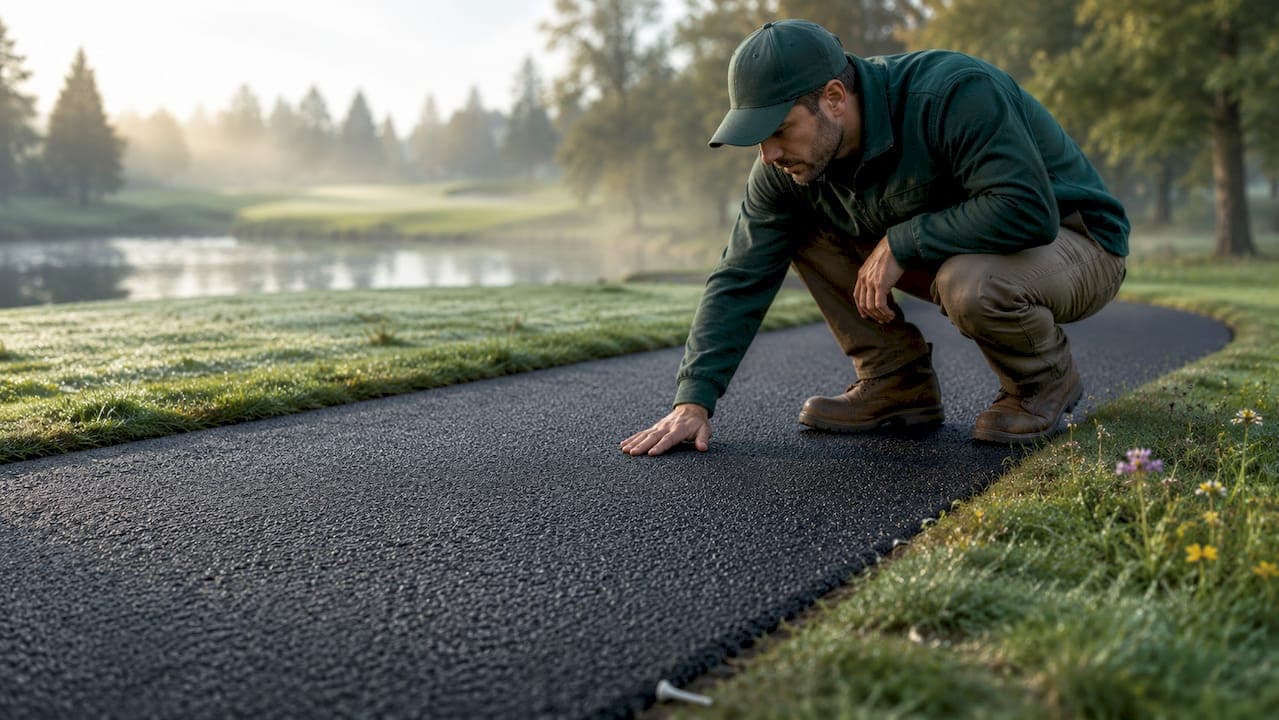
Rubber surfacing is the most durable, permeable, and low-maintenance paving option available for golf course pathways, bunker linings, and cart routes. The technical term used across the industry is "permeable rubber paving," and understanding why rubber surfaces suit golf course environments comes down to three factors: material composition, drainage performance, and long-term cost control. Courses using recycled rubber paving report fewer path closures, less equipment damage, and stronger alignment with environmental regulations than those relying on gravel, asphalt, or woodchip alternatives. For golf course managers weighing surfacing decisions in 2026, the case for rubber is grounded in data, not preference.
Why rubber surfaces suit golf course environments
Rubber surfaces perform well on golf courses because their physical properties directly match what course conditions demand. The material is dense enough to handle daily cart and foot traffic, flexible enough to absorb ground movement, and porous enough to drain rainfall without pooling. No other common paving material combines all three of those qualities at the same price point.
The most widely specified rubber slab pavers for golf facilities are composed of 92% recycled SBR rubber and 8% polyurethane binder. That ratio produces a density of 950–1,000 kg/m³, which is firm enough for stable footing but forgiving enough to reduce joint stress on players walking long distances. The PU binder locks the rubber granules together without making the surface brittle, which matters in climates with freeze-thaw cycles or intense summer heat.

Slip resistance is the safety standard that separates rubber from concrete and asphalt on wet course paths. Rubber slab pavers meet EN 13036-4 slip resistance standards in both dry and wet conditions. That standard is the European benchmark for outdoor surface friction, and meeting it means the surface performs safely during rain, morning dew, and irrigation runoff. A studded underside on most rubber slabs also allows water to escape from beneath the tile, preventing hydrostatic pressure buildup that causes lifting.
UV stabilization and frost resistance extend the usable life of rubber surfaces across all seasons. Unlike asphalt, which softens and ruts under summer heat, or concrete, which cracks under freeze-thaw pressure, rubber maintains its structural integrity year-round. Warranties on rubber slab pavers for golf facilities typically run four years, which reflects the material's expected durability under active outdoor use.
Pro Tip: Specify UV-stabilized rubber tiles for any south-facing path or open area with no tree cover. Non-stabilized rubber degrades faster under direct sun, shortening the surface lifespan significantly.
| Property | Performance Detail |
|---|---|
| Material composition | 92% recycled SBR rubber, 8% PU binder |
| Density | 950–1,000 kg/m³ |
| Slip resistance | Meets EN 13036-4 in wet and dry conditions |
| Weather resistance | UV stabilized and frost resistant |
| Drainage | Studded underside allows water escape |
How do rubber surfaces support environmental sustainability on golf courses?
Permeable rubber paving reduces stormwater runoff by allowing water to reenter the soil naturally rather than channeling it into drainage systems or adjacent turf. This matters on golf courses because impervious surfaces like asphalt and concrete concentrate runoff, which accelerates erosion along path edges and deposits sediment into water features. Permeable paving preferred by municipalities reflects a regulatory shift toward surfaces that support groundwater recharge rather than diverting it.

The recycled content in rubber paving also addresses a real waste problem. Scrap tires are one of the most difficult materials to dispose of responsibly. Using them as the base material for golf course paths diverts them from landfills and gives them a functional second life. Courses that adopt recycled paving for golf sustainability can document that material choice as part of broader environmental reporting, which increasingly matters to club members, local governments, and certification bodies.
The ecological contrast with asphalt and concrete is significant:
- Asphalt and concrete create fully impervious surfaces that block groundwater recharge and increase surface temperatures through heat absorption.
- Rubber paving with 27% void space allows air and moisture to pass through, supporting soil biology beneath the surface.
- Gravel paths allow drainage but migrate constantly, requiring labor to redistribute and causing damage to adjacent turf and mower blades.
- Woodchip paths decompose, introduce fungal growth, and require annual replacement, adding both cost and organic waste.
- Rubber surfaces remain stable, do not migrate, and do not introduce biological contaminants to the course environment.
Municipal and design trends increasingly favor permeable rubber surfaces to reduce stormwater issues inherent in impervious paving. Golf courses that align with those trends position themselves well for future regulatory requirements and demonstrate environmental responsibility to their communities.
In what ways does rubber surfacing reduce maintenance costs?
Rubber path surfaces protect maintenance equipment by eliminating gravel migration. Gravel that wanders onto turf regularly damages mower blades, and blade replacement costs represent a hidden but significant operational expense that most course managers underestimate until they track it directly. Rubber paths stay where they are installed. That single characteristic removes an entire category of recurring repair cost.
The operational savings extend beyond equipment protection. Rubber paths are all-weather surfaces that do not become impassable after rain. That means fewer course closures, less turf damage from carts rerouting onto grass, and reduced labor spent on path restoration after wet weather events. Managers who track maintenance budget reductions from rubber paths consistently report savings across multiple cost categories simultaneously.
The cost advantages of rubber over traditional surfaces break down across five operational areas:
- Equipment protection. Rubber eliminates gravel migration onto turf, removing the primary cause of mower blade damage and unplanned equipment downtime.
- Labor reduction. No gravel redistribution, no woodchip replacement, and no path reconstruction after frost or heavy rain means fewer labor hours spent on surface upkeep.
- Course availability. All-weather usability keeps cart paths open during and after rain, reducing the turf damage that occurs when carts reroute onto grass.
- Drainage maintenance. Built-in permeability reduces the need for manual drainage intervention after storms, cutting the time grounds crews spend clearing blocked paths.
- Surface longevity. A semi-permanent rubber surface does not require the annual material top-ups that gravel and woodchip paths demand, lowering recurring material costs.
Pro Tip: Track mower blade replacement frequency for six months before and after installing rubber paths. The reduction in blade damage alone often justifies the surfacing investment in the first year.
Managers should treat rubber surfaces as a preventive investment rather than a recurring repair expense. That reframe changes how the budget conversation happens at the board level and makes the long-term cost case much easier to defend.
What are the practical applications and installation considerations?
Rubber surfacing applies across multiple areas of a golf course, each with specific performance requirements. Cart paths and player walkways are the most common applications, but bunker linings represent one of the highest-value uses because of the direct impact on playability and maintenance frequency.
Rubberized bunker liners prevent sand contamination by creating a barrier between the sand and the underlying soil. They improve drainage and resist wear from club strikes, which reduces both sand replacement cycles and the labor cost of restoring bunker consistency after play. Consistent bunker playability directly affects golfer satisfaction and course ratings, making this application one that pays back quickly in both operational and reputational terms.
Golf pathway mats with open-hole designs allow grass to grow through apertures while distributing weight evenly to prevent ruts. That design prevents drainage issues and is favored by environmental agencies because it maintains soil permeability even under high foot traffic. The weight distribution also reduces compaction, which protects root systems along path edges.
Installation quality determines whether rubber surfaces deliver their full performance potential. The most common failure point is sub-grade preparation. Poor sub-grade compaction causes drainage failure and uneven settling, which shortens the surface lifespan regardless of the rubber quality used. A properly compacted, stable substrate is the single most important factor in a successful rubber paving installation.
Key installation and application considerations include:
- Substrate preparation. Compact the sub-grade thoroughly and verify drainage before laying any rubber surface. Skipping this step is the leading cause of premature failure.
- Freeze-thaw accommodation. Rubber's flexibility allows it to move with soil expansion and contraction, but the substrate must also be stable enough to prevent differential settling.
- Slip resistance verification. Confirm that specified tiles meet EN 13036-4 before purchase, particularly for areas exposed to irrigation or rainfall runoff.
- Bunker liner installation. Install without removing turf where possible to minimize course disruption and recovery time.
- Ongoing maintenance. Rubber surfaces require minimal upkeep. Periodic inspection for debris accumulation in drainage apertures and checking edge stability is sufficient for most installations.
Porous rubber surfaces also reduce ball-bounce by up to 73% compared to traditional surfaces. That reduction in ricochet risk matters on paths adjacent to playing areas, where errant cart movements or dropped equipment can create safety hazards.
Key Takeaways
Rubber surfacing outperforms gravel, asphalt, and woodchip on golf courses because it combines drainage, durability, safety, and low maintenance in a single material.
| Point | Details |
|---|---|
| Technical composition | 92% recycled SBR rubber and 8% PU binder delivers density, flexibility, and EN 13036-4 slip resistance. |
| Environmental performance | Permeable design supports groundwater recharge and reduces stormwater runoff compared to asphalt and concrete. |
| Maintenance cost reduction | Eliminates gravel migration, protects mower blades, and reduces labor across drainage, path repair, and material top-ups. |
| Installation priority | Sub-grade compaction is the single most critical factor in rubber surface longevity and drainage performance. |
| Bunker and pathway value | Rubber liners and pathway mats reduce sand replacement cycles, prevent ruts, and keep surfaces open in all weather. |
What I've learned from watching courses get this decision wrong
Golf course managers are generally good at evaluating turf. They are less experienced evaluating hard surfaces, and that gap shows up in two recurring mistakes I've seen across multiple course renovation projects.
The first mistake is treating path surfacing as a commodity purchase. Managers compare price per square meter, pick the lowest number, and move on. That approach ignores the total cost of ownership. Gravel looks cheap until you factor in annual redistribution labor, mower blade replacements, and the turf damage from carts rerouting after rain. Rubber costs more upfront and costs less every year after that.
The second mistake is underinvesting in sub-grade preparation. I've watched premium rubber installations fail within two seasons because the contractor skipped proper compaction. The rubber itself was fine. The ground beneath it wasn't. Soil stability beneath rubber surfacing is inseparable from surface longevity, and no amount of material quality compensates for a poorly prepared base.
The benefit I see most consistently overlooked is equipment protection. Grounds crews track mower hours and fuel. They rarely track blade replacement frequency against path material type. When they do, the numbers are striking. Eliminating gravel from path surfaces removes the primary source of blade damage, and that saving alone often covers a significant portion of the rubber installation cost.
My recommendation is straightforward. Treat rubber surfacing as infrastructure, not maintenance. Budget it accordingly, prepare the substrate properly, and specify tiles that meet EN 13036-4. Courses that do all three report fewer operational headaches and better long-term financial outcomes than those that don't.
— Roger
Ecotecrubber's rubber paving solutions for golf courses
Golf course managers in Florida have a specific set of challenges: intense heat, heavy rainfall, and high humidity that accelerate the degradation of conventional path materials. Ecotecrubber addresses those conditions directly through professional Rubberway® installations built from recycled rubber with built-in drainage, UV stabilization, and ADA-compliant surfaces.
Ecotecrubber's installations are licensed, insured, and focused exclusively on rubber paving, which means every project benefits from specialized expertise rather than a generalist contractor's approach. The Rubberway® system is designed for Florida's climate and delivers the drainage performance, crack resistance, and surface safety that golf courses require year-round. Contact Ecotecrubber to discuss your course's surfacing needs and review available rubber paving products suited to pathways, bunkers, and cart routes.
FAQ
What makes rubber better than gravel for golf cart paths?
Rubber paths stay in place, protect mower blades from gravel migration, and remain usable in all weather. Gravel migrates onto turf, damages equipment, and becomes impassable after heavy rain.
Does rubber surfacing meet safety standards for wet conditions?
Rubber slab pavers for golf facilities meet EN 13036-4 slip resistance standards in both wet and dry conditions. A studded underside also allows water to drain from beneath the tile, preventing surface pooling.
How does permeable rubber paving help with stormwater management?
Permeable rubber paving allows water to reenter the soil naturally rather than channeling it into drainage systems. This reduces runoff, supports groundwater recharge, and aligns with municipal stormwater regulations.
What is the most important factor in a rubber surface installation?
Sub-grade compaction is the single most critical factor. Poor compaction causes drainage failure and uneven settling, which shortens surface lifespan regardless of rubber quality.
Can rubber surfaces be used in golf course bunkers?
Rubberized bunker liners prevent sand contamination, improve drainage, and resist wear from club strikes. They reduce sand replacement cycles and support consistent bunker playability across all weather conditions.