
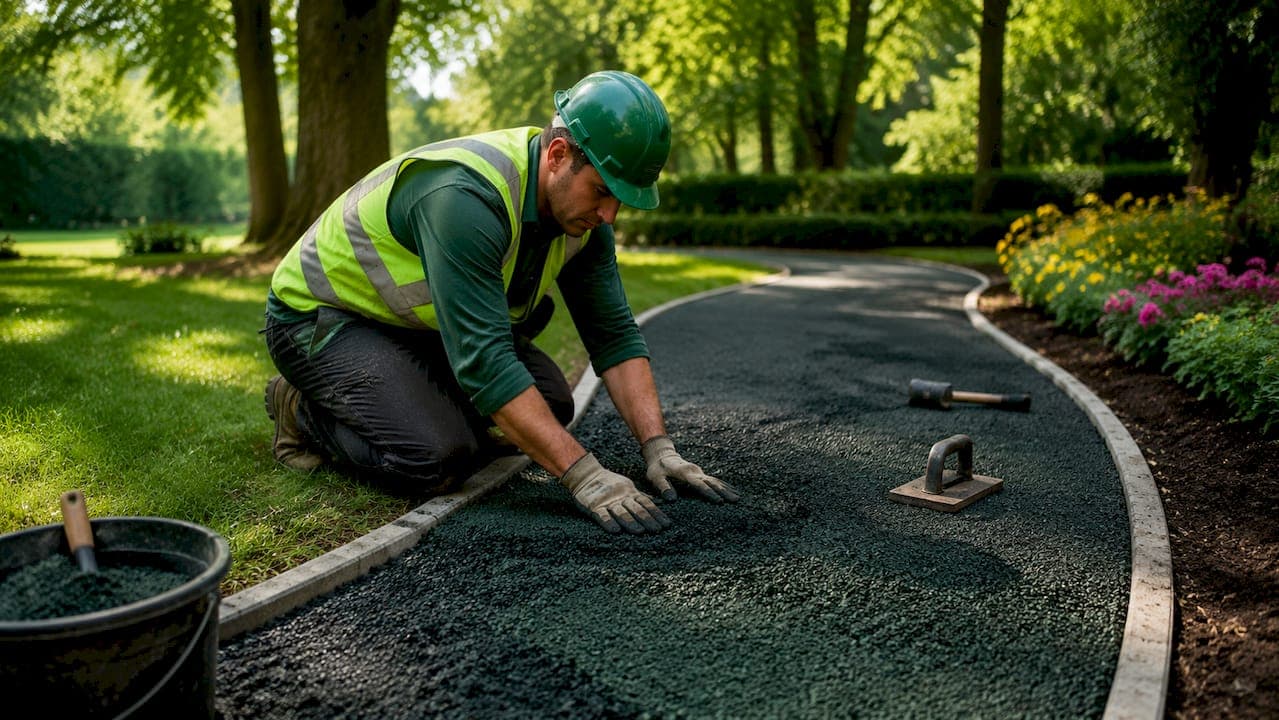
Rubber paths are defined as flexible, porous walkway surfaces made from recycled rubber granules bound together to form a durable, crack-resistant pavement. Understanding how rubber paths reduce maintenance budgets starts with one fact: they eliminate the most expensive failure modes of traditional pathway materials. Concrete cracks under tree roots. Asphalt softens in heat. Gravel migrates. Woodchips decompose. Rubber does none of these things. Property managers and municipalities that switch to rubberized surfaces stop paying for the same repairs year after year, and they gain a surface that meets ADA compliance standards without costly retrofits.
What are the main maintenance cost drivers for traditional outdoor pathways?
Traditional pathway materials fail in predictable, expensive ways. Concrete and asphalt crack when tree roots push upward from below, creating uneven surfaces that become trip hazards. Each repair cycle requires labor, materials, and often temporary closure of the path. For municipalities managing dozens of pathways across parks and public spaces, these cycles add up fast.
Loose-fill materials like gravel and woodchips present a different problem. They migrate off the path surface, clog drainage systems, and require regular top-ups to stay functional. Maintenance crews spend hours raking, redistributing, and replacing material that simply walks away with foot traffic. That labor cost is largely invisible in annual budgets because it gets absorbed into general grounds maintenance.
Accessibility compliance failures are a significant hidden cost. Loose-fill surfaces fail ADA firmness and stability tests, which means municipalities face either ongoing retrofits or legal exposure. A single accessibility lawsuit can cost far more than a full pathway replacement. The ADA compliance risk alone justifies a serious look at alternative materials.
- Concrete and asphalt: Crack from root intrusion, thermal expansion, and ground movement. Repairs require cutting, patching, and resurfacing.
- Gravel and woodchips: Migrate with foot traffic, require frequent top-ups, and fail ADA firmness standards.
- Timber boardwalks: Rot, splinter, and require replacement on a 10–15 year cycle at significant material and labor cost.
- Asphalt overlays: Soften in high heat, particularly in Florida climates, and bond poorly to existing surfaces over time.
Pro Tip: Track your path repair costs separately from general grounds maintenance for one full year. Most property managers are surprised to find that pathway patching accounts for a disproportionate share of their total outdoor maintenance spend.
How do rubber paths prevent these cost drivers and reduce maintenance expenses?
Rubber paths prevent the most expensive failure modes by design. The material flexes under pressure rather than cracking, which means tree root movement beneath the surface does not fracture the path. A case study at Blair Park in Auckland showed approximately $3,000 in savings when timber boardwalks were replaced with porous rubber paths. That figure reflects avoided replacement costs, not just reduced repair frequency.
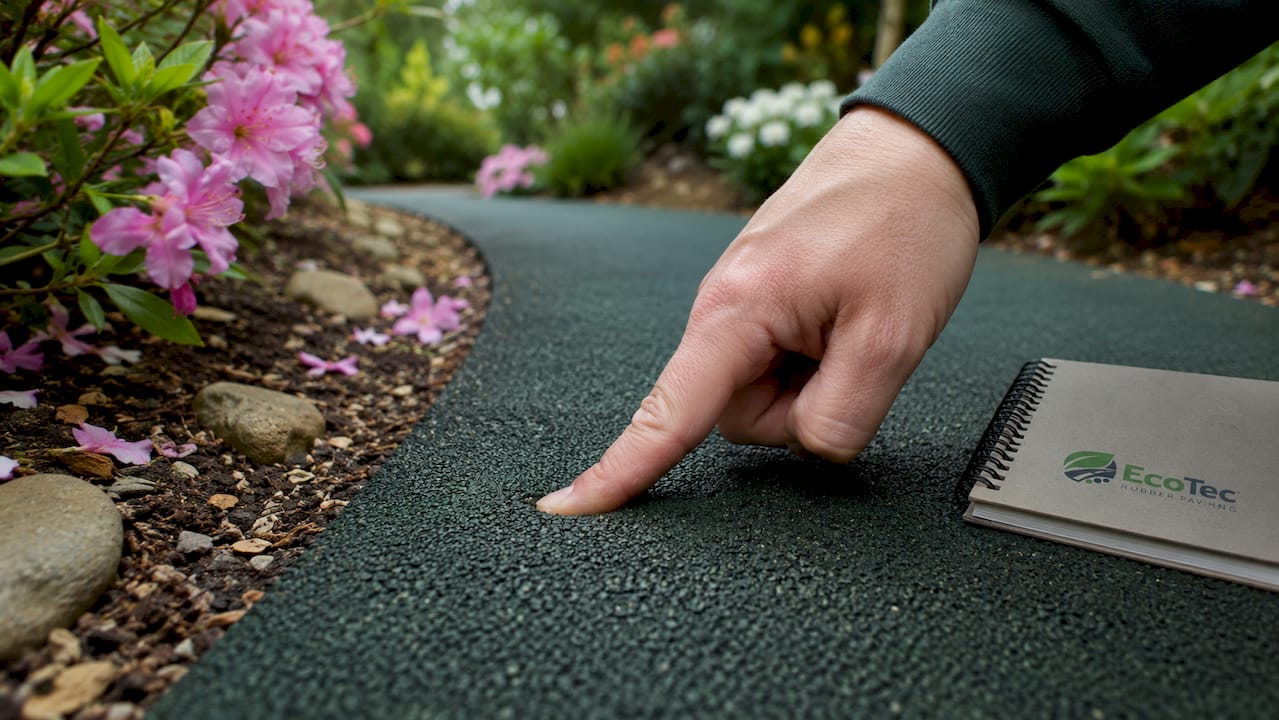
The porous structure of rubber surfacing handles drainage without additional infrastructure. Water passes through the surface rather than pooling on top, which eliminates the freeze-thaw cracking cycle common in northern climates and the standing water problems that accelerate surface degradation in Florida. Poured-in-place rubber surfacing requires minimal upkeep beyond periodic cleaning and inspection, making it one of the lowest-maintenance options available for outdoor pathways.
ADA compliance is a direct budget benefit. Rubber paths provide a firm, consistent surface that meets accessibility standards without modification. Rubber paths reduce ADA liability because they maintain their surface integrity under heavy use, unlike loose-fill materials that shift and compress unevenly. Municipalities that install rubber paths eliminate the cost of periodic accessibility audits and the retrofits those audits typically require.
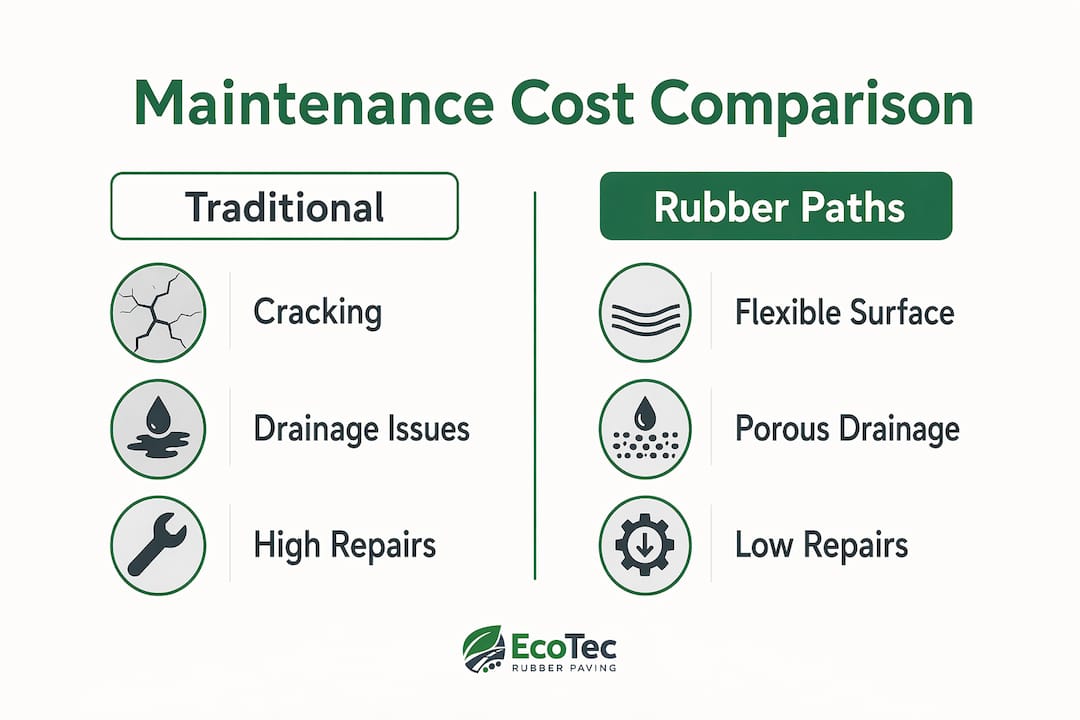
Rubber paving also protects adjacent landscaping by preventing loose material migration. When gravel or woodchips scatter onto turf, mower blades strike them and cause equipment damage. Rubber paths stay in place, which reduces both turf repair costs and equipment maintenance cycles.
| Cost driver | Traditional materials | Rubber paths |
|---|---|---|
| Root intrusion cracking | High frequency, costly patching | Flexible surface absorbs movement |
| ADA compliance | Loose-fill fails; retrofits required | Firm surface meets standards by default |
| Drainage and pooling | Requires added drainage infrastructure | Porous surface drains without extras |
| Adjacent turf damage | Loose material migrates, damages mowers | Material stays contained |
| Repair frequency | Annual to biannual patching cycles | Minimal intervention for 8–20 years |
Pro Tip: When evaluating rubber path proposals, ask for the total cost of ownership over 10 years, not just the installation quote. The upfront premium looks very different when spread across a decade of avoided repairs.
What are the best installation practices to maximize rubber path savings?
Site preparation is the single most critical factor in rubber path longevity. Poor sub-base preparation leads to premature binder degradation and dramatically shortens the path's useful life. A rubber surface installed over an unstable or poorly drained base will fail years before its expected lifespan, erasing the cost advantage entirely.
The two primary installation methods serve different site conditions. Poured-in-place rubber suits curved paths, irregular areas, and surfaces that require a custom fit. Prefabricated rubber rolls work best for straight, uniform sections where consistent density matters and speed of installation is a priority. Rubber paving installed over existing stable surfaces avoids demolition costs entirely, which can represent a significant portion of a project budget.
Follow these steps to get the most from a rubber path installation:
- Assess and compact the sub-base. Remove organic material, compact the base layer to the correct density, and verify drainage before any rubber material is applied.
- Choose the right installation method. Use poured-in-place for complex shapes and uneven terrain. Use prefabricated rolls for straight, uniform sections where installation speed matters.
- Verify drainage before installation. Standing water under a rubber surface accelerates binder breakdown. Install perimeter drainage channels if the site does not drain naturally.
- Schedule annual inspections. Check for edge lifting, surface separation, or binder degradation. Catching minor issues early prevents them from becoming full-section replacements.
- Clean surfaces periodically. Leaf litter and organic debris can block pores over time. A pressure wash once or twice a year keeps drainage functioning and extends surface life.
Rubber paths carry a lifespan of 8–20 years depending on site conditions, traffic volume, and installation quality. That range is wide because site preparation quality is the primary variable. A well-prepared base with good drainage consistently reaches the upper end of that range.
How do rubber paths compare to other cost-effective walkway options?
The upfront cost of rubber paving is higher than asphalt or concrete. Recycled rubber paving costs 10%–20% more upfront than asphalt or concrete but lasts 2–3 times longer with significantly less maintenance. That math changes the conversation from installation cost to total cost of ownership.
Concrete paths require patching every 3–5 years in areas with active tree roots or significant temperature variation. Asphalt needs seal coating on a regular cycle and full resurfacing every 10–15 years. Gravel and woodchips require annual top-ups and never achieve ADA compliance. Rubber paths, by contrast, need only periodic cleaning and occasional edge inspection across their full lifespan.
- Concrete: Low installation cost, high long-term repair cost, fails under root intrusion, requires ADA retrofits for uneven surfaces.
- Asphalt: Moderate installation cost, regular seal coating required, softens in high heat, poor performance in Florida climates.
- Gravel: Very low installation cost, high ongoing labor cost, fails ADA standards, migrates onto adjacent turf.
- Woodchips: Low installation cost, decomposes within 3–5 years, fails ADA standards, attracts pests.
- Rubber paths: Higher installation cost, minimal ongoing maintenance, meets ADA standards, protects adjacent landscaping.
Facility managers should treat rubber paths as an asset protection strategy, reallocating maintenance budgets from repetitive patching to higher-value landscaping care. The community maintenance savings extend beyond the path itself. Rubber surfaces prevent the loose material migration that damages mowing equipment and requires turf repair, so the savings show up in equipment budgets and grounds crew labor hours as well.
Key Takeaways
Rubber paths reduce maintenance budgets by eliminating the recurring repair cycles, compliance retrofits, and adjacent turf damage that make traditional pathway materials expensive over time.
| Point | Details |
|---|---|
| Root intrusion prevention | Flexible rubber surfaces absorb ground movement without cracking, ending costly patching cycles. |
| ADA compliance by default | Rubber paths meet firmness and stability standards, eliminating retrofit costs and legal exposure. |
| Total cost of ownership | Higher upfront cost is offset by 2–3 times longer lifespan and minimal ongoing maintenance. |
| Site preparation is critical | Sub-base quality determines whether a rubber path reaches 8 or 20 years of service life. |
| Adjacent savings matter | Rubber paths prevent loose material migration, reducing turf repair and equipment maintenance costs. |
What I've learned after years of watching property managers choose the wrong path material
The most common mistake I see is evaluating pathway materials on installation cost alone. A property manager chooses gravel because it costs less per square foot to install. Two years later, the same manager is paying grounds crew overtime to rake it back onto the path, replacing mower blades damaged by scattered stones, and fielding accessibility complaints from residents. The gravel was never cheap. It just looked cheap on the original quote.
The second mistake is underestimating the liability exposure from non-compliant surfaces. Most property managers know that ADA compliance matters, but they treat it as a checkbox rather than a budget line. The biggest overlooked benefit of rubber paths is the reduction in liability from providing a firm, stable surface. One accessibility claim can cost more than the entire pathway replacement budget for a given year.
What I tell clients is this: rubber paths are not a premium product. They are a cost-reduction tool that happens to cost more at installation. The clients who get the most value are the ones who track their current maintenance spend carefully before switching. When you can show that concrete patching, gravel top-ups, and turf repairs cost $8,000 a year across a property, a rubber path installation that eliminates most of that spend pays for itself in a defined timeframe. That is a business case, not a sales pitch.
The future of municipal pathway management points toward materials that require less labor, not more. Grounds crews are expensive and hard to retain. Every hour spent patching a concrete path is an hour not spent on higher-value work. Rubber paths free up that labor. That is the argument I would make to any budget committee.
— Roger
Ecotecrubber's Rubberway® system for Florida property managers
Property managers and municipalities in Florida face a specific challenge: heat-induced cracking, standing water after heavy rain, and ADA compliance requirements that standard materials handle poorly. Ecotecrubber addresses all three with the Rubberway® installation system, a professional rubber paving solution built from recycled materials and designed for Florida's climate demands.
Ecotecrubber is licensed and insured, and every project focuses exclusively on rubber paving. That specialization means installations are coordinated by professionals who understand sub-base preparation, drainage requirements, and compliance standards. The full range of Rubberway® products covers pathways, recreational surfaces, and commercial applications. Contact Ecotecrubber for a consultation to see what rubber paving can do for your maintenance budget.
FAQ
How much can rubber paths reduce annual maintenance costs?
Rubber paths eliminate the most frequent cost drivers in traditional pathway maintenance, including root intrusion repairs, ADA retrofits, and loose material replacement. A case study at Blair Park documented approximately $3,000 in savings from a single boardwalk-to-rubber conversion.
Do rubber paths meet ADA accessibility standards?
Rubber paths provide a firm, stable surface that meets ADA firmness and stability requirements by default, unlike gravel or woodchip surfaces that shift under foot traffic and fail accessibility tests.
How long do rubber paths last compared to concrete or asphalt?
Rubber paths last 8–20 years depending on site conditions and installation quality. Recycled rubber paving lasts 2–3 times longer than asphalt or concrete with significantly less maintenance required over that period.
What is the most important factor in rubber path installation?
Sub-base preparation is the most critical factor. Poor compaction or inadequate drainage shortens the path's lifespan significantly and eliminates the cost savings that make rubber paths a sound investment.
Can rubber paths be installed over existing surfaces?
Rubber paving can be installed over existing stable surfaces, which avoids demolition costs and reduces project timelines. The existing surface must be structurally sound and properly drained before installation begins.