
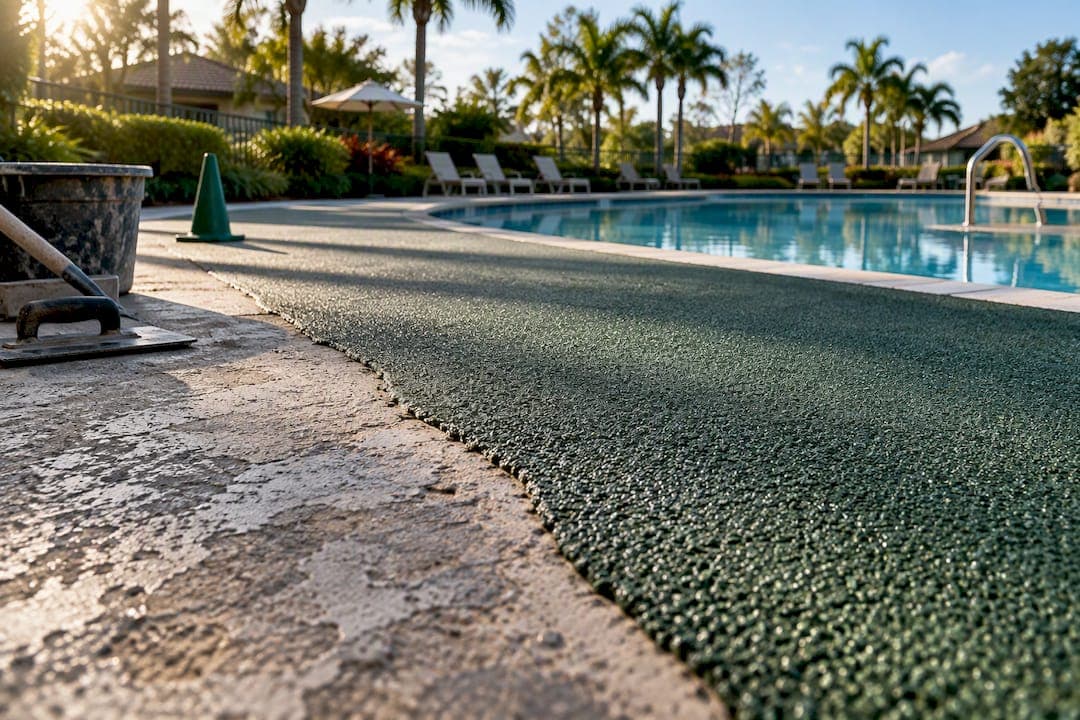
If the pool deck slab is structurally sound, resurfacing is the cost-effective, liability-reducing move for most HOAs. Replace only when the slab or sub-base has failed. Start with a documented substrate inspection, solicit three bids with line-itemed prep scopes, and weigh options against national per-square-foot ranges and ADA pool accessibility requirements before your board signs anything.
TL;DR:
- Resurfacing is significantly cheaper and less disruptive than full replacement as long as the slab is structurally sound and shows no signs of failure.
- Elevated or coastal decks require an engineering assessment before resurfacing due to load, waterproofing, and corrosion risks.
- Rubberized systems like Rubberway® address drainage, crack resistance, and ADA compliance better than traditional coatings in high-traffic, salt, or sun-exposed environments.
- Proper bidding involves detailed, line-item proposals with documented substrate inspections, manufacturer warranties, and clear phasing to avoid scope gaps.
- Regular inspections and reseals every 2 to 5 years are essential to prevent minor issues from developing into costly, liability-exposing failures.
Table of Contents
- Resurface vs. Replacement: Decision Criteria for HOA Boards
- Material Families: Pros, Cons, and HOA Use Cases
- Costs, Budgeting, and Reserve Planning for HOA Projects
- Selecting Contractors and Writing an RFP for HOA Resurfacing
- Timeline, Phasing, and Minimizing Resident Disruption
- Maintenance, Lifecycle, and Safety: Slip Resistance and ADA Access
- How Rubberized Resurfacing (Rubberway®) Fits HOA Priorities
- Procurement Discipline Protects the Amenity and the Reserve Fund
- EcoTec Rubber Paving: Rubberway® Options for HOA Pool Decks
- Primary Sources and Standards to Verify Claims
- Sources
- FAQ
Resurface vs. Replacement: Decision Criteria for HOA Boards
A sound slab shows surface-level wear: fading, minor spalling, hairline cracks that haven't moved in a year, or a coating that's simply lost its texture. A failing slab shows something different. Structural failure looks like cracks wider than a quarter inch that keep growing, sections that rock or drum hollowly underfoot, exposed and rusting rebar, or soil erosion beneath the deck causing visible settlement.
That distinction drives the entire budget conversation. Resurfacing typically runs 50% to 70% less than tear-out-and-replace, because you're not demolishing concrete, disposing of debris, or rebuilding a sub-base. But that math only works when the underlying structure is intact.

Elevated pool decks, common on podium-level amenities in condo-style HOAs, need an engineering assessment before anyone talks material choice. A deck sitting on a structural slab over parking or living space carries load and waterproofing requirements a ground-level deck doesn't, and commercial resurfacing guidance for Florida properties treats these as structural jobs first, cosmetic jobs second.
Boards that delay a resurfacing decision usually don't save money. They trade a five-figure resurfacing job for a six-figure replacement once water intrusion reaches the rebar. Watch for these escalation signs:
- Cracks that widened over two consecutive inspection cycles
- Rust staining bleeding through the coating
- Standing water that doesn't drain within 30 minutes after rain
- Any board member or resident reporting a trip or near-fall on deck seams
Every one of those is a liability exposure clock running, not just a maintenance line item.
Material Families: Pros, Cons, and HOA Use Cases

No single material wins every category. The right choice depends on how much foot traffic your deck sees, whether it's coastal, and how much annual maintenance your reserve fund can absorb.
Spray texture and cool deck coatings are the most common HOA choice. They're acrylic-based, applied in a knockdown or orange-peel texture, and typically last 5 to 10 years before needing a fresh topcoat. They stay noticeably cooler underfoot than plain concrete and offer decent wet slip resistance, but they're also the most prone to peeling if the substrate wasn't fully prepped.
Acrylic and epoxy coatings run tougher and more chemical-resistant, useful for decks that see a lot of pool-chemical splash-back, but they can trend slicker when wet unless an aggregate is broadcast into the finish.
Decorative overlays and stamped concrete deliver the strongest curb appeal and can mimic stone or pavers, but they cost more upfront and need resealing on a tighter cycle, especially in high-UV climates.
Rubberized systems sit at the premium end of the range but bring pervious drainage, exceptional crack resistance under thermal expansion, and consistently high slip resistance even saturated. They fit high-traffic community pools, coastal decks battling salt exposure, and elevated decks where a flexible overlay matters more than raw hardness.
Pro Tip: Ask any contractor for the manufacturer's wet coefficient of friction rating before you approve a material, not just a marketing claim of "slip resistant."
Costs, Budgeting, and Reserve Planning for HOA Projects
National pool deck resurfacing costs run roughly $3 to $12 per square foot in 2026, with premium and rubberized systems trending toward the higher end of that band. A typical 3,000-square-foot community deck lands somewhere between $9,000 on the low end for basic spray texture and $36,000 or more for a full rubberized installation with drainage work.
Coastal and hot-climate properties skew higher still. Salt air accelerates rebar corrosion, and South Florida-area pricing commonly runs $5 to $14 per square foot once that hidden repair scope gets factored in.
Line items that catch boards off guard:
- Crack injection and spot slab repair, priced separately from the resurfacing itself
- Rebar remediation where corrosion has already started
- Mobilization and equipment fees, especially for elevated or hard-to-access decks
- Phasing premiums when a contractor has to remobilize between sections
Compare quotes by line item, not by bottom-line total. Two bids at $22,000 can represent wildly different scopes if one includes full crack remediation and the other quietly assumes the slab needs nothing.
For reserve planning, budget an annual set-aside equal to roughly 8% to 10% of the last resurfacing project's total cost, spread across the coating's expected 10 to 15 year lifespan, so the next cycle doesn't require a special assessment.
Selecting Contractors and Writing an RFP for HOA Resurfacing
A strong RFP does most of the risk management before a single crew shows up. Structure your bid request around these requirements:
- Documented substrate inspection. Require dated photos, a mapped crack diagram, and a written note from a licensed engineer if the deck is elevated or in a coastal, high-corrosion zone.
- Line-itemed prep scope. The bid must separate crack repair, grinding, and old-coating removal from the resurfacing application itself.
- Named products and warranties. Every bid should list the exact manufacturer product being applied, its stated cure time, and the written warranty term.
- Phasing plan with dates. The contract should lock specific closure dates per section, not vague estimates.
- Insurance and licensing proof. Request a certificate of insurance naming your association as additional insured, plus current state contractor license numbers.
The biggest failure point in resurfacing projects isn't the material. It's contractors who skip full substrate documentation and prep, which is consistently the single biggest determinant of how long a finish lasts. A bid that's 20% cheaper than the others almost always got there by cutting that scope.
Pro Tip: Treat a bid that skips crack repair pricing entirely as a red flag, not a bargain. That work always resurfaces, sometimes literally, within two years.
Timeline, Phasing, and Minimizing Resident Disruption
Most HOA pool deck resurfacing projects take one to three weeks for a standard-sized deck, with each section needing a 24 to 72-hour cure window before foot traffic resumes. Rubberized and epoxy systems generally need the longer end of that range.
Phasing keeps residents happy and keeps liability exposure down: closing one half of the deck while resurfacing it, then flipping to the other side, is standard practice for HOA amenity renovations and keeps the pool itself accessible even when the surrounding deck isn't finished.
Lock these into the signed contract, not a verbal understanding:
- Exact start and completion dates per phase
- A weather contingency clause specifying how rain delays get handled
- The season targeted (late spring through early fall usually cures most reliably)
- A resident notification requirement, including posted closure signage 7 to 10 days ahead
Maintenance, Lifecycle, and Safety: Slip Resistance and ADA Access
Most coating systems need a topcoat reseal every 3 to 5 years and a professional structural inspection every 2 to 3 years, even when the surface looks fine. Skipping that inspection cycle is how hairline cracking turns into a slab problem nobody caught in time.
Ask any contractor for actual wet coefficient of friction test data on the product they're proposing, not a verbal assurance. The 2010 ADA Standards require pools over 300 linear feet to have two accessible means of entry, and set specific clear deck-space dimensions around lifts and ramps that a resurfacing project can accidentally violate if nobody checks the plans against code first.
Beyond entry requirements, ADA guidance also requires that accessible features stay operable during all open hours, meaning a board can't let a pool lift sit broken during peak season without a portable substitute on hand.
Build these into every resurfacing contract:
- Nonabrasive finish specification, since some slip-resistant textures shred bare feet
- Expansion joint repair scoped as its own line item
- Confirmation that new deck slopes don't create ponding at lift or ramp locations
- A written maintenance schedule handed to the board at project close
Statistic Callout: Pool deck coatings typically last 10 to 15 years when properly maintained, which is the window your reserve study should be planning around, not the shorter 5 to 8 year lifespan of a poorly prepped or under-maintained surface.
How Rubberized Resurfacing (Rubberway®) Fits HOA Priorities
Rubberized systems solve problems the other material families don't. Standing water, heat-cracked coatings, and ADA clearance headaches are exactly what a pervious, flexible rubber surface addresses by design.
Consider a rubberized system like Rubberway® when your deck has chronic drainage complaints, sits in heavy year-round sun exposure, or is an elevated podium deck where a rigid coating keeps cracking along the same expansion lines every few years.
When requesting a bid for this category of product, ask for:
- Manufacturer specification sheets and published warranty terms
- A written maintenance schedule specific to the recycled-rubber surface
- Proof of installer training or certification on that specific product line
- Documentation showing the surface meets ADA accessibility requirements for the pool's entry and deck clearances
Procurement Discipline Protects the Amenity and the Reserve Fund
Boards that fund the inspection first and the coating second rarely get burned. The lowest bid usually got there by leaving out crack repair or substrate documentation, which is exactly the scope that determines whether your resurfacing lasts a decade or fails in two years. Compare line items, not totals.
— Roger
EcoTec Rubber Paving: Rubberway® Options for HOA Pool Decks
Traditional resurfacing gets you a new coating. It doesn't solve standing water, heat retention, or a coating that recracks along the same joint every few years. EcoTec Rubber Paving is a different route to the same goal: a pervious, ADA-friendly surface built from recycled materials, designed specifically for Florida's heat and rain cycles rather than patched to survive them.
The Rubberway® product line, including Rubberway® Pervious Pavement, Rubberrock 6000, and EVOLUTION, gives boards a rubberized option engineered for drainage, crack resistance under thermal stress, and ADA-compliant deck surfaces, backed by a licensed and insured installer specializing in rubber paving. If your deck has recurring ponding complaints, sun-baked coating failures, or an elevated slab that needs flexibility instead of rigidity, request a project evaluation and ask for documented insurance, product warranties, and a maintenance schedule before your next board vote.
Primary Sources and Standards to Verify Claims
Verify every figure and requirement in this guide directly against the source before including it in a board vote or RFP:
- ADA pool accessibility requirements for entry standards, deck-space dimensions, and lift operability rules
- National cost and lifecycle data for HOA pool deck resurfacing
- Complete resurfacing and prep standards guide covering substrate prep and startup chemistry protocols
Sources
- Accessible pools — requirements (ADA)
- Pool deck resurfacing: Useful life & replacement cost for HOAs (Effortless HOA)
- Resurfacing a Swimming Pool: Complete 2026 Guide (Sharper Image Pools)
FAQ
What Is the Average Cost to Resurface a Pool Deck?
National pricing runs roughly $3 to $12 per square foot, with premium and rubberized systems like Rubberway® trending toward the higher end. A typical 3,000-square-foot HOA deck falls between $9,000 and $36,000 depending on material and how much slab repair is needed.
Can You Resurface a Pool Deck Instead of Replacing It?
Yes, as long as the slab and sub-base are structurally sound with no major cracking, rebar exposure, or settlement. Resurfacing typically costs 50% to 70% less than full replacement, but elevated or coastal decks should get an engineering assessment first.
What Time of Year Is Best to Resurface a Pool Deck?
Late spring through early fall generally gives the most reliable curing conditions for coatings and rubberized systems alike. Scheduling around your region's rainy season and locking a weather contingency clause into the contract protects your timeline either way.
What Is the Best Material for Resurfacing a Pool Deck?
There's no single best material. Spray texture coatings suit standard budgets, decorative overlays suit curb appeal, and rubberized systems like Rubberway® suit decks with drainage problems, heavy heat exposure, or ADA accessibility priorities.
How Often Should an HOA Reseal or Inspect the Pool Deck?
Most coatings need a topcoat reseal every 3 to 5 years and a full structural inspection every 2 to 3 years. Skipping that inspection cycle is how minor cracking turns into a costly slab repair before the board even notices.