
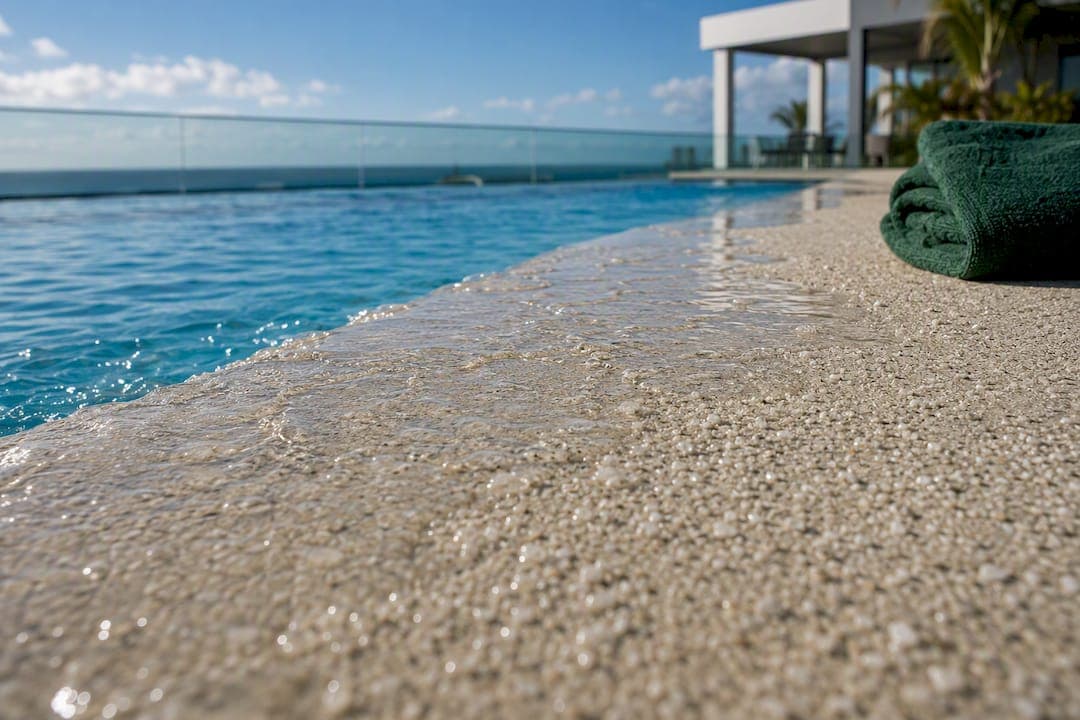
Porcelain pavers and dense, well-sealed travertine top the list for saltwater pool decks because their low porosity keeps salt out where it does the most damage. Capped composite and epoxy aggregate coatings run close behind as lower-maintenance options. Three factors decide the winner every time: porosity, slip resistance, and heat retention, plus whether drainage and sealing are handled correctly during installation.
TL;DR:
- Proper installation with correct slope and drainage is crucial to prevent water pooling and salt crystallization, which can damage even durable materials.
- Sealing porous stones with breathable, penetrating sealers and resealing every few years significantly extends deck lifespan by minimizing salt intrusion.
- Rubber paving systems offer effective drainage and cooler surfaces, making them a strong alternative for zones prone to pooling and high heat in saltwater environments.
- Material choice depends heavily on usage and climate; low-absorption pavers last longer but must be installed with proper drainage and sealing routines.
- Homeowners should prioritize detailed installation plans and maintenance schedules over material selection alone to ensure long-term saltwater resistance.
Table of Contents
- Best Saltwater Pool Deck Materials, at a Glance
- How Salt Actually Damages a Pool Deck
- Getting the Installation and Drainage Right
- Sealing and Maintenance That Actually Prevent Salt Damage
- Matching Material to Your Site and Budget
- When Rubber Paving Solves the Salt Problem Differently
- The Real Trade-Off Nobody Talks About Enough
- A Different Kind of Salt Resistance Worth Considering
- Sources
Best Saltwater Pool Deck Materials, at a Glance
Pick your starting point based on how you use the deck, not just how it looks in photos.
- Porcelain pavers: near-zero porosity, essentially immune to salt staining, and the lowest maintenance of any option on this list.
- Travertine: stays cool underfoot and reads as the natural-stone standard for pool decks, but only performs long-term if it's dense and sealed on schedule.
- HD/low-absorption concrete pavers: strong, budget-friendly, and design-flexible; needs a quality sealer to match porcelain's salt resistance.
- Capped composite or PVC decking: inert to salt exposure, minimal upkeep; stick to lighter colors to avoid turning the deck into a griddle.
- Epoxy or aggregate coatings: chemically impervious with slip-resistant texture built in, good for resurfacing worn concrete.
- Limestone and other soft natural stones: gorgeous, but they demand premium penetrating sealers and closer attention than travertine or porcelain.
Skip untreated sandstone, untreated wood, and any low-density natural stone near saltwater. Those materials soak up splash-out like a sponge and start pitting within a couple of seasons.
How Salt Actually Damages a Pool Deck
Salt doesn't dissolve concrete or eat through stone on contact. The damage comes from a slower, more mechanical process: water splashes onto the deck, evaporates in the Florida sun, and leaves salt crystals behind inside the material's pores. As those crystals form and expand repeatedly, they act like tiny wedges, pushing apart the surface from the inside. The Concrete Masonry and Hardscapes Association points out that this crystallization effect, not a direct chemical reaction, is what causes most pitting and surface breakdown around saltwater pools.
Porosity is the whole story. A material that absorbs less water simply has less room for salt to crystallize in.
That's why porcelain pavers, with their near-zero absorption, and HD concrete pavers rated below roughly 4% absorption, resist the crystallization cycle that eventually chews through cheaper, more porous surfaces, according to Techo-Bloc's guidance on concrete pavers near saltwater pools.
Here's the material rundown builders actually work with:
- Porcelain pavers: 25 to 50 year lifespan, minimal sealing needs, mid-to-high installed cost, ideal where low maintenance matters more than a natural-stone look.
- Travertine: 20 to 30 years when sealed on schedule, stays noticeably cooler than concrete or porcelain in direct sun, mid-to-high cost, best where barefoot comfort is the priority. Swimmer Living calls it close to the gold standard for cool, dense natural stone.
- HD/low-absorption concrete pavers: 20 to 30 years, moderate sealing schedule, lower to mid cost, strong choice when budget and design flexibility both matter.
- Capped composite/PVC: 25 to 30 years, virtually no sealing required, mid cost, best paired with light colors since dark composite can retain more heat than stone.
- Epoxy/aggregate coatings: 10 to 15 years before recoating, moderate maintenance, low-to-mid cost, useful for resurfacing tired concrete with built-in traction.
- Limestone: 15 to 25 years with diligent sealing, higher maintenance burden, mid cost, chosen mostly for its light, soft coloring.
Slip resistance and repairability separate these materials further. Textured porcelain and broom-finished or aggregate-coated concrete both grip wet feet well; polished travertine needs a honed or tumbled finish to do the same. Composite and PVC boards let you swap a single damaged plank; a cracked porcelain paver usually means pulling and replacing that one unit, while a chipped travertine tile often needs a color-matched patch. If barefoot comfort matters more than anything else, a cooler pool deck surface is worth prioritizing over raw hardness numbers.
Getting the Installation and Drainage Right
Even the best material fails early if water has nowhere to go. Decks need a slope of about 1/8 to 1/4 inch per foot directing splash-out away from the pool and toward a drain, according to Swimmer Living's installation guidance. That slope matters more than most homeowners realize: standing water that sits and evaporates in place is exactly what triggers the salt crystallization that wrecks porous decking. Trench or channel drains placed at low points, paired with tight polymeric jointing between pavers, keep salt water moving instead of pooling in the joints where it does the most harm.
Metal hardware near a saltwater pool corrodes fast unless it's rated for the environment. EagleClawCo recommends 316-grade marine stainless steel for any exposed fasteners, brackets, or hinges, since standard galvanized hardware pits and rusts within a couple of seasons of salt spray exposure. Before signing a contract, confirm these points with your installer:
- Slope direction and grade are marked on the site plan, not just described verbally.
- Drains sit at the actual low points, not just at the pool's edge.
- All exposed fasteners are specified as 316 stainless, not generic galvanized.
- Joint material is polymeric sand or a comparable product, not standard sand.
- The contractor can name the sealer they plan to use before installation begins.
Homeowners planning a full outdoor renovation should also look at broader drainage solutions for paved surfaces before finalizing a layout.
Pro Tip: Ask your installer to walk the site with a level and mark exactly where water will exit the deck. If they can't point to a specific drain location, the slope hasn't been planned, it's been guessed.
Sealing and Maintenance That Actually Prevent Salt Damage
Sealer type matters as much as sealer schedule. Techo-Bloc's research is blunt on this: use a penetrating, breathable sealer, never a film-forming coating, on porous stone or pavers near a saltwater pool. Film-forming products trap moisture underneath, and trapped moisture peels, bubbles, and eventually fails faster than no sealer at all.
- Reseal travertine roughly every 3 to 5 years, depending on foot traffic and sun exposure.
- Reseal concrete pavers on a schedule set by the specific sealer product, since formulations vary widely.
- Rinse salt deposits off any porous surface with fresh water weekly during peak pool season.
- Never use rock salt for ice or algae control on porous stone decking; it accelerates the exact crystallization process you're trying to prevent.
- If white efflorescence appears, treat it as cosmetic first: a stiff brush and fresh water usually clears it without professional intervention, since the CMHA notes it's typically surface deposit, not structural decay.
Matching Material to Your Site and Budget
Start with how the deck gets used, not how it looks in a catalog; see this travertine pool deck installation in Marana, AZ for a relevant example. A hot, sun-exposed deck where kids run barefoot points toward light-colored travertine or porcelain. A rental property or low-maintenance household points toward capped composite or porcelain. Freeze-thaw climates favor low-absorption concrete pavers installed with correct slope, since freeze cycles amplify whatever moisture the surface already holds.
Before hiring anyone, ask:
- What's the material's rated water absorption percentage?
- What sealer will be used, and how often does it need reapplication?
- Where exactly does splash-out drain to?
- What fastener grade will be used on any exposed metal?
- Can you show photos of a saltwater pool deck you installed at least three years ago?
Budget for the sealer and drainage work up front rather than treating them as add-ons. A cheaper material with proper drainage often outlasts an expensive one installed flat.
When Rubber Paving Solves the Salt Problem Differently
Ecotecrubber's Rubberway® system, built from recycled tire material, is inherently porous by design rather than by accident, which lets splash-out drain straight through instead of pooling and crystallizing. That drainage-first structure, combined with a surface that stays notably cooler than concrete or porcelain, addresses two of the three deciding factors in this guide directly. Licensed and insured installations focus on ADA-compliant, crack-resistant surfaces, making it a legitimate option for the high-traffic zones around a saltwater pool where standing water is the real enemy.

The Real Trade-Off Nobody Talks About Enough
Most guides treat this as a straight salt-resistance ranking, but that misses the point. Porcelain wins on paper because it barely absorbs anything, yet homeowners who install it in full Florida sun without checking surface temperature end up avoiding their own deck by 2 PM. The material that "wins" against salt isn't automatically the material that gets used.

The bigger gap in conventional advice is how little attention goes to the installer's execution versus the product spec sheet. A $12 per square foot paver installed with a sloppy 1/16 inch slope will crystallize and pit faster than a $6 per square foot paver installed correctly with real drainage. Homeowners fixate on material names, and contractors know it, which is exactly why so many quotes skip the drainage conversation entirely.
If you take one thing from this guide, prioritize the sealer conversation and the slope plan before you fall in love with a stone sample. Salt resistance on paper means nothing if the water never had anywhere to go in the first place.
— Roger
A Different Kind of Salt Resistance Worth Considering
Stone and porcelain solve salt resistance through density. Ecotecrubber solves it through drainage, letting water pass through the surface instead of sitting on top of it waiting to crystallize.
That distinction matters most in the exact zones this guide flagged as trouble spots: coping edges, splash zones, and anywhere water tends to pool before it evaporates. Rubberway® surfaces stay noticeably cooler underfoot than concrete or porcelain in direct sun, which solves the barefoot-comfort problem without asking you to trade away durability. Recycled-material construction and ADA-compliant surfacing round out a package built specifically for Florida's heat and salt exposure rather than adapted from a colder-climate product.
If your current deck plan is centered on stone or pavers alone, it's worth getting a second opinion on how Rubberway® would perform in your highest-traffic zones. Visit EcoTec Rubber Paving to request a site evaluation, or browse the Rubberway® product lineup to see color and texture options before your next installer meeting.
Sources
- Using pavers around saltwater pools: what you need to know - Concrete Masonry and Hardscapes Association
- Are concrete pavers safe around salt water pools | Techo-Bloc
- 6 Best pool deck systems for salt water pools to install - Swimmer Living
- The best materials for building a saltwater deck - EagleClawCo