

Permeable paving can help your HOA meet post-construction stormwater quantity and water-quality requirements when the system is designed to local standards, properly installed, and maintained on a documented schedule. The core mechanism is straightforward: rain infiltrates through the surface into an open-graded aggregate reservoir, where it is temporarily stored, filtered, and either absorbed into native soil or released slowly through an underdrain. That process directly addresses the two things most municipal stormwater programs care about most — how much water leaves your site and how clean it is when it does.
Permeable paving reduces runoff volume, lowers peak discharge rates, and can achieve up to 80% TSS removal when designed to treat a water-quality design storm — making it one of the few single-surface BMPs that addresses quantity and quality simultaneously.
Quick regulatory wins permeable paving can deliver for HOAs:
- Reduced total runoff volume, satisfying post-construction volume-reduction targets
- Lower peak discharge rate, meeting rate-control requirements in county manuals
- Pollutant filtration (TSS, metals, hydrocarbons) that maps to water-quality permit conditions
- Potential stormwater-fee credits from municipal programs that recognize on-site infiltration
- Urban heat island reduction and improved surface safety as co-benefits that support board buy-in
Table of Contents
- How does permeable paving help HOAs meet stormwater rules?
- How permeable paving reduces runoff and improves water quality
- How permeable paving maps to permit requirements and documentation
- What site conditions does your HOA need to check first?
- How do you keep permeable paving performing and compliant over time?
- What do permeable paving installations cost, and how can HOAs offset them?
- When permeable paving alone won't meet your compliance requirements
- Rubberway® porous rubber paving: an HOA-friendly option
- A step-by-step checklist for evaluating and approving a permeable paving project
- Key Takeaways
- Why boards should stop treating permeable paving as a compliance checkbox
- Ecotecrubber brings Rubberway® porous paving to Florida HOAs
- Useful sources for HOA stormwater research
How does permeable paving help HOAs meet stormwater rules?
Permeable pavement is any engineered surface that allows rain to pass through it vertically rather than sheet off horizontally. Traditional asphalt and concrete are essentially impervious — water hits the surface and runs off, carrying sediment, oil, fertilizer, and other pollutants directly into storm drains. Permeable systems flip that model by treating the pavement itself as a stormwater management feature.
The five system types your board will see in proposals:
- Porous asphalt: Open-graded mix with interconnected voids; good for parking lots and drive aisles; requires vacuum cleaning to prevent clogging
- Pervious concrete: Similar void structure in a concrete mix; higher upfront cost than asphalt but long service life; sensitive to freeze-thaw in northern climates
- Permeable interlocking concrete pavers (PICP): Precast units with aggregate-filled joints; individual units can be removed for sub-base repairs; well-suited to pedestrian plazas and low-speed parking courts
- Grid/grass pavers: Plastic or concrete cells filled with gravel or turf; best for overflow parking and low-frequency use areas; not ADA-compliant in most configurations
- Porous rubber (Rubberway®): Made from recycled tire material; porous by design; crack-resistant in heat; ADA-compliant; well-suited to pool decks, walkways, and community gathering areas in warm climates like Florida
For light pedestrian paths and pool surrounds, porous rubber or PICP are the most practical choices. Drive aisles and standard parking lots typically use porous asphalt or pervious concrete. Grid pavers work for grass overflow areas that see occasional vehicle traffic.
How permeable paving reduces runoff and improves water quality
The layered system
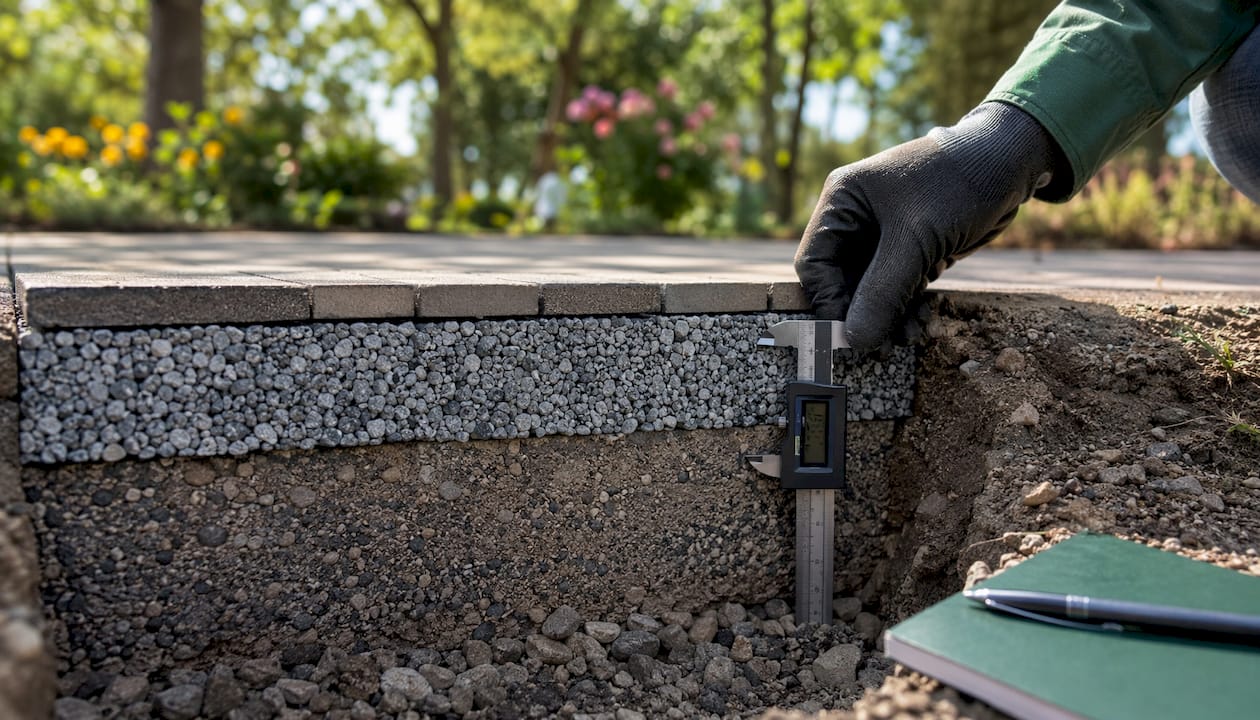
A permeable pavement system consists of three functional layers. The surface course — whether asphalt, concrete, pavers, or rubber — provides structural support while allowing water to pass through its void structure. Beneath it, an open-graded aggregate reservoir (typically with about 30% void space) temporarily stores water and slows its movement. At the base, an optional filter fabric separates the aggregate from native soil, and a perforated underdrain pipe handles overflow when native infiltration is too slow to drain the reservoir within the required timeframe.
Hydrologic functions
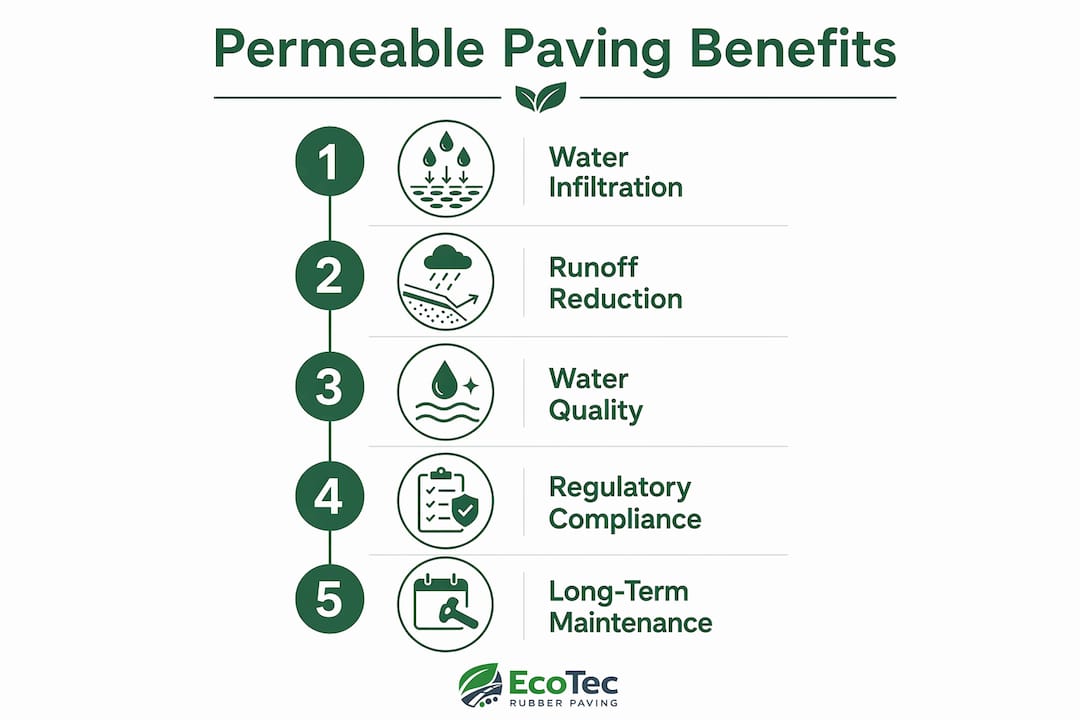
Three processes work together to reduce the stormwater burden on your community's infrastructure. Infiltration moves water directly into native soil, permanently removing it from the runoff stream and recharging groundwater. Temporary detention in the aggregate reservoir attenuates peak flow — water that would have hit the storm drain in 15 minutes instead drains over several hours. Filtration through the aggregate and soil removes suspended solids, heavy metals, and hydrocarbons as water percolates downward.
Performance metrics to demand in proposals
When a contractor submits a proposal, these are the numbers that matter for permit packages:
- Infiltration rate (in/hr): The surface should meet or exceed the design infiltration rate specified in your local manual; new installations often target 100–500 in/hr at the surface before any clogging occurs
- TSS removal: Systems designed to treat a water-quality design storm can achieve 80% TSS removal per some state BMP manuals; ask the designer to show which standard they are designing to
- Design storm: The storm event (e.g., 1-inch, 1.5-inch, or 90th-percentile storm) the system is sized to fully capture and treat
- Runoff volume reduction: The percentage of annual runoff volume the system is expected to eliminate through infiltration and evaporation
Studies have found that permeable pavements can retain up to 93% of suspended pollutant load — though that performance depends entirely on regular maintenance to prevent clogging.
How permeable paving maps to permit requirements and documentation
Most U.S. municipal stormwater programs impose three types of post-construction requirements: volume reduction, peak rate control, and water-quality treatment. Permeable pavement can address all three from a single surface, which is why county manuals increasingly list it as an accepted BMP. The Fairfax County Public Facilities Manual explicitly recognizes permeable pavement as a method to reduce peak rate and volume through detention storage and infiltration — a pattern you will find repeated in manuals across Virginia, New Jersey, Pennsylvania, and Florida.
For water-quality compliance, the key benchmark is TSS removal. When a system is designed to treat the local water-quality design storm volume, it can meet the 80% TSS removal threshold that several state manuals specify. That single metric often satisfies the water-quality condition on a land-disturbance permit.
Your permit submittal package should include:
- Engineered design drawings with cross-sections showing surface, aggregate, filter fabric, and underdrain layers
- Infiltration/percolation test results from the native soil at the proposed installation depth
- Hydrologic calculations showing volume reduction and peak rate attenuation for the design storm
- Water-quality analysis documenting expected TSS removal against the applicable standard
- Maintenance plan with inspection schedule, cleaning frequency, and responsible party
- As-built drawings and certification after installation is complete
The Metropolitan Area Planning Council (MAPC) permeable paving fact sheet is a useful reference for framing these submittals, particularly for communities in the Northeast. The U.S. EPA stormwater BMP guidance provides the national regulatory context that underpins most state and local programs.
Pro Tip: Ask your engineer to include a maintenance log template as an exhibit to the permit package. Reviewers notice it, and it signals that your HOA understands the long-term commitment — which can accelerate approvals.
What site conditions does your HOA need to check first?
Not every site is a good candidate. Before your board approves a permeable paving proposal, require a site suitability evaluation that addresses these factors:
- Soil infiltration rate: A field infiltration test (double-ring infiltrometer or similar) at the proposed installation depth is non-negotiable. Virginia Tech Extension guidance advises against permeable paving on steep slopes or where the seasonal high water table is close to the surface; a minimum 2-foot separation between the bottom of the aggregate reservoir and the seasonal high groundwater is a common design requirement
- Load requirements: Pedestrian walkways and pool surrounds need a much shallower aggregate base than a parking lot. Drive aisles serving delivery vehicles or garbage trucks require structural analysis — standard permeable pavement mixes may not carry heavy truck loads without reinforcement
- Slope: Most manuals cap permeable pavement at slopes of 5% or less; steeper grades cause water to run off laterally before it can infiltrate
- Contaminated soils or proximity to hotspots: Avoid permeable paving near fuel storage, underground utilities, or known soil contamination — infiltrating water can mobilize contaminants downward toward groundwater
- Overflow and underdrain routing: Every system needs a defined overflow path for storms that exceed the design event; confirm where that water goes and that it does not create a nuisance or liability for adjacent properties
- ADA compliance: Surface texture and firmness requirements under the Americans with Disabilities Act apply to any pedestrian surface; porous rubber and PICP generally meet these requirements; grid/grass pavers typically do not
Pro Tip: Budget for the infiltration test before you budget for the paving. A $500–$1,000 soil test can save your board from approving a $50,000 installation on a site where the water table makes full infiltration impossible.
How do you keep permeable paving performing and compliant over time?
Clogging is the primary failure mode for every permeable surface type. Sediment, leaf debris, mulch tracked from adjacent beds, and grass clippings gradually fill the surface voids, reducing infiltration capacity. The visible sign of failure is standing water that persists 24–48 hours after a rain event. Once you see that, the system is already underperforming against its permitted design.
A realistic maintenance schedule looks like this:
- Monthly visual inspection: Walk the surface after a significant rain. Note any areas of ponding, surface cracking, or debris accumulation. Log date, conditions, and observations
- Seasonal sweeping: Use a regenerative-air sweeper (not a brush sweeper, which pushes debris into voids) to remove loose surface debris in spring and fall
- Annual vacuum (vactor) cleaning: A vacuum truck extracts embedded sediment from the surface voids. This is the single most important maintenance task, and it requires a specialized contractor with the right equipment — budget for it in your annual operating expenses
- Post-storm inspection: After any storm exceeding the design event, inspect for surface damage, underdrain function, and overflow routing
- Permeability testing: Every 3–5 years, or whenever ponding is observed, conduct a field permeability test to verify the system is still meeting its design infiltration rate
Recordkeeping is not optional if you want to stay compliant. Your maintenance log should capture the date of each inspection or cleaning, the contractor or staff member who performed it, observations, and any corrective actions taken. That log is what an inspector or auditor will ask for first. Long-term paving maintenance pays dividends in avoided replacement costs and preserved permit standing.
When vacuum cleaning no longer restores infiltration, milling the top layer or replacing clogged sections may be necessary. Specify rejuvenation options in your original contract so you know the cost before you need it.

What do permeable paving installations cost, and how can HOAs offset them?
Permeable paving costs more upfront than traditional asphalt. Porous asphalt typically runs at a modest premium over conventional asphalt; pervious concrete and permeable interlocking pavers carry higher material and labor costs. Porous rubber systems like Rubberway® sit in a mid-to-upper range for installation but offer long service life and minimal crack maintenance in warm climates, which matters for Florida HOAs.
The lifecycle picture is more favorable than the upfront number suggests. Permeable systems reduce or eliminate the need for traditional storm sewer infrastructure, curbing, and inlet structures. Over a 20–30 year horizon, those avoided costs can offset a significant portion of the installation premium.
Funding and cost-offset options worth investigating:
- Municipal stormwater-fee credits: Many utilities offer annual credits to properties that manage runoff on-site. The Minnesota Pollution Control Agency notes that municipal programs often provide stormwater-fee credits or recognition for on-site infiltration — check your local utility's credit program before finalizing the budget
- State and local grants: Several states offer green infrastructure grants through their environmental agencies; Florida's water management districts periodically fund stormwater retrofits
- HOA reserve study integration: Treat permeable paving as a capital asset with a defined useful life and replacement cost. Including it in your reserve study prevents the deferred-maintenance trap that kills long-term performance
- Special assessment or phased installation: Large parking lots can be converted in phases, spreading capital cost across multiple budget years
Boards that treat permeable paving as a long-term asset strategy — rather than a one-time compliance expense — consistently report better outcomes in both cost management and regulatory standing.
When permeable paving alone won't meet your compliance requirements
Permeable paving is not a universal solution. Several site conditions can limit its effectiveness or make it inappropriate as the sole BMP:
- High seasonal water table: Less than 2 feet of separation between the aggregate base and seasonal high groundwater limits infiltration and risks saturating the sub-base
- Contaminated soils: Infiltrating water through contaminated ground can mobilize pollutants; a liner-and-underdrain design may be required, which changes the cost and permit picture
- Heavy truck traffic: Standard permeable mixes are not designed for frequent heavy truck loading; structural failure can occur, and replacement is expensive
- Very fine silty or clay soils: Native infiltration rates below roughly 0.01 in/hr make full infiltration impractical; the system functions only as detention, not volume reduction
- Steep slopes (above 5%): Water runs off laterally before infiltrating; the surface provides little stormwater benefit
When your site has one or more of these constraints, permeable paving works best as part of a combined stormwater strategy. Bioswales, rain gardens, and offline detention basins complement permeable surfaces by handling overflow, treating additional runoff from adjacent impervious areas, and providing redundancy when the pavement needs maintenance. Stormwater managers consistently recommend integrating permeable pavement with native landscaping and bioswales to create a multilayered defense against flooding.
Quick suitability check before you proceed:
- Seasonal high water table more than 2 feet below proposed base? ✓ Proceed
- Native soil infiltration rate above 0.01 in/hr? ✓ Proceed
- No known soil contamination within the drainage footprint? ✓ Proceed
- Traffic loading limited to passenger vehicles and light trucks? ✓ Proceed
- Site slope below 5%? ✓ Proceed
Any "no" answer means you need an engineer to evaluate whether a modified design (underdrain, liner, reinforced mix) or a complementary BMP is required before the system will meet your permit conditions.
Rubberway® porous rubber paving: an HOA-friendly option
Rubberway® is a porous rubber paving system made from recycled tire material, installed by Ecotecrubber across Florida for HOA communities, municipalities, and commercial properties. For boards evaluating sustainable paving solutions for walkways, pool decks, and community gathering areas, it offers a specific set of attributes worth understanding.
Material attributes relevant to HOA stormwater compliance:
- Porosity: The recycled rubber matrix allows water to pass through, contributing to on-site infiltration and reducing surface runoff
- Recycled content: Made from post-consumer tire material, which supports sustainability goals and can contribute to green building credits
- ADA compliance: The surface meets firmness and stability requirements for accessible pedestrian routes
- Crack resistance: Unlike concrete or asphalt, rubber does not crack under Florida's heat cycles, eliminating the surface failures that compromise drainage performance over time
- Color options: Available in a range of colors, which matters for HOA aesthetic standards and ACC approval
When reviewing a Rubberway® proposal, ask for:
- Sub-base preparation specifications and aggregate reservoir depth for the intended use
- Edge detail drawings showing how the rubber surface transitions to adjacent paving or landscaping
- Integration details for underdrains or overflow routes if the site requires them
- ADA surfacing compliance documentation
- Installer licensing and insurance certificates
- Product warranty terms and what they cover (surface delamination, infiltration performance, color stability)
- Post-install maintenance support and cleaning guidance
Ecotecrubber is licensed and insured, and its installations are focused exclusively on rubber paving — meaning the team you hire has done this specific system repeatedly, not as a side offering alongside conventional paving.
A step-by-step checklist for evaluating and approving a permeable paving project
- Conduct a site feasibility assessment: Commission an infiltration test, confirm seasonal high groundwater depth, map slopes, and identify any contamination or utility conflicts
- Define the regulatory requirement: Pull your local stormwater manual or contact your county stormwater program to confirm which quantity, rate, and water-quality standards apply to your project
- Develop a preliminary budget: Include installation, sub-base work, any underdrain infrastructure, annual maintenance (vacuum cleaning), and a reserve contribution for eventual rejuvenation or replacement
- Issue a request for proposals: Require bidders to specify system type, aggregate depth, infiltration rate at installation, TSS removal basis, maintenance plan, warranty terms, and installer credentials
- Verify contractor qualifications: Ask for references from HOA projects specifically, confirm licensing and insurance, and request documentation of prior permeable paving installations
- Review the engineering package: Confirm the design includes infiltration test results, hydrologic calculations, cross-section drawings, and a maintenance schedule before signing
- Secure ACC and board approval: Tie the proposal to HOA goals — reduced flooding incidents, stormwater-fee credits, improved curb appeal — and include maintenance budget language in the motion
- Oversee installation and document as-builts: Require the contractor to provide as-built drawings and a signed certification that installation matches the permitted design
- Establish the maintenance log: Start the log on day one; record the installation date, contractor, warranty start, and first inspection date
- Schedule the first annual vacuum cleaning: Put it on the calendar before the installation crew leaves the site
For contractor questions, ask specifically: What is your experience with HOA permeable paving projects? Can you provide a maintenance plan with cleaning frequencies and estimated annual cost? What does the warranty cover, and who handles warranty claims? What infiltration rate will you certify at installation?
The permit and documentation pack should include: infiltration test report, engineered drawings with cross-sections, hydrologic calculations, maintenance schedule, maintenance log template, and as-built drawings. Sustainable paving installation best practices provide additional procurement guidance for boards working through this process for the first time.
Key Takeaways
Permeable paving addresses HOA stormwater compliance most effectively when it is designed to local standards, maintained on a documented schedule, and treated as a long-term capital asset rather than a one-time infrastructure expense.
| Point | Details |
|---|---|
| TSS removal potential | Systems designed to treat the water-quality design storm can achieve 80% TSS removal per state BMP manuals. |
| Maintenance is non-negotiable | Annual vacuum (vactor) cleaning prevents clogging; standing water 24–48 hours after rain signals system failure. |
| Site suitability first | Require an infiltration test and groundwater depth check before approving any permeable paving proposal. |
| Funding options exist | Municipal stormwater-fee credits, state grants, and reserve study integration can offset the higher upfront cost. |
| Ecotecrubber's Rubberway® | A porous, ADA-compliant, crack-resistant option for HOA walkways, pool decks, and community areas in Florida. |
Why boards should stop treating permeable paving as a compliance checkbox
The conventional framing around permeable paving in HOA settings is almost always wrong. Boards hear "stormwater compliance" and immediately think cost center — something the county is making them do. That framing leads to the worst possible outcome: a system installed to minimum spec, with no maintenance budget, that fails within five years and has to be replaced at full cost.
The smarter frame is liability reduction and asset protection. An HOA that cannot manage its stormwater runoff faces real exposure: complaints from downstream neighbors, regulatory notices of violation, and in some cases civil liability for flood damage to adjacent properties. A properly designed and maintained permeable surface eliminates most of that exposure at a cost that is genuinely manageable when it is built into the reserve study from day one.
What boards consistently underestimate is how much the maintenance budget matters relative to the installation budget. A $40,000 permeable parking court that gets annual vacuum cleaning for $1,500 a year will outperform a $50,000 installation that never gets cleaned. The surface is only as good as the maintenance program behind it. Choose an installer who will give you a written maintenance plan, not just a warranty card, and build the annual cleaning cost into your operating budget before the first board vote.
Ecotecrubber brings Rubberway® porous paving to Florida HOAs
Florida HOAs face a specific challenge: intense rainfall, high heat, and surfaces that crack under UV exposure before they ever clog. Ecotecrubber's Rubberway® installations are built for exactly that environment — porous rubber made from recycled tire material that drains fast, stays flexible in the heat, and meets ADA requirements without the cracking and resurfacing cycle that plagues conventional paving.
For HOA communities, Ecotecrubber handles the full scope: site evaluation coordination, sub-base specification, certified installation, and post-install maintenance guidance. The work covers driveways, parking courts, pool decks, walkways, and community gathering areas across Florida. Every project comes with licensing, insurance, and a product warranty — the documentation your board needs for permit packages and reserve studies.
If your community is evaluating permeable paving for stormwater compliance or a surface upgrade, request a site evaluation from Ecotecrubber to get a proposal built around your site's specific conditions. For product details on the Rubberway® system, the Rubberway product page covers material specifications, color options, and installation capabilities.
Useful sources for HOA stormwater research
These references belong in your permit package and your board's research file:
- U.S. EPA Permeable Pavements BMP Document: The national regulatory foundation for permeable pavement design and performance claims; use it to verify that a contractor's design assumptions align with federal BMP guidance
- Fairfax County Public Facilities Manual (PFM): A detailed example of how a county manual specifies permeable pavement as an accepted BMP for peak rate and volume control; useful as a benchmark even if your HOA is not in Fairfax County
- MAPC Permeable Paving Fact Sheet: The Metropolitan Area Planning Council's guidance covers design layers, maintenance requirements, and cost considerations for communities in the Northeast
- New Jersey Stormwater BMP Manual — Permeable Pavement: One of the most detailed state-level specifications for TSS removal targets and design storm sizing; useful for understanding how water-quality compliance is calculated
- Virginia Tech Extension — Permeable Paving Fact Sheet (SPES-610): Practical guidance on layer profiles, site suitability, and maintenance; written for property managers and local governments, not engineers
- FHWA Tech Brief: Use of Permeable Pavements: Federal Highway Administration overview of system types, structural considerations, and stormwater performance; authoritative for boards that want to understand the full technical picture
- Alabama Cooperative Extension — HOAs and Water Quality: Practical framing for HOA boards on treating stormwater management as a community asset-protection strategy
This article provides general informational guidance on permeable paving and stormwater management. It is not a substitute for professional engineering advice or legal counsel. Confirm applicable stormwater requirements and design standards with your local authority having jurisdiction and a licensed engineer before proceeding with any installation.