
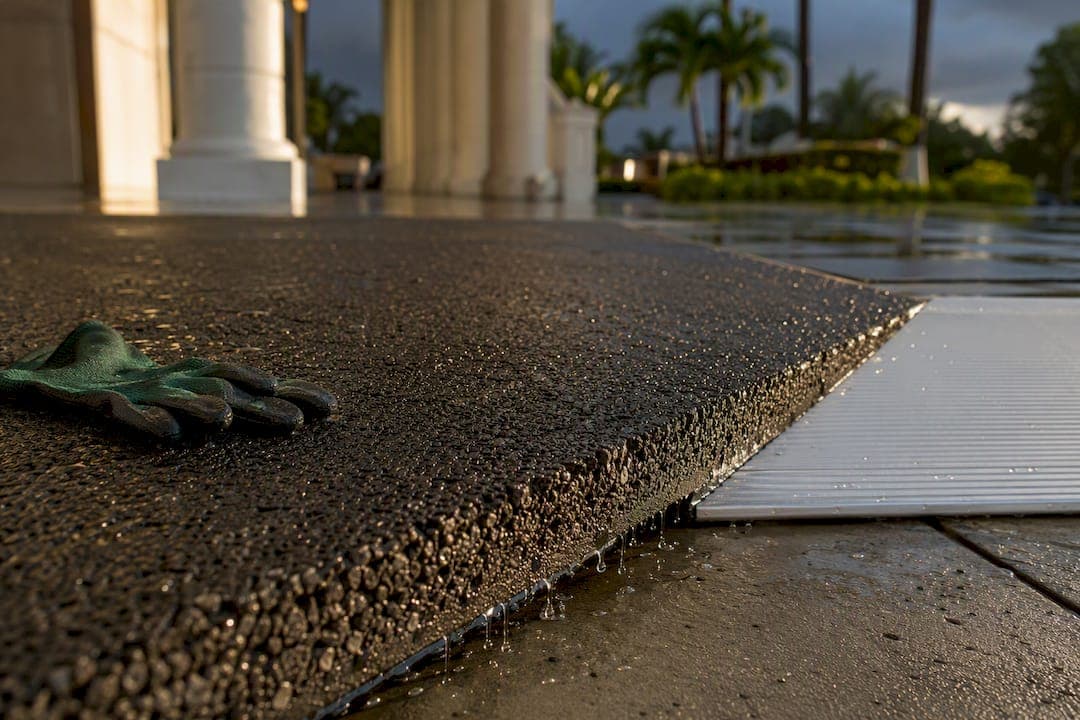
For most outdoor ramps, choose textured aluminum for modular or portable installs, or porous rubber paving for permanent, weather-exposed landings. Both combine slip resistance, real drainage, and low maintenance. Concrete, composite, or wood can work in narrower situations, but every choice still has to clear the ADA's 1:12 maximum slope rule.
TL;DR:
- Aluminum is ideal for portable ramps due to its corrosion resistance, lightweight design, and typical load capacity of around 1,000 pounds per section.
- Porous rubber paving provides seamless drainage, shock absorption, and durability against weather, making it suitable for permanent outdoor landings and ramp runs.
- Open-mesh decking drains water efficiently but may trap debris or pose a hazard for narrow wheelchair casters, so solid textured surfaces are often recommended for consistent traction.
- Regular inspections twice a year, especially before winter, are essential to assess surface wear, fastener security, drainage, and coating integrity.
- Material choice must consider climate exposure, load needs, and maintenance costs, with aluminum and rubber offering the best long-term safety performance.
Table of Contents
- What Makes an Outdoor Wheelchair Ramp Surface Safe?
- Which Ramp Material Performs Best Outdoors?
- What Surface Textures Actually Improve Traction in the Rain?
- How Does ADA Compliance Shape Ramp Surface Choices?
- How Often Should You Inspect an Outdoor Wheelchair Ramp?
- How Do You Choose the Right Ramp Surface for Your Site?
- How Does Rubberway® Address Weather and ADA Requirements?
- What's the Bottom Line on Choosing a Ramp Surface?
- How Do Ramp Surfaces Handle Rain, Ice, and UV Over Time?
- An Editorial Take on What Actually Matters Here
- Get a Weather-Ready Ramp Surface Installed the Right Way
- Sources
What Makes an Outdoor Wheelchair Ramp Surface Safe?
Traction and drainage decide whether a ramp is safe or a liability. A surface that grips well when dry but sheets water when wet isn't a safe surface, it's a half-solution. Ribbed treads, grated decking, and textured coatings work because they displace water and multiply the contact points between wheels or feet and the ramp itself.
Drainage failures compound the danger. A ramp that pools water on a landing turns a manageable slope into an ice rink the moment temperatures drop, and pooling at the base of a run creates exactly the kind of standing water that undermines footing for cane users and wheelchair casters alike. Slope interacts with all of this: a ramp built close to the ADA's recommended maximum incline gives water less time to run off, so drainage design matters more, not less, as slope increases.
Material lifecycle behavior is the quiet safety factor most people miss:
- Untreated steel rusts, and rust pits change surface texture unpredictably over time.
- Wood swells, cracks, and splinters through repeated freeze-thaw cycles.
- Concrete can develop a slick laitance layer if it wasn't finished with an anti-slip broom or additive.
- UV exposure breaks down adhesives and coatings faster than most owners expect.
Slip-resistant treatments wear down with exposure and traffic, which is why ramp surfaces need seasonal checks, not a one-time inspection at installation.
Which Ramp Material Performs Best Outdoors?
Every wheelchair ramp material trades off differently between cost, load capacity, and how it behaves after five years of sun, rain, and freeze-thaw cycles. Here's how the six most common options actually stack up.
Aluminum is the closest thing the ramp industry has to a default answer, and for good reason. It doesn't rust, rot, or attract termites, and most modular systems come with built-in tread patterns baked into the panel rather than applied as an afterthought. ADA guidance treats aluminum favorably for modular ramps precisely because of its corrosion resistance and light weight, which also makes it the practical choice for portable or temporary installs that need to move between sites. The tradeoff is load capacity. Typical modular aluminum sections handle roughly 1,000 pounds per section, which covers virtually every residential and most commercial use, but it isn't the material for heavy institutional foot traffic or equipment loads.
Porous rubber paving is the strongest option for permanent, weather-exposed landings and ramp runs. The open-cell structure that gives it drainage also gives it shock absorption, which matters on a surface that gets rolled over daily by hard plastic and rubber wheelchair wheels. Porous rubber and composite decking hold up well in extreme weather because the material resists the cracking that plagues concrete and the rot that plagues wood. It's a poured, seamless surface, so there are no seams or fasteners for water to exploit over time.
Composite decking splits the difference between wood's look and aluminum's durability. It resists rot far better than real lumber, and most composite boards include some texture molded into the surface. Slip resistance is moderate rather than excellent, and it needs periodic cleaning to prevent algae buildup on shaded runs. Maintenance sits in the middle of the pack, better than wood, not as hands-off as aluminum or rubber.
Concrete is the material people default to because it feels permanent, and it is. Properly poured concrete can support extremely heavy loads, well over 20,000 pounds for a standard slab, which is why it dominates institutional and municipal ramp construction. The catch is finish quality. Smooth-troweled concrete can become very slick when wet, so any outdoor concrete ramp needs a broom finish, exposed aggregate, or a textured coating applied at pour time, not bolted on afterward. Once it's poured wrong, fixing the texture means resurfacing.
Wood has the lowest upfront cost of any material on this list, and that's the entire case for it. Everything else works against it outdoors. Lumber swells and contracts with moisture, splinters as it ages, and needs annual sealing just to slow the decline. Recommend wood only for covered, dry locations or genuinely short-term installs, a rental property staging a ramp for a few months, for instance. Anywhere it faces direct rain and sun for years, it becomes a maintenance project with a ramp attached.
Steel offers the highest load capacity of any common ramp material, over 10,000 pounds in typical configurations, which is why it shows up in industrial and some municipal settings. But raw steel rusts fast, and rust changes surface texture in ways that create sudden slip hazards rather than gradual wear. Steel ramps only make sense with heavy-duty coatings maintained on a strict schedule, which pushes up lifetime cost. It's a niche pick for specific institutional loads, not a general recommendation.
What Surface Textures Actually Improve Traction in the Rain?
The texture pattern matters as much as the material underneath it. Ribbed, transverse treads channel water sideways off the ramp path instead of letting it collect under wheels. Grated or perforated decking goes further, letting water and even light ice pass straight through the surface instead of sitting on top of it. Porous rubber does the same job through its cell structure rather than through visible gaps.
There's a real tradeoff between the two main approaches. Open-mesh or grated surfaces drain best, full stop, but open or perforated decking isn't ideal for every wheelchair tire; narrow casters and small power-wheelchair wheels can catch on wide grate openings, and gaps invite debris. Solid textured surfaces, like porous rubber or a broom-finished concrete, give a more consistent rolling surface for power wheelchairs while still shedding water through the material itself or a slight crown in the grade.
Skip the adhesive fix. Anti-slip tape and grip strips look like an easy retrofit, but outdoors they fail fast: UV exposure and temperature swings lift the edges, and a lifted strip edge is its own trip hazard, often worse than the bare surface it was meant to fix. Integrated tread, poured texture, or a permanent coating system holds up far longer than anything applied with adhesive.
- Ribbed or transverse treads: good all-around drainage, works with most tire types
- Grated or open-mesh decking: best drainage, but check gap width against your wheelchair's casters
- Porous rubber paving: drainage through material structure, consistent rolling surface
- Textured broom-finish concrete: solid and consistent, needs correct finish at pour time
- Adhesive tape or strips: avoid for permanent outdoor use
Pro Tip: If a supplier's slip-resistance claim leans entirely on an add-on tape or coating rather than the base material's texture, ask how it performs after two winters. That answer tells you more than the spec sheet does.
How Does ADA Compliance Shape Ramp Surface Choices?
Slope is the first filter, and it rules out more surface options than people expect. The ADA caps ramp slope at a maximum of 1:12, meaning one inch of rise for every twelve inches of run, though many designers push for 1:15 where site space allows, since the gentler grade slows water runoff and reduces rolling effort. Clear width needs to stay at a minimum of 36 inches along the run.

Landings do more than break up a long ramp They also change the drainage math. A flat landing at the top or bottom of a run collects more standing water than the sloped sections around it, so landing surfaces need texture and drainage that match or exceed the ramp run itself, not a lesser finish because it's "just a landing." Landings at direction changes also need cross-directional traction, since wheelchairs pivot there rather than rolling straight through.
For inspections, keep records that show the ramp meets slope and width minimums, and document the surface's slip-resistance rating if the manufacturer provides one. Photograph drainage performance during or right after rain when possible; it's the single most convincing piece of documentation for both ADA reviews and insurance purposes. Architects coordinating rubber paving installs often build this documentation into the project handoff rather than treating it as an afterthought, and a detailed breakdown of the 1:12 slope rule is worth reviewing before finalizing any ramp design.
- Maximum slope is generally 1:12, with gentler slopes preferred where space permits
- Minimum clear width is generally about 36 inches
- Landings need equal or better traction and drainage than the ramp run
- Keep dated photos and slip-rating documentation for inspections
How Often Should You Inspect an Outdoor Wheelchair Ramp?
Twice a year is the baseline, and it isn't arbitrary. Ramps should be inspected before winter and again in early spring, which brackets the season that does the most damage to texture, fasteners, and coatings. Skipping this costs more later than it saves now.
- Check surface texture first. Run a hand or shoe across the ramp looking for smoothed-down spots where treatments have worn thin, especially at the most-traveled center path.
- Inspect fasteners and seams. Loose bolts, lifted panel edges, or gaps at transitions are where water gets underneath a surface and does hidden damage.
- Test drainage after rain. Standing water anywhere on the ramp or landing means the slope or drainage design needs correcting, not just monitoring.
- Assess coating integrity. Faded, chalky, or peeling coatings have stopped protecting the material underneath and need recoating before winter, not after.
Winter care depends heavily on material. Use plastic shovels, not metal ones, since metal edges gouge textured coatings and rubber surfaces alike. Avoid rock salt on aluminum ramps, it accelerates pitting on the surface even though aluminum resists rust in normal conditions; sand or a calcium-based ice melt rated for the material is the safer call for temporary traction.
Recoating on schedule, rather than waiting for visible failure, is where total cost of ownership actually gets decided. A wood ramp deferred on sealing for even one season often needs board replacement within a few years, while aluminum and rubber surfaces maintained on schedule rarely need more than periodic cleaning and the occasional recoat.

How Do You Choose the Right Ramp Surface for Your Site?
Picking a surface gets a lot simpler when you work through it in order instead of starting with a material you've already heard of.
- Assess your climate and site exposure. A shaded, snow-prone Northern site has different priorities than a sun-baked, wet Southern one. Note how much direct rain and sun the ramp actually gets, not just the regional climate in general.
- Decide permanence and load needs. A portable ramp for occasional access calls for aluminum's light weight and quick setup. A permanent landing serving daily foot and wheelchair traffic calls for a poured, seamless surface like rubber or properly finished concrete.
- Match safety features to the site. Once you know the climate and load, ask suppliers directly about their traction method and drainage design, not just a general "slip-resistant" claim.
- Get a written maintenance plan. Any installer worth hiring can tell you upfront what inspection and recoating schedule the surface needs, and put it in writing before the contract is signed.
Run through these before comparing quotes:
- What is the documented slip-resistance rating or method, and is it built into the material or applied afterward?
- How does the surface handle standing water during heavy rain?
- What is the realistic 5 to 10 year maintenance cost, not just the installed price?
- Does the surface meet the 1:12 slope maximum and 36 inch clear width for your specific layout?
How Does Rubberway® Address Weather and ADA Requirements?
Rubberway®, Ecotecrubber's rubber paving system, is built from recycled tire material formed into a porous, seamless surface designed specifically for outdoor exposure. The open-cell structure lets water pass through rather than pool on top, which addresses the standing-water problem that undermines so many outdoor ramps. That same porosity gives the surface some shock absorption underfoot and under wheel, and it resists the cracking that heat and freeze-thaw cycles cause in traditional concrete.
The material comes in a range of colors, so a ramp or landing can match a building's design rather than looking like a bolted-on accessibility fix. The surface is installed by licensed and insured contractors, coordinating projects that are ADA-compliant by design, including slope verification during installation rather than as a guess after the fact. For homeowners weighing pool decks and patios alongside a ramp, or for municipalities specifying ADA-compliant rubber paving across a park or trail system, the same porous, crack-resistant material applies across both use cases.
What's the Bottom Line on Choosing a Ramp Surface?
Match the material to the situation rather than chasing a single "best" answer. Aluminum wins for modular or portable ramps that need to move or install fast. Porous rubber paving wins for permanent, weather-exposed landings where drainage and shock absorption matter most. Concrete and composite still earn their place for heavy institutional traffic where load capacity outweighs everything else.
Before signing with any supplier, demand answers on three things:
- Traction method: built into the material, or an add-on coating that will wear off?
- Drainage plan: how does water actually leave the surface during a downpour?
- Maintenance plan: what's the inspection schedule, and what does recoating or replacement cost over 5 to 10 years?
A supplier who can't answer all three clearly probably hasn't thought through the ramp's outdoor performance, only its installation.
How Do Ramp Surfaces Handle Rain, Ice, and UV Over Time?
Rain exposes drainage flaws almost immediately, but ice and UV are slower, quieter problems that show up over seasons rather than in a single storm. Freeze-thaw cycling is the one that catches people off guard. Water that seeps into a hairline crack in concrete expands as it freezes, widens the crack, and repeats the process every cold snap until a small flaw becomes a structural one. Porous rubber and composite materials largely sidestep this because they don't hold water inside the material the way concrete's pore structure can.
UV degradation works differently but ends at a similar place: brittleness. Wood grays and splinters under sustained sun exposure. Coatings and adhesives, including the anti-slip tapes mentioned earlier, lose flexibility and adhesion under UV over a year or two, which is exactly why raised edges become trip hazards on ramps that relied on taped-on fixes rather than integrated texture.
Edge and curb design deserves specific attention here too. Wheel guards and raised curbs that look protective can actually trap debris and ice at the ramp's edge if they aren't designed with drainage gaps of their own. A well-designed edge sheds water outward instead of collecting it, which matters just as much as the main ramp surface during a hard freeze. Materials that resist rust and pitting, like aluminum and coated rubber systems, hold their edge geometry longer than steel or untreated wood exposed to the same freeze-thaw cycles.
An Editorial Take on What Actually Matters Here
Most ramp guides treat material choice like picking a paint color, a matter of preference dressed up as a technical decision. It isn't. The research keeps pointing to the same two winners for outdoor use, aluminum and porous rubber, because they're the only common materials that solve drainage and traction at the same time without demanding constant upkeep.
The industry's blind spot is treating slip resistance as a coating problem instead of a material problem. Anti-slip tape sales exist because tape is cheap and fast to apply, not because it works long term. It doesn't. Integrated texture, whether that's aluminum's stamped tread or rubber's porous structure, outperforms anything glued on within a single season of real weather.
If you take one thing from this: stop asking "what's the cheapest surface" and start asking "what does this cost over ten years, including every recoat and repair." That question alone eliminates most of the bad choices before a contractor ever shows up.
— Roger
Get a Weather-Ready Ramp Surface Installed the Right Way
Aluminum kits and DIY composite decking get you partway there, but neither solves standing water the way a properly poured, porous surface does. Ecotecrubber installs Rubberway® rubber paving specifically for the drainage and heat challenges that make Florida ramps and landings fail early, using recycled material that resists cracking instead of a surface you'll be resealing every spring.
That matters most on landings and permanent runs, exactly the spots where this article recommends porous rubber over aluminum or wood. The project is handled by licensed, insured contractors coordinating the whole installation around ADA slope and drainage requirements, not retrofitting an existing slab after the fact. For specialty textured or resin-bound finishes, suppliers like Expleco's aggregate materials also factor into some decorative surface options worth discussing with your contractor.
If you're planning a residential ramp, a pool deck transition, or a municipal walkway that needs to survive a Florida summer without cracking, request a quote through Ecotecrubber or browse the Rubberway® product options to see which finish and color fit your project.
Sources
- How weather affects outdoor wheelchair ramp safety
- What Is The Best Material For A Wheelchair Ramp?
- Outdoor anti-slip ramp covering
- Best ADA ramp material - pros and cons