

Use PROWAG for public right-of-way pedestrian facilities. Use the 2010 ADA Standards for buildings, facilities, and most site elements. PROWAG, published by the U.S. Access Board, fills gaps the 2010 ADA Standards never addressed: sidewalks, crosswalks, curb ramps, pedestrian signals, and on-street parking. The Department of Justice and Department of Transportation govern which entities must comply and when.
Three things to do right now:
- Treat PROWAG as best practice on every new sidewalk, curb ramp, or crossing project, regardless of formal adoption status in your jurisdiction.
- Check current DOJ/DOT rulemaking status before citing PROWAG as an enforceable requirement in a permit condition.
- When a project element could fall under either standard, apply whichever technical requirement is more stringent.
Key Takeaways
PROWAG governs public right-of-way pedestrian facilities while the 2010 ADA Standards govern buildings and sites, and applying the more stringent requirement wherever they overlap keeps projects defensible.
| Point | Details |
|---|---|
| Scope split | PROWAG covers sidewalks, curb ramps, and crossings; the 2010 ADA Standards cover buildings and site elements. |
| PAR width difference | PROWAG requires a 48-inch minimum route, wider than the 36-inch site-based standard. |
| Enforceability status | PROWAG functions as best practice now, with DOT adoption underway through federal rulemaking. |
| Design margin matters | Design slopes and widths below the maximum to survive construction tolerances and inspection. |
| Material choice supports compliance | EcoTec's Rubberway® rubber paving delivers ADA-compliant, drainage-friendly surfaces built for Florida conditions. |
Table of Contents
- PROWAG vs the 2010 ADA Standards: What Each One Covers
- How Do the Technical Requirements Actually Differ?
- Is PROWAG Legally Enforceable Yet?
- When Should You Apply PROWAG on an Active Project?
- What Mistakes Show Up Most in Right-of-Way Projects?
- A Practitioner Checklist for PROWAG-Compliant Projects
- Frequently Asked Questions
- Sources
PROWAG vs the 2010 ADA Standards: What Each One Covers
The two documents split the built environment cleanly, at least on paper. PROWAG governs the public right-of-way: sidewalks, crosswalks, curb ramps, pedestrian signals, on-street parking, shared-use paths, and transit stops. The 2010 ADA Standards were written for buildings, facilities, and the site elements tied to them, mostly on private property; though many government-owned buildings fall under the same rules through Title II.
Real projects rarely respect that clean split. A sidewalk that runs along a municipal parking garage, or a plaza that blends a building entrance with a public street corner, can trigger both documents at once. When that happens, a few rules keep you out of trouble:
- If an element is specifically addressed by one document (a curb ramp, for instance, is squarely PROWAG territory), apply that document first.
- Where scope genuinely overlaps, apply the more stringent technical requirement, not the more convenient one.
- Document your reasoning in the project file. Reviewers and inspectors will ask why you picked one standard over the other, and "it was easier" is not an answer that survives an audit.
How Do the Technical Requirements Actually Differ?
This is where the two documents stop being philosophically different and start being numerically different, and where most compliance failures actually happen. A few dimensions matter more than the rest.
PROWAG requires a 48-inch minimum Pedestrian Access Route, wider than the 36-inch accessible route typical of site-based ADA design. That extra 12 inches changes drainage slopes, curb ramp flare geometry, and how much room you have for street furniture and signage. PROWAG also permits the pedestrian route to match roadway running slope in constrained right-of-way contexts, and it allows cross-slopes up to 5% at certain uncontrolled crossings, a tolerance driven by real road geometry rather than an arbitrary limit.

| Dimension | 2010 ADA Standards | PROWAG |
|---|---|---|
| Scope | Buildings, facilities, site elements | Sidewalks, crosswalks, curb ramps, signals, parking |
| Minimum route width | 36 inches typical | 48 inches minimum |
| Cross slope at crossings | Generally 2% max | Up to 5% in some uncontrolled contexts |
| Detectable warnings | Site-based application | Required at street/rail crossings and unprotected transit stops |
| Enforceability | Fully enforceable federal standard | Best practice; adoption underway |
A few checks belong on every plan review before it leaves your desk:
- Confirm PAR width holds at 48 inches through the entire pedestrian route, not just at the curb ramp.
- Verify detectable warning placement at every street, rail, and unprotected transit crossing along the route.
- Check that cross-slope tolerances at crossings stay within PROWAG's allowances, not the tighter site-based figures.
Pro Tip: Design to slopes and widths comfortably below the maximum allowed values. Field tolerances during concrete placement routinely eat up a percentage point or two of slope, and a ramp designed exactly to the 8.33% maximum has zero room for error before it fails inspection.
Is PROWAG Legally Enforceable Yet?
Not universally, but the gap is closing fast. The Access Board finalized PROWAG as guidance, and DOT has since moved to adopt it into enforceable regulations for Title II entities. A December 2024 Federal Register entry documents DOT's rulemaking on adopting accessibility standards for pedestrian facilities in the public right-of-way, a milestone worth citing directly in any staff memo or council briefing.
Until full adoption lands in your jurisdiction's specific regulatory framework, PROWAG functions as the state-of-practice guidance that FHWA recommends whenever the ADA standards go quiet on street-level pedestrian design.
The enforcement picture right now:
- Federal agencies and GSA-managed projects are moving toward PROWAG-level compliance ahead of full mandatory adoption.
- Municipalities that adopt PROWAG early avoid the retrofit costs of designing to an outdated standard and then rebuilding, a point the Access Board itself has flagged as a real cost driver.
- Contractors should expect PROWAG-level specs to appear in municipal bid documents well before the rule is formally binding everywhere.
When Should You Apply PROWAG on an Active Project?
The decision tree is simpler than most agencies make it. New pedestrian facilities in the right-of-way get PROWAG, full stop. Alterations that change the pedestrian experience trigger it too. Routine maintenance generally does not, unless the maintenance work crosses into alteration territory, a distinction Kittelson's transportation practice frames as asking whether the change substantially alters how a pedestrian uses the facility.
- Confirm whether the work is new construction, an alteration, or maintenance, since that classification decides everything downstream.
- If it is new construction or a qualifying alteration, apply PROWAG's technical specs for PAR continuity, curb ramps, detectable warnings, and accessible pedestrian signals.
- Build contract language that requires "PROWAG-level minimums, or the more stringent applicable standard where documents intersect," so contractors can't quietly default to the older, looser spec.
That third step matters more than it sounds. A procurement checklist that spells out the standard explicitly saves months of change-order disputes later.
Pro Tip: Write PROWAG citations into the technical specifications section of your bid documents now, even if your state hasn't formally adopted the standard. It's far easier to specify it up front than to add it as a change order after construction starts.
What Mistakes Show Up Most in Right-of-Way Projects?
Most PROWAG violations aren't caused by ignorance of the rule. They come from integration failures, moments where a constrained roadway design quietly drops a requirement that was never in question on paper.
- Sidewalk closures during construction with no alternate accessible route provided, forcing wheelchair users into traffic lanes.
- Curb ramps poured at the wrong running slope or missing a compliant landing at the top.
- Accessible pedestrian signals omitted at a signalized crossing that clearly requires one.
- On-street parking spaces without an access aisle connecting to the pedestrian access route.
One municipal resurfacing project we've seen referenced closed a sidewalk for six weeks with a "sidewalk closed" sign and nothing else, no detour, no temporary route. A corridor retrofit elsewhere poured curb ramps at 9.5% running slope, over the allowable maximum, and failed inspection on first pour. Construction tolerances are the quiet culprit behind both: a ramp designed exactly at the limit has no margin left once concrete settles.
A Practitioner Checklist for PROWAG-Compliant Projects
Paste this into a project spec or permit review memo and adapt it to the scope at hand.
- Confirm jurisdiction: Title II, ABA, or Section 504, and which standard governs each element in scope.
- Survey existing conditions for PAR continuity, cross-slope, and obstruction issues along the full corridor.
- Inventory curb ramps that need upgrading and flag which ones require full reconstruction versus resurfacing.
- Verify accessible pedestrian signal and detectable warning placement at every required crossing.
- Draft signage and alternate PAR plans for every phase of construction before work begins.
Pro Tip: Design every slope and ramp geometry below the regulatory maximum, and document your assumptions for field variation allowances in the project file. It's the cheapest insurance against a failed final inspection.
The Access Board and FHWA remain the authoritative sources behind every item on this list.
Why We Push Municipal Clients Toward PROWAG Now
I've watched enough municipal retrofit budgets balloon to know the pattern: agencies that wait for formal PROWAG adoption end up rebuilding curb ramps twice. EcoTec's work on ADA-compliant surfaces across Florida has reinforced one lesson repeatedly. Treating PROWAG as best practice today, not someday, cuts long-term risk and gets pedestrian access right the first time.

How EcoTec Rubber Paving Helps You Meet PROWAG-Level Standards
EcoTec Rubber Paving is the practical answer to a design problem PROWAG makes explicit: pedestrian surfaces need slip resistance, drainage, and durability that hold up under Florida's heat and rain, not just on paper but through years of foot traffic. The Rubberway® system's porous, recycled-rubber surface is built to stay ADA-compliant across seasons, resisting the cracking and standing water that turn a compliant curb ramp into a liability two summers later.
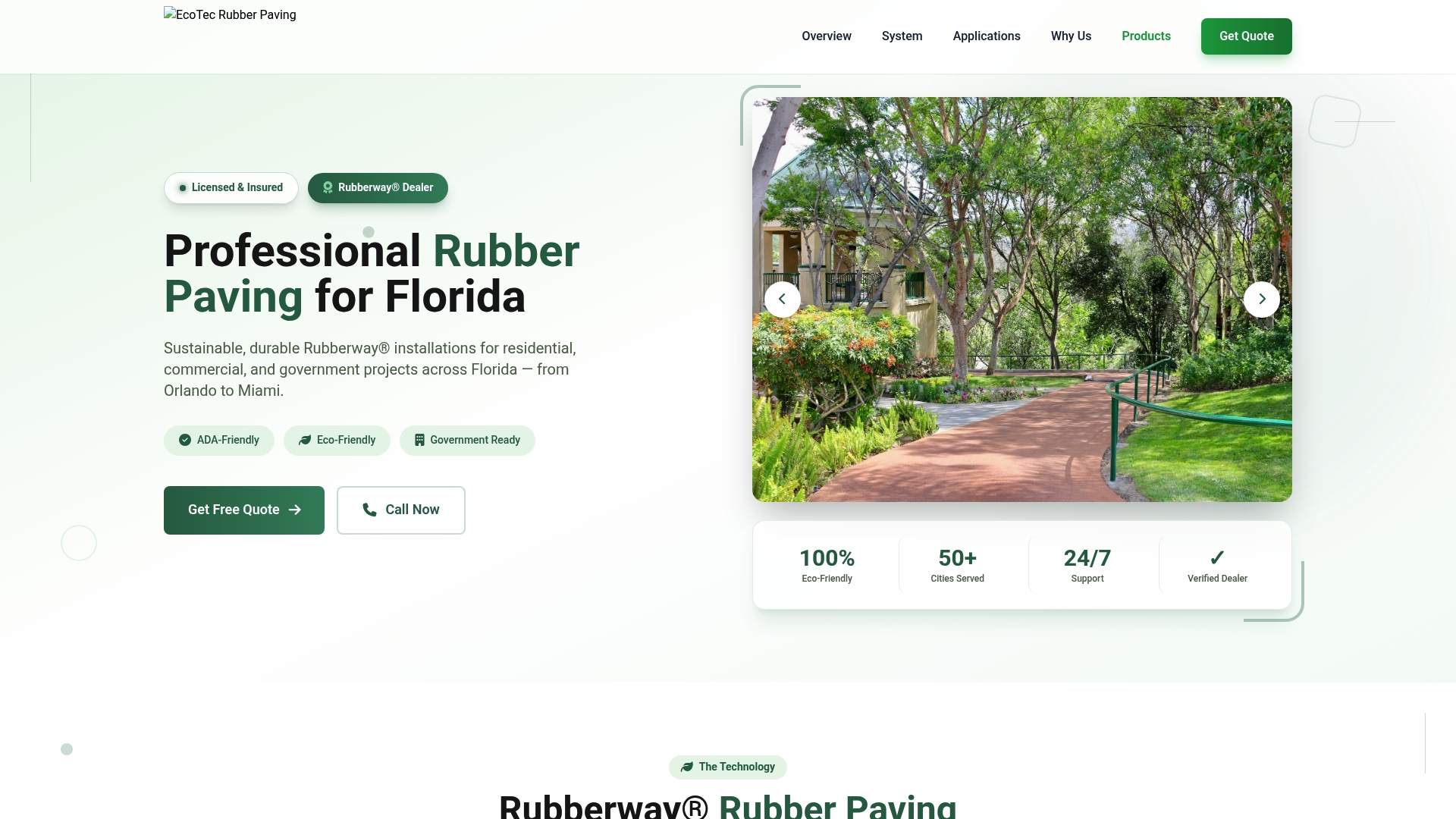
If your municipality, HOA, or commercial property is planning a sidewalk, walkway, or public plaza upgrade anywhere in Florida, review EcoTec's Rubberway® product specifications or reach out through the main EcoTec site to request a municipal specification packet or a site assessment. Getting the surface right the first time is a lot cheaper than a second concrete pour.
Frequently Asked Questions
Is PROWAG the same as the 2010 ADA Standards? No. PROWAG addresses public right-of-way elements like sidewalks and curb ramps, while the 2010 ADA Standards focus on buildings, facilities, and connected site elements.
Do I have to follow PROWAG right now? Formal enforceability varies by jurisdiction and entity type, but the Access Board and FHWA both recommend treating it as current best practice regardless of adoption status.
What happens if a project falls under both standards? Apply whichever standard specifically addresses the element in question, and default to the more stringent technical requirement when scope genuinely overlaps.
Does PROWAG apply to web accessibility too? No. PROWAG is strictly a physical infrastructure standard. Digital accessibility for government websites typically references WCAG as a separate technical benchmark under Title II.
What's the biggest technical difference designers miss? The PAR width jump from 36 inches to 48 inches, which affects everything downstream: drainage slope, curb ramp flare design, and how much clear space remains for signage and furniture.
This article is general information, not a substitute for advice from a qualified lawyer. Consult a qualified legal professional about your own circumstances before acting on anything here.
Sources
- Public Rights of Way Accessibility Guidelines (PROWAG) | U.S. Access Board
- Public Right-of-Way Accessibility Guidelines (PROWAG) | FHWA
- 2010 ADA Standards vs PROWAG | Rocky Mountain ADA
- Transportation for Individuals With Disabilities; Adoption of Accessibility Standards for Pedestrian Facilities in the Public Right-of-Way | Federal Register