

Aesthetics convert paving from a load-bearing engineering element into social infrastructure that shapes driver behavior, pedestrian comfort, place identity, and long-term community stewardship. That is the core claim, and the evidence behind it is practical enough to carry into a council presentation or an RFP.
TL;DR:
- Surface texture, color, and pattern function as behavioral signals: they slow traffic, guide pedestrians, and define gathering nodes without adding signage.
- Paving that reflects local culture and history builds civic pride and reduces vandalism and neglect.
- Aesthetic choices carry legal weight: ADA requirements for contrast, slip resistance, and detectable warnings must be verified before approval.
- Higher upfront investment in patterned or modular surfaces often yields lower lifecycle costs through reduced crack repair and extended service life.
This guide walks through design principles, material trade-offs, a planner-ready checklist, and RFP language you can use immediately. Stormwater permeability guidance and sustainable material options are covered in depth in later sections.
Table of Contents
- Why do aesthetics matter in community paving?
- Core design principles that make paving work visually and functionally
- How do different paving materials compare on aesthetics and performance?
- How do aesthetic choices affect safety and ADA compliance?
- What does aesthetic paving actually cost over its lifetime?
- How do you align paving aesthetics with local culture and community priorities?
- Planner's checklist for specifying aesthetic paving projects
- Case study: sustainable rubber paving in community settings
- Key Takeaways
- The case for treating paving as a design decision, not a procurement default
- EcoTec Rubber Paving brings Rubberway® to Florida community projects
- Useful sources for procurement and technical detail
Why do aesthetics matter in community paving?
Affordance theory classifies pavement functions into four categories: mobility and load-bearing, safety and guidance, environmental comfort, and social and cultural expression. Most municipal specifications address only the first two. The third and fourth are where aesthetic choices earn their budget.
When a street surface looks like a freeway, drivers treat it like one. When it looks like a shared civic space, they don't. That behavioral shift is not accidental; it is a design outcome.
Concrete benefits of aesthetic-led paving:
- Traffic calming: Textured and patterned surfaces change perceived speed, reducing actual vehicle speeds without additional signage or enforcement.
- Wayfinding: Color and pattern variations guide pedestrians through complex intersections and toward key destinations, reducing confusion and improving safety.
- Active use and public health: Attractive, well-maintained surfaces invite walking, cycling, and social gathering, directly supporting active-transportation goals.
- Civic pride and stewardship: Communities that feel ownership over their public spaces maintain them better and report higher satisfaction with local government.
- Ecological performance: Permeable aesthetic surfaces reduce stormwater runoff, recharge groundwater, and lower the urban heat island effect when combined with light-colored or recycled materials.
A tree-shaded residential street in a Florida HOA community illustrates the before/after dynamic well. Before: standard asphalt, no visual differentiation, resident complaints about speeding. After: modular paving with a consistent palette at key intersections, raised entry treatments, and planted medians. Residents reported feeling safer crossing the street, and the visual character shifted from utilitarian to neighborhood-scale. The curb appeal effect on adjacent property values followed.
Research on resident participation in street-surface decoration found that information about the design process significantly increased pedestrians' attachment to pavement treatments. Attachment, in turn, correlates with reduced vandalism and higher maintenance compliance. That is a measurable social return on an aesthetic investment.
Core design principles that make paving work visually and functionally
Five principles govern well-executed community paving design: coherence, legibility, material honesty, human scale, and expressive restraint. None of them require expensive materials. All of them require deliberate decision-making.

Coherence means the paving palette complements surrounding architecture, street furniture, and planting. A granite-edged brick path reads as intentional in a historic downtown; the same material in a 1990s suburban park reads as incongruous. Aesthetic harmony is achieved when paving complements surrounding materials and landscape, building pride rather than mere ornament.
Legibility uses texture, color, and pattern as navigational signals. Crosswalk emphasis, nodal-point treatments at intersections, and border bands that define pedestrian zones all communicate hierarchy without words. Analysis of 115 urban projects found color to be an effective urban design tool for identity and wayfinding, particularly when chromatic interventions are concentrated at key decision points rather than spread uniformly.
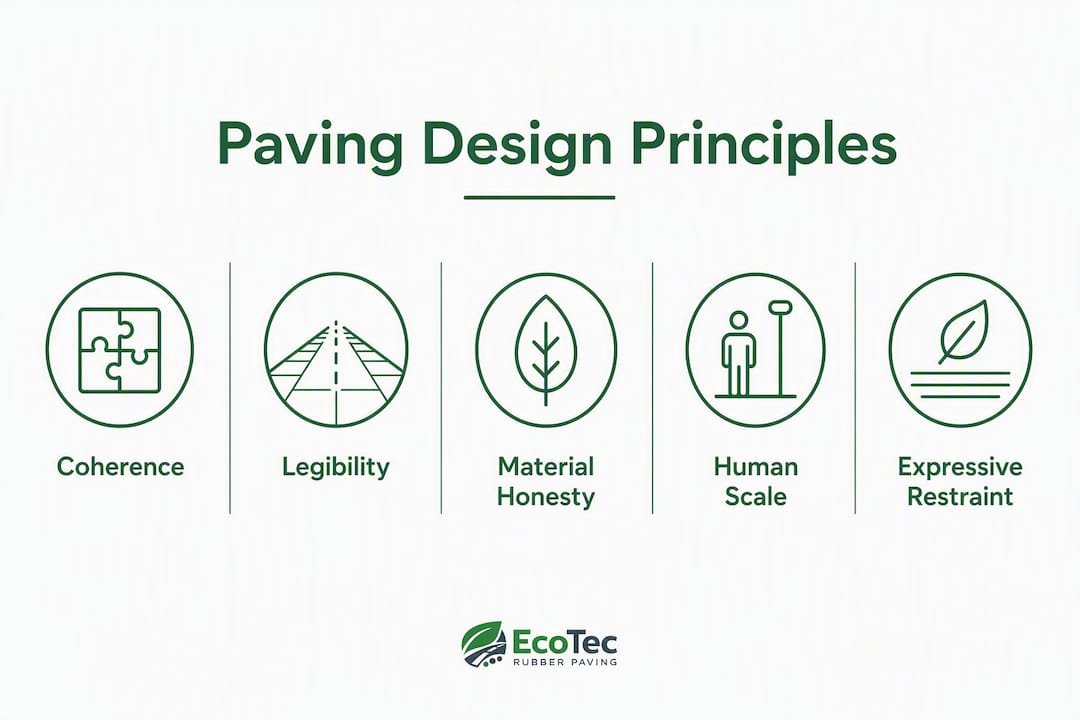
Material honesty means using materials that age gracefully and look appropriate for their context. Concrete that mimics brick rarely fools anyone and often looks worse at year five than honest concrete would.
Human scale governs module size and pattern complexity. Large-format slabs read well from a car; small-unit pavers read well at walking speed. Matching module size to the dominant mode of use is one of the most overlooked paving design considerations.
Expressive restraint is the hardest principle to defend in a community process, but the most important for long-term acceptance. Bold chromatic interventions work at nodal points. Applied across an entire block, they fatigue quickly.
Pro Tip: Limit your palette to two or three complementary materials or colors across a project. Interpave's work with Haringey Council and Sustrans demonstrated that a limited, consistent palette at nodal points can establish local character and influence driver behavior without resorting to aggressive colors.
A simple verbal design diagram for a residential block: a border band (contrasting material, 18–24 inches wide) defines the edge between carriageway and footway; nodal treatments (patterned or raised surface, 20–30 feet in length) mark intersections and crossings; the field between nodes uses a single, consistent base material. Three elements, one coherent system.
Pro Tip: Use nodal point interventions at the two or three highest-conflict locations on a block before committing to a full-street redesign. The behavioral and visual evidence from those pilots will make the council case for you.
How do different paving materials compare on aesthetics and performance?
Material choice is where aesthetic ambition meets budget reality. The table below compares the four main categories across the dimensions planners care about most.

| Dimension | Asphalt | Concrete | Permeable pavers | Modular/rubber systems |
|---|---|---|---|---|
| Visual cohesion / cultural fit | Low: uniform black, limited variation | Medium: can be stamped or colored; fades | High: wide unit variety, historic compatibility | High: broad color range, customizable patterns |
| Durability / maintenance | Medium: cracks in heat, needs sealing | Medium-high: durable but crack-prone at joints | High: individual units replaceable | High: crack-resistant, UV-stable with quality systems |
| Safety / traffic calming | Low: smooth surface encourages speed | Medium: texture options available | High: texture and visual change slow traffic | High: surface texture signals shared-space behavior |
| Accessibility / ADA | Medium: smooth but heaves over roots | Medium: joint gaps can be problematic | Medium: requires tight joint tolerances | High: consistent surface, ADA-compatible textures available |
| Stormwater / permeability | Low: impervious, increases runoff | Low-medium: standard concrete is impervious | High: designed for infiltration | Medium-high: porous options available (e.g., Rubberway®) |
| Upfront vs. lifecycle cost | Low upfront, higher lifecycle (repairs, sealing) | Medium upfront, medium lifecycle | Medium-high upfront, lower lifecycle | Medium-high upfront, low lifecycle (no crack repair) |
| Environmental impact | High heat island, no recycled content | Medium: some recycled aggregate options | Low heat island, permeable | Low: recycled tire content, lower heat absorption |
Common specification mistakes to avoid:
- Omitting a geotextile layer under modular systems. Without it, poor or shifting subgrade conditions degrade paving performance within a few years. A geotextile between soil and paver base is critical to decouple paving performance from subsurface variability.
- Specifying stamped concrete as a cost-saving substitute for unit pavers. Stamped concrete loses its pattern definition as it weathers and becomes a maintenance liability.
- Ignoring joint width tolerances for permeable pavers. Joints that are too narrow reduce infiltration rates; joints that are too wide create ADA surface issues.
Ecotecrubber's Rubberway® system sits in the modular/rubber column and performs particularly well on permeability, recycled content, crack resistance in Florida's heat, and ADA surface consistency. For green building material options that combine aesthetic flexibility with sustainability credentials, rubber paving is worth specifying in pool decks, park walkways, HOA common areas, and low-speed shared streets.
Integrating paving with planting and landscape elements amplifies the aesthetic return on any material choice. Pavers paired with natural landscaping create a coherent outdoor environment that reads as designed rather than assembled.
How do aesthetic choices affect safety and ADA compliance?
Surface aesthetics and safety are not separate concerns. They are the same concern expressed in different languages: one speaks to engineers, the other to the people using the space.
Visual texture and contrast change perceived speed. A driver entering a patterned surface reads it as a pedestrian zone and adjusts behavior accordingly. Switching from asphalt to modular paving makes streets feel different to drivers and can curb speeding without additional signage, because asphalt conveys a freeway visual cue that modular surfaces do not.
Color and pattern also guide pedestrian crossing behavior. High-contrast crosswalk markings, detectable warning surfaces at curb cuts, and material transitions at grade changes all communicate information that keeps pedestrians safe. These are not decorative choices; they are functional requirements with legal backing under the ADA.
ADA and safety verification checklist before approval:
- Detectable warning surfaces (truncated domes) at all curb ramps, per ADA Standards for Accessible Design Section 4.29.
- Slip resistance: wet dynamic coefficient of friction of 0.60 or higher for pedestrian surfaces.
- Cross-slope: 2% maximum perpendicular to direction of travel.
- Running slope: 5% maximum for accessible routes (8.33% maximum for ramps with handrails).
- Joint width: 13 mm (½ inch) maximum for unit paver joints on accessible routes.
- Color contrast between field paving and edge/border treatments to aid low-vision users.
- Surface stability: no rocking units, no vertical displacement exceeding 6 mm (¼ inch) at joints.
When an aesthetic intervention conflicts with an accessibility requirement, the accessibility requirement wins. Document any accommodation or exception in the project record and have it reviewed by a certified accessibility consultant before construction.
What does aesthetic paving actually cost over its lifetime?
The upfront cost comparison between asphalt and a modular or rubber system is real, and it is the number that kills good projects in budget reviews. The lifecycle comparison tells a different story.
Cost categories to budget for:
- Materials: Unit cost per square foot varies by material type, color complexity, and regional supply.
- Site prep: Subgrade excavation, compaction, and geotextile installation. Skipping or undersizing this category is the most common cause of premature failure.
- Drainage and permeability features: Aggregate base depth, edge restraints, and outlet connections for permeable systems.
- Installation labor: Modular and rubber systems require more skilled labor than asphalt but less heavy equipment.
- Maintenance over 10–20 years: Asphalt requires sealing every 3–5 years and patching after heat cycles. Modular systems allow individual unit replacement. Rubber systems resist cracking in high-heat climates, reducing repair frequency significantly.
The lifecycle argument for higher-aesthetic materials is strongest in Florida's climate, where asphalt degrades faster due to UV exposure and thermal cycling. A surface that costs 30–40% more to install but requires no crack repair for 15 years often delivers a lower total cost of ownership. Budget allocation guidance for sustainable paving can help officials frame this for finance committees.
Grant and sustainability funding can offset higher upfront costs when aesthetic paving delivers measurable public benefits. EPA's Green Infrastructure funding programs, CDBG grants, and state stormwater management programs all recognize permeable paving as an eligible investment. Documenting placemaking outcomes, pedestrian safety improvements, and stormwater retention volumes strengthens grant applications.
How do you align paving aesthetics with local culture and community priorities?
Aesthetics that ignore regional identity risk rejection regardless of technical quality. A project that looks beautiful in a design presentation but feels foreign to the people who live with it every day will not be maintained, and it will not be loved.
The engagement workflow that produces durable design acceptance follows four stages:
- Diagnostic listening: Surveys, walking audits, and photo-elicitation sessions to understand what residents value about existing surfaces and what they want changed.
- Co-design workshops: Include children. Research on resident participation in street-surface decoration found that children's workshops produced designs that increased attachment in survey results, because children's input signals genuine community ownership rather than consultation theater.
- Pilot and nodal trials: Install the proposed treatment at one or two key intersections before committing to a full block. This produces real evidence of behavioral and aesthetic outcomes and gives residents something concrete to react to.
- Formal review and maintenance planning: Confirm the design, document maintenance responsibilities, and establish a review cycle.
Participatory design can yield artful and pride-inducing projects when practitioners use structured openness and quality control. The key word is structured. Community input without guardrails produces incoherent palettes and unbuildable designs. Set the constraints first (palette limits, material categories, ADA requirements), then invite input within them.
Pro Tip: Run a small pilot installation at a key nodal point and photograph it across seasons before presenting the full-block proposal to council. Visual evidence of real outcomes is more persuasive than renderings, and it gives residents a chance to adjust their preferences based on something they can actually walk on.
For deeper guidance on running these processes, the role of community input in municipal paving covers participatory methods in detail.
Planner's checklist for specifying aesthetic paving projects
Use this checklist as a project management tool and as a basis for RFP evaluation criteria.
Site analysis and context:
- Document existing surface materials, colors, and conditions within a 500-foot radius.
- Identify cultural or historic references relevant to the neighborhood's identity.
- Map pedestrian desire lines, conflict points, and high-speed vehicle corridors.
- Confirm stormwater drainage requirements and any impervious surface limits.
Design principles and material selection: 5. Define a palette of no more than three materials or colors before community engagement begins. 6. Identify nodal points for expressive interventions; specify field material separately. 7. Confirm material availability and lead times from regional suppliers. 8. Verify that selected materials meet ADA surface requirements (slip resistance, joint width, cross-slope).
Safety and accessibility verification: 9. Confirm detectable warning surfaces at all curb ramps. 10. Verify cross-slope and running slope on all accessible routes. 11. Document color contrast between field paving and edge treatments. 12. Have ADA compliance reviewed by a certified accessibility consultant.
Community engagement: 13. Conduct at least one co-design workshop with residents before finalizing the palette. 14. Install a pilot nodal treatment and collect resident feedback before full-block approval. 15. Document engagement process and outcomes for grant applications.
Maintenance and evaluation: 16. Specify a maintenance plan with inspection intervals and repair protocols. 17. Define evaluation metrics: pedestrian counts, vehicle speed data, resident satisfaction surveys at 12 and 36 months post-installation.
RFP Snippet A — Pilot nodal-point aesthetic treatment: RFP Snippet B — Full-block paving upgrade: Evaluation criteria weights: design quality and coherence (25%), durability and lifecycle cost (30%), ADA and safety compliance (25%), community engagement plan (20%).
Case study: sustainable rubber paving in community settings
Rubber paving excels in specific project types where the combination of ADA-compatible surfaces, crack resistance, permeability, and color flexibility delivers outcomes that asphalt and standard concrete cannot match. Playgrounds, pool decks, park walkways, HOA common areas, and low-speed shared streets are the strongest use cases.
Typical outcomes in these settings:
- Drainage improvement: porous rubber surfaces allow water to pass through rather than pond, reducing slip hazards and eliminating standing water complaints.
- Crack resistance: Florida's thermal cycling destroys asphalt surfaces within 5–7 years in high-UV areas. Rubber surfaces absorb thermal expansion without cracking.
- Color options: Rubberway® installations are available in a range of colors, allowing planners to match neighborhood palettes or create wayfinding distinctions between zones.
- ADA compatibility: the surface texture of rubber paving provides consistent slip resistance and meets joint-width requirements for accessible routes.
Project specification guidance for Rubberway® installations:
- Subgrade prep: compact to 95% Proctor density; address any soft spots before base installation.
- Geotextile: install a non-woven geotextile separation layer between native soil and aggregate base.
- Base course: minimum 4-inch compacted aggregate base for pedestrian applications; 6 inches for light vehicle areas.
- Permeability: specify porous Rubberway® mix for applications where stormwater infiltration is required; confirm with permeability test at installation.
- ADA surface testing: request third-party slip resistance test results (wet DCOF) from the installer before final acceptance.
- Color selection: review color samples in the actual site lighting conditions, not just in a showroom.
What to request in an RFP evaluation for rubber paving: installer licensing and insurance certificates, Rubberway® product data sheets, permeability test results from comparable installations, color sample boards, a 5-year maintenance warranty, and at least two references from municipal or HOA projects in Florida. For sustainable installation best practices, Ecotecrubber's technical guidance covers subgrade requirements and climate-specific considerations in detail.
Key Takeaways
Aesthetic paving choices function as measurable design levers: they influence driver behavior, pedestrian safety, community attachment, and long-term maintenance costs in ways that justify higher upfront investment.
| Point | Details |
|---|---|
| Aesthetics as behavioral tools | Surface texture and color change perceived speed and guide pedestrian movement without additional signage. |
| Participation increases attachment | Resident co-design workshops, including children, significantly increase attachment to pavement treatments and reduce neglect. |
| ADA compliance is non-negotiable | Verify detectable warnings, slip resistance, cross-slope, and joint width before approving any aesthetic specification. |
| Lifecycle cost favors quality materials | Higher upfront investment in modular or rubber surfaces typically yields lower total cost over a 10–20 year horizon in high-heat climates. |
| Ecotecrubber's Rubberway® system | Offers porous, crack-resistant, ADA-compatible rubber paving in Florida with recycled content and a broad color range for community projects. |
The case for treating paving as a design decision, not a procurement default
Most paving projects fail aesthetically not because of bad taste but because aesthetics were never on the agenda. The specification went out as a materials-and-labor bid, the lowest compliant price won, and the community got another block of standard asphalt. Nobody made a wrong decision; they just made no decision at all about what the surface should communicate.
The evidence in this guide points to something planners already sense but rarely have language for: the surface underfoot shapes how people feel about a place. A textured, coherent, well-lit paving environment signals that someone cared. That signal is not decorative. It reduces speeding, increases pedestrian use, and correlates with higher resident satisfaction scores. When you present aesthetics to a skeptical council member, frame it that way: not as beautification, but as behavioral infrastructure with a measurable return.
The political hurdle is usually the upfront cost comparison. The answer is the lifecycle table, the grant eligibility, and the pilot installation. One well-executed nodal treatment at a problem intersection, photographed before and after, is worth more than any rendering. It gives decision-makers something real to vote on.
EcoTec Rubber Paving brings Rubberway® to Florida community projects
Florida's heat, UV intensity, and stormwater demands make standard asphalt a short-term solution with long-term costs. Ecotecrubber offers a direct alternative: Rubberway® rubber paving installations that combine porous drainage design, recycled tire content, crack resistance, ADA-compatible surfaces, and a broad color palette, all installed by a licensed and insured team focused exclusively on rubber paving.
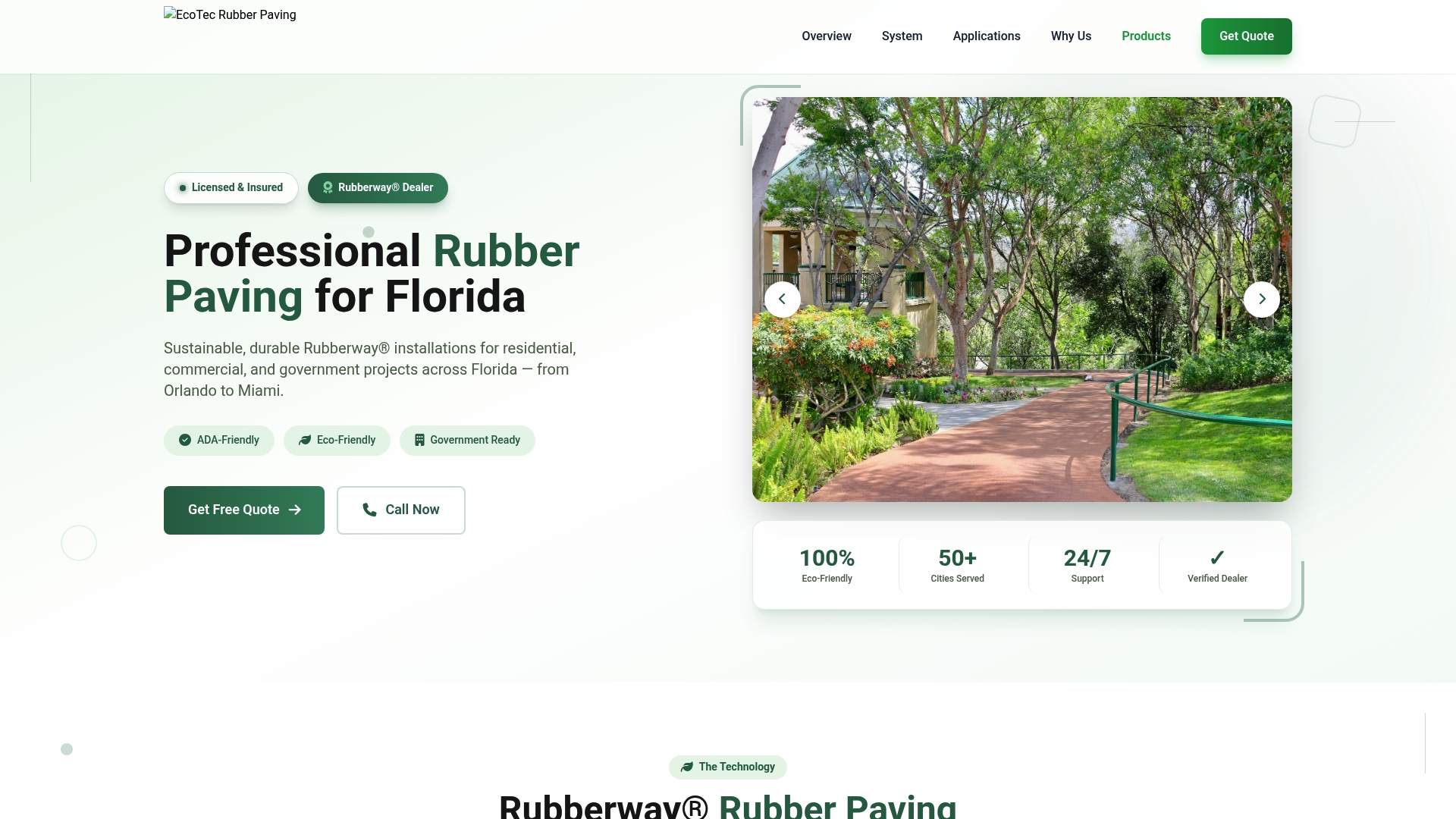
For community planners and HOA decision-makers, that focus matters. Ecotecrubber does not install asphalt or concrete on the side; Rubberway® is the entire offering, which means the installation team knows the system and the specification inside out.
Before requesting a proposal, ask for:
- Installation warranties and permeability test documentation
- Color sample boards reviewed in site lighting conditions
- References from comparable municipal or HOA projects in Florida
- Proof of licensing and insurance
To request a consultation or specification review for your next community paving project, visit Ecotecrubber's Rubberway® installations page and submit a project inquiry. If you need product and color specifications for an RFP attachment, the Rubberway® products page has technical data sheets and color options.
Useful sources for procurement and technical detail
These sources are worth bookmarking for RFP technical attachments, council memos, and specification writing.
- Redefining the potential value of pavement through affordance theory: Classifies pavement functions across mobility, safety, comfort, and social dimensions. Useful for framing the "why aesthetics matter" argument to engineers and finance officers.
- Chromatic interventions in urban space paving: Analysis of 115 urban projects examining color as a wayfinding and identity tool. Cite in design specifications that include color requirements.
- Many Voices, One Project: Participation and Aesthetics in Community-Built Practices: Qualitative evidence that structured participatory design produces both high aesthetic quality and community ownership. Use when writing community engagement plan requirements for RFPs.
- Research on the effects and potential of resident participation in street surface decoration: Empirical study showing that participation significantly increases pedestrian attachment to pavement treatments. Supports grant narratives around placemaking outcomes.
- Paving for Communities, Interpave: Practitioner guidance on nodal-point interventions, palette selection, and traffic-calming through surface design. Directly applicable to RFP evaluation criteria.
- Permeable Pavement Design Guide, City of Rockville: Technical installation guidance for permeable systems, including subgrade requirements and stormwater performance expectations. Use as a technical attachment reference for permeable paving specifications.