
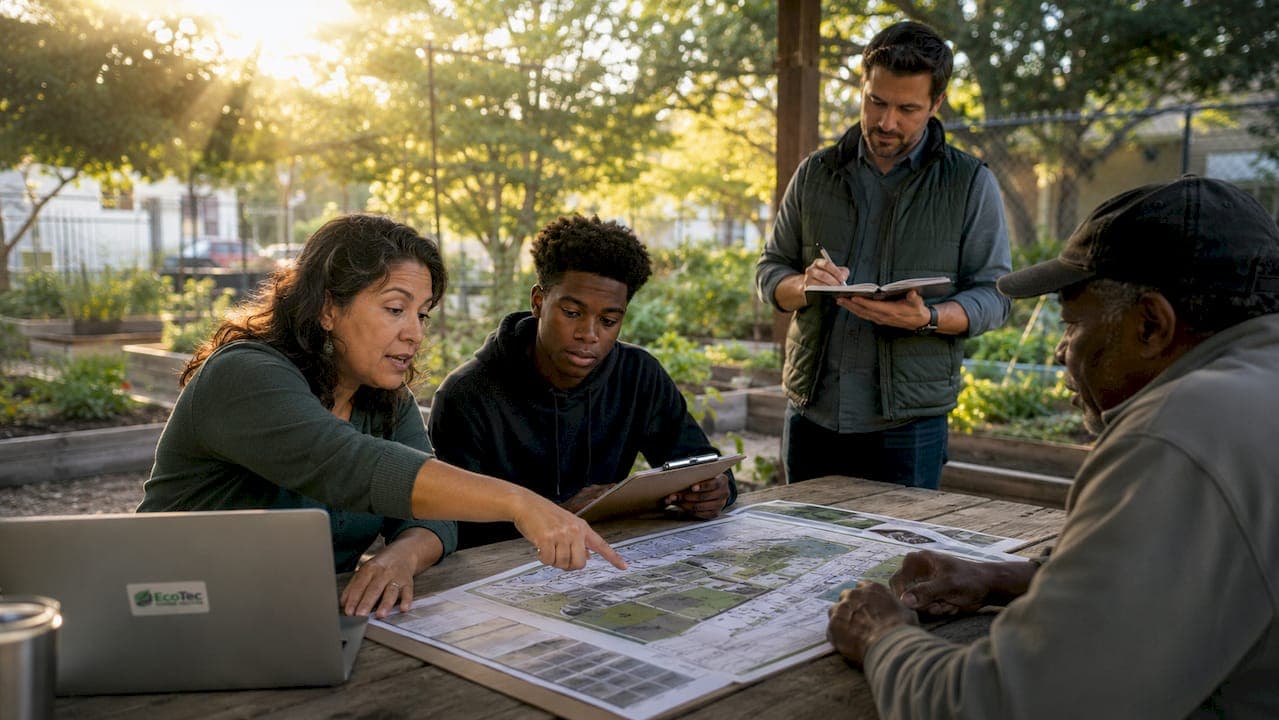
Community input in municipal paving is defined as the structured process of gathering resident feedback to shape road project priorities, designs, and funding decisions. Planners who skip this step produce infrastructure that misses local needs, wastes budget, and erodes public trust. The role of community input in municipal paving goes beyond courtesy. Citizen engagement improves policymaking and builds the kind of government trust that makes future projects easier to fund and execute. When residents help set priorities, the resulting pavement projects reflect real conditions on the ground, not just what looks good on a spreadsheet.
How community feedback shapes the municipal paving planning process
Public participation in road planning, the industry term for what many call community engagement in infrastructure, works best when it enters the process early. Most municipal paving projects follow a defined sequence: needs assessment, data collection, concept development, engineering design, and construction. Resident feedback belongs in the first two stages, not the last.
Capital Improvement Plans, or CIPs, are the annual budget documents that determine which streets get funded each year. Budget hearings during summer and early fall are the single most influential window for residents to affect which roads make the list. Miss that window, and the project waits another year.

Participatory budgeting programs formalize this influence. Cambridge, Massachusetts, launched its program in 2014 and now allocates $1 million annually through resident votes. In 2026, over 10,000 residents voted on nine funded projects, including a $100,000 flexible pavement replacement. That outcome did not happen by accident. It happened because the city built a repeatable system for collecting and acting on public opinion on pavements.
The planning process also benefits from balancing technical data with contextual community input. Traffic counts and pavement condition indexes tell engineers where roads are failing. Residents tell planners why certain roads matter more, whether that is a school route, a business corridor, or a street with drainage problems that never show up in inspection data.
Key stages where community feedback integrates most effectively:
- Needs assessment: Residents identify roads that cause daily problems, filling gaps in inspection data.
- Concept development: Public hearings and surveys shape design priorities like sidewalk width, crosswalks, and drainage.
- Budget hearings: Organized advocacy and petitions influence which projects receive CIP funding.
- Post-project review: Feedback after completion improves future planning cycles.
Pro Tip: Schedule your community feedback sessions at least six months before the annual CIP deadline. Late input rarely changes project lists that are already locked.
What methods work best for citizen involvement in road projects?
The format of engagement determines the quality of feedback. Formal council meetings produce formal, guarded responses. Residents feel on trial, not consulted. The format shapes the conversation before anyone speaks.
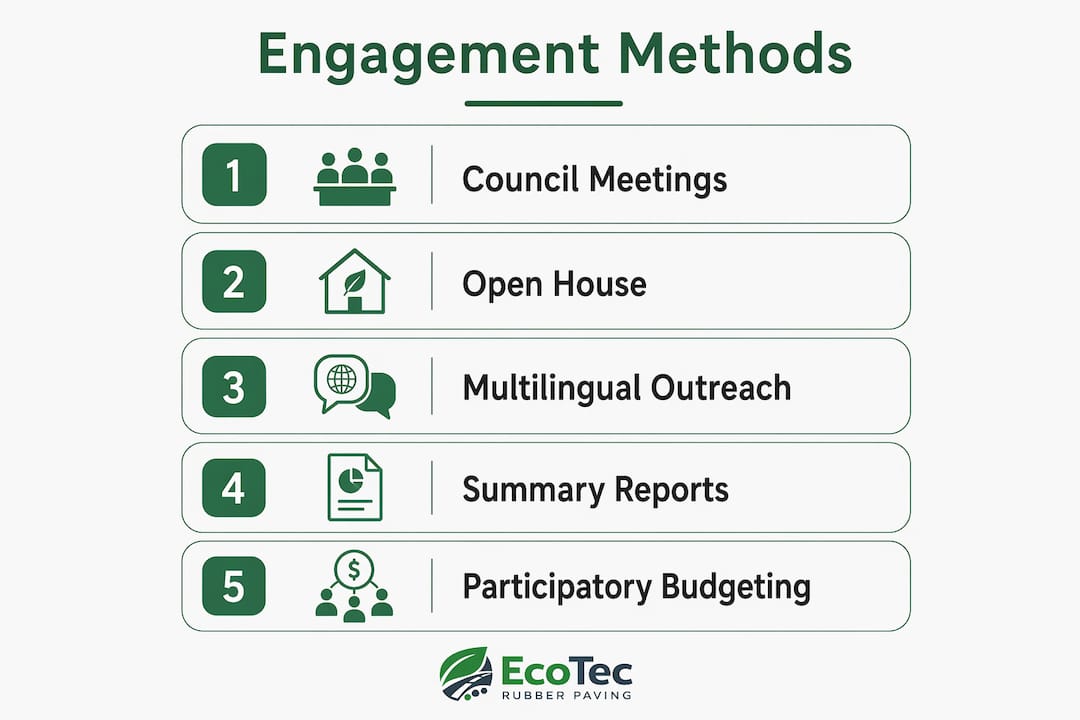
Drop-in open house formats outperform formal presentations in producing nuanced, usable feedback. Residents arrive when it suits them, speak one-on-one with planners, and leave without the pressure of a public microphone. Washington State Department of Transportation (WSDOT) uses this format consistently on highway paving projects and credits it with reducing community friction. A planner's guide to community-wide upgrades reinforces this approach for local road projects as well.
Multilingual outreach expands who participates. WSDOT's SR 99 feedback process included outreach in Punjabi, Somali, Spanish, and Ukrainian. The result was 763 website visits and 179 survey completions, with resident input directly altering the project's safety features and pedestrian improvements. That is a measurable return on the investment in accessible communication.
Organized neighborhood advocacy also moves the needle. In many jurisdictions, a petition signed by the majority of property owners triggers a formal evaluation for repaving. Some jurisdictions set the threshold at 60% support. A well-organized block association carries more weight than individual complaints.
The most effective engagement programs combine several methods in sequence:
- Early online surveys to capture baseline priorities from a broad audience before any design work begins.
- Drop-in open houses to gather detailed, conversational feedback from residents most affected by the project.
- Multilingual outreach materials to reach non-English-speaking neighborhoods that traditional notice-and-comment periods miss.
- Structured petitions to formalize majority support and trigger official review processes.
- Follow-up communication to show residents how their input changed the project, closing the feedback loop.
Pro Tip: Post a one-page summary of how resident feedback changed the project design. Residents who see their input reflected in outcomes participate more actively in the next cycle.
When does timing community input maximize its impact?
Timing is the variable most planners underestimate. Poorly timed public participation stalls projects and creates friction between planners and communities. Input collected after engineering constraints are finalized forces planners to say no to most suggestions, which breeds distrust.
WSDOT's approach on US 101 illustrates the right model. Data collection began in late 2025, and public input shaped design concepts in spring 2026, well before final engineering refinements. That sequence gave pre-design engagement real influence over the project's direction. Traditional notice-and-comment periods, by contrast, often occur too late for public ideas to be technically feasible.
The table below maps the key decision points in a typical municipal paving cycle against the optimal timing for community input.
| Planning stage | Optimal input timing | What residents can influence |
|---|---|---|
| Needs assessment | 12+ months before construction | Road prioritization, safety concerns |
| CIP budget hearings | Summer to early fall, annually | Project funding and inclusion |
| Concept development | 8–10 months before construction | Design features, pedestrian access |
| Engineering design | 4–6 months before construction | Minor adjustments, ADA compliance |
| Post-construction review | Within 90 days of completion | Future project improvements |
The budget hearing window deserves special attention. Annual CIP cycles reset every fiscal year. Residents who miss the summer hearing cycle wait a full year for the next opportunity to influence project funding. Municipal planners who communicate this calendar clearly to neighborhoods see higher participation and better-organized input.
How do planners balance community preferences with technical constraints?
Technical tools and community priorities frequently point in different directions. Lebanon, Missouri, uses PAVER software for objective street prioritization, combining pavement condition indexes, traffic counts, and inspection data to rank roads for its Summer 2026 Street Overlay Program. The software produces a defensible, data-driven list. It does not capture which street a neighborhood considers most critical to daily life.
The solution is to frame community feedback as contextual data, not competing data. Public works officials recommend layering resident input over technical criteria rather than treating the two as opposing forces. A road that ranks eighth on a condition index but sits adjacent to an elementary school may warrant moving up the list. That decision requires both the index score and the community context.
Transparent communication about trade-offs builds credibility. When planners explain why a technically lower-priority road received funding because of safety concerns raised by residents, the community sees that its input mattered. When planners say nothing, residents assume their feedback was ignored.
Practical steps for balancing the two:
- Publish the technical scoring criteria before public hearings so residents understand the framework.
- Create a formal mechanism for community input to adjust rankings within a defined range, such as moving a project up or down by two positions.
- Document every instance where community feedback changed a technical decision and share that record publicly.
- Use flexible pavement options and safety features, such as ADA-compliant surfaces and improved drainage, to address community priorities within existing budget constraints.
Reviewing your public paving procurement checklist before finalizing project specifications helps planners confirm that community priorities are reflected in vendor requirements, not just in planning documents.
Key Takeaways
Effective public participation in road planning requires early engagement, clear timing, and a deliberate process for integrating resident feedback with technical data.
| Point | Details |
|---|---|
| Engage before design locks in | Collect community input during pre-design to keep resident ideas technically feasible. |
| Target the CIP budget window | Summer and early fall hearings are the highest-leverage moment for residents to influence project funding. |
| Use drop-in formats | Open house sessions produce more candid and detailed feedback than formal public meetings. |
| Frame input as contextual data | Layer community priorities over technical scoring rather than treating them as competing factors. |
| Close the feedback loop | Show residents how their input changed the project to build participation in future cycles. |
What I've learned from watching community engagement go right and wrong
Most engagement failures I've observed share one trait: the process starts too late. By the time residents see a project at a public hearing, the engineering team has already ruled out half the options the community would have requested. Planners call it "public comment." Residents call it "going through the motions." Both are right.
The programs that work treat community input as a data source, not a legal requirement. Cambridge's participatory budgeting program is the clearest example I know. Residents do not just comment on a plan. They vote on which projects get funded. That shift in structure changes everything about how residents engage and how much they trust the outcome.
The warning I'd give any planner is this: tokenistic feedback processes are worse than no process at all. When residents invest time in surveys and open houses and then see no trace of their input in the final design, they disengage permanently. That disengagement shows up years later when you need community support for a bond measure or a major infrastructure project.
My honest recommendation is to treat the first engagement session as a listening session, not a presentation. Bring maps, bring data, and ask residents to mark the streets that matter most to them. You will learn things that no pavement condition index will ever tell you. That information makes your technical decisions better, not just more popular.
— Roger
Ecotecrubber's Rubberway® solutions for community-driven paving projects
Municipal planners who incorporate community feedback often find that residents prioritize safety, drainage, and environmental impact alongside basic road quality. Ecotecrubber's Rubberway® paving installations address all three. The system uses recycled rubber materials to deliver ADA-compliant, crack-resistant surfaces with excellent drainage, directly answering the concerns most commonly raised in community engagement sessions.
Ecotecrubber specializes in Florida's climate challenges, where heat-induced cracking and standing water are recurring community complaints. Planners considering sustainable paving options for community-led upgrades can review the full Rubberway® product catalog to match specific installation needs with the right surface solution. Every project is licensed, insured, and focused exclusively on rubber paving, which means no divided attention and no compromised results.
FAQ
What is the role of community input in municipal paving?
Community input in municipal paving defines which roads get prioritized, what safety features are included, and how budget is allocated. It functions as contextual data that complements technical scoring tools like PAVER software.
When should residents submit feedback on road projects?
The most effective window is during annual Capital Improvement Plan budget hearings, typically held in summer and early fall. Input submitted during pre-design phases also carries significant weight before engineering constraints are finalized.
What engagement format produces the best community feedback?
Drop-in open house sessions consistently outperform formal public meetings. Residents engage more candidly in one-on-one conversations with planners than in structured council settings.
How does multilingual outreach improve paving project outcomes?
Multilingual surveys and materials reach residents who are excluded by English-only processes. WSDOT's SR 99 project used outreach in four languages and collected feedback that directly changed the project's safety and pedestrian design features.
Can a resident petition actually change a road repaving decision?
A petition signed by a majority of affected property owners triggers a formal municipal evaluation in many jurisdictions. Some municipalities set the threshold at 60% support, making organized neighborhood advocacy one of the most direct tools available to residents.