

A public paving procurement checklist is a structured framework that guides officials through every step required to acquire paving services that meet quality, regulatory, and budgetary standards. Most disputes in government paving contracts trace back to one root cause: vague scope definitions that leave critical responsibilities unassigned. The Miller Act, Davis-Bacon Act, and state bonding requirements set the legal floor for public works procurement, but a well-built checklist is what turns those mandates into a defensible, repeatable process. This guide gives procurement officials and project managers the specific criteria needed to evaluate bids fairly, control costs, and close out projects without litigation.
1. What belongs on a public paving procurement checklist
The strongest checklists start with site-specific data, not generic scope language. Effective bid solicitations must include location-specific hazard inventories, unit-based pricing, mandatory pre-qualification documents, insurance certificates, and a structured closeout package. That combination gives evaluators a consistent baseline across every bid received.
Federal and local guidelines require bonding for contracts over $150,000. Asphalt mix designs must reference industry standards such as Superpave 9.5 mm or 25 mm, and all quantities must carry unit measurements like square yards or tons. Without those specifics, contractors price risk differently, and your bid comparison becomes meaningless.

GIS-compatible site data belongs in the solicitation package, not as an afterthought. When bidders receive accurate field inventories upfront, they price accurately. That accuracy protects your budget and reduces change orders after award.
2. Essential technical specifications to include
Technical specifications are where most municipal paving project procurement steps break down. Officials often write performance outcomes without defining the inputs that produce them.
Every solicitation should require the following:
- Asphalt mix design submittals referencing Superpave 9.5 mm or 25 mm standards before work begins
- Granular base material certifications covering gradation and Atterberg limits to prevent scope gaps in bids
- Compaction targets stated as 92%–96% gyratory rice density per ASTM D2041
- Density testing frequency set at one nuclear density gauge test per 500 square yards per lift
- Curing periods requiring a minimum of 30 days, or after the first rain event, before line markings are applied
- Proof-rolling requirements for subgrade and granular base, with clear pass/fail inspection criteria
- Thickness specifications that state explicitly whether values are compacted or loose
Pro Tip: Require contractors to submit mix design documentation at least 10 business days before paving begins. Late submittals are a leading cause of schedule slippage on public works projects.
Concrete curb curing requires a minimum of 3 days as a standard baseline. Stating these numbers in the solicitation removes ambiguity and gives your inspectors a clear enforcement standard.
3. How to standardize pricing for fair bid comparison
Bid leveling is the practice of restructuring each received proposal into a single unified template so evaluators compare identical line items. Without it, one contractor prices mobilization separately while another buries it in unit rates, and your cost comparison is distorted from the start.
A unified bid template for paving projects must break quotes into these categories:
- Mobilization and demobilization costs
- Demolition depth and disposal, stated in inches
- Granular base thickness and material type
- Asphalt lift thickness, compacted measurement only
- Tack coat application rate per square yard
- Asphalt mix type and source plant location
- Labor rates by trade classification
- Utility frame and cover adjustments, priced per unit
- Traffic control and signage
- Testing and inspection fees
Each line item must carry a unit of measure and a quantity. Bids that arrive without this breakdown are nonresponsive and should be rejected before evaluation begins.
Pro Tip: Ask bidders to flag any line item where they assumed a quantity not provided in the solicitation. That single question surfaces hidden assumptions before award, not during construction.
Specifying compacted thickness rather than loose thickness is a detail that changes contractor pricing by a measurable margin. Loose asphalt compresses roughly 20%–25% during rolling, so a contractor pricing loose thickness will underbid the actual material cost. Your solicitation must close that gap explicitly.
4. Project management and scheduling requirements
CPM scheduling allows project managers to identify bottlenecks early and align contractor timelines to prevent cascading delays. Critical Path Method scheduling is a standard requirement in public works contracts and belongs as a mandatory deliverable in your procurement documents.
Your checklist should require the following scheduling and management controls:
- Baseline CPM schedule submitted within 10 business days of notice to proceed, showing all dependencies
- Utility and subgrade completion milestones that must be verified before paving begins
- Integrated subcontractor schedules aligned with the prime contractor's CPM to prevent coordination gaps
- Weekly progress reports covering percent complete, open RFIs, and pending submittals
- Change order approval workflow with defined response windows, typically 10 business days for review
- Submittal log tracking mix designs, material certifications, and test reports with required approval dates
Municipal planners who manage projects in isolation from their contractors consistently face cost overruns and schedule failures. Requiring integrated scheduling from day one shifts that dynamic. The contractor becomes a partner in timeline management rather than a source of claims.
Milestone documentation protects both parties. When a project record shows that subgrade was accepted before paving began, disputes about premature pavement failure become far easier to resolve.
5. Compliance and environmental criteria
Compliance in public paving procurement covers licensing, wage law, environmental standards, and accessibility requirements. Each category requires specific, measurable documentation, not general assurances.
Your checklist must include:
- Contractor licensing verification confirming active state licensure and insurance certificates naming the public agency as an additional insured
- Prevailing wage compliance under the Davis-Bacon Act, which mandates locally prevailing wages for public works contracts over $2,000, with certified payroll submitted weekly
- Environmental and zoning documentation confirming contractor experience with local climate conditions, including heat-resistant binders and drainage engineering appropriate to the project region
- ADA compliance metrics stated as measurable pass/fail criteria for ramp slopes, cross slopes, and surface texture, not vague language like "ADA compliant"
- Closeout package requirements including GIS-compatible files, field photographs, and acceptance measurement records for legal defensibility
"Ambiguous ADA compliance statements are insufficient. Procurement documents should require measurable, pass/fail metrics for ramp slopes, cross slopes, and surface conditions. Closeout packages should include GIS-compatible files, photos, and acceptance measurement records for auditability and legal defensibility."
Falsifying certified payroll documentation is a federal crime under Davis-Bacon enforcement. Your solicitation should state that consequence explicitly and require contractors to acknowledge it in writing at bid submission.
For Florida projects specifically, sustainability and zoning regulations must account for heat-induced surface degradation and standing water drainage. Requiring documented contractor experience with those conditions protects the project from material failures that generic specifications miss.
6. Contract closeout and documentation standards
A contract is only as strong as its closeout package. Many officials treat closeout as an administrative formality, but it is the document set that determines whether a warranty claim, audit, or legal dispute goes in your favor.
Your closeout checklist should require the following from the contractor before final payment is released:
- As-built drawings in GIS-compatible format, showing final grades, thicknesses, and utility adjustments
- All compaction test reports organized by station and lift
- Material certifications for asphalt mix, granular base, and tack coat
- Photographic record of subgrade acceptance, each lift, and final surface
- Signed ADA compliance measurement forms with actual slope readings
- Warranty documentation with start date, duration, and contractor contact information
General scope descriptions are inadequate for defensible contracts. A contract that specifies the "remove-verify" workflow, with exact field conditions and pass criteria at each inspection point, gives your team the authority to enforce standards and reject substandard work before it is buried under the next lift.
Digital documentation also creates an audit trail that satisfies public records requirements. When a council member or citizen requests project records, a complete digital closeout package answers that request in minutes, not weeks.
Key takeaways
A defensible public paving procurement checklist requires measurable technical specifications, standardized bid templates, CPM scheduling, Davis-Bacon compliance, and a complete digital closeout package to prevent disputes and protect public investment.
| Point | Details |
|---|---|
| Standardize bid templates | Require identical line items with units and quantities to enable fair, apples-to-apples bid comparison. |
| Specify compacted thickness | Always state asphalt thickness as compacted, not loose, to prevent underbidding on material costs. |
| Mandate CPM scheduling | Require a baseline CPM schedule within 10 days of notice to proceed to control timelines and dependencies. |
| Enforce Davis-Bacon compliance | Require weekly certified payroll for all public works contracts over $2,000 to meet federal wage law. |
| Require measurable ADA criteria | State ramp and cross slope tolerances as pass/fail numbers, not general compliance language. |
What I've learned from watching procurement go wrong
The most expensive mistakes in municipal paving procurement are not technical. They are definitional. I have reviewed contracts where the scope read "supply and install asphalt" with no mention of who owns subgrade bearing capacity. When the subgrade failed, the dispute consumed more time and money than the original paving contract was worth.
The fix is not complicated. Assigning responsibility for subgrade proof-rolling and defining pass/fail criteria in the solicitation takes an extra page of specification language. That page is worth more than any contingency budget line.
The second pattern I see consistently is officials treating the paving project checklist as a bid document rather than a project management tool. The checklist should govern the entire lifecycle, from pre-qualification through closeout. When it does, disputes drop because every decision point has a documented standard attached to it.
Procurement officials who evaluate vendor bids against measurable criteria rather than lowest price alone consistently deliver better projects. That is not an opinion. It is the pattern that shows up in every well-run public works program I have studied.
The hardest part of this work is defending a decision to reject a low bid. A checklist with explicit, documented evaluation criteria makes that defense straightforward. Without it, you are exposed.
— Roger
Ecotecrubber's approach to public paving standards
Public agencies in Florida face paving challenges that generic procurement specifications do not address: heat-induced cracking, standing water after heavy rain, and ADA compliance on surfaces that shift seasonally. Ecotecrubber's Rubberway® installations are built specifically for those conditions, using recycled rubber materials that resist cracking, drain efficiently, and meet ADA surface requirements with documented measurements.
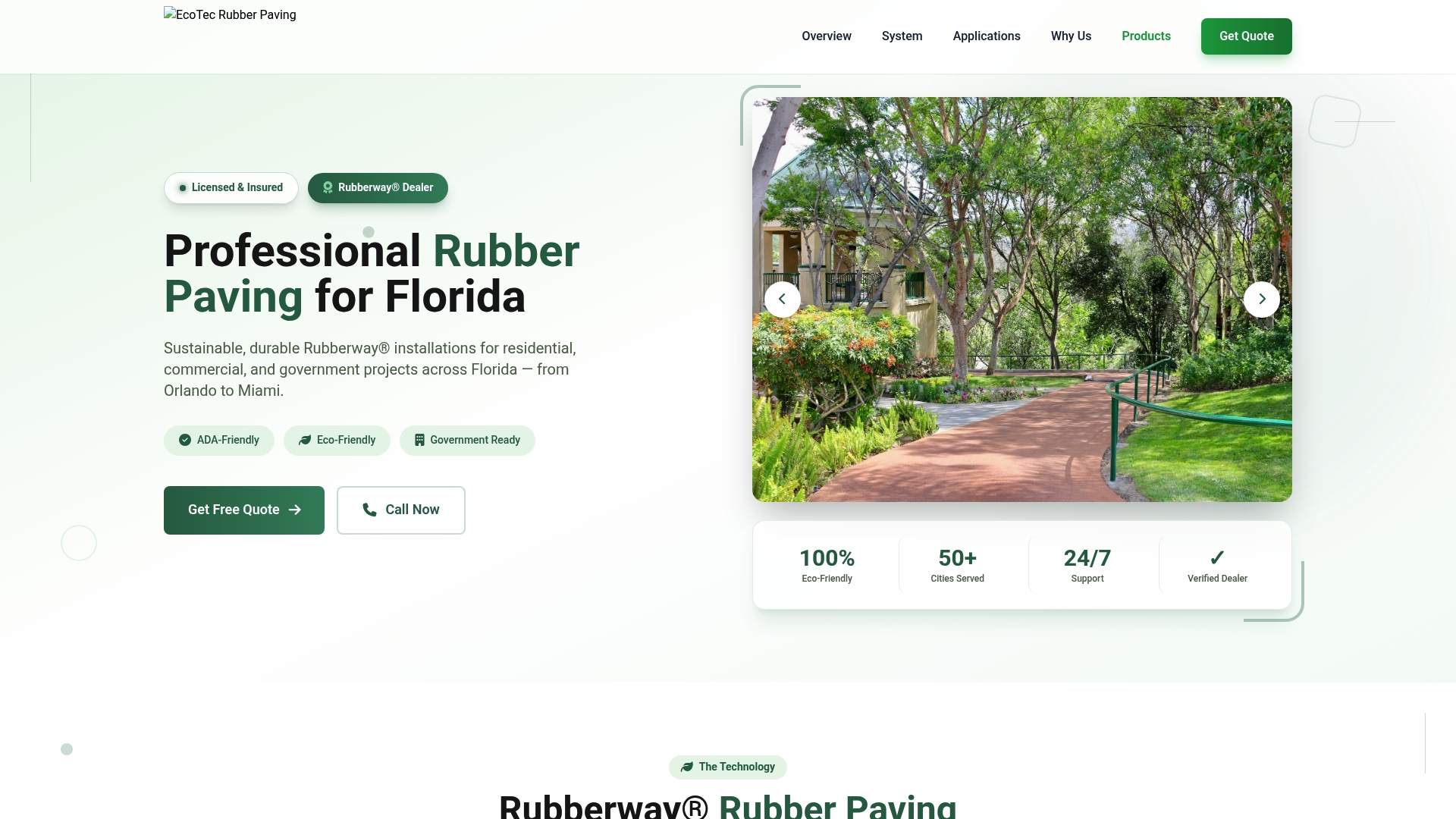
Ecotecrubber is licensed and insured, which means its projects satisfy the pre-qualification and insurance requirements your checklist already demands. For municipalities and public agencies evaluating sustainable paving products that align with procurement best practices, Ecotecrubber offers a documented, professional installation process from site assessment through closeout.
FAQ
What is a public paving procurement checklist?
A public paving procurement checklist is a structured document that guides officials through every required step to solicit, evaluate, and award paving contracts. It covers technical specifications, bid evaluation criteria, compliance requirements, and closeout documentation.
What federal laws govern public paving contracts?
The Miller Act requires bonding for federal contracts over $150,000, and the Davis-Bacon Act mandates prevailing wages for public works contracts over $2,000. Both apply to most municipal paving projects that receive federal funding.
Why does compacted versus loose thickness matter in bid documents?
Asphalt compresses during rolling, so a contractor pricing loose thickness will underbid the actual material cost. Specifying compacted thickness in your solicitation closes that gap and produces accurate, comparable bids.
How often should density testing occur on a paving project?
The standard is one nuclear density gauge test per 500 square yards per lift. Compaction targets should be stated as 92%–96% gyratory rice density per ASTM D2041 to give inspectors a clear enforcement standard.
What should a paving contract closeout package include?
A complete closeout package includes as-built GIS drawings, compaction test reports by station and lift, material certifications, photographic records, signed ADA measurement forms, and warranty documentation with a confirmed start date.