

A budget public infrastructure paving project is a planned combination of cost-effective surface methods, sound scope management, and lifecycle cost thinking to improve public roads without overspending. Municipal officials face a real tension: roads deteriorate faster than budgets grow, and the American Society of Civil Engineers consistently grades U.S. infrastructure poorly. The good news is that 2026 paving programs across the country prove you can stretch public funds significantly by matching the right surface treatment to the right road type. This guide walks you through method selection, budget alignment, project execution, and the most common pitfalls that turn affordable projects into expensive ones.
What budget public infrastructure paving methods work best by road type?
The most cost-effective paving strategy is not one method applied everywhere. It is a hybrid approach that assigns surface treatments based on traffic volume, road classification, and maintenance cycles.
Chip seal (also called tar and chip) is the best fit for residential and low-traffic roads. Installation costs range $1.80–$3.50 per square foot compared to $5.00–$7.00 for conventional asphalt. That cost gap makes chip seal the default choice for municipalities managing large road networks on tight budgets. Chip seal also delivers a lifespan of 10–15 years with proper maintenance and provides better traction in wet conditions than smooth asphalt.
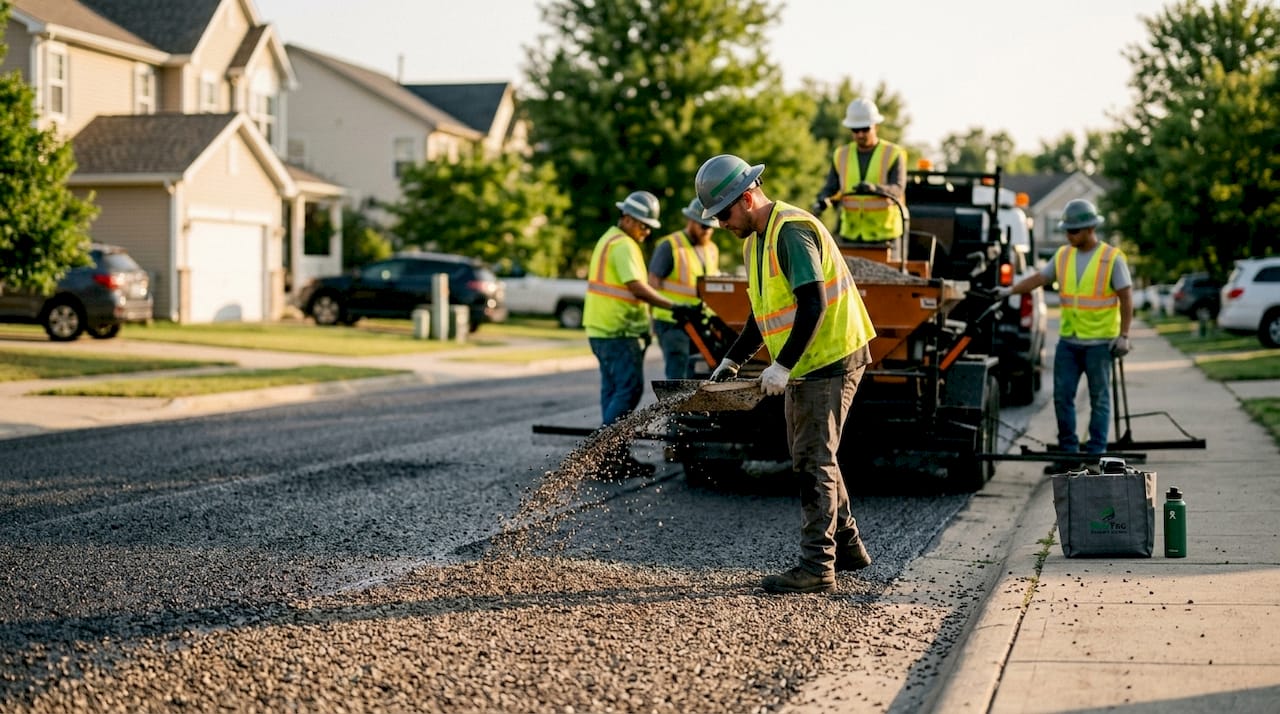
Mill and overlay is the right call for collector and arterial roads that carry heavier daily traffic. It costs significantly more per lane mile, but it restores structural integrity and extends pavement life on roads where chip seal would break down too quickly. Overland Park allocated $14.8 million for 36 lane miles of mill and overlay at roughly $411,000 per lane mile, while spending $5.9 million on 137 lane miles of chip seal at about $43,000 per lane mile. That ratio reflects a deliberate, traffic-based allocation strategy.
Rubber-based paving, such as the Rubberway® system used by Ecotecrubber, adds a third option for municipalities prioritizing ADA compliance, drainage performance, and crack resistance. Recycled rubber surfaces handle Florida's heat-induced cracking and standing water problems that traditional asphalt cannot. They also reduce long-term maintenance frequency on pedestrian paths, parking areas, and shared-use surfaces.
| Surface method | Best road type | Approx. cost per sq. ft. | Typical lifespan |
|---|---|---|---|
| Chip seal | Residential, low-traffic | $1.80–$3.50 | 10–15 years |
| Mill and overlay | Arterial, collector | Higher (varies by depth) | 15–20 years |
| Rubber paving (Rubberway®) | Pedestrian, ADA surfaces | Varies by project | Long-term with low maintenance |
| Ultrathin bonded asphalt | Lightly deteriorated roads | Mid-range | 8–12 years |
Pro Tip: Match surface treatment to traffic volume before you finalize any budget line. Applying chip seal to a high-traffic arterial road will cost you more in two years than the initial savings justified. Review your paving surface material options before writing your RFP.
How do you plan and align scope for a cost-efficient paving project?
Budget alignment starts before you pick a surface material. The first step is a pavement condition index (PCI) assessment of every road in your program. PCI scores tell you which roads need full reconstruction, which need resurfacing, and which need only preventive treatment. Spending mill-and-overlay money on a road with a PCI score that only warrants chip seal is one of the fastest ways to blow a paving budget.
The second step is bundling related infrastructure repairs into the same procurement. Integrating drainage repairs, crosswalk upgrades, and culvert replacement into a single arterial paving contract reduces total mobilization costs and prevents you from tearing up a freshly paved road six months later for a utility fix. Overland Park does this consistently, folding sidewalk, lighting, ramp, and stormwater repairs into its annual paving program. The savings on contractor mobilization alone justify the planning effort.
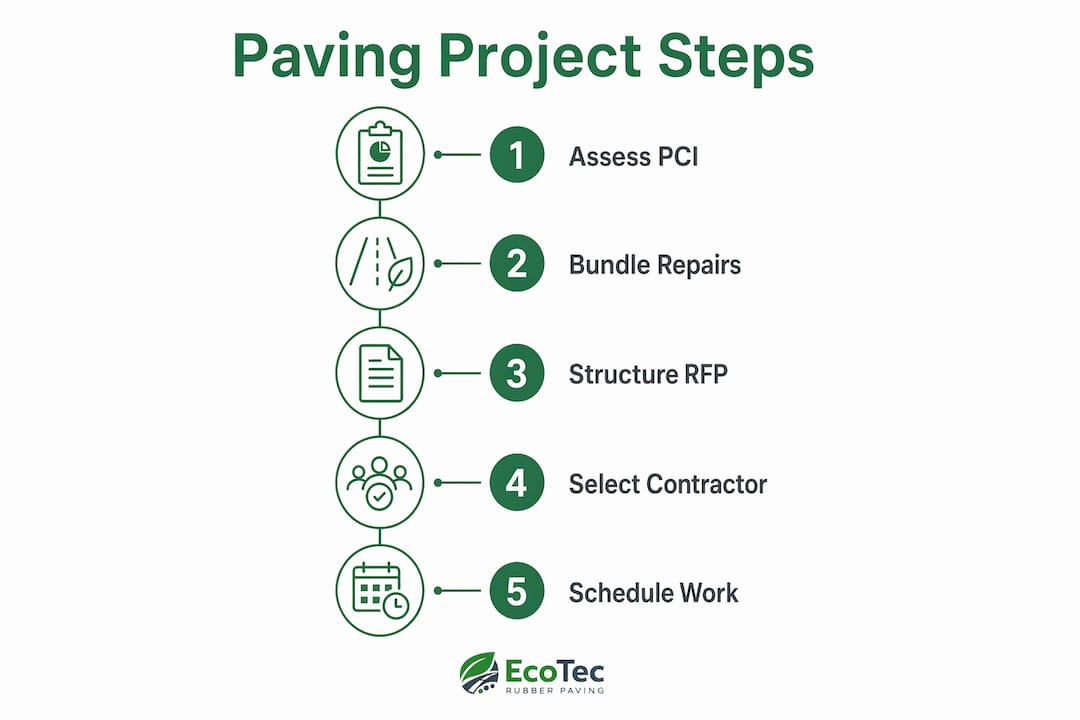
Funding alignment is the third prerequisite. Federal and state grant programs expand what your local budget can accomplish, but they come with strict procurement timelines. Indiana's Community Crossings Matching Grant is one example of a state program that enables growing paving initiatives while requiring contractors to meet specific compliance standards. You need to know your grant deadlines before you write your scope, not after.
Key planning steps for a cost-efficient project:
- Complete a PCI assessment for all roads in the program before setting budget allocations.
- Identify drainage, culvert, sidewalk, and utility conflicts along each corridor.
- Confirm grant funding timelines and procurement compliance requirements early.
- Write a scope that separates base bid items from bid alternates so you can scale up or down based on final bids.
- Coordinate with your public works, utilities, and parks departments to catch conflicts before construction.
Pro Tip: Structure your RFP with a clear base bid and at least two bid alternate tiers. If your base bids come in under budget, you can award alternates immediately without a second procurement cycle. This is how budget allocation for paving actually scales in practice.
Step-by-step execution for a public works paving project
Execution quality determines whether your budget investment holds up for 10 years or falls apart in three. The phases below reflect how successful 2026 municipal programs structure their work.
- Issue the RFP with base bid and alternates. Include detailed technical specifications, traffic control requirements, and material standards. Vague scopes attract inflated bids.
- Evaluate bids on total value, not just unit price. A low unit price from a contractor with no local asphalt plant access can cost you weeks of delay. Strong project scoping attracts competitive bids even when market conditions are volatile, as Worthington demonstrated after a local asphalt plant fire disrupted supply in 2025.
- Award alternates at bid opening if budget allows. Bundling bids and alternates in a single procurement, as Holmes County and Worthington did in 2026, maximizes the impact of every public dollar without triggering a second competitive process.
- Schedule work around community events and school calendars. Arterial closures during a local festival or the first week of school generate complaints and political pressure that can slow your project.
- Assign a dedicated inspector to each active paving crew. Compaction failures, incorrect mix temperatures, and poor joint construction are invisible until they cause early cracking. Catch them during placement, not after.
- Document as-built conditions for every completed segment. This feeds your next PCI cycle and gives you defensible data when residents ask why their street was not included.
For roads with multiple surface treatments in one project, sequence chip seal work after mill and overlay is complete. Chip seal is sensitive to traffic contamination during curing, and heavy equipment from overlay work will damage a freshly sealed surface.
Pro Tip: Coordinate your paving schedule with your stormwater and utilities departments at least 60 days before construction starts. One unplanned utility conflict can halt a crew for days and push your project into a weather window that forces you to stop for the season.
What causes cost overruns in affordable public infrastructure paving projects?
Cost overruns in local paving projects share a short list of root causes. Recognizing them before construction starts is the difference between a project that finishes on budget and one that requires an emergency appropriation.
Skipping drainage repairs is the most expensive mistake. Ignoring culverts and underlying infrastructure during a paving budget leads to premature pavement failure and higher total costs. Water infiltrating a road base destroys the investment within a few years, regardless of how well the surface was applied. Budget for drainage work upfront or plan to repave the same road again.
Market volatility in material costs catches many project managers off guard. Asphalt prices track crude oil markets and can shift significantly between budget approval and bid day. Well-scoped projects with flexible bidding strategies protect municipalities from the worst of these swings by giving contractors clear scope and room to price competitively.
Common mistakes that inflate costs and reduce pavement life:
- Applying high-cost surface treatments to roads that only need preventive maintenance.
- Failing to address base failures before resurfacing, which accelerates reflective cracking.
- Underestimating traffic control costs on arterial roads.
- Ignoring ADA ramp and sidewalk requirements, which can trigger compliance issues and costly change orders.
- Accepting the lowest bid without verifying contractor experience with the specified surface treatment.
Extending pavement life on a limited budget comes down to one principle: matching materials to road type and traffic prolongs lifespan and reduces future costs. Overland Park reduced chip seal use on high-traffic roads specifically to protect pavement longevity. That kind of disciplined material assignment is what separates programs that compound savings year over year from those that repave the same streets repeatedly.
For pedestrian surfaces, rubber paving from Ecotecrubber addresses two of the most common failure points in Florida: standing water and heat-induced cracking. The Rubberway® system's drainage performance and crack resistance reduce the maintenance calls that quietly drain public works budgets. Learn more about stormwater management paving approaches that address these issues at the design stage.
Key Takeaways
Budget-friendly public infrastructure paving succeeds when surface methods match road type, drainage is addressed upfront, and procurement is structured to scale with available funding.
| Point | Details |
|---|---|
| Match method to road type | Use chip seal for residential roads and mill and overlay for arterials to control cost and extend pavement life. |
| Bundle infrastructure repairs | Include drainage, culvert, and ADA repairs in the same contract to cut mobilization costs and prevent future rework. |
| Use bid alternates | Structure RFPs with base bids and alternates so you can scale scope up or down based on final bid results. |
| Assess before you spend | A pavement condition index assessment prevents overspending on roads that only need preventive treatment. |
| Plan for market volatility | Well-scoped projects with clear technical specs attract competitive bids even when material markets are unstable. |
What I've learned about cost and durability in municipal paving
The most persistent mistake I see in municipal paving programs is treating initial cost as the primary decision variable. A chip seal job at $43,000 per lane mile looks like a win on a budget spreadsheet. It is a loss if it goes on a road carrying 15,000 vehicles a day.
The programs that consistently get the most out of their paving budgets share one habit: they treat lifecycle cost as the real budget. That means accounting for how often a surface will need resealing, what drainage failures will cost if ignored, and how ADA compliance gaps will compound into legal and capital costs. The math almost always favors spending slightly more upfront on the right material.
Bid alternates changed how I think about procurement. Before I understood their value, I watched municipalities leave money on the table at bid opening because their scope was too rigid to absorb savings. A well-structured RFP with two or three alternate tiers turns a good bid day into a great one. Holmes County and Worthington both demonstrated this in 2026.
The other thing I would tell any project manager: do not treat paving as an isolated infrastructure event. Every time you mobilize a contractor, you have an opportunity to fix the drainage problem, upgrade the crosswalk, and replace the failing culvert. Worthington bundles these repairs as standard practice. The result is a road that lasts longer and a community that sees visible, coordinated improvement rather than a series of disconnected patches.
Budget constraints are real. But the officials who manage them best are not the ones who spend the least. They are the ones who spend deliberately.
— Roger
Ecotecrubber's rubber paving solutions for public infrastructure
Municipal projects that need ADA-compliant, drainage-ready surfaces without the long-term maintenance burden of traditional asphalt have a direct option in Ecotecrubber's Rubberway® system.
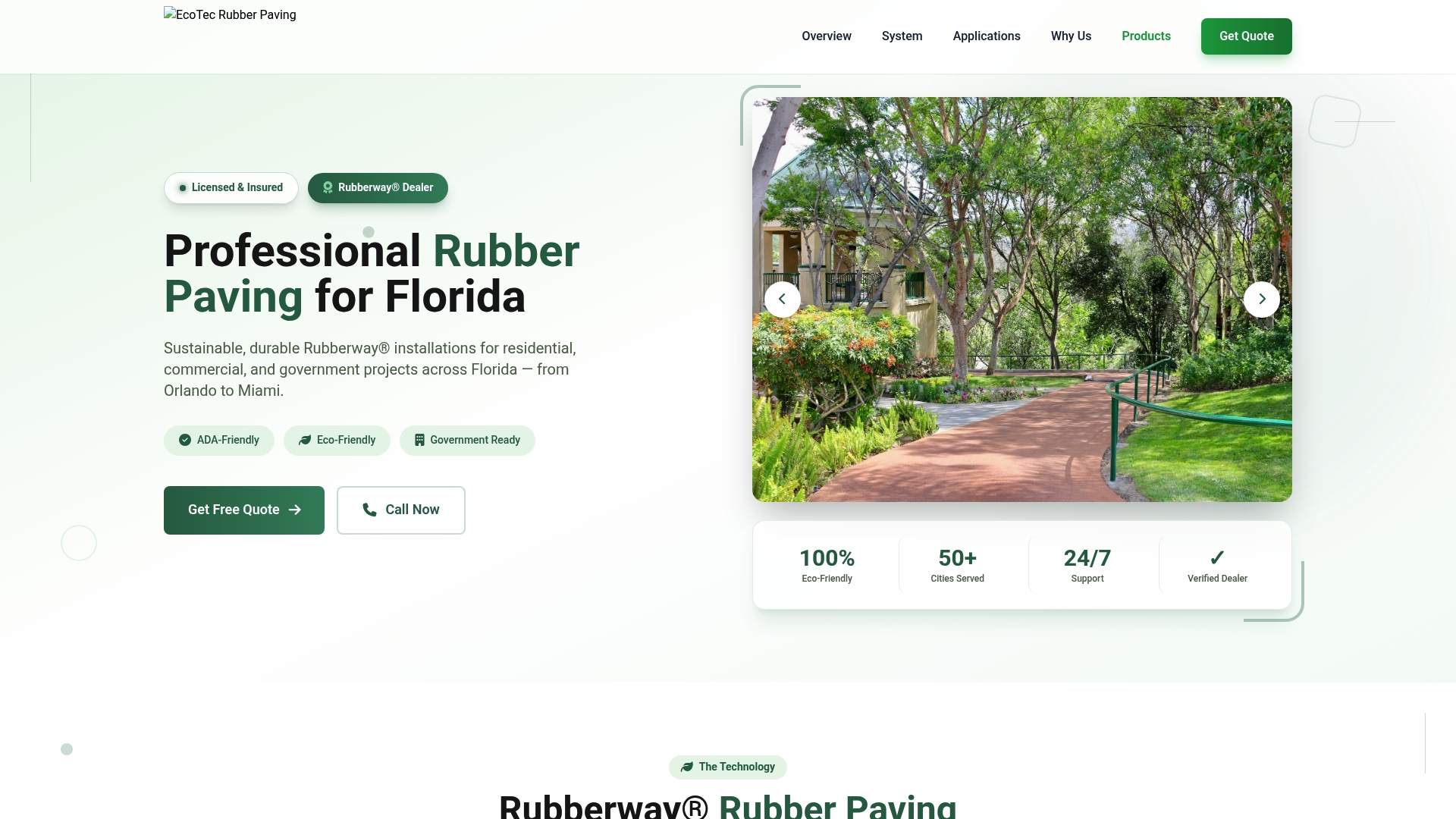
Ecotecrubber installs recycled rubber paving surfaces designed for Florida's climate, where heat-induced cracking and standing water are the two most common reasons paved surfaces fail ahead of schedule. The Rubberway® system handles both. It is licensed, insured, and focused exclusively on rubber paving, which means municipalities get a contractor who knows the product and the compliance requirements. For public works teams managing pedestrian paths, parking areas, and shared-use surfaces, Ecotecrubber's rubber paving solutions offer a durable, eco-friendly alternative that aligns with community accessibility goals and long-term budget planning.
FAQ
What is the most affordable paving method for residential roads?
Chip seal is the most affordable option for residential and low-traffic roads, with installation costs ranging $1.80–$3.50 per square foot and a lifespan of 10–15 years with proper maintenance.
How do bid alternates help stretch a paving budget?
Bid alternates let municipalities add project scope at bid opening if base bids come in under budget, eliminating the need for a second procurement cycle and maximizing the use of available funds.
Why does drainage matter in a paving project budget?
Skipping drainage and culvert repairs during paving leads to premature pavement failure, which forces municipalities to repave the same road years earlier than planned and at significantly higher total cost.
What federal or state funding options exist for local paving projects?
State matching grant programs like Indiana's Community Crossings Matching Grant expand local paving budgets but require strict procurement compliance and alignment with grant timelines.
When should a municipality use rubber paving instead of asphalt?
Rubber paving is the better choice for pedestrian surfaces, ADA-compliant paths, and areas prone to standing water or heat-induced cracking, where traditional asphalt requires frequent and costly maintenance.