

A sustainable paving ROI business case is a financial and environmental evaluation that proves eco-friendly paving delivers superior long-term returns compared to traditional asphalt or concrete. The core argument rests on lifecycle cost analysis (LCCA), not just upfront price tags. Yes, permeable and recycled paving systems cost 10–20% more to install. But they reduce total ownership costs by 19–33% over 20 years through lower maintenance, eliminated drainage infrastructure, and stormwater fee savings. This guide walks business owners, municipalities, and contractors through every financial layer of that equation.
What are the key financial components of a sustainable paving ROI business case?
The business case for eco paving breaks down into four distinct financial categories: installation costs, operational savings, infrastructure avoidance, and incentive revenue. Most procurement teams only evaluate the first category. That is where sustainable paving projects get rejected prematurely.
Installation costs run 10–20% higher than traditional asphalt. That gap is real, but it is the smallest part of the total picture.
Operational savings are where the math shifts. Sustainable paving reduces maintenance costs by 19–33% over a 20-year period, driven largely by 40% lower maintenance labor. Fewer crack repairs, less resurfacing, and reduced pothole patching add up fast across large commercial or municipal lots.

Stormwater fee reduction is the most underestimated driver. Permeable pavement cuts stormwater utility fees by 70–85%, with cost parity typically reached within 8–12 years. For a mid-size commercial property paying $3,000 per year in stormwater fees, that is up to $2,550 in annual savings from a single line item.
Infrastructure avoidance compounds those savings further. Eliminating secondary stormwater infrastructure saves $2,000–$2,500 per parking space. A 100-space lot could avoid $200,000–$250,000 in detention basin construction costs alone.
Incentive programs close the gap on upfront costs. LEED v4.1 and BREEAM certifications tied to sustainable paving offer incentives of $85,000–$220,000 in North America and Western Europe. These credits are not hypothetical. They are structured financial instruments tied to verified performance metrics.
| Cost Category | Traditional Paving | Sustainable Paving |
|---|---|---|
| Installation premium | Baseline | 10–20% higher |
| 20-year maintenance cost | Baseline | 19–33% lower |
| Stormwater fees | Full rate | 70–85% reduction |
| Detention basin cost | $2,000–$2,500/space | Eliminated |
| LEED/BREEAM incentives | None | $85,000–$220,000 |
Pro Tip: Request a line-item breakdown of stormwater fees from your utility provider before finalizing any paving budget. Many property owners discover they are paying fees that a permeable system would eliminate entirely, and that single number can change the entire ROI calculation.
How do you conduct a lifecycle cost analysis for paving?
Lifecycle cost analysis (LCCA) is the standard methodology for evaluating infrastructure investments over their full operational life, not just at purchase. For paving, a proper LCCA covers construction, maintenance, operational costs, and avoided costs across the entire service period.
Step 1: Establish the service life baseline. Sustainable paving systems last 25+ years compared to 15–18 years for traditional asphalt. That difference means capital expenditure is spread over a significantly longer period, reducing the annualized cost of the initial investment.
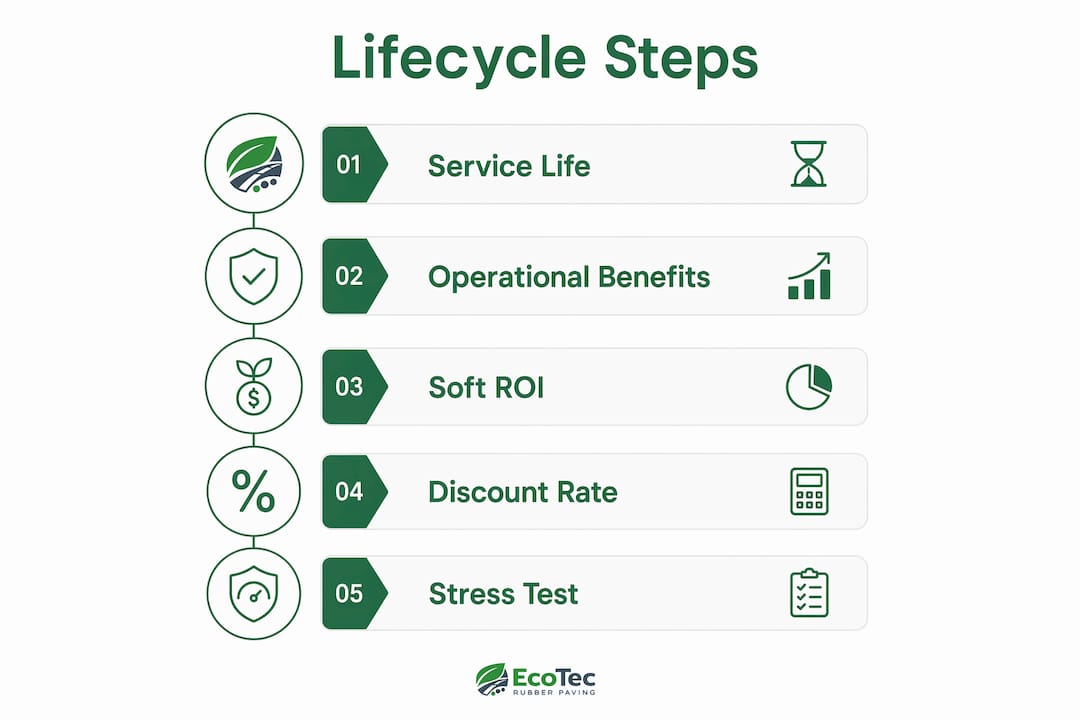
Step 2: Include operational phase benefits. Standard LCCA frameworks often omit flood mitigation and potable water savings, which systematically undervalues sustainable options. Add these line items explicitly: stormwater fee avoidance, reduced runoff treatment costs, and avoided emergency repair costs from flooding.
Step 3: Account for soft ROI. Sustainable parking features command premium lease rates, improve tenant retention, and reduce insurance claims. These benefits rarely appear on a procurement spreadsheet, but they are real and measurable. A property manager who tracks tenant turnover costs will recognize the value immediately.
Step 4: Apply a discount rate. Use a discount rate of 3–5% for public sector projects and 6–8% for commercial projects to convert future savings into present value. This step is where many business cases fail. Teams calculate nominal savings but never convert them to net present value (NPV), making the comparison with upfront costs appear worse than it actually is.
Step 5: Stress-test the assumptions. Run three scenarios: conservative (low savings, high maintenance), base case, and optimistic (full stormwater fee elimination, LEED credits realized). Decision-makers trust analyses that show a range, not a single number.
| LCCA Component | Often Included | Often Omitted |
|---|---|---|
| Construction cost | Yes | N/A |
| Routine maintenance | Yes | N/A |
| Stormwater fee savings | Rarely | Yes |
| Flood mitigation value | No | Yes |
| Soft ROI (tenant retention) | No | Yes |
| Incentive credits (LEED/BREEAM) | Sometimes | Often |
Pro Tip: When presenting an LCCA to a city council or CFO, lead with the NPV figure, not the payback period. Payback period is intuitive but ignores value generated after the break-even point. NPV captures the full financial picture.
How do recycled materials improve the ROI of green paving?
Recycled content in paving is not just an environmental talking point. It is a direct cost reduction lever. Using recycled aggregates and waste-based asphalt mixtures reduces procurement costs by 20–30% compared to virgin materials. That savings applies to the highest-cost line item in most paving projects.
The environmental impact of paving with recycled content goes beyond procurement. Recycled materials cut embodied carbon by 20–30%, reduce transportation costs by 30%, and cut disposal costs by 50%. Each of those reductions has a direct dollar value in a project budget.
Recycled content also unlocks certification credits. LEED v4.1 awards points for material sourcing and recycled content thresholds. Projects that hit the required percentages qualify for the incentive ranges cited above. Understanding recycled content percentage requirements before bidding is critical to capturing those credits.
Community and tenant perception adds another layer. Properties built with documented green procurement practices attract tenants who prioritize ESG (environmental, social, and governance) commitments. That is not soft sentiment. It translates into lower vacancy rates and stronger lease renewal rates, both of which appear on a property's income statement.
Key recycled content advantages:
- 20–30% lower material procurement costs versus virgin aggregates
- 20–30% reduction in embodied carbon emissions
- 30% lower transportation costs due to local sourcing of recycled stock
- 50% reduction in disposal costs for waste materials
- Eligibility for LEED v4.1 and BREEAM material credits
- Stronger ESG positioning for commercial and municipal properties
For municipalities evaluating [eco paving and city maintenance budgets](https://blog.ecotecrubber.com/blog/how eco paving reduces city maintenance budgets), recycled content paving reduces both the capital and operational cost lines simultaneously. That is a rare combination in public infrastructure.
How does maintenance protect long-term paving ROI?
Sustainable paving systems require active maintenance to deliver their promised financial returns. This is the part of the business case that gets underplanned. A permeable system that loses its drainage capacity is not just a performance failure. It is a financial failure that erases the ROI justification.
Neglected maintenance causes up to 50% loss in drainage capacity, leading to surface failure and negating the ROI. The fix is straightforward but non-negotiable: biannual vacuum sweeping to remove sediment from the pore structure. Skip it twice and you are looking at premature resurfacing costs that wipe out years of maintenance savings.
Budget for maintenance as a fixed operational line item from day one. The cost of biannual vacuum sweeping is a fraction of the stormwater fee savings it protects. Treating it as optional is the single most common mistake in sustainable paving project management.
"The difference between a sustainable paving project that delivers ROI and one that doesn't usually comes down to whether maintenance was budgeted and scheduled before the first stone was laid."Operational success scenarios share a common trait: the property owner or municipality contracted with an experienced paving vendor who provided a maintenance schedule at project handoff. Failure scenarios almost always involve a low-bid contractor who handed over a finished surface with no operational guidance.
Operational best practices for protecting paving ROI:
- Schedule biannual vacuum sweeping as a fixed contract, not a reactive repair
- Inspect surface drainage performance after every major rain event
- Document drainage performance annually to track any capacity decline
- Partner with vendors who specialize in eco-friendly paving solutions and provide post-installation support
- Include maintenance cost projections in the original LCCA to avoid budget surprises
The long-term paving ROI on sustainable systems is real and well-documented. But it is conditional on treating the surface as a managed asset, not a set-and-forget installation.
Key takeaways
The strongest sustainable paving ROI business case combines lifecycle cost analysis, stormwater fee elimination, recycled material savings, and disciplined maintenance into a single financial framework.
| Point | Details |
|---|---|
| Lifecycle costs beat upfront price | Sustainable paving reduces total ownership costs by 19–33% over 20 years despite a 10–20% higher install cost. |
| Stormwater fees are the hidden driver | Permeable systems cut stormwater utility fees by 70–85%, reaching cost parity within 8–12 years. |
| Recycled materials cut both cost and carbon | Recycled aggregates reduce procurement costs by 20–30% and embodied carbon by the same margin. |
| Maintenance is non-negotiable | Skipping biannual vacuum sweeping risks 50% drainage loss and premature surface failure. |
| LCCA must include operational benefits | Standard analyses omit flood mitigation and water savings, systematically undervaluing sustainable options. |
Why the "cost" framing is the wrong starting point
Most sustainable paving projects die in procurement because the conversation starts with cost instead of value. I have seen this pattern repeat across commercial developments, municipal RFPs, and HOA board meetings. The team looks at a 15% installation premium, compares it to the baseline bid, and stops there.
That framing treats paving as a fixed expense. The better frame is infrastructure asset management. A surface that manages stormwater at the source is replacing a utility function that would otherwise cost money every single month. CFOs who recognize this shift stop asking "why does it cost more?" and start asking "what is the annual return on this asset?"
The soft ROI elements deserve more credit than they typically receive. Tenant retention, premium lease rates, and lower insurance claims are not speculative. They are documented outcomes from sustainable parking infrastructure. The problem is that they live in different budget lines than paving costs, so no one connects them during procurement.
My honest recommendation: build your business case in two columns. Column one is the traditional cost comparison. Column two is the value generated, including stormwater savings, avoided infrastructure, incentive credits, and soft ROI. Present both to decision-makers. The column two numbers almost always win the argument.
— Roger
See how Ecotecrubber delivers these returns in florida
Ecotecrubber's Rubberway® system is built specifically for Florida's climate, where heat-induced cracking and standing water destroy traditional paving investments within a few years. Every installation uses recycled rubber materials, supports ADA compliance, and delivers the drainage performance that makes the sustainable paving ROI numbers above achievable in real projects.
Ecotecrubber is licensed, insured, and focused exclusively on rubber paving solutions. That specialization means you get a vendor who understands the full financial picture, from installation through long-term maintenance, not a general contractor treating paving as a side service. Explore the full Rubberway® product line or contact Ecotecrubber directly to build a custom ROI projection for your specific project.
FAQ
What is a sustainable paving ROI business case?
A sustainable paving ROI business case is a financial analysis that compares the total lifecycle costs and benefits of eco-friendly paving against traditional alternatives. It includes installation costs, maintenance savings, stormwater fee reductions, and incentive credits to demonstrate long-term financial value.
How long does it take for sustainable paving to pay for itself?
Permeable paving systems typically reach cost parity within 8–12 years, driven primarily by stormwater fee reductions of 70–85% and elimination of secondary drainage infrastructure costs of $2,000–$2,500 per parking space.
What certifications improve the financial case for eco paving?
LEED v4.1 and BREEAM are the primary certification programs that generate financial returns for sustainable paving projects. In North America and Western Europe, these programs offer verified incentives of $85,000–$220,000 per qualifying project.
Why do standard cost analyses undervalue sustainable paving?
Standard lifecycle cost analyses omit operational phase benefits like flood mitigation savings and potable water cost avoidance. Including these line items in a full LCCA framework produces a significantly more accurate and favorable financial evaluation.
How does maintenance affect the ROI of sustainable paving?
Neglected maintenance can cause up to 50% loss in drainage capacity, leading to surface failure and eliminating the financial advantages that justified the investment. Biannual vacuum sweeping is the minimum required to protect system performance and long-term returns.