

Municipal capital improvement paving is the structured financial and operational process local governments use to plan, prioritize, and fund road resurfacing projects through multi-year Capital Improvement Plans (CIPs) and data-driven Pavement Management Systems. Understanding what is municipal capital improvement paving means recognizing it as far more than filling potholes. It is a multi-year strategic process that rates every road using an Overall Condition Index (OCI), allocates funding across budget cycles, and sequences construction to protect public assets. For local government officials and urban planners, mastering this process is the difference between a well-maintained road network and a backlog of expensive emergency repairs.
What is municipal capital improvement paving and how does it work?
Municipal capital improvement paving is the formal term for a government's program to resurface, rehabilitate, or reconstruct public roads using planned budget allocations tied to measurable asset conditions. The industry standard term is "capital improvement paving program," and it sits within the broader Capital Improvement Plan framework that governs all major public infrastructure spending.
The process starts with a Pavement Management System, which assigns each road segment an OCI score on a scale of 0 to 100. Roads scoring below 60 are typically prioritized for resurfacing. That threshold matters because roads in the 40–60 range respond well to overlays and milling, while roads below 40 often require full reconstruction at three to five times the cost.

Public infrastructure paving programs also connect directly to community goals. A road near a school or emergency facility ranks higher than a low-traffic residential street with a similar OCI score. Safety risk, regulatory mandates, and asset condition data all feed into the final project list. This combination of technical scoring and community priority is what separates a well-run program from one driven purely by political requests.
How do Capital Improvement Plans structure municipal paving investments?
A Capital Improvement Plan is a multi-year, fiscally constrained roadmap that ties infrastructure projects to available funding. CIPs typically span 3–6 years and are updated annually to reflect new condition data, completed projects, and revised budget forecasts. San Francisco's 2025–2029 CIP, for example, includes 180 projects with both planned and adopted budgets to maintain financial stability across fiscal years.
The first year of a CIP is the adopted budget, meaning funds are locked in and projects are ready to proceed. Years two through five remain flexible, adjusted each cycle based on updated OCI scores and fiscal realities. This structure gives planners the ability to respond to unexpected road failures without abandoning the long-term program.
Project prioritization within a CIP follows defined criteria:
- OCI threshold: Roads below 60 enter the active project pool.
- Safety and regulatory compliance: ADA requirements, school zones, and emergency access routes receive elevated priority.
- Traffic volume: High-volume corridors generate more wear and affect more residents, so they rank higher.
- Utility coordination: Roads scheduled for water or sewer work move up the list to avoid repaving over fresh cuts.
- Cost-effectiveness: Preventative treatments on roads scoring 60–75 cost far less than reconstruction on roads that have deteriorated past 40.
Avoiding deferred maintenance is the central fiscal argument for a well-structured CIP. Deferred maintenance due to political prioritization causes major cost increases over time. A road that costs $80,000 to overlay today may cost $400,000 to reconstruct in five years if left untreated.
Pro Tip: Treat your CIP's year-one list as locked and your years two through five as a working draft. Revisit condition scores every fall so the next budget cycle reflects actual road performance, not last year's assumptions.
What role do Pavement Management Systems and data play in selecting roads?
Pavement Management Systems turn road condition assessment from a subjective process into a repeatable, auditable one. The OCI scale rates pavement from 0 (failed) to 100 (perfect), with scores derived from field inspections that document cracking, rutting, raveling, and surface distress. Software tools like PAVER, developed by the U.S. Army Corps of Engineers, automate this scoring and generate prioritized project lists based on condition thresholds and budget constraints.
The practical benefit of objective scoring systems is that they remove political pressure from project selection. When a council member requests paving on a street that scores 72 on the OCI, the data provides a defensible reason to defer that project in favor of a street scoring 48. That transparency builds public trust and protects planners from accusations of favoritism.
Data integration also improves cost forecasting. When a Pavement Management System tracks deterioration rates over multiple inspection cycles, planners can model how quickly a road will drop below the intervention threshold. That predictive capability lets municipalities use data-driven tools to schedule projects before they become emergencies rather than reacting after failure.
Pro Tip: Run your Pavement Management System condition update every two years at minimum. Road deterioration accelerates once a surface reaches the 50–60 OCI range, and a two-year-old score can significantly underestimate how much a road has declined.
The table below shows how OCI ranges translate to recommended treatment types and relative cost levels.
| OCI Range | Condition | Recommended Treatment | Relative Cost |
|---|---|---|---|
| 85–100 | Good | Preventative seal or crack fill | Low |
| 60–84 | Fair | Thin overlay or surface treatment | Moderate |
| 40–59 | Poor | Mill and overlay | High |
| 0–39 | Failed | Full reconstruction | Very High |
Which funding sources and budgeting strategies support municipal paving projects?
Municipal paving projects draw from several funding sources, and the mix varies by city size, state policy, and project type. The most common mechanisms are dedicated sales tax revenues, state and federal grants, general obligation bonds, and annual operating budget allocations. Rome, NY's 2026 paving program, for instance, budgeted $2.4 million funded by sales tax revenues to cover multi-ward resurfacing across the city.
Lexington's FY25 paving budget reached $14 million, with 40% allocated to local roads and 10% reserved for preventative maintenance. That 10% preventative maintenance allocation is a recognized best practice. Dedicating consistent funding to chip sealing, crack filling, and surface treatments extends pavement life and delays the need for full reconstruction cycles.
Common funding sources for public infrastructure paving programs include:
- Dedicated sales tax: Provides a predictable, voter-approved revenue stream tied directly to road programs.
- State transportation grants: Federal Surface Transportation Program funds and state-level grants supplement local budgets for arterial roads.
- General obligation bonds: Used for large-scale reconstruction projects that exceed annual budget capacity.
- Special assessment districts: Property owners in a defined area contribute to the cost of road improvements that directly benefit their parcels.
- Federal Community Development Block Grants (CDBG): Available for road improvements in low-to-moderate income areas.
Matching the right funding source to the right project type is as important as securing the funds. Grant programs often restrict spending to specific road classifications or project types. Using bond financing for routine overlays is fiscally inefficient. A well-structured paving budget aligns each funding source with the project category it was designed to support.
What are the key operational and community considerations during paving execution?
Executing a municipal paving project requires more than asphalt and equipment. Coordination between public works, utilities, traffic management, and residents determines whether a project runs on schedule or generates complaints and cost overruns.
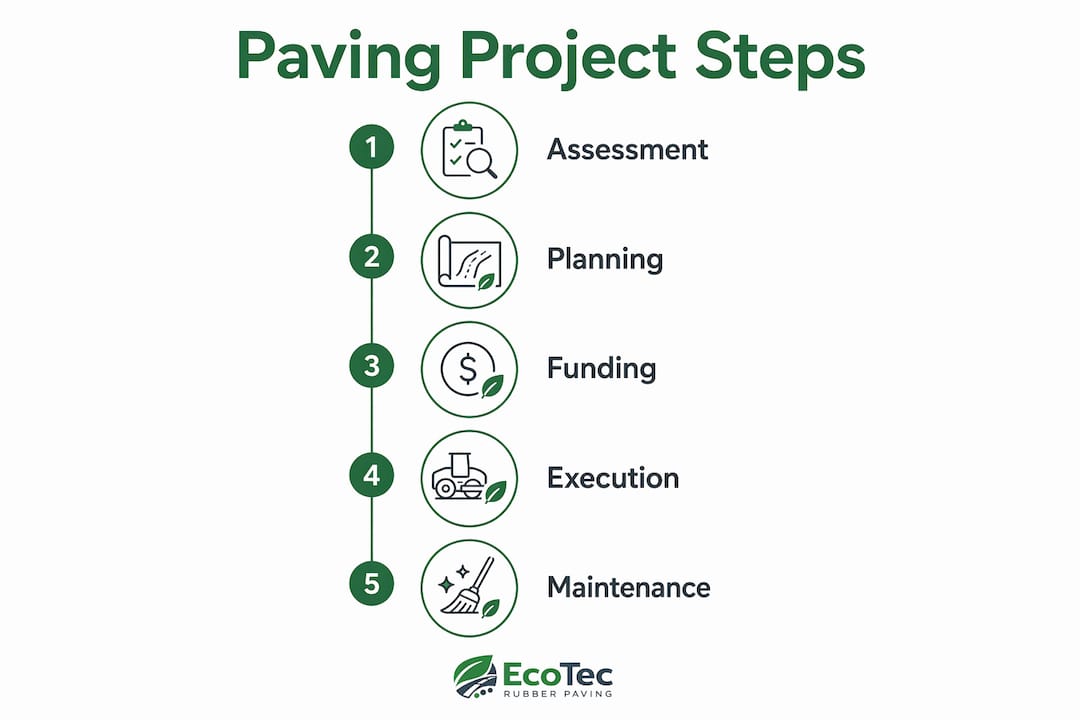
Standard paving operations follow a defined sequence:
- Utility clearance: Water, sewer, and gas lines are inspected and relocated if needed before any milling begins. Failure to sequence utility work ahead of paving is a common cause of rework and wasted budget.
- Cold milling: The existing surface is ground down to remove deteriorated material. Rome, NY's 2026 program uses cold milling on multiple ward streets as part of its annual resurfacing cycle. This process removes the top layers without full-depth excavation, reducing cost and improving surface smoothness.
- Base repair: Any subbase failures identified during milling are corrected before the new surface goes down.
- Overlay placement: New asphalt is laid, compacted, and finished to grade.
- Striping and restoration: Lane markings, curb ramps, and ADA-compliant features are restored to meet current standards.
Typical road segments take around two weeks to complete, with traffic controls including lane closures and parking restrictions in effect throughout. Projects in Norman, OK and Rye Brook, NY in july 2026 maintained at least one travel lane open during phased milling and overlay operations. Most municipal paving seasons run april through october to take advantage of stable temperatures for asphalt compaction.
Resident communication is not optional. Municipalities that notify residents at least 72 hours in advance of lane closures and parking restrictions generate fewer complaints and face fewer project delays from parked vehicles blocking work zones.
Key Takeaways
Municipal capital improvement paving succeeds when OCI-based data, multi-year CIP budgeting, coordinated utility sequencing, and dedicated preventative maintenance funding work together as a single system.
| Point | Details |
|---|---|
| OCI drives project selection | Roads scoring below 60 on the Overall Condition Index are prioritized for resurfacing to prevent costly reconstruction. |
| CIPs span 3–6 years | Year one is a locked budget; years two through five adjust annually based on updated condition data and fiscal realities. |
| Preventative maintenance saves money | Allocating 10% of the paving budget to preservation activities delays full reconstruction and extends road life. |
| Utility sequencing prevents rework | Completing utility relocation before milling begins avoids damage to new surfaces and eliminates costly do-overs. |
| Funding source matching matters | Aligning sales tax, grants, and bonds with the correct project types maximizes fiscal efficiency across the program. |
Why data discipline is the real test of a paving program
I have reviewed enough Capital Improvement Plans to know that the document itself is rarely the problem. The problem is how municipalities treat it once it is adopted.
The CIPs that work are the ones treated as living documents updated every year with real council actions, design contract awards, and public outreach milestones. The ones that fail get filed after adoption and pulled out again when a council member asks why their street has not been paved yet.
The second failure I see consistently is utility coordination. Planners schedule the paving, the asphalt goes down, and then a water main project cuts through the new surface six months later. That is not bad luck. It is a sequencing failure that a well-run CIP prevents by requiring utility clearance as a condition of project advancement.
The third issue is harder to fix because it is political. Ward-based paving requests, where roads get selected because a council member asked rather than because the data supports it, produce patchwork infrastructure with a faster rate of failure and inequitable outcomes across the city. The OCI scoring system exists precisely to give planners a defensible, transparent alternative to that dynamic. Use it consistently, document your methodology, and present it publicly. That transparency is the strongest tool a planner has.
— Roger
Ecotecrubber's approach to sustainable municipal paving
Municipal planners focused on long-term infrastructure performance are increasingly looking beyond traditional asphalt for surfaces where drainage, ADA compliance, and material sustainability matter.
Ecotecrubber installs the Rubberway® system, a recycled rubber paving solution built for Florida's climate challenges, including heat-induced cracking and standing water. The system delivers excellent drainage, crack resistance, and ADA-compliant surfaces without the maintenance cycle that asphalt requires. For municipalities managing public infrastructure paving projects that include pedestrian paths, plazas, and recreational surfaces, Ecotecrubber offers licensed, insured professional installations focused entirely on rubber paving. Review the full range of Rubberway® paving products to see which system fits your next capital project.
FAQ
What is municipal capital improvement paving?
Municipal capital improvement paving is the structured process local governments use to plan, fund, and execute road resurfacing and rehabilitation projects through multi-year Capital Improvement Plans tied to Pavement Management System data.
What OCI score triggers road paving eligibility?
Roads with an Overall Condition Index score below 60 are typically prioritized for resurfacing. Roads below 40 often require full reconstruction at significantly higher cost.
How long does a typical municipal paving project take?
Most road segments take around two weeks to complete, with phased milling and overlay operations maintaining at least one travel lane open throughout the work zone.
What percentage of a paving budget should go to preventative maintenance?
Preventative maintenance activities like crack filling and chip sealing should represent about 10% of the total paving budget to extend pavement life and reduce the frequency of full reconstruction.
How are municipal paving projects funded?
Common funding sources include dedicated sales tax revenues, state and federal transportation grants, general obligation bonds, and special assessment districts, with each source matched to the appropriate project type for fiscal efficiency.