
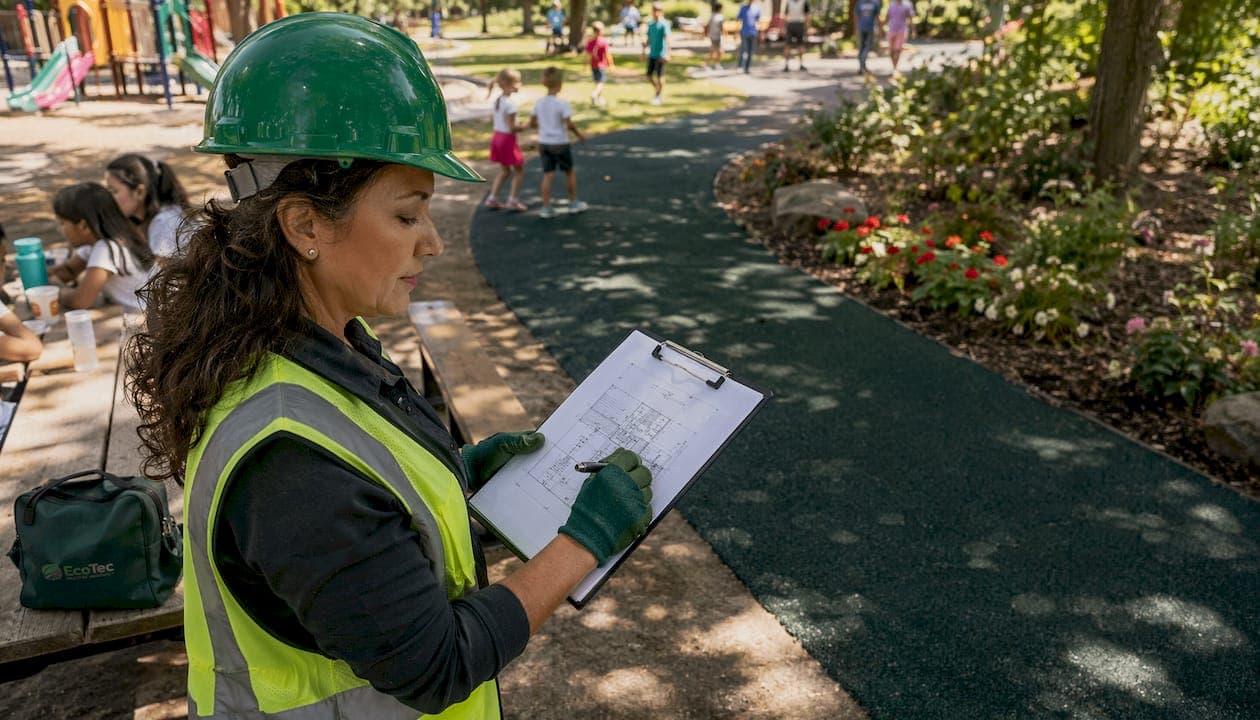
Commercial property ADA compliance paving is defined as the installation and maintenance of paved surfaces that meet federal Americans with Disabilities Act standards for dimensions, slopes, signage, and accessible route connectivity. Every commercial property open to the public carries this obligation under federal law. Federal fines for violations can reach $75,000 for a first offense, with private lawsuits adding $50,000 to $200,000 in legal fees. Those numbers make accessibility compliance paving one of the highest-stakes line items in any property manager's budget. Getting the paving right from the start costs far less than defending a lawsuit.
What are the key ADA guidelines for parking lot paving?
ADA guidelines for parking lots set specific minimums for space size, aisle width, slope, signage, and route quality. Meeting every requirement is not optional. Missing even one standard can expose a property to federal enforcement.
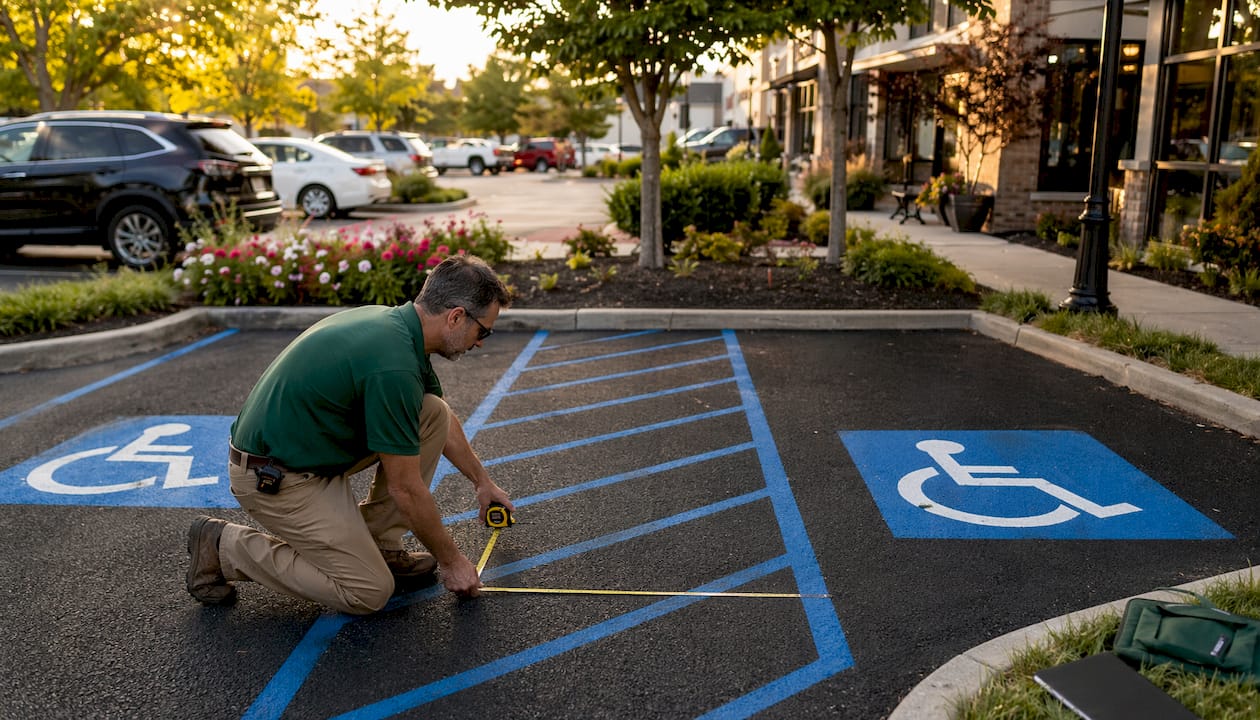
Parking space and aisle dimensions
Standard accessible parking spaces must be at least 8 feet wide with a 5-foot access aisle alongside. Van-accessible spaces require a minimum 11-foot-wide stall with an 8-foot access aisle, or an 8-foot stall with a 16-foot aisle. The ratio of accessible spaces to total spaces follows a tiered federal scale. A lot with 1–25 total spaces requires 1 accessible space. A lot with 26–50 spaces requires 2, and the count scales upward from there. At least one in every six accessible spaces must be van-accessible.
Slope requirements for parking and ramps
Surface slope violations are one of the most common reasons properties fail ADA audits. Parking spaces and access aisles must not exceed a 2% slope in any direction. ADA curb ramp requirements set a maximum running slope of 1:12, which equals 8.33%, and a maximum cross slope of 1:48, which equals 2.08%. Landings at the top and bottom of each ramp must be at least 48 inches deep. These numbers are legal maximums, not targets.
Signage standards
Every accessible space requires a sign mounted at least 60 inches above the ground, measured from the bottom of the sign to the finished grade. Van-accessible spaces need an additional "Van Accessible" designation. Signs must be visible from inside a parked vehicle. Faded or missing signage is a standalone violation, even when the pavement itself is compliant.
Accessible route connectivity
The accessible route from each parking space to the building entrance must be continuous, stable, and firm. The route cannot cross unpaved surfaces or require users to travel behind parked vehicles. Cross slopes on accessible routes must stay at or below 2.08%. Running slopes on routes must stay at or below 5% unless the route is classified as a ramp, in which case the 8.33% ramp standard applies.
| ADA Requirement | Standard |
|---|---|
| Standard accessible space width | 8 feet minimum |
| Van-accessible space width | 11 feet minimum (or 8 ft with 16-ft aisle) |
| Access aisle width | 5 feet minimum (8 feet for van spaces) |
| Max parking space cross slope | 2% (1:50) |
| Max curb ramp running slope | 8.33% (1:12) |
| Max curb ramp cross slope | 2.08% (1:48) |
| Minimum ramp landing depth | 48 inches |
| Signage mounting height | 60 inches minimum from grade |
How do you evaluate your property's ADA compliance before repaving?
A compliance evaluation before any repaving project protects you from two risks: starting work that fails inspection, and triggering broader upgrade obligations you did not budget for. Even minor restriping can legally require a full upgrade of the accessible path of travel to current ADA standards. That single fact changes how property managers should think about routine maintenance.
Common violations to look for
Walk your lot with a digital slope meter and a tape measure before calling any contractor. The most frequent failures include:
- Incorrect space count. Too few accessible or van-accessible spaces for the total lot size.
- Missing van-accessible stalls. Many older lots predate the van-accessible requirement entirely.
- Faded striping. Paint that has worn below visible contrast is a violation regardless of the underlying dimensions.
- Improper slopes. Pavement settling over time pushes cross slopes above the 2% limit in spaces and aisles.
- Signage deficiencies. Signs mounted too low, missing van designations, or obscured by landscaping.
- Broken or missing curb ramps. Ramps that have cracked, settled, or were never installed at all.
- Disconnected accessible routes. Paths that dead-end, cross vehicle lanes, or have surface breaks.
The alteration vs. maintenance distinction
The ADA draws a clear line between maintenance and alteration. Routine maintenance, such as crack sealing or pothole patching, does not automatically trigger a full compliance review. Alteration, which includes resurfacing, restriping, or reconfiguring the lot, does. Consulting a CASp inspector or a licensed architect before any paving work helps you classify the project correctly and plan the scope accordingly.
Pro Tip: Hire a Certified Access Specialist (CASp) for a pre-project audit. CASp inspectors carry state certification specifically for ADA access compliance and can identify violations that general contractors routinely miss.
How do you plan and execute an ADA compliant paving project?
A well-planned paving project integrates legal requirements, design specifications, and realistic budgets before a single shovel hits the ground. Skipping any of those three elements creates expensive problems after the fact.
Step-by-step project process
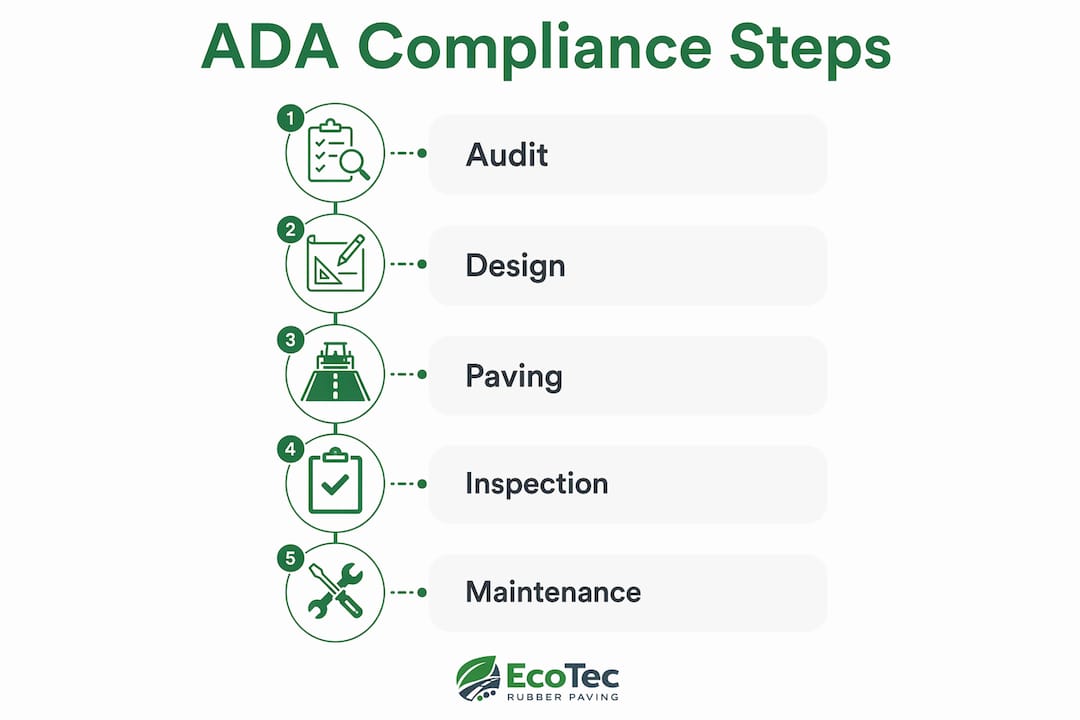
- Commission a CASp audit. Get a written compliance report before design begins. This document defines the legal baseline and protects you if the project is later challenged.
- Engage a licensed paving contractor with ADA experience. Licensed contractors who specialize in accessibility work understand slope tolerances, ramp construction, and signage installation as part of the paving scope, not as afterthoughts.
- Set slope targets below the legal maximum. Construction tolerances require targeting slopes below the legal limit. Aim for 1.5% cross slope instead of 2.08% to account for pavement settling and measurement variance. A surface installed at exactly 2.08% will likely fail inspection within a few years as the ground shifts.
- Budget for the full scope. Commercial paving costs range from $3 to $7 per square foot. A standard 100-space lot commonly runs $50,000 to $150,000 and takes 7 to 14 days to complete. ADA-specific work, including ramps, signage, and accessible route improvements, adds to that baseline.
- Specify surface texture and material. ADA requires firm, stable, and slip-resistant surfaces. Smooth concrete, properly installed asphalt, and rubber paving systems all qualify when installed correctly. Review paving surface material options before finalizing the material spec.
- Install signage as part of the paving contract. Signage is frequently treated as a separate task and then forgotten. Include sign posts, hardware, and mounting heights in the paving contract scope.
- Schedule a post-installation compliance check. Bring the CASp inspector back after completion to verify slopes, dimensions, and signage before the lot opens.
Pro Tip: Ask your contractor to provide as-built slope measurements at every accessible space and ramp landing. This documentation is your legal defense if a complaint is filed later.
| Project phase | Key action |
|---|---|
| Pre-design | CASp audit and written compliance report |
| Design | Slope targets set below legal maximums |
| Construction | Licensed contractor with ADA experience |
| Post-installation | CASp verification of slopes and signage |
| Ongoing | Annual compliance review and maintenance log |
What are the most common ADA paving pitfalls to avoid?
Most ADA compliance failures on commercial properties are not dramatic design errors. They are small, preventable problems that compound over time and eventually trigger complaints or lawsuits.
- Slope creep. Pavement settles after installation. A cross slope installed at exactly 2% can drift above the legal limit within a few years. Targeting 1.5% at installation builds in a safety margin.
- Faded markings. Paint fades faster in hot climates. Faded accessible space markings and access aisle lines are violations that inspectors cite routinely.
- Water pooling. Standing water in accessible spaces and aisles signals a drainage problem that also indicates a slope problem. Water pooling and uneven surfaces are early indicators of non-compliance requiring proactive maintenance.
- Ignored curb ramps. Ramps crack and settle independently of the surrounding pavement. A lot that passes inspection one year can fail the next if ramp edges have lifted or cracked.
- Scope underestimation. Property managers who budget only for restriping and discover mid-project that the alteration triggers a full accessible route upgrade face unexpected costs.
Treating ADA compliance as a one-time checklist is the single most expensive mistake a property manager can make. Pavement ages, slopes shift, and paint fades. A property that passed inspection three years ago may be out of compliance today. Routine annual reviews cost a fraction of what a federal complaint or private lawsuit will cost.
The legal exposure is real. First-offense federal fines reach $75,000. Private litigation adds $50,000 to $200,000 in attorney fees on top of that. No repaving project is expensive enough to justify skipping compliance.
Key Takeaways
ADA-compliant commercial paving requires meeting strict federal standards on dimensions, slopes, signage, and accessible routes, then maintaining those standards continuously as pavement ages.
| Point | Details |
|---|---|
| Know the legal minimums | Parking spaces, ramps, and routes each carry specific ADA dimension and slope requirements. |
| Audit before you pave | A CASp inspection before any repaving project defines scope and prevents costly surprises. |
| Target below the maximum | Install cross slopes at 1.5% instead of 2.08% to account for settling and measurement variance. |
| Budget for the full project | A 100-space lot can cost $50,000 to $150,000; ADA work adds to that baseline. |
| Maintain continuously | Annual compliance reviews catch slope drift, faded markings, and drainage problems early. |
Why I think most property managers underestimate ADA paving compliance
After working with commercial properties across Florida, the pattern I see most often is not willful neglect. It is a misunderstanding of what ADA compliance actually requires over time.
Property managers hire a paving contractor, get a fresh lot, and check the box. Three years later, the pavement has settled, the striping has faded, and the cross slopes have drifted above 2%. A tenant files a complaint, or worse, a professional plaintiff's attorney files a lawsuit. The property owner then spends more on legal fees than the original paving project cost.
The fix is not complicated. ADA compliance is a continuous obligation, not a one-time event. Build an annual review into your property maintenance calendar. Bring a CASp inspector back every two to three years. Restripe before markings fade completely, not after.
The other mistake I see is treating ADA compliance as purely a legal burden. A well-designed accessible lot serves every customer better, not just those with disabilities. Wider aisles, clear markings, and smooth routes reduce accidents, reduce liability, and signal to customers that the property is professionally managed. That is a business advantage, not just a legal obligation. Inclusive design enhances a property's reputation in ways that go well beyond regulatory compliance.
— Roger
Ecotecrubber's ADA-compliant paving solutions for Florida properties
Florida's heat, heavy rainfall, and freeze-thaw cycles create paving conditions that accelerate slope drift, cracking, and drainage failures. Those are exactly the conditions that push a compliant lot out of compliance faster than average.
Ecotecrubber installs the Rubberway® rubber paving system on commercial properties across Florida, delivering firm, stable, slip-resistant surfaces that meet ADA texture and drainage requirements. The recycled rubber material resists cracking and handles Florida's standing water problems better than standard asphalt. Ecotecrubber is licensed and insured, and every project is coordinated by specialists focused exclusively on rubber paving. Property managers who want a durable, ADA-compliant paving solution built for Florida's climate can request a project proposal directly through the Ecotecrubber website.
FAQ
What slope is required for ADA-compliant parking spaces?
ADA standards require parking spaces and access aisles to have a maximum cross slope of 2% in any direction. Curb ramps may have a maximum running slope of 8.33% (1:12) with a maximum cross slope of 2.08% (1:48).
Does restriping a parking lot trigger ADA compliance requirements?
Yes. Restriping is classified as an alteration under the ADA, which can trigger an obligation to upgrade the entire accessible path of travel to current standards. A CASp inspection before restriping helps define the full project scope.
How many accessible parking spaces does a commercial lot require?
The number scales with total lot size. A lot with 1–25 spaces requires 1 accessible space. Larger lots follow a tiered federal scale, and at least one in every six accessible spaces must be van-accessible.
What are the fines for ADA parking violations?
Federal fines for a first ADA parking offense can reach $75,000. Private lawsuits filed by individuals can add $50,000 to $200,000 in legal fees on top of any federal penalty.
How often should a commercial property review ADA paving compliance?
ADA compliance requires ongoing maintenance as pavement ages, slopes shift, and markings fade. Annual visual inspections and a professional CASp review every two to three years represent the minimum standard for most commercial properties.