

Florida HOA boards that want to stay legally defensible on outdoor compliance should do four things right now: audit governing documents against Florida Statutes Chapter 720, confirm your enforcement process matches §720.305, apply the visibility test from §720.3045 before citing any backyard item, and publish a current ARC checklist. Boards that skip even one of those steps are one selective-enforcement claim away from a costly legal dispute. For any paving repairs or upgrades in the pipeline, Ecotecrubber's Rubberway® system is a permeable, ADA-compliant option worth putting on the vendor shortlist now.
Immediate actions to take this week:
- Pull your CC&Rs, bylaws, and current rules and compare them against the 2025 version of Chapter 720.
- Check §720.3045: if any current rule restricts items that are not visible from the parcel frontage, an adjacent parcel, an adjacent common area, or a community golf course, flag it for legal review.
- Walk the community with a dated inspection log and photograph every potential violation.
- Post your ARC application checklist on the association website (required for associations with 100 or more parcels under post-2024 statutory changes).
- Note that UF/IFAS Florida-Friendly Landscaping guidance shapes what boards can and cannot restrict under §720.3075.
Table of Contents
- What should your board inspect and document today?
- How does Florida law limit and enable HOA outdoor rules?
- What outdoor rules can Florida HOAs actually enforce?
- How to enforce rules lawfully: notices, hearings, and a clear timeline
- How to work with homeowners on ARC submissions and landscaping conversions
- What technical specs should boards require for outdoor paving projects?
- How do you amend HOA rules or CC&Rs in Florida?
- When should you call an HOA attorney?
- Key Takeaways
- Moving from reactive to proactive compliance
- Ecotecrubber's Rubberway® system for HOA paving compliance
- Authoritative sources and next-step reading
What should your board inspect and document today?
A focused 30-day sprint covers most of the compliance gaps that generate disputes. Run this sequence: Inspect → Document → Notify → Offer ARC meeting.
- Street-view inspection. Walk or drive every street and photograph any visible exterior change since the last inspection. Rainy season (May through October) accelerates lawn growth dramatically, so schedule inspections more frequently during those months rather than relying on a single annual sweep.
- Pull pending ARC requests. Confirm every open application has a logged receipt date and a decision deadline per your governing documents.
- Review recent enforcement letters. Check that each letter cites the specific rule violated, describes the cure steps, and includes the 14-day notice of hearing rights required by §720.305.
- Confirm web and records compliance. Associations with 100 or more parcels must maintain a website with governing documents, meeting notices, and financial records accessible to members under post-2024 amendments to Chapter 720.
- Check board education status. Post-2024 changes require newly elected or appointed board members to complete approved education within a set period; verify your board is current.
Pro Tip: The most commonly missed items are backyard installations that boards have been citing for years but that §720.3045 now protects from restriction. Vegetable gardens, clotheslines, and recreational vehicles stored out of sight from the frontage and adjacent parcels are off-limits for enforcement. Review your last 12 months of violation letters against that visibility standard before sending another one.
How does Florida law limit and enable HOA outdoor rules?
Florida Statutes Chapter 720 is the controlling statute for homeowners' associations in Florida. It sets the floor for due process, defines what boards can regulate, and, critically, carves out categories of items boards cannot touch regardless of what the CC&Rs say.
§720.3045 — the visibility rule. Under this section, an association cannot restrict installations, displays, or storage that are not visible from the parcel's frontage, an adjacent parcel, an adjacent common area, or a community golf course. Artificial turf, boats, flags, vegetable gardens, clotheslines, and recreational vehicles all fall within that protection when they are out of sight from those vantage points. The practical effect: boards must test visibility from each of those four positions before issuing a notice.
§720.305 — notice, hearing, and fines. Before levying any fine or suspension, the board must give the parcel owner at least 14 days' written notice of the right to a hearing. The hearing must be held within 90 days. Fines are capped at $100 per violation with an aggregate cap of $1,000, unless governing documents authorize higher amounts. The hearing committee must include at least three members who are not officers, directors, employees, or close relatives of those. Hearings may be held electronically.
§720.3075 — Florida-Friendly Landscaping. Boards cannot enforce covenants that effectively prohibit water-wise or drought-tolerant landscaping. The board retains review authority for appearance and can apply reasonable aesthetic standards, but an outright ban on Florida-Friendly plants or practices is void.
| Statute | Core rule | Required board action |
|---|---|---|
| §720.3045 | Cannot restrict items not visible from frontage, adjacent parcel, common area, or golf course | Apply four-point visibility test before any citation |
| §720.305 | 14-day notice, hearing within 90 days, $100/violation cap, $1,000 aggregate | Update all enforcement letters and fine schedules |
| §720.3075 | Cannot prohibit Florida-Friendly Landscaping | Audit CC&Rs for absolute turf or plant bans; flag for amendment |
| Chapter 720 (post-2024) | Website/records requirements for 100+ parcel associations; board education mandates | Publish governing docs online; confirm board training compliance |
When governing documents conflict with state law, state law wins. CC&Rs that predate §720.3045 or §720.3075 may contain language that is now unenforceable. Boards should align rules and forms to statutory changes rather than continuing to enforce provisions a court would strike down.
What outdoor rules can Florida HOAs actually enforce?
Most boards enforce rules across six broad categories. The enforceability of each depends heavily on visibility and whether the governing documents are current.
- Exterior paint and roofing. Color palettes and approved roofing materials are among the most consistently enforceable rules because changes are visible from the street by definition.
- Fences and walls. Height, material, and placement are fair game when visible. Boards cannot use fence rules to indirectly restrict backyard items that §720.3045 protects.
- Sheds and accessory structures. Visible from the frontage or adjacent parcel? Enforceable. Tucked behind a solid fence with no sightline? Likely not.
- Landscaping. Lawn overgrowth is one of the most common HOA violations in Florida, especially May through October. Boards can enforce maintenance standards but cannot ban Florida-Friendly plant choices under §720.3075.
- Paving and driveways. Material, color, and drainage impact are all reviewable through the ARC process. Permeable paving options that meet stormwater requirements are worth approving proactively.
- Parking. Vehicle type, placement, and inoperable vehicles are enforceable when visible from the street or common areas.
Scope notes: Safety concerns and local ordinances can expand board authority beyond what the CC&Rs alone would support. Easements recorded in the county may also limit what homeowners can install regardless of HOA approval.
Pro Tip: Pull your CC&Rs and search for the words "turf," "grass," and "lawn." Older documents sometimes require a minimum percentage of turf coverage. That language is likely void under §720.3075. Flag it for your attorney before your next enforcement cycle, not after a homeowner challenges it.
How to enforce rules lawfully: notices, hearings, and a clear timeline
Follow the association's governing documents plus the notice and hearing timelines required by §720.305 to impose any fine or suspension. Skipping a step does not just delay enforcement; it can void the fine entirely and expose the board to a selective-enforcement claim.
Step-by-step enforcement sequence:
- Collect objective evidence: dated photographs, inspector name, parcel address, and the specific rule cited.
- Send a written courtesy notice describing the violation and the cure steps. This is not the formal §720.305 notice but reduces disputes.
- If uncured, send the formal written notice: identify the violation, state the proposed fine or suspension, and give the owner at least 14 days to request a hearing.
- If the owner requests a hearing, schedule it within 90 days before a committee of at least three members who are not officers, directors, employees, or close relatives of those.
- The committee (not the board) decides whether to confirm, reduce, or reject the fine.
- If confirmed, record the fine and begin collections per governing documents and state law.
Sample notice language fragment: "Pursuant to Florida Statutes §720.305, you are hereby notified of the following violation: [describe violation and rule citation]. You have the right to request a hearing before the association's fining committee within 14 days of this notice. To request a hearing, contact [name/address/email]."
Documentation checklist: dated photographs, property inspection log with inspector name, copy of the rule cited, copy of each notice sent with proof of delivery, and written committee decision.

| Enforcement step | Statutory requirement | Practical note |
|---|---|---|
| Written notice | At least 14 days before hearing | Must describe violation and cure steps |
| Hearing window | Within 90 days of notice | Committee of 3+ non-officer members; may be electronic |
| Fine per violation | $100 cap (unless governing documents allow more) | Aggregate cap of $1,000 |
| Collections/suspension | Per governing documents | Engage counsel before foreclosure steps |
Consistent, documented enforcement is the single most important protection a board has. Boards that enforce rules against some homeowners but not others face selective-enforcement claims that can unwind years of compliance work.
Escalation timeline: Friendly notice (Day 1) → Formal §720.305 notice (Day 15 if uncured) → Hearing scheduled (within 90 days) → Committee decision → Fine recorded → Collections if unpaid. Engage management at the formal notice stage and counsel before any suspension of access rights or collections action.
How to work with homeowners on ARC submissions and landscaping conversions
A well-run ARC process prevents most disputes before they start. The goal is a clear, predictable path from application to approval that homeowners can follow without a lawyer.
What a complete ARC submission looks like:
- Site plan showing property boundaries, existing structures, utility lines, drainage swales, and easements.
- Description of materials, colors, and dimensions.
- Phased implementation schedule if the project spans multiple weeks.
- Contractor name, license number, and insurance certificate.
- Drainage notes if the project affects impervious surface area.
Detailed site plans and phased schedules reduce committee concerns about drainage and grading. Vague, all-at-once proposals are the most common reason for delays and denials.
Phased approval approach: Allow immediate work on items that are clearly within existing rules (paint, minor plantings). Require conditions for projects that affect drainage or grading (professional site plan, phased schedule, post-installation inspection). Deny only when a project clearly violates a valid, enforceable rule.

For Florida-Friendly Landscaping conversions, require a phased plan that addresses screening, appearance, and maintenance. The board can apply reasonable aesthetic standards; it cannot reject the conversion outright.
Pro Tip: When a homeowner's project could affect drainage or grading, ask for a professional site plan showing utility lines and swales before approving. It takes one poorly drained patio to create a neighbor dispute that costs more to resolve than the original project.
What technical specs should boards require for outdoor paving projects?
Require vendor documentation for drainage performance, permeability, ADA compliance, and Florida-grade durability before approving any paving project. Florida's heat, UV exposure, and stormwater rules make material selection a compliance issue, not just an aesthetic one.
Material considerations for Florida's climate:
- Porosity and drainage. Impermeable surfaces increase runoff and can trigger local stormwater requirements. Permeable paving options that allow water to pass through reduce that risk. For a detailed look at how permeable surfaces support stormwater compliance, the permeable paving and HOA stormwater rules guide covers the board-level decisions involved.
- Slip resistance. Pool decks and walkways must meet slip-resistance standards; request test data from vendors.
- UV and heat resistance. Florida's sun degrades many standard paving materials within a few years. Ask for warranty terms that specifically address UV exposure and thermal cycling.
- ADA compliance. Common areas and shared walkways must meet ADA surface requirements. The ADA compliance paving guide outlines the documentation boards should request from vendors.
Vendor documentation checklist:
| Item | Why it matters |
|---|---|
| Permeability test results | Confirms drainage performance for stormwater compliance |
| Slip-resistance rating | Required for pool decks and pedestrian walkways |
| UV/heat warranty | Protects against premature failure in Florida's climate |
| ADA compliance certificate | Required for common areas and shared access routes |
| Installer license and insurance | Board liability protection |
| Maintenance schedule | Affects long-term HOA budget and appearance standards |
Ecotecrubber's Rubberway® system uses recycled tire materials to deliver a permeable, crack-resistant surface that addresses drainage, ADA, and durability requirements in a single product. For boards reviewing construction plan requirements before approving a paving project, the Miami-Dade construction plan review guide explains what permit reviewers look for in technical submissions.
How do you amend HOA rules or CC&Rs in Florida?
The board can create and modify reasonable operational rules under existing CC&Rs without a member vote, as long as those rules do not conflict with the declaration or state law. Amending the CC&Rs themselves requires a member vote, and the threshold is set by the declaration, typically two-thirds or three-quarters of all voting interests.
Rule change vs. covenant amendment:
- Board-adopted rules: Require proper notice of the board meeting, a board vote, and distribution to members. Effective relatively quickly.
- CC&R amendments: Require written notice to all members, a membership vote meeting the declaration's threshold, and recording in the county official records.
Drafting tips to avoid unenforceable language:
- Never include an absolute ban on turf alternatives or Florida-Friendly plants; §720.3075 voids it.
- Avoid rules that restrict backyard items without a visibility qualifier; §720.3045 will preempt them.
- Write rules in terms of observable standards (height, color, material) rather than categorical prohibitions.
- Have a Florida-licensed HOA attorney review any amendment before the member vote.
Voting checklist: Provide written notice at least 14 days before the meeting (check your declaration for longer requirements). Confirm quorum. Achieve the required percentage of all voting interests (not just those present). Record the amendment in the county official records within the timeframe your documents specify.
When should you call an HOA attorney?
Consult counsel when disputes involve statutory interpretation, potential selective-enforcement claims, or significant fines, foreclosure, or collections steps. Those are not situations where a board should rely on management guidance alone.
Decision triggers for engaging an attorney:
- A homeowner threatens litigation or sends a demand letter.
- A violation involves ambiguous statute application (e.g., whether an item is "visible" under §720.3045).
- The board is considering suspending access rights or pursuing collections.
- A pattern of repeat noncompliance suggests a homeowner may raise a selective-enforcement defense.
- A project raises ADA or insurance exposure questions.
- The board wants to amend CC&Rs and needs language reviewed for statutory compliance.
Document checklist for your legal meeting:
- Current CC&Rs, bylaws, and all board-adopted rules.
- Copies of all notices sent to the homeowner, with proof of delivery.
- ARC submissions and decisions related to the dispute.
- Dated photographs and inspection logs.
- Meeting minutes where the violation or enforcement action was discussed.
- Any written guidance from the management company.
Selective enforcement is one of the most common and costly mistakes Florida HOA boards make. Bringing complete documentation to your attorney shortens the engagement and reduces fees.
Key Takeaways
Florida HOA outdoor compliance requires aligning governing documents with Chapter 720, applying the §720.3045 visibility test before every citation, and following the §720.305 notice and hearing process without shortcuts.
| Point | Details |
|---|---|
| Visibility test first | Apply the §720.3045 four-point visibility test before issuing any backyard citation. |
| Due-process timelines | Give written notice sufficiently in advance and hold hearings promptly; fines are limited per violation and in aggregate unless governing documents allow otherwise. |
| Florida-Friendly Landscaping | §720.3075 voids absolute turf bans; audit CC&Rs and remove unenforceable language before your next enforcement cycle. |
| Consistent documentation | Photograph every violation with dates and inspector names; inconsistent enforcement invites selective-enforcement claims. |
| Ecotecrubber for paving | Ecotecrubber's Rubberway® system provides permeable, ADA-compliant paving that meets Florida stormwater and durability requirements for HOA projects. |
Moving from reactive to proactive compliance
Proactive policy plus clear communication produces fewer fines and fewer lawsuits. That is not an aspiration; it is what the enforcement data consistently shows. Boards that wait for complaints before inspecting, or that update forms only after a legal challenge, spend far more time and money than boards that run a quarterly street-view inspection and keep their ARC forms current.
The cultural shift is smaller than it sounds. A board that sends a one-page seasonal reminder about rainy-season lawn care in April, before the violations start, will write fewer formal notices in July. A board that publishes a clear ARC checklist with a two-week turnaround commitment will receive better applications and approve more of them on the first submission.
What boards underestimate is how much enforcement friction comes from homeowners who genuinely did not know the rule existed or thought it did not apply to them. Posting governing documents online, sending an annual compliance summary, and making the ARC process feel navigable rather than adversarial changes the dynamic. Residents who feel the process is fair are far less likely to push back when a notice arrives.
The boards that handle outdoor compliance well are not the ones with the strictest rules. They are the ones whose rules are current, whose process is predictable, and whose homeowners know what to expect before they start a project.
Ecotecrubber's Rubberway® system for HOA paving compliance
Florida HOA boards dealing with cracked driveways, standing water on pool decks, or aging walkways that no longer meet ADA standards have a paving option that addresses all three at once. Ecotecrubber installs the Rubberway® permeable rubber paving system using recycled tire materials, delivering a surface that drains through rather than pooling, resists Florida's heat-driven cracking, and meets ADA surface requirements for common areas and shared walkways.
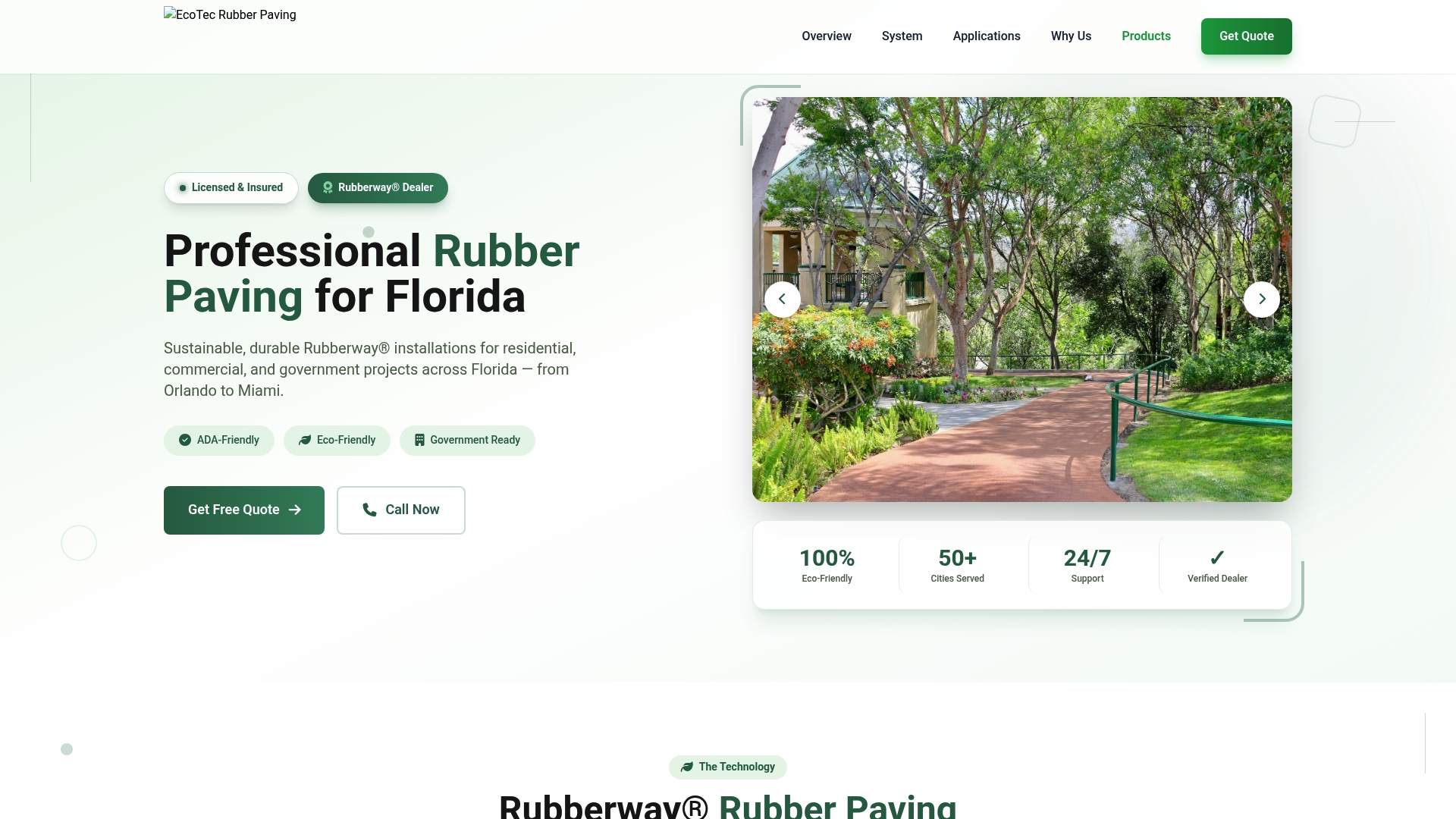
The system works across the full range of HOA outdoor surfaces: residential driveways, pool decks, patios, community walkways, and stormwater-sensitive areas where impermeable materials would trigger local drainage requirements. Because Rubberway® is permeable by design, it supports compliance with local stormwater rules without requiring separate drainage infrastructure. For boards building a vendor packet, request drainage test results, permeability specs, ADA compliance documentation, warranty terms covering UV and thermal cycling, and proof of installer licensing and insurance. Ecotecrubber is licensed and insured, and every project is coordinated by specialists focused exclusively on rubber paving. Contact Ecotecrubber to request a site assessment or vendor documentation package for your next HOA paving project.
Authoritative sources and next-step reading
Boards should work from primary sources when making enforcement decisions. The resources below are the ones cited throughout this article.
Florida statutes:
- Florida Statutes Chapter 720 (Florida Senate, 2025) — full text of the Homeowners' Associations chapter.
Florida-Friendly Landscaping:
- UF/IFAS: Key changes for HOAs under House Bill 1203 — practical summary of 2024 statutory changes affecting HOA landscaping rules.
Permitting and construction plan review:
Practical HOA guidance:
For community-specific questions about statute interpretation, CC&R amendments, or enforcement disputes, consult a Florida-licensed HOA attorney. General information in this article does not constitute legal advice, and rules change; confirm current requirements with the Florida Legislature's official statute database or qualified counsel.