

Hire a rubber-paving vendor who can hand you, on day one, a Florida contractor license, a COI naming your HOA as Additional Insured, an itemized bid with explicit subgrade and compaction specs, a signed Rubberway®-style warranty and at least three verifiable HOA references. That single standard filters out most of the risk before a shovel touches the ground.
Before you issue your RFP, lock in these non-negotiables:
- Active Florida contractor license (verify through the state licensing board)
- COI naming the HOA as Additional Insured, with at least $1,000,000 per occurrence general liability and $1,000,000 automobile liability coverage (plus $1,000,000 umbrella coverage for high-risk work)
- Itemized bid specifying aggregate base depth, compaction density, and rubber surfacing system (Rubberway® or equivalent)
- Written warranty and maintenance plan
- Three verifiable HOA references with permission for a site visit
- Mandatory pre-bid site walk, documented and circulated as a written addendum
Any bid that arrives significantly below the average of comparable proposals is a red flag. Demand written clarification before you consider it further. EcoTec Rubber Paving meets every item on this list and focuses exclusively on Florida installations, which is where local experience pays off most.
Table of Contents
- Why rubber paving is often the right call for Florida HOAs
- What qualifications must every bidder supply?
- How do you run an RFP and evaluate bids fairly?
- Questions to ask vendors during interviews and site visits
- What contract clauses protect your HOA?
- How do you accept the work before releasing final payment?
- What do HOA-scale rubber paving projects cost and how long do they take?
- Why Ecotecrubber is a strong fit for Florida HOA projects
- Key Takeaways
- The mistake most HOA boards make
- Ecotecrubber's rubber paving services for Florida HOAs
- Useful sources
Why rubber paving is often the right call for Florida HOAs
Florida's combination of heavy rainfall, sandy soils, intense UV, and daily heat cycles punishes conventional pavement faster than almost any other climate in the country. Rubberway®-style rubber paving addresses each of those pressure points directly.
The porous surface drains water through the material rather than sheeting it across the pavement, which cuts standing water on pool decks and walkways. The recycled-rubber composition flexes under thermal expansion instead of cracking, which is the failure mode that ends asphalt's useful life prematurely in South Florida summers. Slip resistance is built into the texture, reducing resident liability around wet areas. And because the system uses recycled tire materials, it supports the sustainability commitments many HOA boards now include in community communications.
ADA compliance is another practical driver. Rubber surfacing can be installed to meet ADA slope and firmness requirements, reducing the board's exposure on accessible routes. Lifecycle cost matters too: a properly installed rubber surface with documented subgrade prep typically requires less reactive maintenance than asphalt over a 10–20 year horizon, which is directly relevant to reserve fund planning.
What qualifications must every bidder supply?
Paving specialists confirm that local soil and climate knowledge is non-negotiable for longevity in Florida. Treat the following as a hard pass/fail checklist before a vendor makes your shortlist.
Required paperwork:
- Active Florida contractor license (verify on the state licensing board website before the interview)
- COI naming the HOA as Additional Insured, with at least $1,000,000 per occurrence general liability, $1,000,000 automobile liability coverage, and $1,000,000 umbrella coverage for high-risk work
- Workers' compensation coverage with no exclusions for subcontractors
- Proof of bonding capacity appropriate to your project size
Technical deliverables in the bid:
- Aggregate base depth specified in inches
- Compaction density target specified according to industry standards
- Rubber surfacing system identified by name and mix design
- Drainage plan with slope percentages
- ADA compliance details for accessible routes
Verification steps: Pull the license number directly from the Florida Department of Business and Professional Regulation portal. Call the COI issuer to confirm the policy is active. If a vendor resists providing three verifiable HOA references, treat that resistance as a disqualifying signal.
Pro Tip: Ask for references specifically from other Florida HOAs, not general residential or commercial clients. Request permission to visit at least one completed installation and look for drainage performance and surface integrity, not just appearance.
How do you run an RFP and evaluate bids fairly?
A mandatory pre-bid site visit ensures every vendor prices the same scope. Require attendance, document all questions in writing, and circulate a formal addendum to all bidders simultaneously. Vendors who skip the site walk or submit questions late are showing you their project management style.
RFP structure (minimum sections):
- Community overview and project location
- Scope of work with explicit subgrade depth, compaction density, drainage requirements, and ADA specs
- Insurance and licensing requirements (non-negotiable)
- Submission deadline and sealed-bid format
- Evaluation criteria and weights (published in advance)
- Site-walk date and attendance requirement
Score every compliant bid with a weighted matrix. Industry guidance recommends these weights as a starting point:
| Criterion | Weight |
|---|---|
| Price | 25% |
| Florida HOA experience | 20% |
| References | 20% |
| Scope understanding | 15% |
| Insurance and licensing | 10% |
| Communication and responsiveness | 10% |
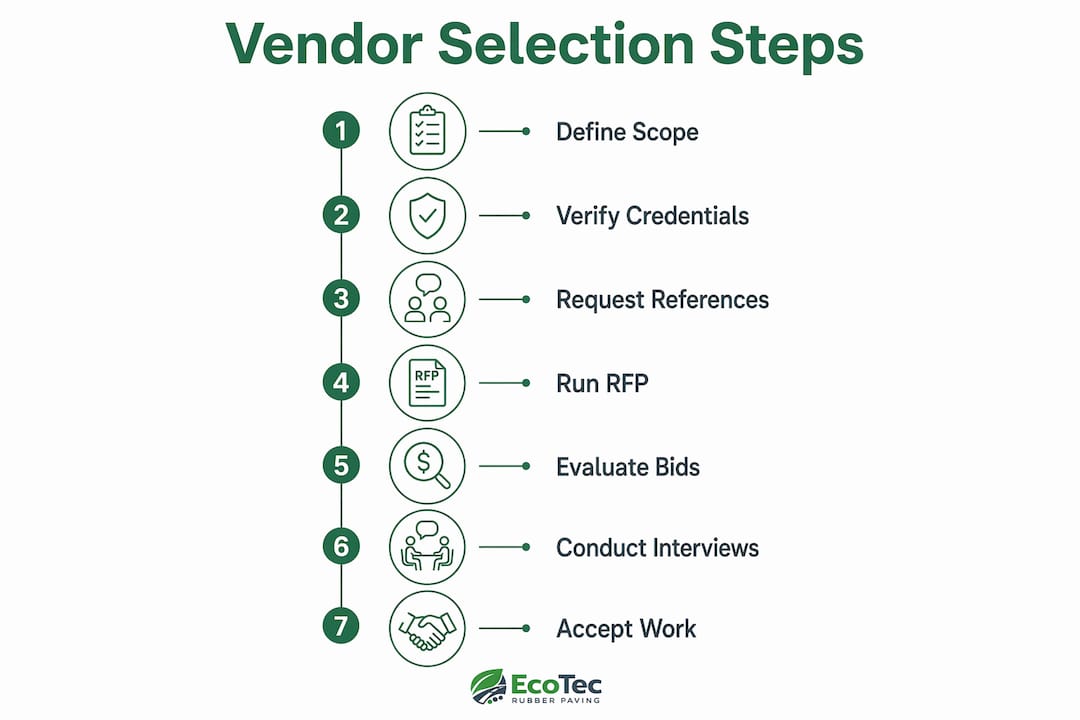
Vendor responsiveness during the RFP predicts project communication quality. A vendor who takes four days to answer a pre-bid question will take four days to answer a field question during installation. Score it accordingly.
Red flags: verbal-only bids, missing line items, refusal to sign standard HOA contract protections, and any price more than 20% below the average of comparable bids.
Questions to ask vendors during interviews and site visits
Technical questions reveal whether a vendor actually understands Florida conditions or is just familiar with the general process.
- What aggregate base depth do you specify for Florida sandy soils, and why?
- How do you verify compaction density on site? Do you use a nuclear density gauge?
- How does your rubber surfacing mix perform under sustained UV and heat above 95°F?
- What drainage slope do you design for, and how do you verify it after installation?
- Which ADA surfacing measures do you include as standard, and which are add-ons?
- How many crew members will be on site, and what equipment will they bring?
- How do you phase work to keep resident access open during installation?
- What is your cleanup and debris removal plan?
For references, ask specifically: "Can we visit a Florida HOA project you completed in the last two years?" A vendor who cannot produce that is not the right fit for your community.
Site-visit checklist: Look for consistent surface texture with no visible seams or delamination, verify drainage slope with a level, check for any settlement or cracking near transitions, and ask the property manager whether the vendor communicated clearly during the project.
What contract clauses protect your HOA?
HOA contracting guidance identifies several clauses that reduce financial and legal exposure. Insist on all of them.
- Explicit scope exhibit attached to the contract (not just referenced)
- COI maintenance requirement with annual renewal notices sent to the HOA
- 30-day termination for convenience clause
- Termination for cause with defined cure period
- Indemnification in favor of the HOA
- Lien waiver required for each payment over $5,000
- Written warranty terms with clear coverage definitions
- Price escalation cap (CPI-indexed or fixed percentage annually)
Payment schedule template:
- Deposit: a reasonable initial payment at contract signing
- Milestone payment 1: after subgrade inspection and approval
- Milestone payment 2: after rubber surfacing installation
- Final retainage held until punchlist completion and COI renewal verified
Note: Florida Statutes § 720.3055 requires competitive bids for certain contracts based on the HOA's budget. Have your HOA attorney review contracts before signing.
How do you accept the work before releasing final payment?
Most pavement failures trace back to inadequate subgrade preparation, not the surface material. Your acceptance inspection should verify the work below the surface, not just what you can see.
- Confirm aggregate depth and compaction density against the contract specs
- Verify drainage gradient with a level at multiple points
- Check adhesion and seam integrity across the rubber surfacing
- Confirm ADA clearances on all accessible routes
- Document everything with dated photos
Conduct the walk-through with both a vendor representative and a board member present. Require a signed warranty document and a current COI before releasing any portion of the final retainage.
Pro Tip: Retain the final 10% for 30 days after installation. A short post-installation inspection at the 30-day mark catches settlement and drainage failures before the warranty clock becomes a dispute.
What do HOA-scale rubber paving projects cost and how long do they take?
Cost drivers for Florida HOA projects include base repair extent, aggregate depth, drainage work, site mobilization, ADA modifications, color selection, and warranty length. No single per-square-foot figure applies across all scenarios, but lifecycle cost comparisons consistently favor better subgrade preparation upfront over reactive repairs later.
| Scenario | Mobilization | Installation | Curing | Punchlist | Total |
|---|---|---|---|---|---|
| Small cul-de-sac resurfacing | 1–2 days | 2–3 days | 1–2 days | 1 day | 5–8 days |
| Medium parking area conversion | 2–3 days | 4–6 days | 2 days | 1–2 days | — |
| Full common-area resurfacing | 3–5 days | — | 2–3 days | 2–3 days | — |
Phase heavy-use areas first so residents maintain access during the project. Build weather delays into your schedule; Florida's afternoon storm season can add days to any outdoor installation.
Why Ecotecrubber is a strong fit for Florida HOA projects
Ecotecrubber installs the Rubberway® system exclusively in Florida, which means every credential, reference, and case study they provide is directly relevant to your climate and soil conditions. That focus matters when you are vetting vendors: a contractor who splits time between Florida and other states has less accumulated knowledge of local drainage behavior, sandy subgrade challenges, and permit requirements.
When you request Ecotecrubber's proposal package, ask for:
- Active Florida contractor license number (verify independently)
- COI naming your HOA as Additional Insured
- Itemized scope with compaction density targets and aggregate depth
- Sample warranty document for a Rubberway® installation
- Portfolio of Florida HOA projects with contact references
Ecotecrubber's ADA-compliant surfacing and documented installation process align directly with the selection criteria this guide outlines. Their focus on rubber paving, rather than a general paving menu, means the crew installing your community's surfaces works with this system every day.
Key Takeaways
Choosing the right rubber-paving vendor for a Florida HOA comes down to verified credentials, explicit subgrade specs in the bid, and HOA-specific references you actually contact.
| Point | Details |
|---|---|
| Bid red-flag rule | Treat any bid more than 20% below the average as suspicious and demand written clarification. |
| Subgrade specs are mandatory | Require aggregate base depth and 95% Proctor compaction density in every bid — most failures start underground. |
| COI naming HOA as Additional Insured | Minimum $1,000,000 per occurrence general liability coverage, $1,000,000 automobile liability, and $1,000,000 umbrella for high-risk work; verify the policy directly with the insurer. |
| Score bids with a weighted matrix | Weight price at 25%, Florida HOA experience at 20%, references at 20%, scope understanding at 15%, insurance and licensing at 10%, and communication at 10%. |
| Ecotecrubber for Florida HOAs | Ecotecrubber's Rubberway® system and Florida-only focus match the selection criteria this guide outlines. |
The mistake most HOA boards make
The pattern I see repeated most often: a board selects the lowest bid, the vendor skips detailed subgrade prep to protect their margin, and the surface fails within three years. The board then spends more on emergency repairs than the price difference between the low bid and the next-highest proposal ever was.
The pre-bid site visit is where this gets prevented, not the contract. When you require every vendor to walk the site, answer questions in writing, and submit a sealed bid against an identical scope, the low-ball outlier becomes obvious. A vendor who cannot explain their compaction method or who submits a bid with no line items for base work is telling you exactly what the installation will look like.
One Florida community avoided a failed installation by requesting a sample COI during the RFP phase. The low bidder's certificate listed the wrong policy period. That single document check saved the board from a contractor who had let their coverage lapse. The second-lowest bid, from a vendor with three verifiable HOA references and a complete scope exhibit, became the obvious choice.
Contact Ecotecrubber to request an RFP-ready scope and a preliminary site walkthrough before you issue your next bid.
Ecotecrubber's rubber paving services for Florida HOAs
Florida HOA boards that want a rubber-paving vendor already aligned with the criteria in this guide have a direct option.
Ecotecrubber provides Rubberway® installations for HOA common areas, walkways, pool decks, and parking surfaces across Florida, with ADA compliance checks, written warranty packages, and RFP support built into every proposal. Their team can supply a sample scope document, a COI template, and a site evaluation at no cost so your board can compare their proposal against other bids on equal footing.
Request a site evaluation or download Ecotecrubber's RFP-ready checklist to get your vendor selection process started with the right documentation in hand.
Useful sources
- HOA Vendor Management: Hiring & Vetting Guide — insurance minimums, scoring matrix weights, and contract clause recommendations
- HOA Road Paving Projects: What Boards Need to Know — pre-bid site visit protocols and Florida climate considerations
- The 2026 Paving Contractor Vetting Red-Flag Checklist — subgrade preparation standards and compaction density requirements
- How to Choose a Commercial Paving Contractor — responsiveness scoring and commercial selection criteria
- How to Run a Fair HOA Bidding Process — RFP structure, bid tabulation, and scoring system guidance
- HOA Vendor Contracts: Procurement and Contract Management — Florida Statutes § 720.3055 competitive bidding thresholds and fiduciary duty framework
- ADA Compliance Paving Guide — ADA surfacing requirements for commercial and HOA paved surfaces
- Florida Business Paving Challenges — Florida-specific soil, drainage, and heat considerations for paving projects