
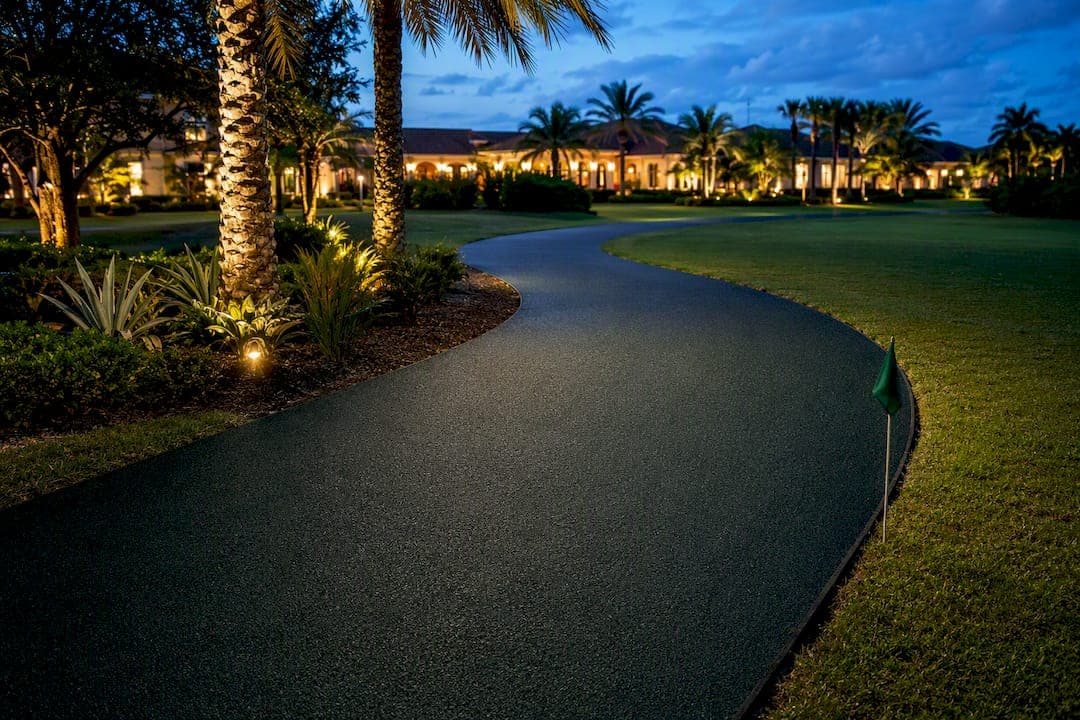
A Rubberway®-style rubber golf cart path typically installs for $6 to $14 per square foot, which puts a 300 square foot path at roughly $1,800 to $4,200 and a 1,000 square foot trail closer to $6,000 to $14,000. Where you land inside that range depends mostly on subgrade condition, the system type you choose, and your region.
TL;DR:
- Site conditions like shifting soil, roots, or water pooling can significantly increase costs, requiring extensive groundwork before rubber paving.
- Dual-layer pour-in-place systems priced at $9 to $14 per square foot are the most durable choice for repeated golf cart traffic and heavy use.
- Proper installation involves detailed subgrade preparation, drainage, and edge containment, with photos of the subgrade recommended for quality assurance.
- Typical project costs for a 300 to 1,000 square foot path range from about $2,400 to $14,000, depending on system type and site conditions.
- An itemized bid, including materials, labor, subgrade prep, and permits, is essential to accurately compare contractor quotes and avoid hidden expenses.
Table of Contents
- How Much Does a Golf Cart Path Cost Per Square Foot?
- What Site Conditions Push the Price Up?
- Which Installation Method Fits a Golf Cart Path?
- How Long Does a Rubber Cart Path Last?
- How Should You Compare Golf Cart Path Quotes?
- What EcoTec Sees in the Field
- Get an Itemized Rubber Path Quote
- Sources
- FAQ
How Much Does a Golf Cart Path Cost Per Square Foot?
Every rubber paving quote breaks into the same buckets, and knowing them lets you compare bids that otherwise look nothing alike.
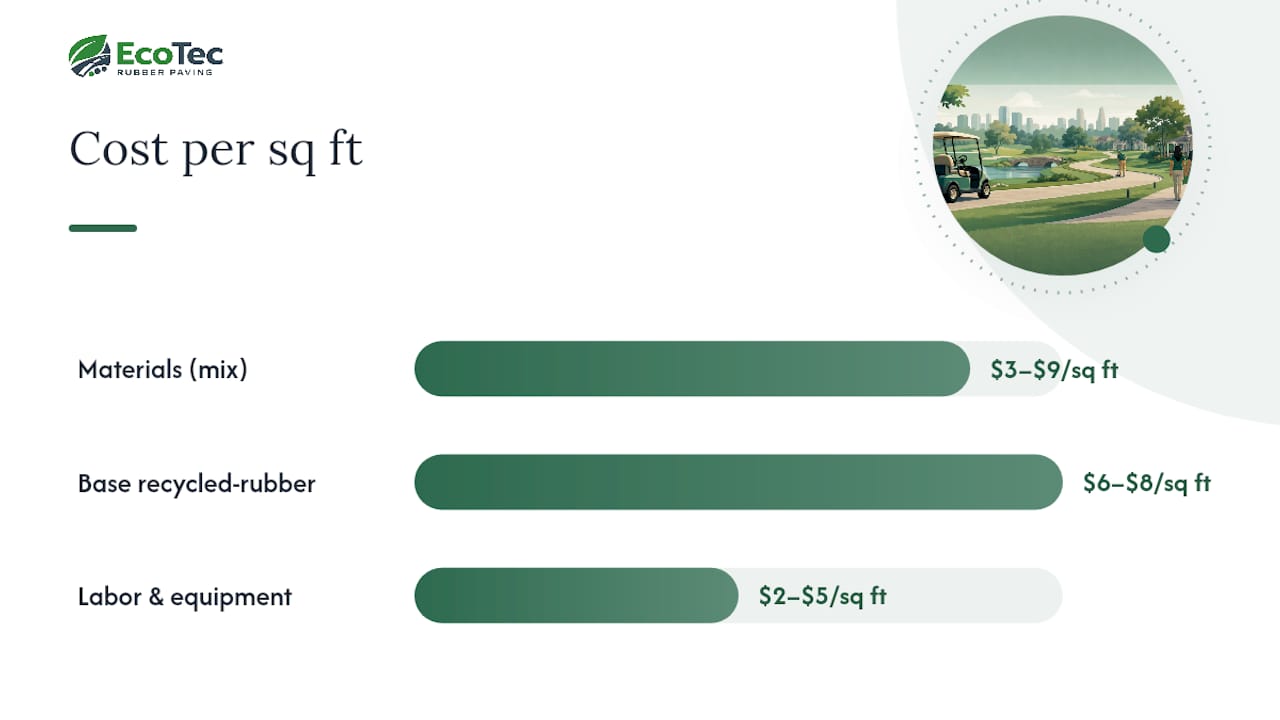
Materials generally run $3 to $9 per square foot, depending on whether you choose a basic black recycled-rubber mix or a colored EPDM blend. Base recycled-rubber product often starts around $6 to $8 per square foot, with colored EPDM adding roughly $1 to $1.50 per square foot on top. Labor typically adds $2 to $5 per square foot, and that's before subgrade work, which can run $1,000 to $4,000 depending on how much of the existing base needs to be fixed.
Here's how those line items usually stack up on a written estimate:
- Materials (rubber mix, binder, EPDM color): $3–$9 per sq ft
- Labor and equipment: $2–$5 per sq ft
- Subgrade prep and grading: $1,000–$4,000 per project
- Edge restraints and transitions: $2–$6 per linear foot
- Debris removal and delivery: often bundled, sometimes $200–$600 flat
- Permits (where required): $50–$300 depending on municipality
For a 300 square foot path with average site conditions, a realistic itemized estimate lands around $2,400 to $3,600 total: $1,500 to $2,700 in materials and labor, plus $500 to $900 in prep and edging.
What Site Conditions Push the Price Up?
The path itself is rarely what blows a budget. The ground underneath it is.
Tree roots pushing up an old slab, a section of yard that holds water after every rain, or a base that's shifted over the years all mean the crew has to do real corrective work before a single square foot of rubber goes down. Installers consistently flag untreated shifting bases and root movement as the leading cause of premature failure, since rubber will bond to a bad surface just fine and then crack apart when that surface keeps moving underneath it.
Before you sign anything, walk the site with the installer and confirm they've addressed:
- Grading and slope for positive drainage away from structures
- Root or slab removal in any area showing heave or cracking
- ADA transitions at doorways, curbs, and path intersections
- Compaction testing on new or disturbed subgrade
- Edge containment to keep the rubber surface from creeping over time
Pro Tip: Ask for photos of the exposed subgrade before it gets covered. A reputable crew documents this automatically, and it's your only real proof the prep work actually happened.
Which Installation Method Fits a Golf Cart Path?
Not every rubber surface is built to carry a loaded golf cart making repeated turns and stops, so the installation method matters as much as the price tag.
- Roll-out mats: the cheapest option and reasonable for short, low-traffic connector paths, but they tend to shift at seams under repeated cart turning.
- Interlocking rubber pavers: a step up in stability, with decent per-square-foot pricing, though seams can still telegraph over years of heavy use.
- Dual-layer, pour-in-place Rubberway®-style systems: the professional standard for cart traffic, using a porous base layer for drainage topped with a durable wear layer, commonly priced at $9 to $14 per square foot installed.
The dual-layer approach costs more upfront because it actually is more work. Crews prep the sub-base, mix the rubber compound on site, trowel it for consistent drainage slope, then let it cure under controlled conditions, steps that require specialized equipment and an experienced crew. That process is also why wheel loads, turning stress, and constant starts and stops make dual-layer systems the more sensible call for golf cart traffic specifically, rather than a patio-grade mat.
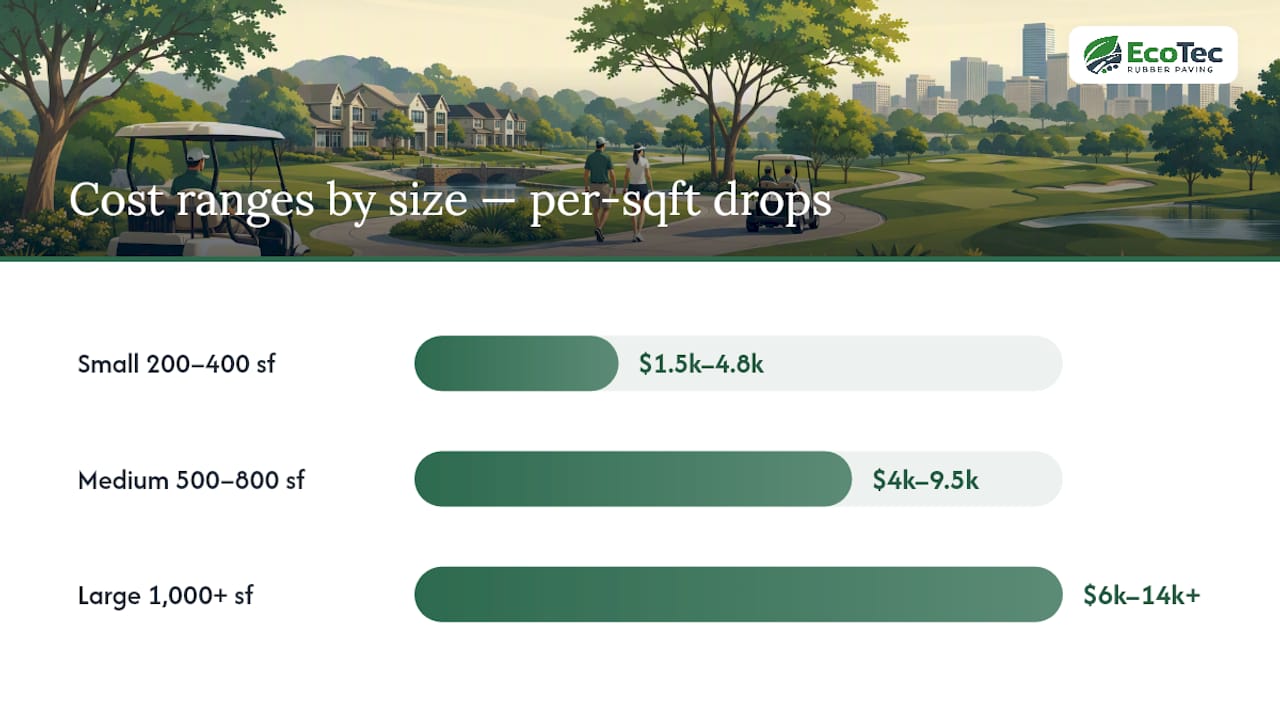
Here's what that looks like in real project sizes: a small connector path at 200 to 400 square feet typically installs for $1,500 to $4,800; a medium HOA loop or community path at 500 to 800 square feet often lands between $4,000 and $9,500; and a 1,000+ square foot trail connecting multiple amenities can run $6,000 to $14,000 or more, with the per-square-foot rate usually dropping slightly as the area grows, since edge and detail labor gets spread across more square footage.
How Long Does a Rubber Cart Path Last?
A well-installed dual-layer system commonly delivers more than a decade of service in high-traffic commercial settings, and many properties achieve well over a decade of use from a properly prepped installation before a full resurfacing is needed. The variable that decides where you land on that scale isn't the rubber, it's the subgrade underneath it.
Routine upkeep is minor compared to concrete or asphalt:
- Surface cleaning: a few times a year to clear debris and prevent staining
- Seam or edge repair: as needed, usually every few years in high-wear zones
- Reseal or refresh (colored systems): roughly every 5 to 8 years depending on UV exposure
Rubber surfaces also flex rather than crack under freeze-thaw cycling and standing water, which is precisely what causes concrete to spall and asphalt to pothole. Over a 10 to 15 year horizon, that flexibility often means avoided resurfacing and patch-repair costs that would otherwise show up as a recurring line item in an HOA or municipal parks budget. Municipal buyers in particular should weigh rubber paving as long-term infrastructure rather than a one-time expense, since flexible surfaces reduce the recurring repair costs that root heave and freeze cracking create in rigid materials.
How Should You Compare Golf Cart Path Quotes?
Two bids that look close on price can hide wildly different scopes. The fix is forcing every installer to itemize the same way.
- Require a written, itemized estimate covering materials, labor, subgrade prep, drainage, edging, and permits separately, not as one lump number.
- Verify license and insurance directly with the installer, not just a claim on their website, and ask for at least two recent references.
- Normalize every bid per square foot using total project scope, since a "cheap" quote that skips subgrade repair usually costs more once you factor in the remediation work that ends up costing more than the rubber layer itself.
- Watch for lowball red flags: no site visit, no mention of subgrade condition, or a price with no cure-time or warranty attached.
- Confirm a payment schedule tied to milestones, such as deposit, subgrade completion, and final walkthrough, rather than paying in full upfront.
Regional labor and shipping costs also shift these numbers. Coastal urban markets often run $1 to $3 per square foot higher than rural or Midwest markets, so a quote that seems high for your area might just reflect local labor rates.
What EcoTec Sees in the Field
Most golf cart path failures seen in the field trace back to one thing: a subgrade nobody fixed before pouring. Rubber systems designed for drainage and heat swings perform best with a properly prepared base underneath. Every on-site estimate starts with checking that base first, because that's where the real budget conversation happens.
— Roger
Get an Itemized Rubber Path Quote
If you've been comparing roll mats, pavers, and pour-in-place systems and still aren't sure which fits your property, an on-site assessment settles it faster than another spec sheet. A crew typically walks the actual ground your golf cart path will sit on, checks subgrade condition, drainage, and ADA transitions, and provides a written scope with materials, labor, prep, and warranty broken out line by line, not a single ballpark number.
That itemized approach matters most for HOA boards and municipal buyers who need board approval or bid comparisons, since a vague estimate gets rejected while a detailed one gets funded. Rubberway® installations are designed specifically around Florida's drainage and heat challenges, which is exactly what golf cart paths, community loops, and park trails need to survive year-round wear without cracking or pooling water. If you're weighing colored EPDM blends or want to see finished project examples before requesting a number, the Rubberway® product lineup covers the options available. Otherwise, the fastest path forward is requesting a free on-site estimate and getting your specific square footage priced against your actual site conditions, not a generic range.
Sources
- Rubber Resurfacing Cost Breakdown 2025: Prices, Factors & Savings | Rubber Stone
- Rubber Driveway Paving Cost: Price Ranges, Components, and Savings 2026 – Current Cost
- How Much Does Rubber Paving Cost In Regina? - Prairie Rubber And Stone
FAQ
How much does a 500 square foot rubber golf cart path cost?
At the typical $6 to $14 per square foot installed range, a 500 square foot path runs roughly $3,000 to $6,000, with the final number depending on subgrade condition and system type.
Is rubber paving cheaper than concrete for a cart path?
Rubber paving often costs more upfront than basic concrete, but its resistance to freeze-thaw cracking and root heave tends to lower repair and resurfacing costs over a 10 to 15 year period.
Do golf cart paths need a permit?
Permit requirements vary by municipality and are more common for HOA or public paths than private residential ones, so check with your local building department before installation begins.
How long does a rubber cart path installation take?
Most residential and HOA-scale paths install within a few days to about a week, though cure time for dual-layer, pour-in-place systems can add extra days before the surface handles cart traffic.
Are rubber cart paths ADA compliant?
Dual-layer, pour-in-place systems like Rubberway® are designed with ADA-compliant slopes and transitions in mind, though final compliance depends on the specific site layout and installer execution.