
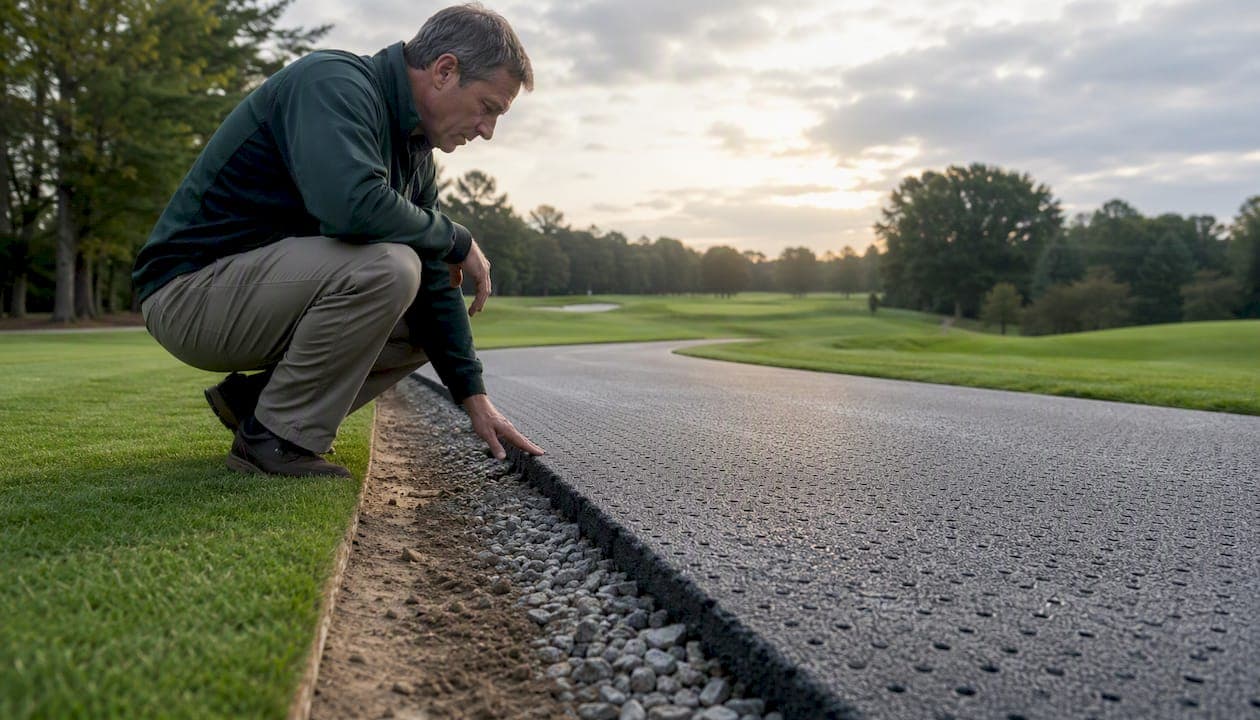
Match material to site. That's the governing principle behind every successful cart path project, and it's the one the USGA recommends for good reason: no single surface works everywhere on a course. Use impervious surfaces where heavy loads, steep grades, or drainage capture demand them. Reach for aggregate or polymer-stabilized mixes where aesthetics and playability matter more than raw durability. And consider Rubberway® recycled-rubber paving where you need porous, ADA-compliant, low-maintenance surfacing that holds up in Florida's heat and rain without cracking.
Here's how that maps to the locations you're actually managing:
- High-traffic maintenance routes and service roads: Asphalt or reinforced concrete. Equipment loads and frequency of use demand it.
- Main cart arteries (18-hole loops): Asphalt is the workhorse. Concrete where budget allows and lifespan matters most.
- Narrow playing corridors and naturalized holes: Angular gravel with stone curbing, or polymer-stabilized screenings. Blends into the landscape; keeps carts on track.
- Wet areas, low-lying holes, tidal zones: Polymer-stabilized aggregate or a porous rubber system like Rubberway®. Standing water destroys loose aggregate and accelerates asphalt deterioration.
- Clubhouse approaches and high-visibility transitions: Rubberway® or poured-in-place rubber. Color options, noise reduction, and ADA compliance make these the right call where first impressions count.
- Tee and green surrounds: Softer aggregate or rubber. Protects adjacent turf, reduces cart noise, and limits compaction near root zones.
Pro Tip: Before specifying any material, walk every path segment and note three things: slope, drainage direction, and what equipment crosses it. Those three factors alone will eliminate half the options on your list.
Key Takeaways
Match material to site conditions first; lifecycle cost and aesthetics follow from that decision, not the other way around.
| Point | Details |
|---|---|
| Traffic and drainage drive the decision | Specify impervious surfaces for heavy loads and steep slopes; use porous or stabilized materials where drainage is the primary problem. |
| Loose aggregate costs more over time | Low installed cost is offset by ongoing grading, replenishment, and edging labor that accumulates significantly over 5–10 years. |
| Lifecycle cost beats installed cost | Concrete's higher upfront cost often produces lower total cost over 25–30 years on high-traffic paths compared to asphalt or aggregate. |
| Mixed-material strategies outperform single-material plans | Use durable impervious surfaces where needed and softer or stabilized materials elsewhere; transition with curbing or graded edges. |
| Rubberway® fits wet areas, ADA routes, and clubhouse approaches | Ecotecrubber installs Rubberway® porous rubber systems in Florida, addressing drainage, crack resistance, and ADA compliance in one surface. |
Table of Contents
- When asphalt and concrete are the right call for cart paths
- Loose aggregates: what they do well and where they fall short
- Aggregate with binder: the middle ground between gravel and pavement
- Other path surfaces worth knowing: rubber, poured systems, and wood products
- How to match material to site conditions
- Installation and drainage practices every superintendent should require
- Maintenance expectations and lifecycle planning by material class
- Installed cost versus lifecycle cost: how to evaluate proposals
- What Rubberway® offers and where it fits on a course
- Site-specific prescriptions: quick rules of thumb by location
- The case for site-driven thinking over material loyalty
- Rubberway® installations from Ecotecrubber: get a site evaluation
- Sources
When asphalt and concrete are the right call for cart paths
Heavy carts, maintenance equipment, steep slopes, and any path designed to capture and redirect runoff all point toward impervious surfaces. The tradeoff is capital cost and long-term cracking risk, but for the right locations, nothing else performs as reliably.

Asphalt costs less to install than concrete and cures fast enough that you can return paths to service within days. It handles moderate cart traffic well and tolerates minor base settlement without catastrophic failure. The problems show up over time: heat retention in summer, surface oxidation that leads to cracking, and real vulnerability to freeze-thaw cycles and root uplift. In Florida's climate, heat-induced softening is a bigger concern than freeze-thaw, but roots from mature trees along fairways will eventually heave any asphalt path that lacks adequate base depth. Cold patching and sealcoating extend the surface life, but plan for a full overlay or replacement cycle over the path's service life for heavily used paths.
Concrete costs more upfront and takes longer to cure, but a properly installed concrete path can last several decades with minimal intervention. Texture and color options give you more aesthetic control than asphalt, and concrete handles heavier equipment loads without deforming. The downsides: reflectivity and heat absorption in open sun, higher initial cost, and the need for properly spaced control joints to manage cracking. Skip the joints or space them too far apart, and you'll see random cracking within a few seasons.
For installation, both materials demand a compacted, well-drained subbase. Asphalt paths need a minimum depth of compacted aggregate base; concrete paths typically require a somewhat deeper compacted aggregate base. Elevation relative to adjacent turf matters: paths that sit too high concentrate runoff onto the fairway; paths that sit too low collect standing water and deteriorate faster.
Pro Tip: For asphalt, specify a dense-graded bitumen mix with strong compaction standards. For concrete, specify a mix with fiber reinforcement and control joints spaced to mitigate cracking. Both specs are worth writing into the bid document, not leaving to contractor discretion.
Loose aggregates: what they do well and where they fall short
Angular gravel, crushed stone, coquina, and concrete screenings are the go-to options when you need a path that looks like it belongs on a golf course rather than a parking lot. Low initial cost and quick installation are real advantages. So is the softer visual character, which matters on naturalized holes, coastal layouts, and anywhere the path runs close to a green or tee complex.
The limitations are just as real. Loose aggregate migrates. It erodes on any meaningful slope. It generates dust in dry conditions and turns to mud in wet ones. Without regular attention, a gravel path that looked clean in spring will have bare spots, ruts, and scattered stone on the turf by midsummer.
Where loose aggregate works:
- Low-slope segments (under 3% grade) where erosion risk is manageable
- Naturalized or links-style holes where a hard surface would look out of place
- Low-frequency paths where cart traffic is light and maintenance equipment rarely crosses
- Temporary paths during construction or renovation phases
Where to avoid it:
- Any slope above 3–4% grade
- Paths that double as maintenance equipment lanes
- Drainage-capture paths where you need a predictable surface to direct water
- ADA-required routes (loose aggregate fails ADA surface firmness standards)
Maintenance tasks for aggregate paths:
- Grade and smooth the surface after heavy rain events or at least monthly during active season.
- Inspect curbing and edging after every significant storm; reset displaced stones or edging immediately.
- Replenish material annually, or more often on high-traffic segments.
- Control vegetation encroachment at path edges with targeted herbicide or mechanical edging.
- Check for migration onto adjacent turf after every mowing cycle and sweep or blow material back.
GCSAA superintendent forums document real-world experience with coquina and concrete screenings as cost-effective regional alternatives, particularly in the Southeast and coastal markets where these materials are locally available and priced competitively. The consistent theme: the material works, but the maintenance commitment is higher than most managers anticipate at the time of installation.
Aggregate with binder: the middle ground between gravel and pavement
Polymer-bound aggregate and stabilized screenings occupy a useful position in the material hierarchy. They look like natural gravel but hold together better, resist erosion more effectively, and require less frequent replenishment than loose aggregate. The installed cost is higher than loose aggregate but lower than asphalt or concrete, which makes them a reasonable choice for mid-tier paths where aesthetics matter and the budget doesn't support full pavement.

The core mechanism is straightforward: a binder, either a polymer resin, a wax-polymer blend, or a cementitious stabilizer, coats the aggregate particles and locks them together without creating a fully impervious surface. Water still moves through the matrix, which is a meaningful advantage over asphalt and concrete in areas where drainage is a concern. That permeability does degrade over time as fines accumulate in the voids, so periodic surface cleaning or re-coating is part of the maintenance cycle.
Types and their tradeoffs:
Polymer-bound systems (resin-bonded aggregate) offer the best particle retention and the cleanest finished appearance. They're also the most expensive of the binder options and require careful surface preparation and dry conditions during installation. Re-coating cycles typically run every 5–8 years depending on traffic and climate.
Wax-polymer mixes are more forgiving during installation and cost less than resin-bound systems, but particle retention is somewhat lower and the surface can soften in sustained high heat, which is worth noting for Florida installations.
Site-installed stabilized screenings use a cementitious or polymer stabilizer mixed into the aggregate on-site. Results vary more than factory-prepared systems, but experienced contractors can produce a durable, permeable surface at a cost closer to standard aggregate than to resin-bound systems.
Pro Tip: Specify binder compatibility with your local climate before signing a contract. In Florida, heat resistance is the critical variable; in northern markets, freeze-thaw cycling is the primary failure mode. Ask the supplier for documented performance data in comparable climates, not just general product specs.
Other path surfaces worth knowing: rubber, poured systems, and wood products
Alternative surfacing materials solve specific problems that asphalt, concrete, and aggregate can't. The key is knowing which problem each one actually addresses.
Rubber paving systems (including Rubberway® and poured-in-place recycled-rubber surfaces) offer a combination of properties that no other material class matches: porous drainage, cushioned surface, non-slip texture, color flexibility, and ADA-compliant firmness. Poured-in-place rubber systems require careful base preparation and thickness specification, but the finished surface handles cart traffic well and produces significantly less noise than asphalt or concrete. These systems make the most sense at clubhouse entrances, high-visibility walkways, ADA routes, and any path segment where noise reduction near the clubhouse or residential boundaries matters.

Poured-in-place synthetic systems beyond rubber (polyurethane-bound aggregate, for example) share many of the same advantages: permeability, cushioning, and color options. Installation is more complex and cost is higher, but the finished surface is durable and low-maintenance.
Wood chips and mulch are a temporary solution at best. They compact, decompose, and create an uneven surface within a single season. Use them only as a short-term measure during construction phases or on very low-frequency naturalized paths where appearance matters more than durability.
Concrete screenings (a byproduct of crushed concrete) behave similarly to crushed stone but compact more firmly and are often available at lower cost in markets where concrete recycling is common. They work well as a base layer under other materials and as a standalone surface on low-traffic paths.
Where each alternative fits:
- Rubber paving: clubhouse approaches, ADA routes, high-visibility transitions, wet areas, noise-sensitive zones
- Poured synthetic: premium applications where budget supports it and aesthetics are a priority
- Wood chips: temporary paths only, low-frequency use, naturalized areas
- Concrete screenings: low-cost aggregate alternative on low-slope, low-traffic segments
How to match material to site conditions
Traffic load and drainage are the two factors that should drive the decision first. Aesthetics and budget follow. USGA course-consulting examples consistently show that the best-performing courses use a multi-material approach: hard surfaces where performance demands it, softer or stabilized surfaces where the landscape and playability benefit from a lighter touch.
Quick prescriptions by location:
- Main cart artery: Asphalt or thick concrete. Load and frequency justify the capital cost.
- Narrow playing corridor: Angular gravel with stone curbing, or polymer-stabilized screenings.
- Wet or low-lying area: Polymer-stabilized aggregate or Rubberway® porous rubber system.
- Clubhouse approach: Rubberway® or poured-in-place rubber for aesthetics, noise, and ADA compliance.
- Service/maintenance route: Concrete or heavy-duty asphalt. Equipment loads are the deciding factor.
| Dimension | Impervious (Asphalt/Concrete) | Loose Aggregate | Aggregate + Binder | Rubber/Synthetic |
|---|---|---|---|---|
| Best for | Heavy traffic, steep slopes, drainage capture | Low-slope, naturalized, low-frequency | Mid-tier paths, aesthetic priority | ADA routes, wet areas, clubhouse zones |
| Durability/lifespan | Long (15–30+ years) | Short (ongoing replenishment) | Medium (5–15 years) | Medium-long (10–20+ years) |
| Installation complexity | Moderate to high | Low | Moderate | Moderate to high |
| Maintenance tasks | Sealcoat, patch, joint repair | Grade, replenish, edge control | Re-coat, clean voids | Inspect, spot repair |
| Drainage/permeability | Low (impervious) | High (variable) | Moderate | High (porous systems) |
| Landscape fit | Functional, utilitarian | Natural, blends in | Natural appearance | Color-flexible, designed |
| Relative installed cost | Medium to high | Low | Medium | Medium to high |
| Freeze-thaw/root resistance | Moderate (vulnerable over time) | Good (flexible) | Moderate | Good (flexible) |
| ADA/slip behavior | Meets ADA with texture; hard surface | Fails ADA firmness | Borderline; depends on binder | Meets ADA; cushioned, non-slip |
Installation and drainage practices every superintendent should require
Insist on an engineered subbase, geotextile separation, positive drainage, and edge restraint in every contract. These four elements account for the majority of premature path failures when they're missing or underspecified.
Installation checklist:
- Excavate to a minimum depth that accommodates the subbase plus surface layer; remove all organic material from the subgrade.
- Compact the subgrade to a minimum of 95% standard Proctor density before placing any base material.
- Install a non-woven geotextile fabric over the compacted subgrade to separate base aggregate from native soil and prevent migration.
- Place and compact base aggregate in lifts; specify maximum lift thickness and compaction testing frequency in the bid document.
- Install geogrid reinforcement for paths that will carry maintenance equipment or vehicles heavier than standard golf carts.
- Set crown or cross-slope at 1.5–2% to direct surface water off the path and away from adjacent turf.
- Install edge restraint (concrete curbing, steel edging, or stone curbing) before placing the surface layer.
- Place surface material per manufacturer or engineer specifications; verify thickness and compaction before accepting the work.
Drainage requirements:
- Perforated drain pipe under or alongside paths in low-lying areas; connect to a positive outlet, not just a gravel sump.
- Catch basins at low points and at the base of any slope longer than 50 feet.
- Design outlet paths to disperse water broadly across turf rather than concentrating flow at a single point.
- Avoid directing concentrated path runoff toward greens, tees, or bunkers.
Specification notes for contractors:
- Require compaction test results (nuclear gauge or sand cone) at specified intervals before surface placement.
- Specify warranty coverage for base settlement and surface delamination separately.
- Ask for references from similar installations in similar climates, not just general project lists.
Pro Tip: Write drainage outlet locations into the bid document with a simple sketch. Contractors who design drainage as an afterthought will direct water wherever is easiest, which is rarely where you want it. Specifying the outlet location up front eliminates the most common post-installation dispute.
For additional guidance on paving drainage design, the principles of crown slope, perforated pipe, and catch basin placement apply directly to course path installations.
Maintenance expectations and lifecycle planning by material class
Lifecycle cost almost always exceeds initial installed cost for any path material. The superintendent who plans maintenance schedules at the time of installation, not after the first failure, is the one who stays within budget over a 10–20 year horizon.
By material class:
- Asphalt: Sealcoat every 3–5 years; crack fill annually; cold patch as needed; plan for full overlay at 15–20 years on high-traffic segments.
- Concrete: Joint sealant replacement every 5–7 years; spot patching for spalls; surface grinding for trip hazards; lifespan of 25–35 years with proper joint maintenance.
- Loose aggregate: Grade and smooth monthly during active season; replenish material annually; reset edging after storm events; ongoing cost is low per event but accumulates significantly over time.
- Polymer-bound aggregate: Surface inspection twice annually; re-coat every 5–8 years; clean surface voids every 2–3 years to maintain permeability.
- Rubber/synthetic: Annual surface inspection; spot repair of any delamination or puncture; no sealcoating required; lifespan of 10–20+ years depending on traffic and UV exposure.
Factors that shorten path lifespan:
- Standing water on or adjacent to the path surface.
- Heavy equipment crossing paths not designed for that load.
- Root uplift from trees planted too close to path edges.
- Deferred maintenance, particularly crack filling on asphalt and joint sealing on concrete.
- Inadequate edge restraint allowing surface material to migrate or undercut.
Pro Tip: Build a simple path maintenance log, one row per segment, with columns for material type, installation date, last maintenance date, and next scheduled task. Review it quarterly. The courses that defer maintenance the longest are the ones that face the largest unexpected capital expenditures.
Rubber paving's maintenance profile is genuinely lower than asphalt or concrete on a per-year basis, primarily because it doesn't require sealcoating and is less vulnerable to the cracking cycles that drive asphalt maintenance costs.
Installed cost versus lifecycle cost: how to evaluate proposals
Evaluate both numbers before signing a contract. The cheapest installed option is rarely the cheapest option over a 15-year horizon, and the most expensive installation sometimes pays for itself in reduced maintenance within 10 years.
Relative cost tiers (qualitative):
- Low installed cost, high ongoing maintenance: Loose aggregate. Fast to install, inexpensive per square foot, but the annual maintenance labor and material replenishment add up.
- Medium installed cost, medium maintenance: Polymer-stabilized aggregate, rubber/synthetic systems. Higher upfront than gravel, but maintenance cycles are longer and less labor-intensive.
- High installed cost, low maintenance: Concrete. The highest capital cost, but a 30-year lifespan with minimal intervention makes it competitive on a lifecycle basis for high-traffic paths.
- Medium-high installed cost, medium maintenance: Asphalt. Sits between concrete and aggregate on both dimensions; the most common choice for main cart arteries because it balances cost and durability reasonably well.
Procurement tips:
- Request unit pricing (per square foot or linear foot) separately from mobilization and base prep costs so you can compare bids accurately.
- Clarify who is responsible for subbase preparation; this is the most common source of scope disputes.
- Ask for warranty coverage terms in writing, including what voids the warranty (inadequate base, overloading, standing water).
- Request references from installations in comparable climates, particularly for polymer-bound and rubber systems where performance varies by climate.
Timeline expectations by material:
- Loose aggregate: site prep 1–2 days; install 1–2 days; return to service immediately.
- Asphalt: site prep 2–5 days; install 1–3 days; return to service in 24–48 hours.
- Concrete: site prep 2–5 days; install 2–5 days; cure time 7–14 days before cart traffic.
- Polymer-bound aggregate: site prep 2–3 days; install 2–4 days; cure time 24–72 hours.
- Rubber/synthetic: site prep 2–3 days; install 2–5 days; return to service in 24–48 hours.
Schedule installations during your low-traffic season. Closing a main cart artery during peak play is a member relations problem, not just a logistics one.
What Rubberway® offers and where it fits on a course
Rubberway® delivers a porous, cushioned surface with strong drainage performance, good crack resistance, an ADA-compliant finish, and color flexibility that no aggregate or asphalt option can match. For the right locations, it's the strongest option in the category.
Ecotecrubber's Rubberway® system uses recycled tire rubber to create a permeable surface that handles Florida's rainfall without the standing water problems that accelerate asphalt deterioration and make loose aggregate unmanageable. The porous design allows water to move through the surface layer rather than sheeting across it, which protects adjacent turf and reduces erosion at path edges.
Documented benefits of Rubberway®:
- Recycled rubber content reduces material waste and supports sustainability goals
- Porous surface provides rapid drainage without directing concentrated runoff onto turf
- Crack resistance in heat and weather, addressing the primary failure mode for asphalt in Florida climates
- ADA-compliant surface firmness and slip resistance
- Color and finish options that integrate with course aesthetics rather than fighting them
- Noise reduction compared to hard surfaces, relevant near clubhouses and residential boundaries
A typical clubhouse entrance installation uses Rubberway® to replace a cracked asphalt path that was directing water toward the building foundation. The porous surface handles the same rainfall load, the color matches the clubhouse exterior, and cart noise at the entrance drops noticeably. The adjacent turf stays drier because water moves through the path rather than sheeting off it.
Pro Tip: Rubber paving systems require a stable, well-drained subbase just like any other surface. The porous top layer doesn't compensate for a saturated or poorly compacted base. Specify the same subbase standards for rubber installations as you would for asphalt.
For a closer look at how rubber surfaces handle golf cart loads and what base specifications support them, the engineering considerations are more straightforward than most superintendents expect.
Site-specific prescriptions: quick rules of thumb by location
Pick the option that solves the primary problem for that location. Load, drainage, aesthetics, and playability each dominate in different parts of the course.
1. Main cart artery (high-frequency, full-loop paths) Recommended: Asphalt or concrete.
- Cart frequency and occasional maintenance vehicle crossings demand a load-rated surface.
- Lifecycle cost favors concrete on segments where replacement would require closing the course.
2. Tight playing corridor (narrow paths between fairways or near hazards) Recommended: Angular gravel with stone curbing, or polymer-stabilized screenings.
- Hard surfaces look intrusive and generate noise in quiet playing zones.
- USGA course-consulting examples show waste-bunker style paths with angular gravel and curbing as a proven, low-maintenance solution for these segments.
3. Tidal or low-lying hole (paths subject to periodic flooding or high water table) Recommended: Polymer-stabilized aggregate or Rubberway® porous rubber.
- Impervious surfaces in these areas create drainage problems; loose aggregate migrates after every flood event.
- Porous systems allow water to move through rather than around the path.
4. Clubhouse approach (high-visibility, high-foot-traffic, ADA-required) Recommended: Rubberway® or poured-in-place rubber.
- Color options and noise reduction matter here more than anywhere else on the course.
- ADA compliance is non-negotiable on any path connecting accessible facilities.
5. Service and maintenance route (paths used by mowers, utility vehicles, and supply trucks) Recommended: Concrete or heavy-duty asphalt with reinforced base.
- Equipment loads on these routes exceed what standard cart path specs are designed for.
- Specify base depth and compaction for the heaviest vehicle that will cross the path, not just golf carts.
6. Tee and green surrounds (paths within 20–30 feet of putting surfaces or tee complexes) Recommended: Soft aggregate, rubber, or polymer-stabilized surface.
- Hard surfaces near greens and tees concentrate cart noise and increase compaction risk near root zones.
- Softer materials reduce both problems without sacrificing path function.
Mixed-material strategy: Use durable impervious surfaces on the segments that genuinely need them and natural or stabilized materials everywhere else. Transition between materials with a concrete curb or graded edge to prevent migration and create a clean visual break. The courses that try to standardize on one material across all 18 holes almost always end up over-specifying in some areas and under-specifying in others.
The case for site-driven thinking over material loyalty
Most cart path failures I've seen in the field come down to one mistake: choosing a material because it's familiar, not because it fits the site. Asphalt is the default for a reason, but it's the wrong default for a wet coastal hole, a tight naturalized corridor, or a clubhouse entrance where appearance and ADA access are the real priorities.
The USGA's guidance on choosing cart path materials makes this point clearly: a multi-material approach, matched to site conditions, consistently outperforms a single-material strategy on both performance and cost. That's not a theoretical position. It's what the best-maintained courses actually do.
Where I think most superintendents underestimate their options is in the middle tier: polymer-stabilized aggregates and rubber systems. These materials have improved significantly, and the maintenance profiles are genuinely better than they were a decade ago. Rubber paving in particular, when installed on a proper subbase, handles Florida's heat and rainfall in ways that asphalt simply doesn't. Ecotecrubber's focus on Rubberway® installations in Florida reflects real-world experience with exactly these conditions: heat-induced cracking, standing water, and the need for surfaces that look right next to a well-maintained course.
The pragmatic answer is almost always a mixed-material plan. Spend the capital on concrete or asphalt where load and frequency demand it. Use stabilized aggregate or rubber where aesthetics, drainage, or ADA access are the driving factors. And don't let the installed cost of a better material stop you from specifying it where it will save you money over the next 15 years.
Rubberway® installations from Ecotecrubber: get a site evaluation
Courses dealing with cracked asphalt, drainage problems, or ADA compliance gaps on high-visibility paths have a concrete next step: a site evaluation from Ecotecrubber.
Ecotecrubber specializes in Rubberway® rubber paving installations across Florida, with licensed and insured project coordination from site assessment through completion. The Rubberway® system addresses the three problems that drive most cart path replacement projects in Florida climates: standing water, heat-induced cracking, and surfaces that look worn next to an otherwise well-maintained course. Color options, ADA-compliant finishes, and porous drainage performance make it the right specification for clubhouse approaches, wet-area paths, and any high-visibility segment where asphalt or gravel simply isn't good enough. Contact Ecotecrubber to request a site evaluation and project quote for your course.
Sources
Curated references for procurement discussions, specification support, and product evaluation:
- Choosing Cart Path Materials