
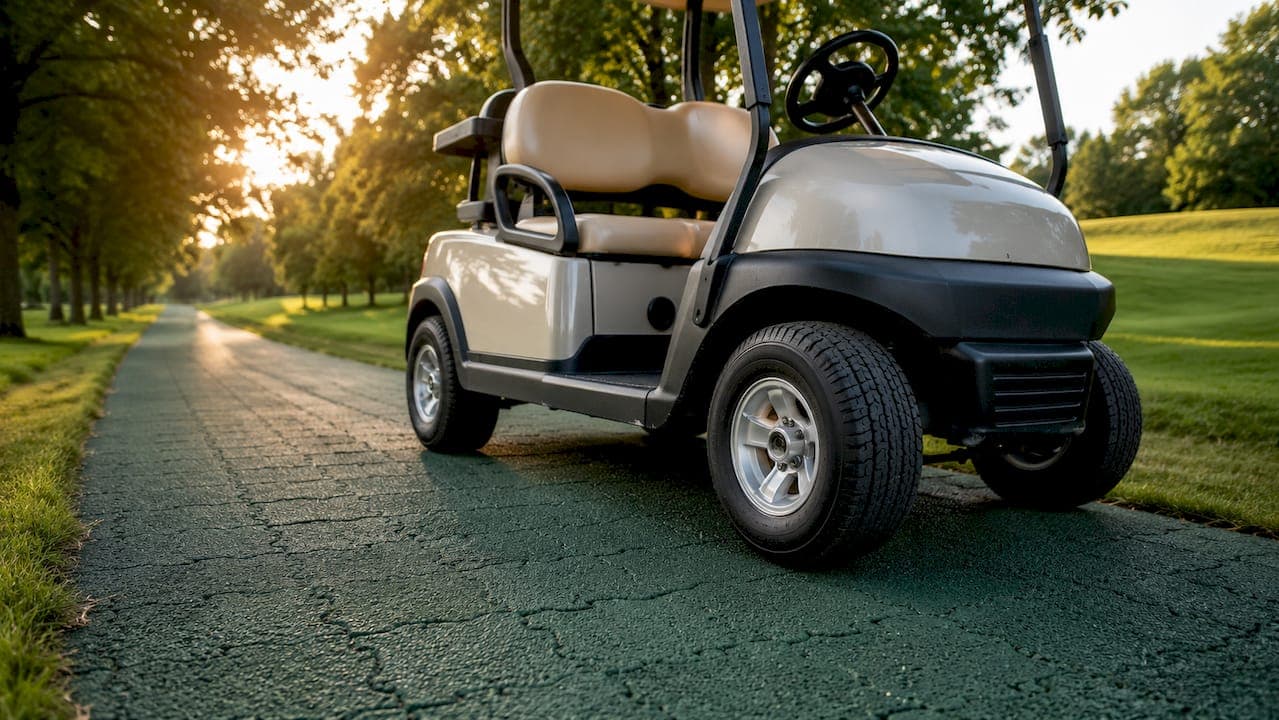
Rubber paving is defined as a load-bearing surface made from recycled rubber that distributes vehicle weight across a flexible, interlocking matrix rather than concentrating it at a single point. Understanding how rubber paving handles golf cart weight matters because golf carts travel the same paths dozens of times daily, and the wrong surface fails fast. Industrial-grade rubber paving systems support loads well beyond typical golf cart mass, while also delivering traction, drainage, and sustainability benefits that concrete and asphalt simply cannot match. For golf course managers, this combination of load capacity and environmental performance makes rubber surfacing the most practical long-term paving choice.
How does rubber paving handle golf cart weight and load capacity?
Rubber paving handles golf cart weight by spreading the load across a wide surface area rather than absorbing it at a single pressure point. A standard electric golf cart weighs between 0.3 and 0.5 tonnes fully loaded. Industrial-grade rubber paving is rated to support vehicles up to 3.5 tonnes. That rating gives golf course managers a load margin that covers not just carts but also maintenance vehicles and turf equipment sharing the same paths.
The key engineering principle is distributed load. Interlocking rubber mats disperse concentrated wheel pressure across the full mat surface, preventing soil compaction and turf damage beneath the path. This matters most on courses where paths run adjacent to fairways or greens, where subsurface damage shows up as ruts and dead grass within a single season.
The table below compares typical vehicle weights against rubber paving load ratings to show the available safety margin.
| Vehicle | Typical Weight | Rubber Paving Rating |
|---|---|---|
| Standard electric golf cart | 0.3–0.5 tonnes | Up to 3.5 tonnes |
| Gas-powered golf cart | 0.4–0.6 tonnes | Up to 3.5 tonnes |
| Turf maintenance vehicle | 1.0–2.0 tonnes | Up to 3.5 tonnes |
Key load-bearing advantages of rubber paving for golf courses:
- Flexible matrix absorbs impact rather than cracking under repeated wheel loads
- Interlocking design prevents individual sections from shifting under directional cart turns
- Thickness of 15mm or greater provides the structural depth needed for sustained vehicle traffic
- Load distribution protects the substrate, reducing base repair costs over time
Pro Tip: Specify a minimum 15mm thickness when ordering rubber paving for cart paths. Thinner decorative grades are not rated for vehicle loads and will deform under repeated cart traffic.
How does rubber paving enhance safety and durability for golf cart paths?
Rubber paving delivers measurable slip resistance that concrete and asphalt cannot replicate in wet conditions. Slip resistance ratings reach 105 PTV dry and 75 PTV wet, which exceeds the performance of standard concrete cart paths. On a course where morning dew, irrigation overspray, and afternoon rain are daily realities, that wet-condition rating directly reduces the risk of cart skidding and pedestrian falls.
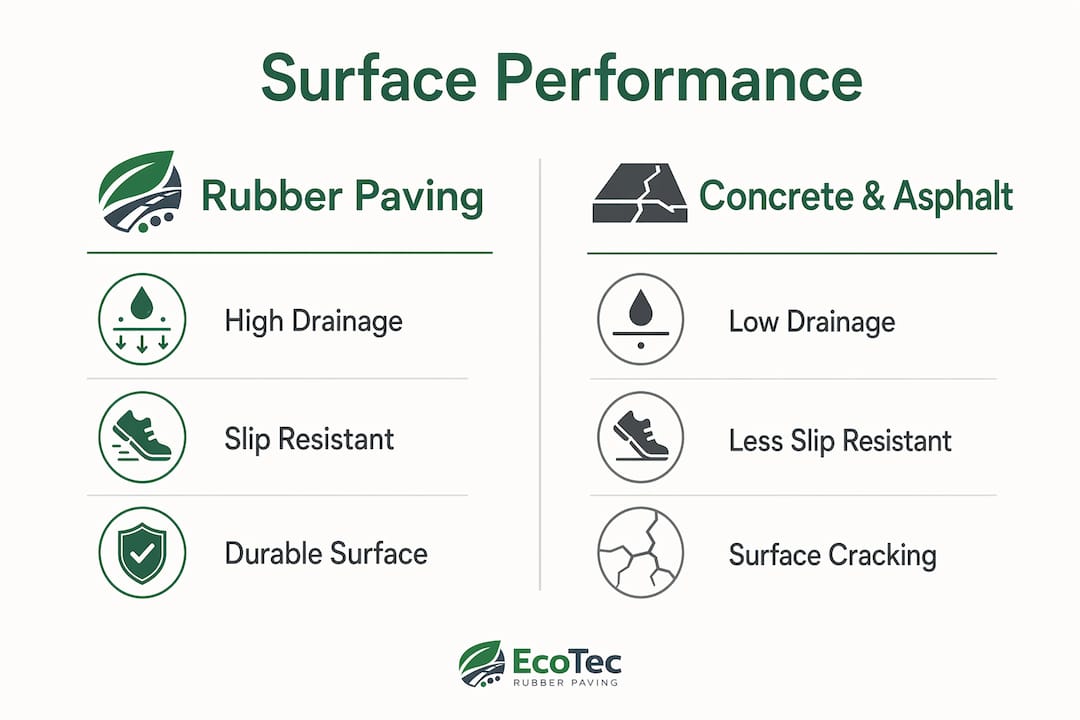
Durability under repeated golf cart traffic is equally strong. Rubber surfaces resist tire tracking, surface deformation, and the kind of edge cracking that makes asphalt paths a maintenance liability within three to five years. The material's natural flexibility means it absorbs the micro-impacts of cart wheels rather than transmitting them to the base layer, which is what causes concrete to crack over time.
Textured rubber surfaces provide dependable grip under rain, irrigation runoff, and fertilizer residues. That last point is specific to golf courses. Fertilizer residue on a smooth concrete path creates a slick film that rubber's open texture prevents from forming a continuous slip layer.
Safety and durability benefits at a glance:
- Slip resistance exceeds standard concrete in both dry and wet conditions
- Surface texture prevents fertilizer and irrigation residue from creating slip hazards
- Flexible composition absorbs repeated wheel impacts without cracking or spalling
- No freeze-thaw cracking, which eliminates the sharp edge hazards common on aged concrete paths
- ADA-compliant surfaces support safe pedestrian access alongside cart traffic
Pro Tip: Inspect rubber cart paths twice per year for any sections showing surface separation at joints. Catching joint failure early prevents water infiltration that accelerates base layer deterioration.
What environmental and sustainability benefits does rubber paving provide for golf course paths?
Rubber paving supports golf course sustainability goals in two direct ways: it manages water and it diverts waste. Permeable rubber paving drains up to 5,800 gallons per square foot per hour, which eliminates the standing water that damages cart paths and adjacent turf after heavy rain. That drainage rate also reduces runoff carrying fertilizers and pesticides into water features on the course, a growing concern under environmental regulations governing golf course operations.
The recycled content story is equally compelling. Rubber paving incorporates recycled tires equivalent to hundreds of car tire volumes per installation. That volume of material stays out of landfills and contributes to green building certifications that some courses pursue as part of broader sustainability programs. For courses marketing themselves as environmentally responsible, the material choice becomes part of the brand story.
Sustainability benefits in practice:
- Permeable surface eliminates standing water on cart paths after heavy rain events
- Recycled rubber content supports landfill diversion and circular economy goals
- Natural integration with turf landscapes preserves course aesthetics without hard-edge visual impact
- Reduced runoff protects water features and ponds from fertilizer and chemical contamination
- Lower maintenance frequency compared to concrete or asphalt reduces fuel and labor consumption over the path's lifespan
Effective permeable rubber designs also integrate with natural water management systems on the course, directing drainage toward retention areas rather than creating concentrated runoff points. Ecotecrubber's Rubberway® system is built around this principle, using recycled materials and permeable construction to address the drainage challenges specific to Florida's high-rainfall climate.
The environmental performance comparison below shows where rubber paving outperforms traditional surfaces on golf courses.
| Performance Category | Rubber Paving | Concrete | Asphalt |
|---|---|---|---|
| Drainage rate | Excellent | Poor | Poor |
| Recycled content | High | None | Minimal |
| Turf preservation | Strong | Weak | Weak |
| Runoff reduction | High | Low | Low |
How does outdoor weather affect the lifespan of rubber paving under golf cart traffic?
Rubber paving tolerates a wide temperature range without losing structural integrity. High-density rubber paving maintains performance from -30°C to +80°C, which covers every climate condition a golf course in Florida or the broader Southeast will encounter. That temperature tolerance means no freeze-thaw cracking in northern courses and no heat-induced softening in southern ones.
Lifespan depends heavily on installation quality and maintenance discipline. A properly installed rubber cart path with correct binder application and adequate thickness lasts significantly longer than asphalt in high-UV, high-humidity environments. Florida's climate accelerates asphalt degradation through UV oxidation and heat cycling. Rubber's composition resists both.
Maintenance practices that extend rubber paving lifespan under golf cart traffic:
- Clear debris and organic material from the surface regularly to prevent moisture retention under leaf litter
- Inspect binder joints after the first full season for any signs of separation or lifting
- Avoid using petroleum-based solvents or cleaners, which degrade the rubber binder
- Reapply surface sealant on high-traffic sections every few years to maintain slip resistance ratings
- Keep cart paths free of sharp metal debris that can puncture or score the surface
For high-traffic paving solutions, the maintenance schedule matters as much as the material choice. A rubber path that receives annual inspection and minor joint repairs will outlast a neglected installation by years.
What are best practices for installing rubber paving to support golf cart weight?
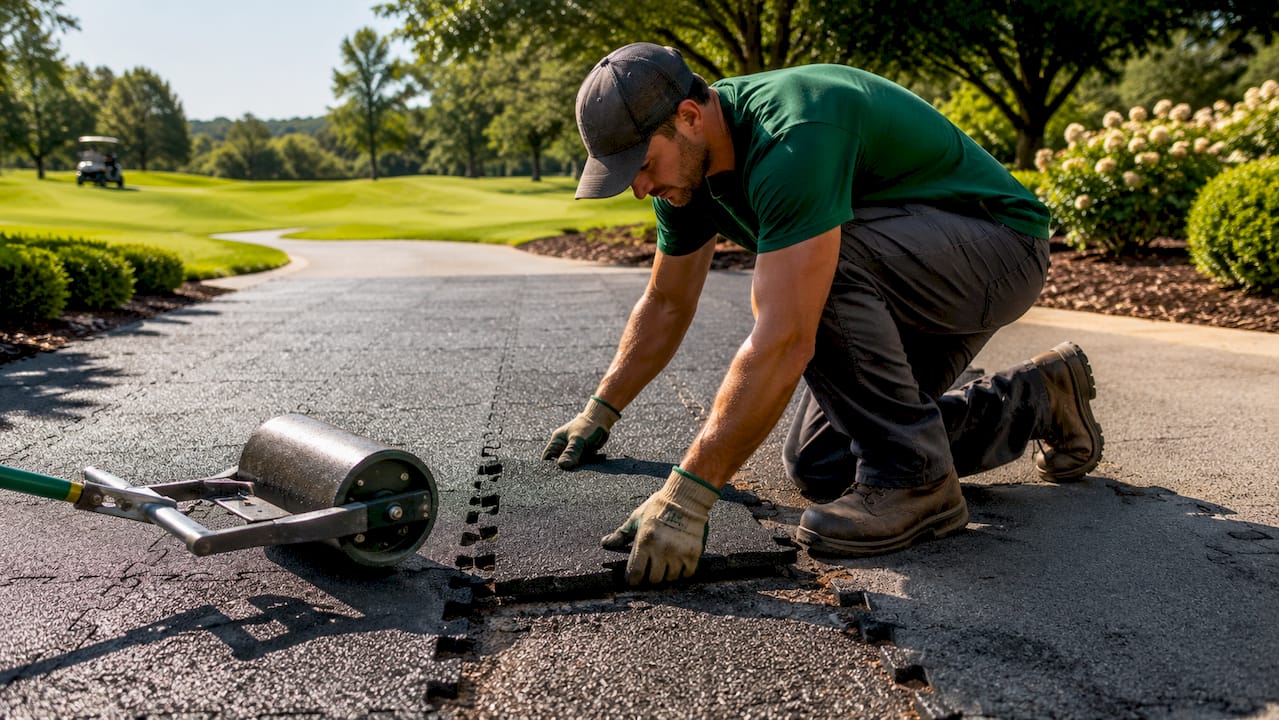
Installation quality determines whether rubber paving performs to its rated load capacity or fails prematurely. The single most common mistake is reopening paths too soon after installation. Poured-in-place rubber paving requires a full 24-hour cure before any vehicle traffic. Opening a path early causes permanent tire tracking and surface deformation that cannot be repaired without full section replacement.
Surface preparation is equally critical. The base layer must be compacted, level, and free of soft spots before rubber is applied. Any subsurface weakness will telegraph through the rubber surface under repeated cart loads, creating low spots that collect water and accelerate wear. Thickness must match the anticipated load. For paths carrying golf carts and maintenance vehicles, 15mm is the minimum specification.
Proper binder application ties the rubber granules together and determines the surface's long-term cohesion. Underbinding creates a friable surface that sheds granules under wheel loads. Overbinding seals the pores and eliminates the drainage performance that makes rubber paving superior to concrete. Ecotecrubber's installation process follows manufacturer specifications for binder ratios to maintain both structural integrity and permeability.
Pro Tip: Always request a written cure-time protocol from your installer before work begins. If the installer cannot provide one, that is a signal to find a more experienced contractor. Cure time compliance is the single biggest predictor of long-term path performance.
For a detailed breakdown of installation standards, Ecotecrubber's sustainable paving installation guide covers base preparation, binder ratios, and thickness specifications for golf course applications.
Key Takeaways
Rubber paving is the most effective golf cart path surface because its load distribution, slip resistance, and permeable drainage outperform concrete and asphalt across every performance category that matters to course managers.
| Point | Details |
|---|---|
| Load capacity far exceeds cart weight | Rubber paving rated to 3.5 tonnes handles golf carts at 0.3–0.5 tonnes with a wide safety margin. |
| Wet-condition slip resistance | Ratings of 75 PTV wet exceed standard concrete, reducing cart skid and pedestrian fall risk. |
| Permeable drainage protects turf | Drainage rates up to 5,800 gallons per square foot per hour eliminate standing water on paths. |
| Recycled content supports sustainability | Recycled tire material diverts waste from landfills and supports green certification programs. |
| Cure time determines long-term performance | A full 24-hour cure before traffic prevents permanent surface deformation and extends path lifespan. |
What I've learned from watching courses get paving wrong
Most course managers I talk to focus on upfront cost when evaluating cart path materials. That focus costs them more in the long run. Asphalt paths in Florida typically show edge cracking and surface oxidation within three to five years under cart traffic and UV exposure. The repair cycle adds up fast, and every repair window means path closures that frustrate members.
The courses that get it right treat the path as infrastructure, not a cosmetic feature. They specify load ratings, ask about drainage performance, and schedule installation during low-traffic periods so cure times are respected. Those are the courses where paths still look and perform well a decade after installation.
Rubber paving also does something concrete and asphalt cannot: it fits into the visual language of a golf course. The textured, natural-looking surface reads as part of the landscape rather than a hard industrial intrusion. That aesthetic alignment matters to members and to the course's overall presentation. Ecotecrubber's Rubberway® system specifically addresses this by using recycled materials that blend with turf environments rather than contrasting against them.
The sustainability angle is not just marketing. Courses face increasing scrutiny over water management and chemical runoff. A permeable cart path that directs drainage toward retention areas rather than creating runoff is a genuine operational advantage, not just a talking point. If you want to understand how recycled paving supports golf sustainability, the environmental case is stronger than most managers realize until they see the drainage data.
— Roger
Rubber paving for golf cart paths: Ecotecrubber's approach
Golf course managers in Florida and the surrounding region have a specific challenge: high rainfall, intense UV exposure, and year-round cart traffic demand a surface that performs in every condition without constant repair.
Ecotecrubber installs the Rubberway® system using recycled rubber materials engineered for exactly these conditions. The system delivers ADA-compliant, permeable surfaces rated for vehicle loads well beyond golf cart weight, with professional installation backed by licensed and insured contractors. Every project is managed from surface preparation through final cure, so paths open on schedule and perform to specification from day one. For course managers ready to replace failing asphalt or concrete paths, Ecotecrubber's professional rubber paving installations cover everything from product selection to post-installation inspection. The full Rubberway product line includes options sized for cart paths, pedestrian walkways, and maintenance vehicle routes.
FAQ
What weight can rubber paving support on a golf course?
Industrial-grade rubber paving supports loads up to 3.5 tonnes, which far exceeds the 0.3–0.5 tonne weight of a standard golf cart. This margin also covers maintenance vehicles sharing the same paths.
How does rubber paving perform on wet golf cart paths?
Rubber paving achieves slip resistance ratings of 75 PTV wet, outperforming standard concrete paths. The textured surface prevents irrigation runoff and fertilizer residue from creating continuous slip hazards.
How long does rubber paving last on a golf cart path?
A properly installed rubber cart path with correct binder application and regular maintenance lasts significantly longer than asphalt in high-UV, high-humidity environments. Lifespan depends on installation quality, thickness, and adherence to cure-time protocols.
Is rubber paving permeable enough for golf course drainage?
Permeable rubber paving drains up to 5,800 gallons per square foot per hour, eliminating standing water on cart paths after heavy rain and reducing fertilizer runoff into course water features.
How soon can golf carts use a newly installed rubber path?
Poured-in-place rubber paving requires a full 24-hour cure before any vehicle traffic. Opening the path early causes permanent tire tracking and surface deformation that requires full section replacement to fix.