
Crack-resistant paving is not a premium upgrade for golf facilities. It is the baseline specification that prevents water from reaching your base layers, stops turf damage at path edges, and keeps lifecycle costs from compounding year after year. The single-sentence recommendation: inspect every cart path and walkway this season, prioritize drainage and permeability in your next specification, and require crack-resistant materials from every bidder.
Three reasons this matters operationally:
- Durability: Crack-resistant surfaces last significantly longer before requiring structural repair or full replacement.
- Safety: Uncracked, stable surfaces eliminate trip hazards and cart-tip risks that create liability exposure.
- Lower lifecycle cost: Preventing water ingress at the surface protects the base, which is always the most expensive repair.
Table of Contents
- 1. What actually breaks cart paths on golf properties
- 3. How common paving materials handle cracking
- 4. Design and installation controls that prevent cracking
- 6. Lifecycle cost: what crack resistance actually saves
- 7. Why rubberized permeable systems work well on golf sites
- 8. Technical standards and references managers should use
- Key Takeaways
- The case for specifying crack resistance from day one
- Ecotecrubber offers a practical crack-resistant option for golf facilities
- Useful sources and standards
1. What actually breaks cart paths on golf properties
Freeze-thaw cycling is the most destructive force on rigid pavements in northern climates. Water enters a hairline crack, freezes, expands, and widens the crack. Repeat that cycle over a single winter and a surface crack becomes a structural one. In warmer climates, heat-driven thermal expansion does the same work more slowly, but the mechanism is identical: movement the pavement cannot accommodate becomes a crack.
Poor subgrade preparation is the second major cause, and it is entirely preventable. When the soil beneath a path is not compacted to the correct density or when organic material is left in place, differential settlement follows. The pavement above it bends, and rigid materials crack rather than flex. USGA guidance specifically recommends evaluating soil and drainage conditions before choosing a path material, because the subgrade determines how any surface will perform over time.
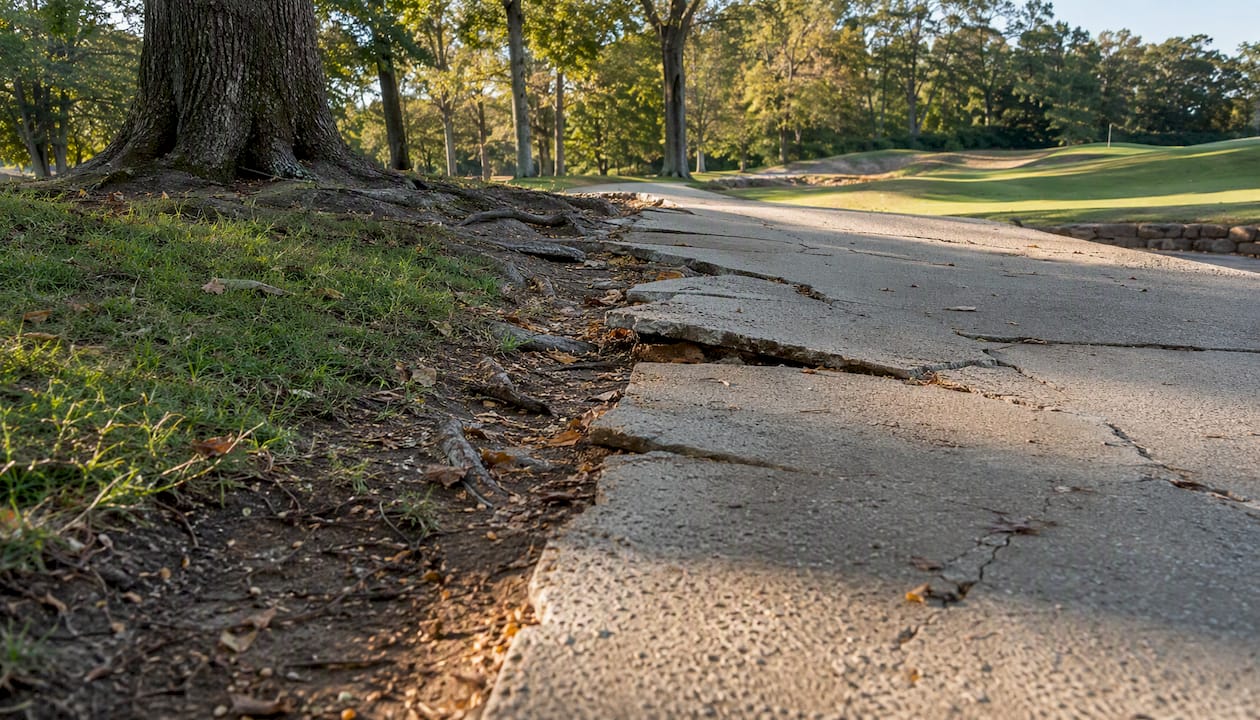
Tree roots are a slow but reliable source of heaving near fairway edges and shaded walkways. A root growing beneath a concrete or asphalt path generates enough upward pressure to fracture the surface from below, often without any visible warning until the heave is already significant.
Drainage failure and ponding accelerate every other cause. Water that sits on or beside a path saturates the base, softens the subgrade, and gives freeze-thaw cycles more material to work with. Concentrated load points, particularly on tight turns where cart traffic always tracks the same line, add fatigue stress on top of everything else.
Diagnostic quick-reference:
- Heaving near tree lines: root pressure or freeze-thaw, often both
- Alligator (fatigue) cracking: base or subgrade failure from repeated loading
- Transverse cracks running perpendicular to the path centerline: thermal contraction in asphalt or concrete
Pro Tip: The moment you see a surface crack, fill it temporarily with a cold-pour crack filler before the next rain event. Stopping water entry at that stage costs a fraction of what base repair costs six months later.
3. How common paving materials handle cracking
No material is immune to cracking. The question is how each one initiates, propagates, and is repaired, and whether the failure mode fits your site conditions.
Asphalt is flexible by design, which gives it some tolerance for minor ground movement. Its weakness is thermal: asphalt softens in heat and becomes brittle in cold, and without the right mix design it develops transverse thermal cracks within a few years. Polymer-modified binders (SBS) can reduce thermal cracking by 40–60% and extend pavement lifespan by 7–12 years compared to standard mixes. Proper compaction is equally critical. Asphalt is the most common cart path material because it is relatively inexpensive to install and repair, but unmodified mixes on poorly prepared bases have short service lives.
Concrete is designed to crack. That is not a flaw; it is an engineering reality. The industry response is to control where cracking occurs through saw-cut control joints and to manage crack propagation through fiber mesh reinforcement or continuous steel reinforcement (CRCP). FHWA's CRCP documentation explains how continuous reinforcement keeps transverse cracks tight and load-transferring rather than open and widening. Experienced golf course superintendents recommend 4,000 psi concrete with fiber mesh for cart paths, along with planned section lengths that keep joint spacing manageable. Concrete lasts 20–30 years when installed correctly, but those control joints are permanent maintenance points that require periodic sealing.
Interlocking concrete pavers handle freeze-thaw well because the jointed system accommodates movement without cracking individual units. They are reusable when a section needs repair, which reduces material waste. The failure mode is chipping or cracking under overloads, and ASTM C 672 is the standard test for assessing their scaling resistance under freeze-thaw and deicing salt exposure. Pavers work well on pedestrian walkways and low-speed areas but can shift under heavy cart traffic if the bedding layer is not properly restrained.
Rubberized permeable systems behave differently from all three rigid or semi-rigid options. A high-rubber-content surface acts like a continuous expansion joint, absorbing thermal movement and minor ground shifts without fracturing. Field reports from golf course operators show these surfaces performing well on slopes and root-affected zones where rigid surfaces would heave. Permeability eliminates ponding at the surface, which removes one of the primary crack-initiation mechanisms. The environmental and turf-protection benefits of recycled rubber paving on golf courses are an additional consideration for facilities with sustainability commitments.
Material-to-condition matching:
| Condition | Recommended material |
|---|---|
| Heavy equipment or service vehicle zones | High-strength concrete (4,000+ psi) |
| Freeze-thaw climates, root zones, wet slopes | Rubberized permeable systems |
| Pedestrian walkways, low-speed areas | Interlocking pavers |
| High-cart-traffic straightaways with good drainage | Polymer-modified asphalt |
For a broader view of how permeability and low-maintenance properties factor into material selection at the facility level, club-level guides consistently point to drainage performance as the deciding criterion on problem sites.
4. Design and installation controls that prevent cracking
The material you specify matters less than how it is installed. A 4,000 psi concrete path on an uncompacted subgrade will crack faster than a standard mix on a properly prepared base.
Subgrade and base checklist:
- Conduct a soil evaluation before design. Identify organic material, clay content, and seasonal water table depth.
- Remove and replace any organic or unstable material. Do not compact over it.
- Compact the subgrade to at least 95% of standard Proctor density (AASHTO T 99) before placing base material.
- Place a compacted aggregate base of at least 6 inches for cart paths; 8–10 inches in areas with heavy service vehicle traffic or poor native soils.
- Verify base compaction with a nuclear density gauge or dynamic cone penetrometer before paving.
Pavement thickness and mix:
- Asphalt cart paths: minimum 3 inches of compacted hot-mix asphalt in two lifts; specify a polymer-modified binder (PG 76-22 or equivalent) for thermal resistance.
- Concrete cart paths: minimum 4 inches thickness; specify 4,000 psi with fiber mesh (1.5 lb/yd³ polypropylene) per practitioner recommendations.
- Saw-cut control joints in concrete at intervals no greater than 10 feet, or 2.5 times the slab thickness in feet, whichever is smaller. Time the cuts within 4–12 hours of placement to prevent random cracking.
- For concrete joint design specifics, control joint spacing and cutting timing are well-documented in contractor technical guides and worth reviewing before finalizing specs.
Drainage design:
- Pitch all paths a minimum of 1.5% cross-slope to shed water to the low side.
- Install edge drainage (French drain or perforated pipe) wherever the path runs parallel to a slope that directs runoff onto the surface.
- Specify permeable base layers or permeable surface materials on slopes and drainage-sensitive areas to eliminate ponding entirely.
Pro Tip: Require proof-rolling of the compacted subgrade before any base material is placed. A loaded roller will reveal soft spots that a visual inspection misses entirely. Make engineer sign-off on subgrade proof-rolling a contract requirement, not an optional line item.
6. Lifecycle cost: what crack resistance actually saves
Higher upfront cost for crack-resistant materials is the argument facility managers most often face in budget reviews. The counterargument is straightforward when you run the numbers over a 15–20 year horizon.
A standard asphalt cart path without polymer modification typically requires crack sealing within 3–5 years, an overlay or significant patching within 8–10 years, and reconstruction within 15 years. A polymer-modified asphalt or rubberized permeable system delays each of those interventions substantially, and the USGA's lifecycle-value guidance consistently points to total cost of ownership rather than installation cost as the correct evaluation metric.
Representative service-life and cost comparison (assumptions: moderate cart traffic, US climate with seasonal freeze-thaw):
| Material | Typical service life | Maintenance frequency | Relative upfront cost |
|---|---|---|---|
| Standard asphalt | 10–15 years | High (annual sealing, frequent patching) | Low |
| Polymer-modified asphalt | 20–30 years | Moderate (periodic sealing) | Moderate |
| Concrete (4,000 psi, fiber mesh) | 20–30 years | Low-moderate (joint sealing every 3–5 years) | Moderate-high |
| Interlocking pavers | 20–30 years | Low (individual unit replacement) | High |
| Rubberized permeable systems | — | Low (no joint maintenance, permeable surface) | Moderate-high |
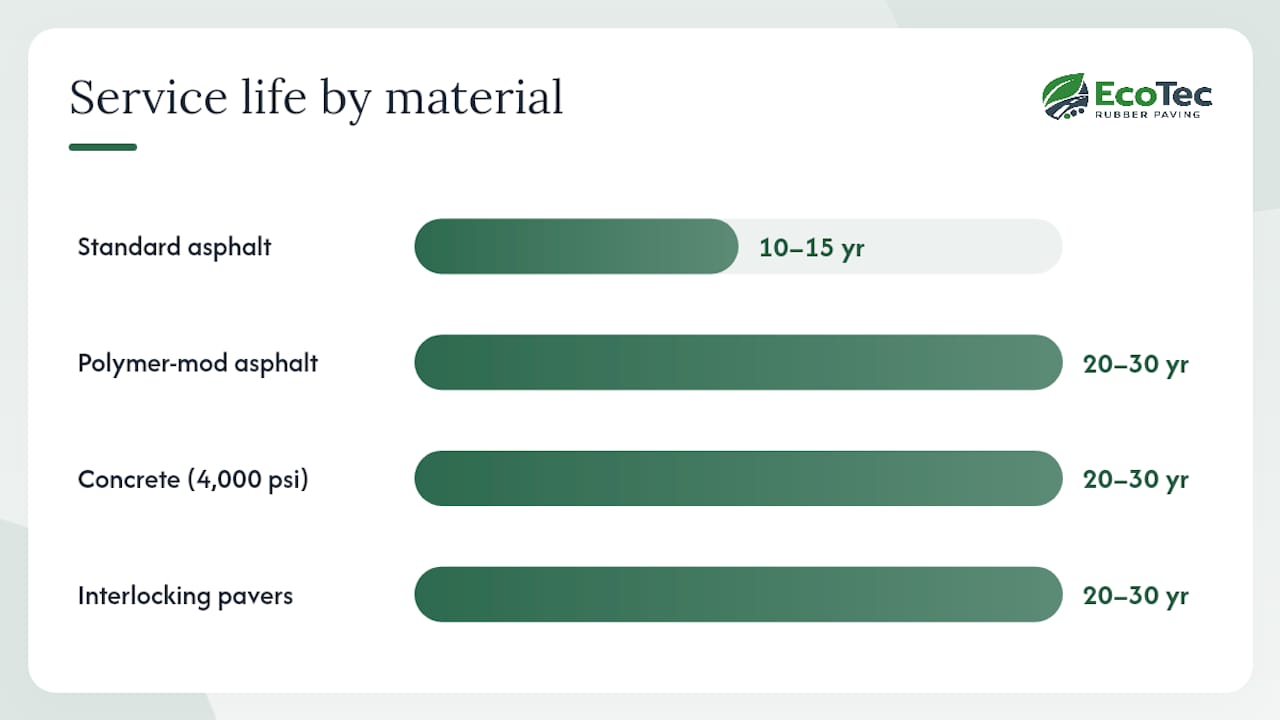
Service-life ranges are industry estimates based on proper installation and routine maintenance. Actual performance varies by site conditions, traffic volume, and climate.
When requesting bids, ask every contractor for three things: expected service life under your specific traffic and climate conditions, warranty terms tied explicitly to crack performance, and a lifecycle cost analysis that includes projected repair intervals. A bidder who cannot provide those numbers is not equipped to make a lifecycle argument for their product.
7. Why rubberized permeable systems work well on golf sites
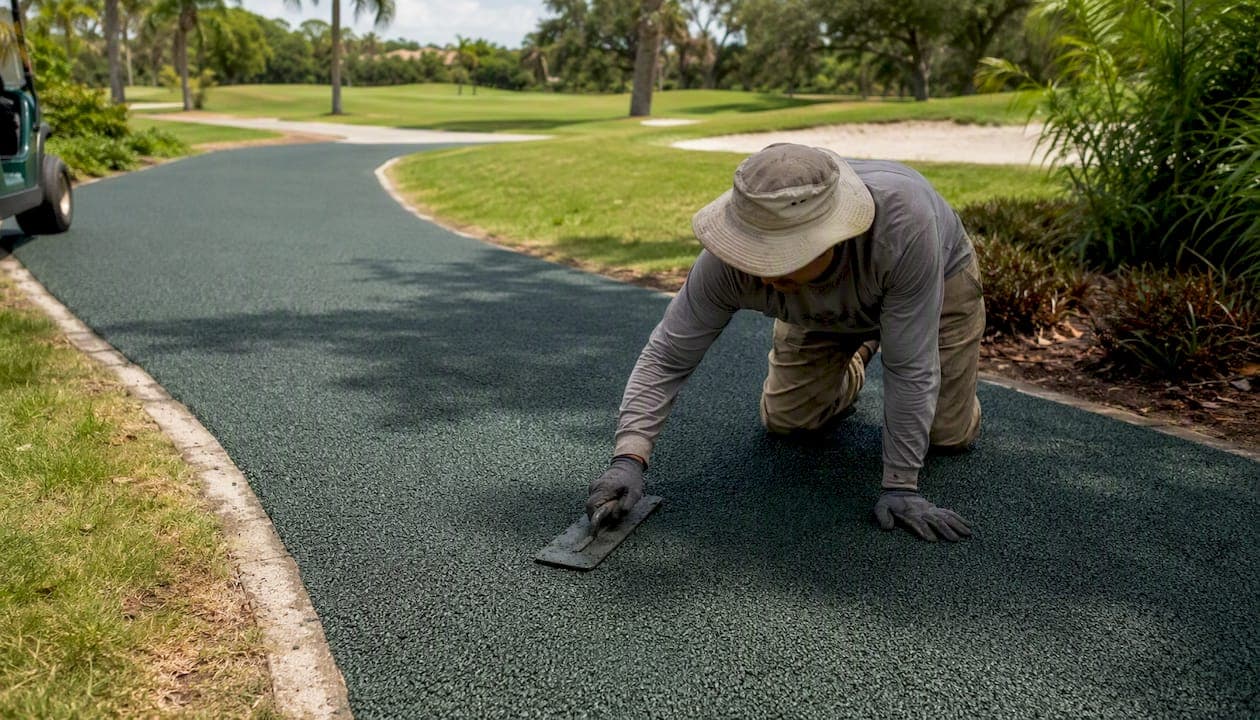
The EcoTec Rubberway® system is a rubberized, permeable paving surface made from recycled tire material. Its core structural advantage on golf properties is that the high rubber content gives the surface enough flexibility to absorb thermal expansion, minor ground movement, and root pressure without fracturing. In practical terms, it functions as a continuous expansion joint across the entire path surface, which eliminates the joint-maintenance work that concrete requires and the thermal cracking that unmodified asphalt develops.
Field experience with rubberized permeable cart paths shows particularly strong performance on slopes, root zones, and shaded walkways where rigid surfaces are most likely to heave. The permeable design allows water to pass through the surface rather than pond on it, which removes the primary mechanism for freeze-thaw crack initiation.
Rubberway® features relevant to facility managers:
- Permeable surface eliminates ponding and reduces stormwater runoff at path edges
- Flexible matrix tolerates freeze-thaw cycling and minor ground movement without cracking
- ADA-compliant surface texture for accessible walkways and cart paths
- Recycled tire content reduces material waste; recycled content percentage directly influences flexibility and crack resistance
- No control joints to seal or maintain
- Available in multiple colors for aesthetic integration with course design
Where Rubberway® fits best:
Wet slopes where rigid surfaces pond and crack, root zones near mature trees, shaded walkways with limited drying time, and path edges adjacent to turf areas where water migration is a recurring problem. It is not the first choice for heavy service vehicle zones where point loads exceed what a rubberized surface is rated to carry. Verify load ratings and warranty terms with Ecotecrubber before specifying for maintenance-vehicle routes.
Installation requires proper subgrade preparation and compaction, the same as any other surface. Ecotecrubber coordinates site evaluation and subgrade verification as part of the installation process.
8. Technical standards and references managers should use
When writing specifications or evaluating bids, these are the sources worth citing directly:
- USGA Green Section Record — Choosing Cart Path Materials: — The authoritative golf-industry reference for matching path material to site drainage, freeze-thaw exposure, and traffic. Use it to justify material selection in RFPs.
- FHWA — Continuously Reinforced Concrete Pavement (CRCP): — Explains how continuous reinforcement controls transverse cracking in concrete. Relevant when specifying concrete paths in high-load zones.
- Asphalt Calculator USA — Asphalt Crack Resistance: — Documents the performance impact of polymer-modified binders and fiber additives. Use it to justify SBS modifier specifications in asphalt bids.
- Unilock — Design Considerations for Interlocking Concrete Pavements: — Covers freeze-thaw resistance and ASTM C 672 testing for pavers. Reference when evaluating paver bids for pedestrian areas.
- Golfdom — Rubberized Cart Path Investment: — Practitioner perspective on rubberized permeable systems and lifecycle savings. Use as supporting evidence when presenting permeable-system bids to a board.
- Golf Course Paving Guide — Abacus PG: — Facility-facing guidance on permeability, aesthetics, and low-maintenance material selection.
- MSU/Golfdom Archive — Cart Path Construction Tips: — Superintendent-level guidance on concrete psi, fiber mesh, and base compaction for golf cart paths.
Spec language to include in RFPs:
Key Takeaways
Crack-resistant paving on golf facilities prevents water-driven base failure, reduces liability exposure, and lowers total lifecycle cost compared to standard materials installed without drainage and compaction controls.
| Point | Details |
|---|---|
| Subgrade is the foundation | Compaction to ≥95% standard Proctor before base placement prevents differential settlement and cracking. |
| Material must match site conditions | Rubberized permeable systems outperform rigid options on slopes, root zones, and freeze-thaw climates. |
| Lifecycle cost beats upfront cost | Polymer-modified asphalt and rubberized systems delay repair cycles and reduce total 15–20 year spend. |
| Inspection cadence prevents escalation | Seasonal inspections and immediate crack sealing stop hairline cracks from becoming structural failures. |
| Ecotecrubber Rubberway® | A flexible, permeable, ADA-compliant option for golf paths where crack resistance and drainage are the primary concerns. |
The case for specifying crack resistance from day one
Most facility managers encounter crack resistance as a line item in a repair budget, not a design specification. That sequencing is the problem. By the time cracking is visible and measurable, water has already been working on the base for months. The repair cost is always a multiple of what prevention would have cost.
The conventional wisdom in golf facility maintenance is to buy the cheapest path material that passes the initial inspection and patch it as needed. That approach makes sense on a short budget cycle. It makes no sense on a 20-year facility plan. A path that costs 30% more to install but requires no structural repair for 20 years is not a luxury. It is the lower-cost option, and the math is not close.
What I find underappreciated in most facility conversations is the turf-damage multiplier. A cracked path edge that allows water migration does not just damage the path. It damages the adjacent turf, which requires its own remediation, which means additional labor, seed or sod, and irrigation adjustment. The repair cost of a cracked path is never just the path.
Specify crack resistance at the design stage. Require engineer sign-off on subgrade compaction. Ask every bidder for a lifecycle cost analysis, not just an installation quote. Those three actions will change the financial profile of your paving program more than any material upgrade alone.
*— Roger
Ecotecrubber offers a practical crack-resistant option for golf facilities
Golf facilities that have dealt with recurring asphalt patching or concrete joint failures know the real cost: not just the repair invoice, but the closed paths, the turf rerouting, and the staff hours spent managing a problem that should have been designed out.
Ecotecrubber installs the Rubberway® system across Florida, a rubberized permeable surface built from recycled tire material that tolerates thermal movement, root pressure, and drainage stress without cracking. No control joints to seal. No rigid surface to heave. ADA-compliant from day one. The system is particularly well-suited to the wet slopes, shaded walkways, and root-affected zones that give rigid pavements the most trouble.
Every Ecotecrubber installation includes site evaluation, subgrade preparation coordination, and compaction verification. If you are evaluating paving options for a cart path renovation or a new walkway installation, view the Rubberway® product specifications or contact Ecotecrubber directly to discuss your site conditions and get a project assessment.
Useful sources and standards
- Choosing Cart Path Materials
- A. John Harvey from Porous Pave shares how a cart path investment can save time and money | Golfdom
- 5 Proven Ways to Improve Asphalt Crack Resistance — Asphalt Calculator USA
- Experts offer tips on how to make the best ones possible
- Design Considerations for Interlocking Concrete Pavements — Unilock
- Golf Course Paving Guide for Clubs & Grounds Teams
When reviewing bids, ask every contractor to provide test results and warranty terms explicitly tied to crack resistance performance, not just general workmanship. A warranty that covers installation defects but excludes cracking from thermal movement is not a crack-resistance warranty.