
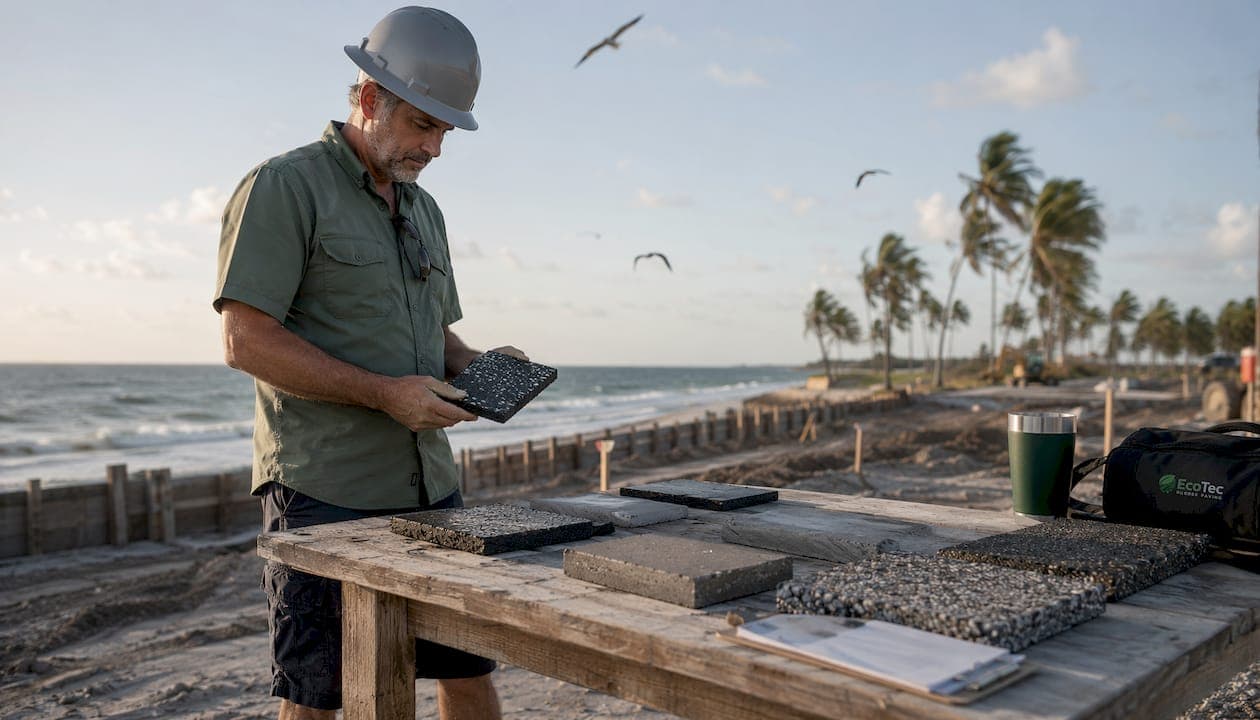
For most eco-conscious Florida business sites, rubber pavers installed through the Ecotecrubber Rubberway® system are the strongest starting point. They flex with Florida's sandy soils and thermal swings instead of fighting them, drain stormwater efficiently, and arrive with meaningful recycled content built in. That said, heavy truck lanes and loading docks still call for reinforced concrete or polymer-modified asphalt. Start with a licensed site assessment to confirm which zones need which material.
- Rubber pavers (Rubberway®): best for pedestrian plazas, ADA paths, pool decks, and overflow parking
- Permeable interlocking concrete pavers (PICP): best for mixed pedestrian/light-vehicle areas with stormwater requirements
- Polymer-modified asphalt: best for main drive lanes and parking fields
- Reinforced concrete overlays: best for loading docks and heavy truck routes
- Grass/vehicular pavers: best for overflow lots and green buffer zones
Table of Contents
- Which crack-resistant paving types work best for Florida businesses?
- Why rubber paving suits Florida's climate and sustainability goals
- What do costs, lifespan, and maintenance actually look like?
- How to evaluate and hire a Florida paving contractor
- What site factors matter most in Florida: drainage, heat, and subbase
- Municipal and large-property procurement checklist
- Why subbase failure causes most premature cracking
- Does your paving meet ADA compliance and slip-resistance standards?
- What makes a Florida paving contractor genuinely sustainable?
- Red flags to watch for when hiring a Florida paving contractor
- How do paving materials compare on environmental impact in Florida?
- Key Takeaways
- Florida rubber paving: a perspective worth considering
- Ecotecrubber: Florida's rubber paving specialist
- Useful sources and standards for procurement
Which crack-resistant paving types work best for Florida businesses?
Material selection should match traffic type first, then climate, then sustainability goals. Here is how the five main options stack up.
| Material | Best for | Typical installed cost | Lifespan | Maintenance needs | Permeability | Sustainability |
|---|---|---|---|---|---|---|
| Rubber pavers (Rubberway®) | Pedestrian, ADA, pool, overlay | Moderate installed cost | Moderate lifespan | Low; periodic cleaning | High (permeable options) | High recycled content |
| PICP | Mixed pedestrian/light vehicle | — | 20–30 yrs | Joint sand replenishment | High | Moderate |
| Polymer-modified asphalt | Drive lanes, parking fields | $4–$8/sq ft | — | Sealcoat every 2–3 yrs | Low–moderate | Low–moderate |
| Reinforced concrete overlay | Loading docks, truck routes | Moderate installed cost | Longer lifespan | Crack sealing, joint fill | Low | Low |
| Grass/vehicular pavers | Overflow lots, green zones | Moderate installed cost | Moderate lifespan | Mowing, infill top-up | Very high | Moderate–high |
Quick-pick guide for Florida commercial sites:
- Pedestrian plaza or ADA path: rubber pavers or PICP
- Small parking area: PICP or polymer-modified asphalt
- Heavy truck lane: reinforced concrete or heavy-duty asphalt
- Overflow/green lot: grass/vehicular pavers
- Utilities-access corridor: rubber pavers or PICP (modular, liftable)
Why rubber paving suits Florida's climate and sustainability goals
Rubber pavers absorb thermal movement rather than resisting it. Florida's heat cycles expand and contract subgrades constantly, and a rigid surface cracks under that stress. A segmented, interlocking rubber system distributes that movement across dozens of small joints instead of concentrating it in one slab fracture.
Rubber pavers are also lightweight, slip-resistant, and can be installed directly over existing hard surfaces, which cuts demolition waste and project time. Many products carry significant recycled content, typically from reclaimed tires, which aligns directly with Florida municipalities' waste-reduction targets.
Rubber paving's real advantage in Florida isn't just crack resistance. It's that the material is engineered to move with the ground rather than against it, which is exactly what sandy, moisture-variable Florida soils demand.
Permeable rubber installations also reduce standing water after Florida's heavy afternoon storms, a chronic problem on flat commercial lots. For a golf-course path or a waterfront boardwalk, that drainage performance matters as much as crack resistance.
Pro Tip: Specify an interlocking rubber paver system with detailed jointing rather than a poured rubber surface. The segmented design lets individual units accommodate subsurface movement without transmitting stress to adjacent panels, which is the single biggest crack-prevention mechanism in Florida's shifting soils.
What do costs, lifespan, and maintenance actually look like?
Lifecycle cost matters more than sticker price. Asphalt's lower upfront cost is routinely offset by sealcoating every 2–3 years and periodic crack filling, which adds up fast over a 20-year horizon. Budget for the full ownership period, not the installation invoice.
| Material | Installed cost (typical) | Lifespan | Key maintenance tasks | Frequency |
|---|---|---|---|---|
| Rubber pavers | $8–$10/sq ft | — | Cleaning, replace damaged units | Annual inspection |
| PICP | — | 20–30 yrs | Joint sand replenishment, vacuuming | Every 1–3 yrs |
| Polymer-modified asphalt | $4–$8/sq ft | — | Sealcoating, crack fill | Every 2–3 yrs |
| Reinforced concrete | $8–$10/sq ft | 30–40 yrs | Joint sealing, crack repair | Every 5–7 yrs |
| Grass/vehicular pavers | $6–$10/sq ft | 20 yrs | Infill top-up, mowing | Seasonally |
20-year maintenance snapshot by material:
- Rubber pavers: initial years minimal; later years spot unit replacements; potential refresh in long term
- PICP: early years top up joints; periodic vacuuming and maintenance over time
- Polymer-modified asphalt: sealcoat and crack fill maintenance periodically; overlays may be needed eventually
- Reinforced concrete: joint sealing and occasional crack repair over the lifecycle
- Grass/vehicular pavers: seasonal infill and mowing maintenance ongoing; infill replacement may be necessary over time
Florida-specific watch items: UV degradation accelerates asphalt softening, joint sand in PICP washes out faster in heavy rain events, and any surface over a poorly drained subbase will fail years ahead of schedule regardless of material.
How to evaluate and hire a Florida paving contractor
Contractor selection and subbase engineering are the most important factors for crack prevention. Get this right before you finalize material choice.
Contractor vetting checklist:
- Confirm active Florida contractor license and current certificate of insurance (COI)
- Verify local Florida project experience, specifically in your climate zone
- Ask for engineered subbase drawings, not just a verbal description
- Request proof of ADA compliance on completed projects (slip-resistance test results)
- Review warranty terms in writing: what is covered, for how long, and under what conditions
- Check references from at least two comparable commercial or municipal Florida projects
- Confirm recycled-content specifications for any rubber or permeable product proposed
- Get a written project timeline with phasing milestones
Key questions to ask during bidding:
- How do you design the subbase for Florida's sandy soils and high water table?
- What permeability solution do you recommend for this site's stormwater load?
- Can you provide sample warranty language before contract signing?
- How do you handle ADA slope and surface-texture compliance on this grade?
Documents to collect before signing:
- Copy of Florida contractor license
- Current COI (general liability + workers' comp)
- Engineered subbase drawings or geotechnical report
- Written warranty document
- Manufacturer data sheets confirming load ratings and recycled content
Always verify load ratings against actual traffic. A pedestrian-rated rubber paver installed in a delivery lane will fail prematurely, no matter how well it was laid.
What site factors matter most in Florida: drainage, heat, and subbase
Subbase preparation and water management determine crack resistance more than surface material alone. In Florida, inadequate subbase and poor drainage cause most premature cracking. A premium surface over a poorly graded subbase is money wasted.
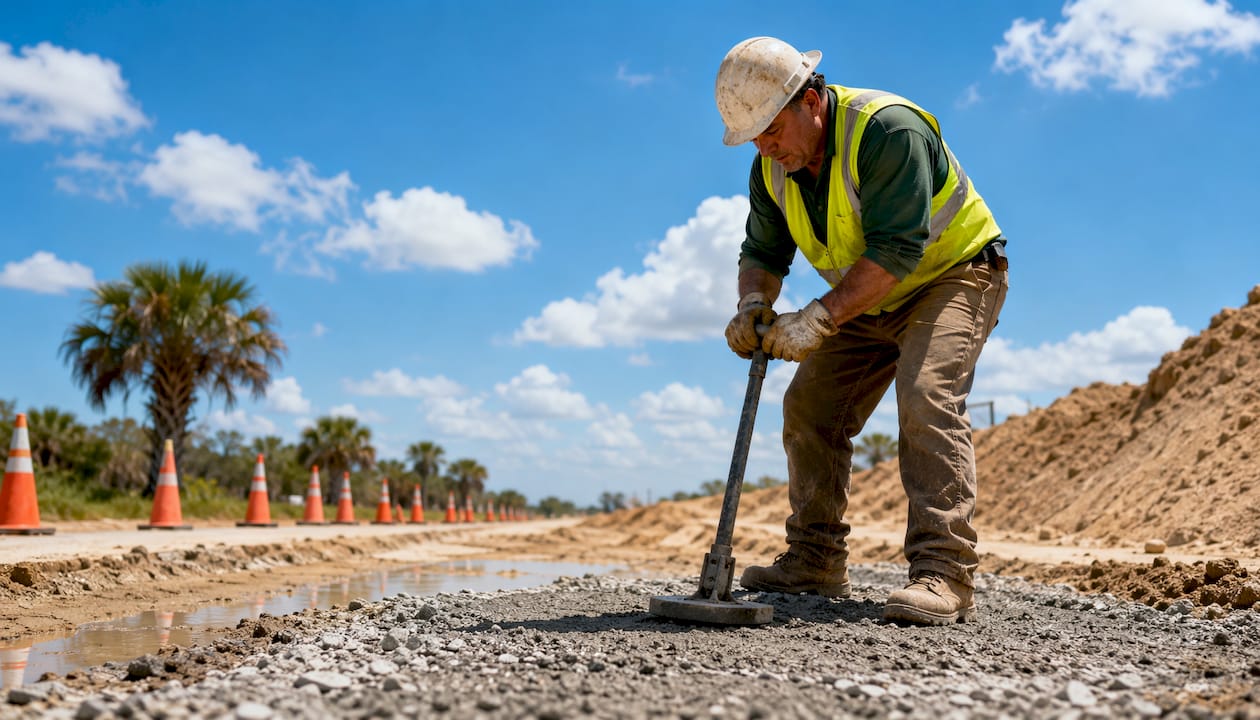
Permeable pavement is classified by the EPA as a low-impact development practice. It reduces runoff, eases pressure on stormwater infrastructure, and prevents the surface pooling that accelerates pavement degradation in Florida's storm season. For stormwater planning on commercial sites, the stormwater management guidance from Ecotecrubber covers permeable system design in detail.
Florida's sandy soils shift with moisture changes, and thermal expansion in summer heat adds stress to any rigid surface. Control joints, modular pavers, or flexible rubber systems distribute that stress. Porous asphalt and pervious concrete also help by letting water drain through rather than pool in surface voids where it degrades the bond layer.
Municipal and large-property procurement checklist
Require geotechnical subbase specs, permeability targets, and minimum warranty terms in every procurement document before soliciting bids.
Procurement document requirements:
- Geotechnical subbase specification with compaction and drainage standards
- Minimum permeability rate for permeable zones (reference EPA low-impact development standards)
- Recycled-content minimum percentage for rubber or permeable products
- ADA surface-texture and slope compliance requirements
- Minimum warranty period (recommend 5 years on materials and installation)
- Contractor QA/QC process and testing acceptance criteria
Approval and permitting steps for Florida municipal projects:
- Confirm stormwater BMP alignment with local water management district requirements
- Submit permeable pavement design to local stormwater authority for review
- Verify ADA compliance with the Americans with Disabilities Act Standards for Accessible Design
- Include lifecycle-cost bid requirement so vendors compete on total ownership cost, not just installation price
- Phase installation to minimize operational disruption: complete one zone before opening the next
For recycled-content specifications in procurement documents, Ecotecrubber's guidance explains how to set and verify percentage targets.
Why subbase failure causes most premature cracking
The surface gets the blame, but the subbase is almost always the culprit. Professionals consistently identify neglected subbase preparation as the primary cause of premature project failure. A well-engineered subbase controls drainage, distributes load, and prevents the differential settlement that opens cracks from below.
In Florida, this means specifying compacted aggregate base layers deep enough to account for the water table, grading for positive drainage away from the surface, and using geotextile fabric where sandy soils risk migration into the aggregate. No surface material, however flexible or modular, compensates for a subbase that moves unevenly.
Installation quality matters equally. Improper compaction, skipped curing time, or rushed joint filling all create weak points that crack under Florida's heat and traffic load within the first few seasons.
Does your paving meet ADA compliance and slip-resistance standards?
ADA-compliant surfaces must meet specific slope tolerances (no more than 1:48 cross-slope on accessible routes) and provide firm, stable, slip-resistant texture. Rubber pavers score well here: their textured surface delivers consistent slip resistance even when wet, which matters on Florida's rain-soaked walkways and pool surrounds.
PICP and polymer-modified asphalt can also meet ADA requirements when properly specified and installed. The key is testing. Request ASTM C1028 or ANSI A326.3 slip-resistance test results from any contractor proposing a surface for an accessible route. A verbal assurance is not documentation.
Modular systems like rubber pavers and PICP have an additional advantage: individual units can be replaced if settlement creates a trip hazard, without disturbing the surrounding surface.
What makes a Florida paving contractor genuinely sustainable?
Sustainability credentials in Florida go beyond using recycled materials. Look for contractors who source locally to cut transport emissions, specify products with documented recycled content, and use equipment and practices that reduce site disturbance and waste. The benefits of sustainable commercial paving extend to lower lifecycle costs and stronger community acceptance, particularly for municipal projects.
Specific criteria to verify:
- Documented recycled content in rubber or permeable products (ask for manufacturer data sheets)
- Local or regional sourcing for aggregate and base materials
- Stormwater-positive design: does the installation reduce runoff compared to the existing surface?
- Waste diversion plan for demolition material from the existing surface
- Energy-efficient equipment and practices on site
Florida's green building programs, including LEED and Florida Green Building Coalition standards, recognize permeable and recycled-content paving. A contractor familiar with these frameworks can help projects qualify for credits.
Red flags to watch for when hiring a Florida paving contractor
A contractor who cannot produce a current Florida license number on request is the clearest warning sign. Beyond that, watch for these patterns:
- No written warranty or vague warranty language ("we stand behind our work" with no terms)
- Subbase described verbally with no engineered drawings or geotechnical reference
- Pressure to sign quickly before you can check references
- No COI or a policy that expired before the project start date
- Unusually low bids with no explanation of how they achieve the price
- No prior Florida commercial or municipal project references
A contractor who dismisses subbase engineering as unnecessary is a particular concern. That attitude is the single most reliable predictor of a cracked surface within three to five years.
How do paving materials compare on environmental impact in Florida?
Rubber pavers made from reclaimed tires divert waste from landfills and require no new raw material extraction for the rubber component. Their lightweight installation over existing surfaces also eliminates the demolition and disposal emissions that come with full-depth replacement. For green building material options, rubber pavers rank among the lowest embodied-impact choices available.
PICP carries moderate embodied carbon from concrete production but delivers strong stormwater performance that reduces downstream infrastructure load. Polymer-modified asphalt has higher embodied carbon and relies on petroleum-derived binders, though porous formulations improve its stormwater profile. Reinforced concrete has the highest upfront embodied carbon but its 30–40 year lifespan spreads that impact over a long service period. Grass/vehicular pavers have low embodied impact and the highest permeability, but their grass infill requires irrigation and maintenance that adds to their operational footprint in Florida's dry seasons.
The most sustainable choice for most Florida commercial sites combines a permeable or rubber surface with a properly engineered subbase that eliminates the need for early replacement.
Key Takeaways
Rubber pavers with an engineered permeable subbase are the most crack-resistant, sustainable, and ADA-capable choice for most Florida commercial pedestrian and mixed-use surfaces.
| Point | Details |
|---|---|
| Subbase first | Poor subbase preparation causes most premature cracking; specify engineered drawings before choosing surface material. |
| Lifecycle cost over sticker price | Asphalt needs sealcoating every 2–3 years; rubber and PICP typically cost less over a 20-year horizon. |
| Rubber pavers for pedestrian and ADA zones | Flexible, slip-resistant, and permeable; Ecotecrubber's Rubberway® system is built for Florida's thermal and drainage demands. |
| Verify sustainability credentials | Require recycled-content data sheets, local sourcing confirmation, and stormwater-positive design from any contractor. |
| Ecotecrubber Rubberway® | Licensed, insured, ADA-capable Florida installer using recycled-content rubber pavers with documented warranty terms. |
Florida rubber paving: a perspective worth considering
The paving industry has a habit of defaulting to asphalt for almost every commercial project, and the reasoning is usually speed and upfront cost. Both are real advantages. But in Florida specifically, that default carries a hidden cost that rarely shows up in the bid: the maintenance cycle. Sealcoating every two to three years, crack filling, and eventual overlays add up to a significant ownership burden, and none of that work happens without disrupting the business operating on that surface.
What gets underestimated is how much of the cracking problem is actually a drainage and subbase problem wearing a surface-material disguise. A property owner who invests in a proper geotechnical subbase and a permeable or flexible surface system will almost always outperform one who chose the cheapest surface over a rushed base. The material matters, but the engineering underneath it matters more.
Rubber paving also tends to get dismissed as a niche product for playgrounds. That reputation is outdated. The Rubberway® system handles real commercial pedestrian loads, meets ADA requirements, and delivers stormwater performance that flat Florida lots genuinely need. For eco-conscious property owners and municipalities, it is one of the few options that checks the sustainability, performance, and compliance boxes simultaneously without requiring a premium surface over a compromised base.
Ecotecrubber: Florida's rubber paving specialist
Florida commercial sites face a specific combination of heat, heavy rain, sandy soils, and ADA requirements that generic paving contractors rarely address as a system. Ecotecrubber installs the Rubberway® system across Florida with a focus on exactly that combination: recycled-content rubber pavers, permeable subbase design, ADA-compliant surfaces, and licensed, insured installation backed by written warranty terms.
Every Ecotecrubber project starts with a site assessment to confirm subbase conditions, drainage requirements, and ADA compliance needs before a single paver is specified. That process is what separates a surface that lasts from one that cracks in year three.
For Florida property owners and municipalities ready to move from generic asphalt to a durable, sustainable solution, visit Ecotecrubber to request a free site assessment, or review the full Rubberway® product range to match specifications to your site.
Useful sources and standards for procurement
Use these sources when writing technical specifications, evaluating contractor proposals, or citing standards in procurement documents.
Core references:
- EPA permeable pavement guidance: cite for low-impact development classification and stormwater BMP alignment
- Commercial paving materials comparison: use for lifecycle cost benchmarks and material use-case guidance
- Contractor hiring best practices: reference for subbase engineering requirements and QA/QC vetting
- Rubber paver performance data: cite for slip resistance, recycled content, and overlay installation guidance
- ADA Standards for Accessible Design (U.S. Access Board): required citation for slope tolerances and surface-texture requirements on accessible routes
- ASTM C1028 / ANSI A326.3: slip-resistance test standards to require in contractor submittals
- Florida Water Management District stormwater BMP guidelines: cite for permeable pavement design review requirements
How to use these in procurement:
Reference the EPA low-impact development classification when specifying permeability minimums. Cite ASTM slip-resistance standards in acceptance criteria. Require contractor submittals to include manufacturer data sheets cross-referenced against load-rating guidance. For recycled-content targets, Ecotecrubber's recycled-content specification guide provides a practical framework for setting and verifying percentage requirements in bid documents.