
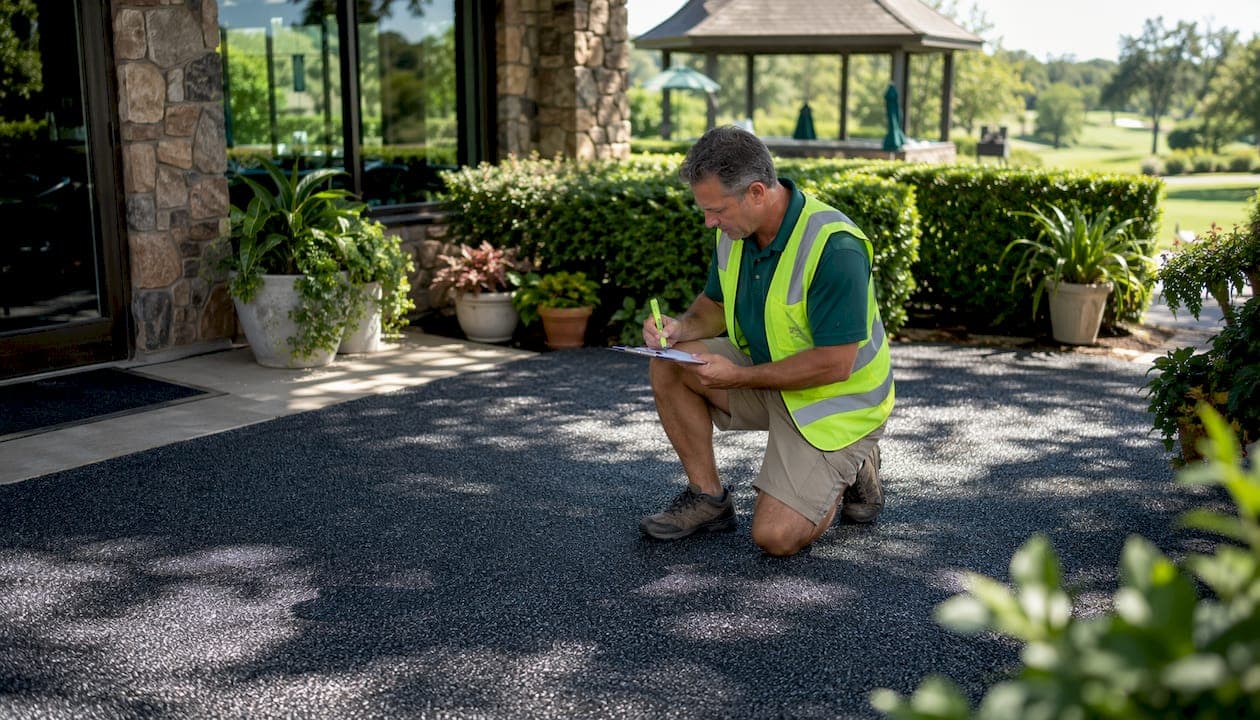
For a golf clubhouse entrance, the right call is a spike-rated, poured-in-place or bonded recycled-rubber surfacing system paired with a heavy-duty ribbed barrier mat at the threshold. That combination delivers long-term slip resistance, ADA-compatible transitions, and permeability that handles Florida's rain loads without pooling or cracking. The EcoTec Rubberway® system is built precisely for this application, using recycled tire granules bonded with a polyurethane binder over a geogrid-reinforced base, and it meets the industry-standard percolation benchmark of 60 litres/M2/hour used to distinguish adequately draining substrates from those at risk of pooling or flooding.
Before you call anyone, run through these steps:
- Inspect the existing substrate for cracks, heaving, and slope (you need at least 2% grade away from the building).
- Confirm any proposed system carries a spike-load rating in writing, not just a verbal assurance.
- Verify the installer is licensed, insured, and has completed golf or high-traffic commercial projects.
- Request permeability test data and a written warranty before signing anything.
Pro Tip: Always ask for the spike-loading rating and the percolation test result as line items in the written proposal. If a bidder can't produce both, move on.
Table of Contents
- What rubber surfacing actually means at a clubhouse entrance
- How rubber handles traction, spikes, and golf cart loads
- Installing over existing asphalt or concrete: what prep actually looks like
- Drainage, slopes, and ADA compliance at the clubhouse threshold
- Maintenance plan: routine upkeep, winter care, and de-icing
- Design, color, and wayfinding that don't compromise safety
- What rubber surfacing costs and how to think about the ROI
- Combining exterior rubber paving with entrance matting at the threshold
- How to choose an installer and what to ask before you sign
- Why EcoTec Rubberway® is a practical U.S. option for clubhouse entrances
- Before and after: what a completed project should look like
- Key Takeaways
- The detail most facility managers get wrong
- Ecotecrubber brings Rubberway® to Florida clubhouse entrances
- Sources and further reading
What rubber surfacing actually means at a clubhouse entrance
"Rubber surface" covers four distinct systems, and they perform very differently at a clubhouse threshold.
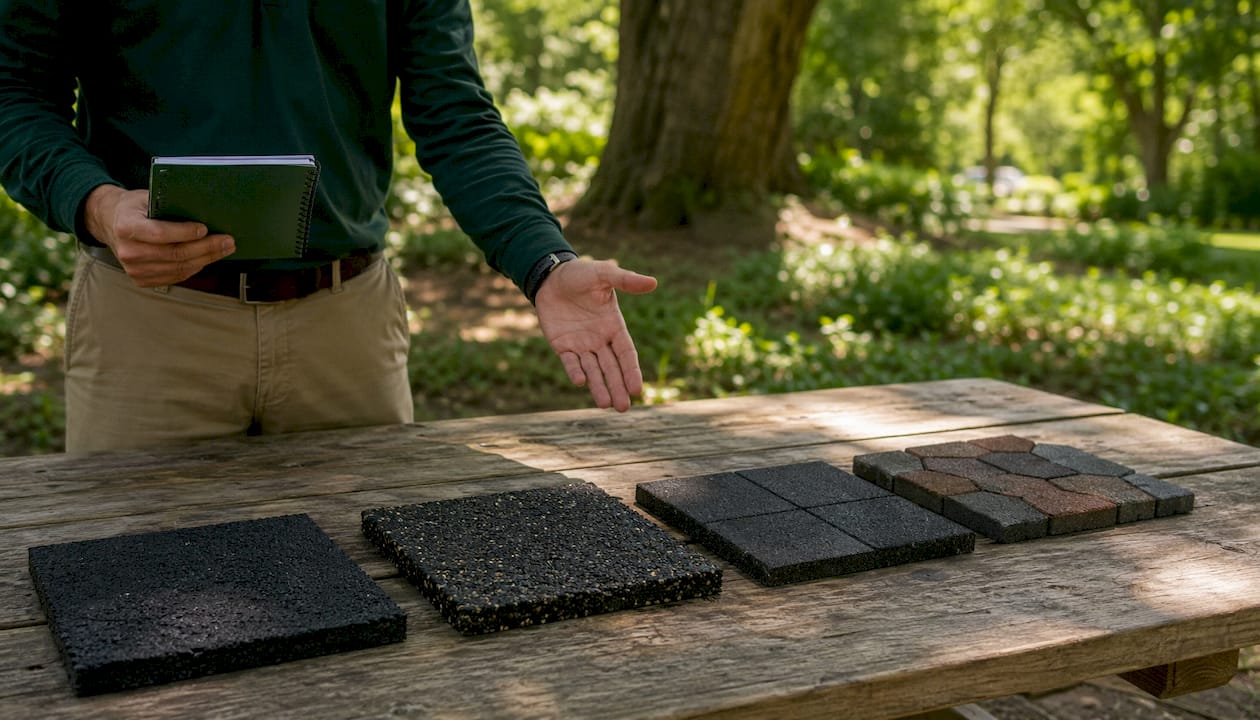
Poured-in-place (PIP): Recycled SBR tire granules mixed with a polyurethane binder, poured seamlessly over a prepared base with geogrid reinforcement. This is the workhorse for exterior entrances. It bonds to asphalt or concrete, tolerates cart traffic when properly reinforced, and is repairable in sections. The seamless finish eliminates trip edges.
Bonded rubber systems: Similar granule-and-binder chemistry but applied in a single thicker layer, often over granular bases. Slightly more flexible in substrate requirements, though drainage design is critical.
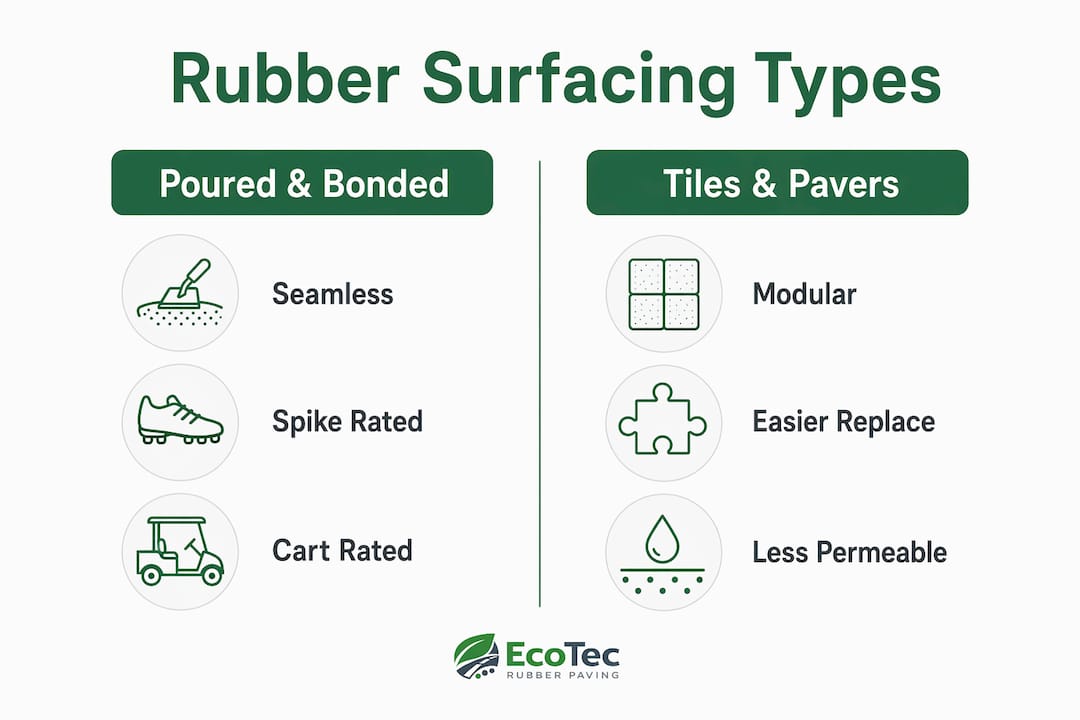
Modular rubber tiles: Interlocking or loose-lay panels. Faster to install and easier to replace individual sections, but the joints can collect debris and present minor trip-edge risk if tiles shift. Better suited to covered or semi-covered transition zones than fully exposed exterior thresholds.
Recycled rubber pavers: Precast units that behave more like traditional pavers. Durable and attractive, but permeability depends on joint spacing, and spike resistance varies by manufacturer.
| System | Spike-rated? | Cart-rated? | Permeability | Repairability | Best use at entrance |
|---|---|---|---|---|---|
| Poured-in-place | Yes (specify) | Yes (with geogrid) | High | Patch sections | Exterior threshold, walkways |
| Bonded rubber | Yes (specify) | Limited | High | Moderate | Exterior paths, transition zones |
| Modular tiles | Varies | No | Moderate | Easy (swap tiles) | Covered vestibule, interior |
| Rubber pavers | Varies | No | Low–moderate | Moderate | Decorative aprons |
The practical rule: use a spike-rated poured or bonded system at any exterior threshold where spikes and carts will pass. Transition to heavy-duty tiles or matting once you're inside the covered entry.
How rubber handles traction, spikes, and golf cart loads
Traction is where rubber surfacing earns its keep over concrete or asphalt. Rubber provides improved traction in wet conditions, which matters at a clubhouse entrance where players arrive straight off the course with wet, muddy shoes. For exterior walkways, suppliers should provide coefficient of friction (COF) test data; the ADA recommends a minimum static COF of 0.6 for accessible routes, and a well-specified poured rubber system typically exceeds that.
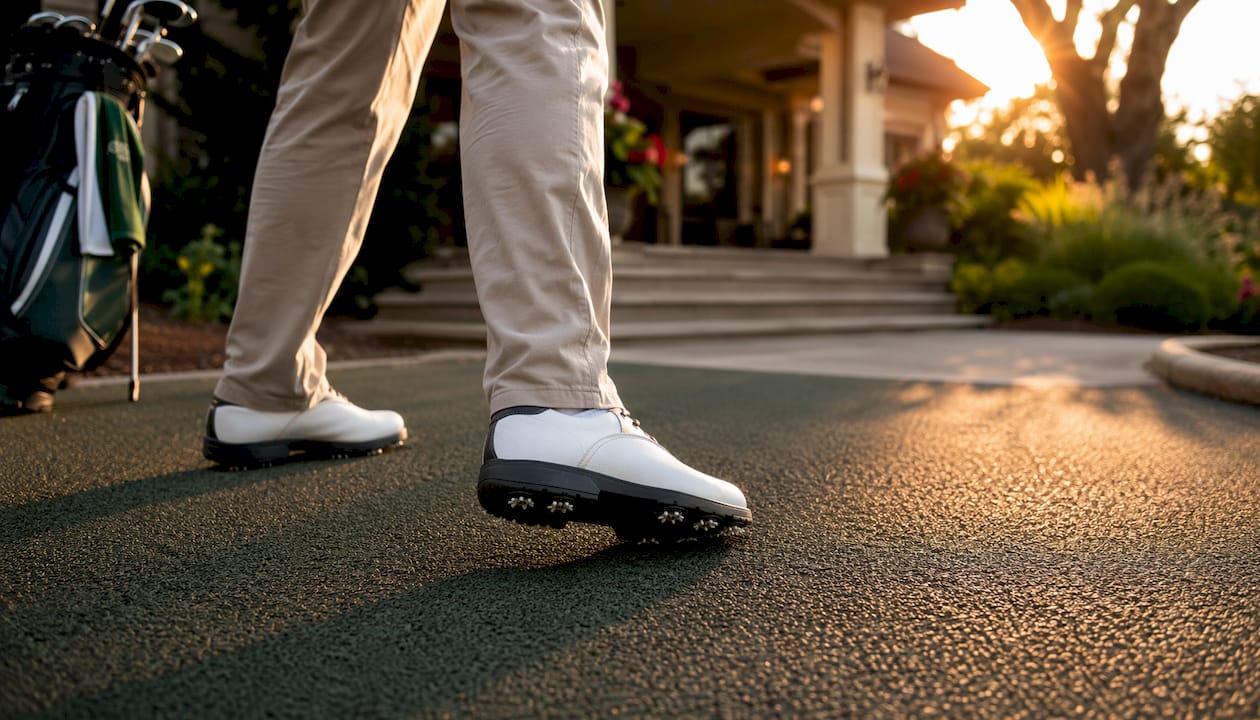
Spike loading is the detail most facility managers overlook. Golf shoe spikes create concentrated point loads that can tear or indent a surface not designed for them. Metal cleats are the worst offenders; modern soft-spike shoes are less aggressive but still concentrate stress on a small contact area. Any system you specify for the exterior threshold must carry an explicit spike-load rating from the manufacturer, not a general "suitable for sports use" claim.
Golf carts add a different challenge. A standard two-passenger cart weighs roughly 900–1,000 lbs loaded, and that load travels through four small tires. For cart crossings, geogrid reinforcement within the rubber base layer distributes that load and prevents rutting. The USGA notes that permeable rubber options provide traction and comfort tradeoffs versus impervious surfaces under heavy cart traffic. For dedicated cart paths, a thicker poured system with geogrid is the right specification; for pedestrian-primary entrances with occasional cart crossings, a standard reinforced PIP system is usually sufficient.
Installing over existing asphalt or concrete: what prep actually looks like
Most clubhouse entrances already have a concrete or asphalt base, which is good news. Poured rubber systems bond directly to both, but the prep work determines whether the surface lasts 15 years or 5.
- Inspect the base. Walk the entire area and mark cracks wider than 3mm, any heaving or settled sections, and areas with standing water after rain.
- Repair structural defects. Fill and seal cracks; replace any section with sub-base failure. Rubber surfacing will telegraph base movement over time.
- Confirm slope. The surface must drain at a minimum 2% grade away from the building. If it doesn't, re-grading or a drainage channel is required before rubber goes down.
- Check percolation. If the existing base percolation falls below 60 litres/M2/hour, a French drain or sub-surface drainage system is mandatory before installation.
- Add geotextile and geogrid where specified. For granular bases, compact to approximately 95% Proctor density at 25–100 mm depth before geogrid placement.
- Clean and prime the surface. Remove all oil, debris, and loose material. A bonding primer is typically applied to asphalt or concrete before the rubber layer.
- Install edge restraints. Clean aluminum or steel edging at all perimeter transitions prevents the rubber from lifting or spreading at the margins.
Pro Tip: If your existing concrete has expansion joints, have the installer detail those joints with a flexible sealant before the rubber layer goes down. Ignoring them is the single most common cause of surface cracking at year two or three.
Drainage, slopes, and ADA compliance at the clubhouse threshold
These two requirements overlap more than most managers expect. A surface that drains well tends to be safer underfoot, and a surface designed for ADA compliance is almost always better drained than one that isn't.
ADA checklist for the clubhouse entrance:
- Static COF of 0.6 or higher on the accessible route
- Cross-slope no greater than 2% on the accessible path
- Running slope no greater than 5% (or 8.33% for a ramp with handrails)
- Flush transitions at all thresholds (no lips greater than ¼ inch, or ½ inch beveled)
- Detectable warning surfaces (truncated domes) where the path meets a vehicular area
- Minimum 60-inch clear width at the entrance approach
- No gaps in the surface greater than ½ inch in any direction
For a deeper look at how rubber paving meets these requirements, the ADA compliance paving guide covers the technical details by surface type.
| Drainage requirement | Threshold | Action if not met |
|---|---|---|
| Surface percolation | 60 litres/M2/hour | Install French drain or sub-surface drainage |
| Surface slope | ≥ 2% away from building | Re-grade or add drainage channel |
| Cross-slope (ADA) | ≤ 2% | Adjust grade during install |
| Threshold lip | ≤ ¼ inch (½ inch beveled) | Mill or build up adjacent surface |
Permeability also affects freeze-thaw performance. A surface that drains quickly holds less water in the pore structure, which means less ice formation and less freeze-thaw cycling that can degrade the binder. In Florida's climate, freeze-thaw is rarely a concern, but standing water under a rubber surface in any climate accelerates sub-base deterioration.
Maintenance plan: routine upkeep, winter care, and de-icing
Rubber surfacing is low-maintenance relative to concrete or asphalt, but "low" doesn't mean "none." A structured maintenance schedule is what separates a surface that looks good at year ten from one that needs patching at year four.
- Daily (peak season): Blow or sweep debris off the surface. Leaves and organic matter hold moisture and accelerate binder degradation if left sitting.
- Weekly: Rinse with water. For porous systems, a light pressure wash removes embedded grit that acts as an abrasive underfoot.
- Monthly: Professional deep clean using a low-alkalinity detergent. High-alkalinity cleaners degrade the polyurethane binder over time.
- Annually: Full inspection by the installer. Check edge restraints, expansion joint sealant, surface integrity, and drainage function. Document with photos.
- After major weather events: Inspect for debris accumulation in drainage channels and any surface displacement at edges.
For winter care in climates where freezing occurs: avoid rock salt and high-sodium chloride de-icers, which attack the binder. Sand or calcium magnesium acetate (CMA) are safer choices. Use plastic-bladed snow shovels or rubber-edged plows; metal blades can gouge the surface. The maintenance budget impact of a proper schedule is significant: surfaces maintained correctly typically reach their full rated lifespan, while neglected ones often need major repairs at the halfway point.
Pro Tip: Build the annual inspection into your service contract with the installer at the time of purchase. Getting it in writing upfront costs nothing and gives you a documented maintenance record that matters if a warranty claim ever comes up.
Design, color, and wayfinding that don't compromise safety
Color and branding options for rubber surfacing are broader than most managers realize. Poured systems can incorporate custom color blends, logo inlays, and lane markings without sacrificing the surface's slip resistance, provided the design is specified correctly from the start.
A few rules that matter:
- Avoid high-gloss sealers or topcoats. They reduce COF and create a slip hazard, especially when wet. Any color treatment must maintain the surface's original texture.
- Use contrasting color strips, not smooth paint, for wayfinding. Textured contrast strips serve visually impaired users and maintain traction. Painted lines on rubber can become slippery.
- Plan logo placement for repairability. A logo centered in a high-wear zone will need to be matched when that section is patched. Place branding elements in lower-traffic areas or specify a full-section replacement approach upfront.
- Keep detectable warning surfaces compliant. Truncated dome fields must meet ADA color contrast requirements (light-on-dark or dark-on-light) and cannot be substituted with a decorative pattern.
Pro Tip: Request a physical color sample cured under UV exposure before approving a color blend. Rubber pigments can shift slightly during the curing process and after UV exposure, and a sample board eliminates surprises on installation day.
What rubber surfacing costs and how to think about the ROI
Cost for a poured-in-place rubber entrance system varies based on several factors, and the upfront number rarely tells the full story.
Primary cost drivers:
- System type: Poured-in-place costs more per square foot than modular tiles but lasts longer and requires less ongoing repair.
- Site prep: Crack repair, re-grading, and drainage work are often the largest variable. A clean, well-sloped concrete base costs far less to prep than a cracked, settled asphalt apron.
- Geogrid reinforcement: Required for cart crossings; adds material and labor cost but is non-negotiable for longevity.
- Custom colors and logos: Pigmented systems and inlaid logos add to material cost. Standard colors are less expensive.
- Drainage infrastructure: A French drain installation, if required, is a significant addition to the base project cost.
| Cost factor | Impact on price | Notes |
|---|---|---|
| System type (PIP vs. tile) | High | PIP costs more upfront; lower lifecycle cost |
| Site prep and drainage | High (variable) | Depends on existing base condition |
| Geogrid reinforcement | Moderate | Required for cart crossings |
| Custom color/logo | Low–moderate | Standard colors are less expensive |
| Surface area | Linear | Larger areas reduce per-sq-ft cost |
A poured rubber system's long service life and lower maintenance demands typically justify the higher upfront cost versus repeated asphalt patching or concrete sealing. Fewer slip-and-fall incidents also reduce liability exposure, which has real insurance implications for a commercial facility. The ROI calculation should include avoided maintenance costs, avoided patch repairs, and the cost of a single liability claim, not just the installation price.
Combining exterior rubber paving with entrance matting at the threshold
The most effective entrance configuration pairs exterior rubber paving with a heavy-duty ribbed barrier mat positioned immediately inside the door. This two-stage approach traps the dirt and moisture that the exterior surface can't fully stop before it reaches interior flooring.
For the matting component:
- Size the mat to cover at least one full stride in every direction from the door. A mat that's too small gets stepped around, not on.
- Use a recessed mat well where possible. A flush-mounted mat eliminates the trip edge that a surface-mounted mat creates, which matters for ADA compliance.
- Anchor surface-mounted mats with non-slip backing and perimeter edging. An unanchored mat at a clubhouse entrance is a liability waiting to happen.
- Confirm ADA clearance. The mat must not reduce the accessible door clear width below 32 inches (36 inches preferred) and must not create a threshold lip above ¼ inch.
- Choose a mat that allows simple replacement. The mat will wear faster than the rubber paving. Design the installation so the mat can be swapped without disturbing the rubber surface or the threshold detail.
Pro Tip: Specify a mat with a drainage channel or perforated surface for the exterior side of the threshold. In wet climates, a solid-surface mat traps water against the door frame and accelerates wood rot or metal corrosion at the base of the door.
How to choose an installer and what to ask before you sign
The installer matters as much as the system. A well-specified rubber surface installed poorly will fail early; a properly installed system on a mediocre spec will still outperform most alternatives.
Installer checklist:
- Licensed and insured in your state (verify the certificate, don't just ask)
- Documented experience with rubber paving specifically, not just general paving or flooring
- Portfolio that includes golf courses, clubhouses, or comparable high-traffic commercial projects
- Willingness to provide references you can actually call
- Written warranty covering both materials and installation workmanship
Questions to ask every bidder:
- What is the spike-load rating of the system you're proposing, and can you provide the manufacturer's test data?
- What permeability rate does this system achieve, and what drainage solution do you recommend if our base doesn't meet the 60 litres/M2/hour benchmark?
- What is your substrate prep plan for our specific base condition?
- Will you use geogrid reinforcement, and if so, what specification?
- What maintenance does the surface require to keep the warranty valid?
- Can you show me photos of a completed golf or high-traffic entrance project, including the edge and threshold details?
Red flags to walk away from: vague warranty language ("we stand behind our work" with no written terms), no test data for spike loading or permeability, reluctance to provide references or project photos, and any pressure to skip substrate repair to save time or money.
Why EcoTec Rubberway® is a practical U.S. option for clubhouse entrances
Ecotecrubber's Rubberway® system is designed specifically for Florida's climate: high humidity, intense UV exposure, and rain events that test drainage performance on a regular basis. The system uses recycled rubber granules bonded with a polyurethane binder over a geogrid-reinforced base, installed by a licensed and insured team with documented experience in rubber paving.
Key trust signals for procurement:
- Licensed and insured: Ecotecrubber carries the credentials required for commercial installations in Florida.
- Recycled materials: The Rubberway® system diverts tire waste from landfills, which supports sustainability reporting for facilities with environmental commitments.
- ADA-aware detailing: Installations are designed with flush transitions and compliant slopes.
- Project gallery: Before-and-after documentation is available for completed projects; request the gallery when you contact the team.
- Warranty: Written warranty terms are available; confirm coverage for both materials and workmanship when requesting a quote.
To request an on-site assessment or a specification package for your clubhouse entrance, visit Ecotecrubber's website or review the Rubberway® product details before your first conversation with the team.
Before and after: what a completed project should look like
Visual documentation is one of the most useful tools in evaluating a rubber paving installer. Here's what to look for in any project gallery, and what to request from bidders.
Image placeholders for your project file:
When reviewing a supplier's photos, check for:
- Smooth, flush transitions at the threshold and at all adjacent landscaping or paving edges. A visible lip or gap is a defect.
- Clean edge terminations with no lifting, cracking, or separation at the perimeter.
- Evidence of drainage detail — a visible slope away from the building or a drainage channel at the low edge.
- Consistent surface texture with no pooling visible in the after photos.
Short captions to request with any photo submission: surface area in square feet, substrate type (concrete, asphalt, or granular), season photographed, and client permission status for publication.
The Winter Park Pines Golf Course Clubhouse project is a documented example of a successful clubhouse flooring renovation combining durable materials for high-use areas on a defined timeline, illustrating what a well-managed project looks like from start to finish.
Key Takeaways
A spike-rated, poured-in-place rubber surface paired with a heavy-duty threshold mat is the most durable, ADA-compatible, and lowest-maintenance choice for a golf clubhouse entrance.
| Point | Details |
|---|---|
| System selection | Specify a spike-rated poured-in-place or bonded rubber system for all exterior thresholds with cart access. |
| Drainage standard | Confirm base percolation meets the industry-standard 60 litres/M2/hour; require a French drain if it does not. |
| ADA compliance | Verify flush transitions (≤ ¼ inch lip), ≤ 2% cross-slope, and COF ≥ 0.6 on the accessible route. |
| Maintenance cadence | Daily debris clearing in peak season, monthly professional deep clean, and annual installer inspection. |
| Ecotecrubber option | Ecotecrubber's Rubberway® system offers licensed, insured installation with recycled materials and ADA-aware detailing for Florida clubhouses. |
The detail most facility managers get wrong
Most procurement decisions for clubhouse surfacing come down to price per square foot. That's the wrong number to anchor on.
The real cost is the five-year total: installation plus patching, plus the one slip-and-fall incident that generates a liability claim, plus the staff time spent managing repeated repair contractors. A poured rubber system costs more on day one than a concrete overlay or an asphalt patch. It costs less by year three in almost every scenario where the substrate was properly prepared and the system was correctly specified.
The other mistake is treating drainage as a secondary concern. Drainage is the foundation. A rubber surface installed over a base that doesn't drain will delaminate, heave, and fail regardless of how good the rubber itself is. The 60 litres/M2/hour percolation benchmark isn't a nice-to-have; it's the threshold between a surface that lasts and one that doesn't.
One more thing worth saying plainly: the best time to install is outside peak season. Florida's summer heat affects cure times, and a clubhouse entrance that's torn up during a tournament weekend creates problems no warranty can fix. Plan the install for late fall or early spring, build the timeline into your annual capital budget, and get the substrate assessment done at least 90 days before you want the surface finished.
Ecotecrubber brings Rubberway® to Florida clubhouse entrances
Replacing a cracked, slippery clubhouse entrance with a surface that actually performs under spike traffic and Florida rain is not a complicated project. It's a planning and specification problem, and Ecotecrubber has solved it for facilities across the state.
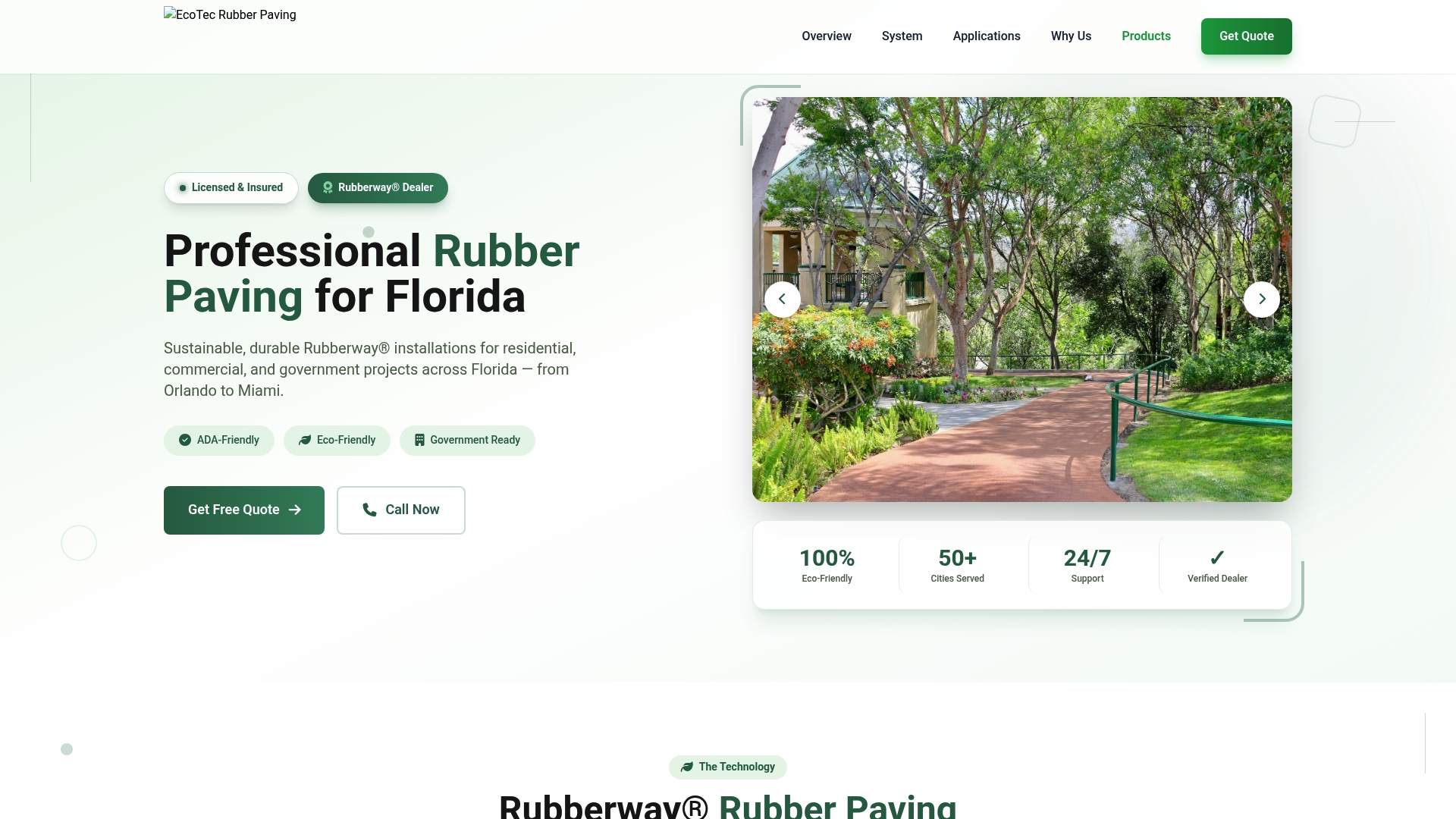
The Rubberway® system is installed by a licensed and insured team using recycled rubber granules, geogrid reinforcement, and ADA-compliant detailing. The result is a surface that handles daily spike traffic, golf cart crossings, and heavy rain without the cracking and pooling that concrete and asphalt entrances develop within a few years. Project galleries, warranty documentation, and specification packages are available on request.
Contact Ecotecrubber to schedule an on-site substrate assessment and get a written specification for your clubhouse entrance. The assessment is the right first step before any bidder puts a number in front of you.
Sources and further reading
- USGA — Choosing cart path materials: Guidance on tradeoffs between impervious and permeable surfaces for cart paths and walkways.
- Golf Path Rubber Surface Systems: Technical specifications for poured rubber systems including percolation benchmarks, geogrid requirements, and installation workflow.
- Vancouver Safety Surfacing — Benefits of rubber surfacing: Overview of traction, safety, and aesthetic benefits of rubber surfacing in wet climates.
- Unsustainable Magazine — Benefits of poured rubber flooring: Lifecycle cost and maintenance analysis for poured rubber systems.
- Flooring Hut — Golf club flooring: Spike-resistance requirements and safety considerations for golf club flooring.
- Slip-Not — Golf club Surrey case study: Case study on exterior rubber access routes paired with heavy-duty entrance matting.
- Mark Tool — Rubber surfacing benefits: Design flexibility including color options and logo inlays for poured systems.
- CFD Flooring — Winter Park Pines Golf Course Clubhouse: Documented clubhouse flooring renovation case study.
- Ecotecrubber — Rubberway® installations: EcoTec Rubber Paving's product and service pages for Rubberway® systems in Florida.
- ADA compliance paving guide — Ecotecrubber blog: Technical ADA compliance guidance by surface type for commercial properties.
When requesting proposals, ask every supplier to provide COF test data, permeability test results, and spike-load ratings as part of their written bid. Any supplier who can't produce those documents is not ready to spec a clubhouse entrance.