
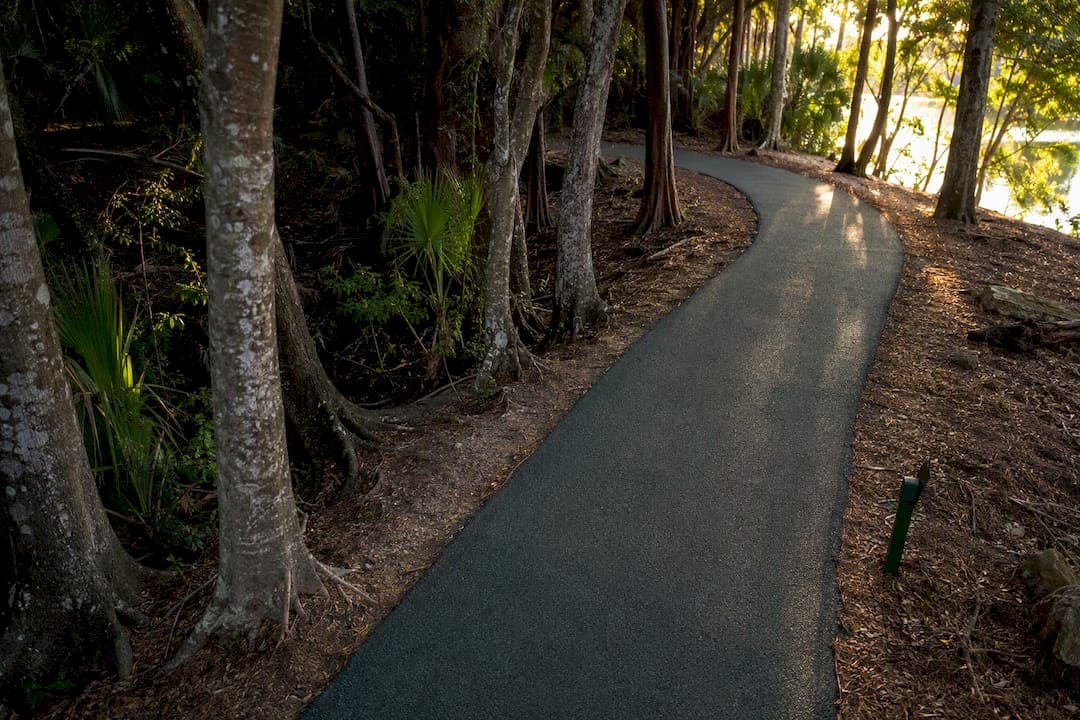
A permeable trail surface is the right call when three conditions line up: the underlying soil can accept water at a reasonable rate, the grade stays within manageable slope limits, and someone is committed to the maintenance schedule. These systems let water pass through the surface into a storage layer and often into the soil below, cutting runoff and keeping paths usable sooner after rain. Skip the format if any of those three conditions fail.
TL;DR:
- Permeable surfaces require suitable soil, manageable slope, and regular maintenance to effectively reduce runoff and support infiltration.
- Porous asphalt is ideal for high-traffic paths with vehicle access but demands precise installation to prevent clogging and draindown issues.
- Rubberized pour-in-place systems are suitable for root-sensitive and shallow soil sites where minimal excavation is needed, although they are more costly to install and maintain.
- Site-specific infiltration testing is critical before design, especially on low-permeability soils or slopes, to ensure proper drainage and avoid ponding.
- Regular inspection, vacuuming, and avoiding sand or organic debris are essential to prevent clogging and maintain long-term permeability performance.
Table of Contents
- Types of permeable trail surfaces and where each performs best
- Design anatomy: surface and subsurface layers, drainage, and typical thicknesses
- Hydrologic performance, benefits, and limitations
- Siting, accessibility, and ecological constraints
- Maintenance, clogging prevention, and long-term performance
- Practitioner perspective: when rubberized porous surfacing is the right choice
- Getting the site assessment right before design begins
- How EcoTec Rubber Paving delivers porous rubber trail surfaces
- Sources
- FAQ
Types of permeable trail surfaces and where each performs best
Material choice depends on traffic type, budget, and how much drainage the site actually needs. Porous asphalt handles higher foot and light vehicle traffic well, using an open-graded friction course that trades density for void space, but it requires careful temperature and mix control during installation to avoid draindown, where binder settles and clogs the very voids meant to pass water, as noted in EPA's porous asphalt retrofit report. Pervious concrete offers strong load capacity and a longer service life in many settings, though its open pore structure is prone to surface abrasion and progressive clogging without a maintenance plan.
Permeable interlocking concrete pavers rely on the joints between units, not the material itself, to move water, which makes joint width and fill material the real design variable, and one that needs review for ADA joint-tolerance rules. Open-graded aggregate and stabilized gravel are the cheapest entry points but struggle to support wheelchairs, strollers, or other mobility devices consistently. Rubberized pour-in-place porous systems need only shallow excavation, protect nearby tree roots, and can meet ADA firmness standards when installed correctly.
- Porous asphalt: best for higher-traffic paths where vehicle access matters.
- Pervious concrete: best where load capacity and longevity outweigh abrasion risk.
- PICP: best where joint maintenance is manageable and ADA joint tolerances can be met.
- Open-graded aggregate: best for low-budget, low-mobility-demand trails.
- Rubberized pour-in-place: best for root-sensitive sites and ADA-focused pedestrian trails.
Design anatomy: surface and subsurface layers, drainage, and typical thicknesses
Every permeable system is built as a stack, not a single material. A choker course or bedding layer sits directly under the wearing surface, leveling it and preventing fines from migrating upward. Below that, a filter or base reservoir course stores water temporarily while allowing it to move downward, and a subbase reservoir extends that storage capacity when soils infiltrate slowly or when the design needs to hold a larger storm volume.

Thickness ranges vary with expected traffic, storage requirements, native soil infiltration rate, and frost depth in colder climates: a lightly trafficked pedestrian trail on well-draining soil needs far less base depth than a path built over clay that requires most of its water storage engineered into the structure itself. The base reservoir's storage volume and the soil's infiltration rate work together to set how quickly the system drains between storms, which is why sizing one without the other produces either a surface that ponds or one that is overbuilt for the site.
Underdrains, overflow inlets, and impermeable liners come into play when soil infiltration is too slow to rely on for full drainage, when the water table sits close to the surface, or when nearby structures need protection from lateral seepage. A sustainable installation checklist built around these layer decisions helps catch specification gaps before construction starts, and material choices for the base and subbase, including aggregate sourced through suppliers offering gravel and base materials, should match the hydrologic sizing rather than default to whatever is locally cheap.
Hydrologic performance, benefits, and limitations
Documented field performance for permeable pavements ranges from roughly 25% to near 100% runoff reduction, with the wide spread reflecting how much design and site conditions matter. A well-sited system on sandy soil with generous storage will land near the top of that range; a poorly maintained system on compacted clay will land near the bottom.
These surfaces also filter and temporarily detain pollutants as water moves through the base layers, which reduces the volume and concentration of runoff reaching downstream waterways, though water that has warmed while passing over dark pavement can still carry some thermal load. The limitations are real: clogging reduces infiltration over time, low-permeability native soils cap how much of the benefit comes from infiltration versus storage and slow release, and permeable surfaces are not appropriate for areas that flood regularly or sit within active floodplains. Any project with tight stormwater targets or a complex drainage area benefits from formal hydrologic sizing, ideally run by a civil engineer rather than estimated from rules of thumb.

Siting, accessibility, and ecological constraints
Before specifying a permeable surface, run a percolation or infiltration test on the actual site soil rather than relying on regional soil survey estimates. Sites with strong infiltration rates support full-infiltration designs; slower sites need partial-infiltration designs with underdrains or added storage.
Slope matters just as much as soil. Steeper grades push water laterally instead of down, which undermines both drainage and stability, and cross-slope has to stay within the accessibility limits described in FHWA's shared-use path guidance, where firmness and stability are treated as essential to meeting ADA goals. Tree root zones deserve particular attention: deep-excavation reservoir systems can sever or suffocate roots, while shallow porous rubber systems disturb far less soil volume. Sites near waterbodies or within floodplain buffers may carry setback restrictions worth checking against local ordinances, and pairing the permeable surface with bioswales or rain gardens is often the most efficient way to handle overflow without oversizing the trail's own base.
Maintenance, clogging prevention, and long-term performance
Clogging is driven mainly by fine sediment and organic debris settling into surface voids, and how fast that happens depends more on the surrounding drainage area and land use than on the pavement's age alone. A trail bordered by turf and heavy leaf drop needs a tighter maintenance cycle than one set in stabilized woodland.
- Inspect the surface quarterly for standing water or visible debris buildup.
- Vacuum or use a regenerative air sweeper on a schedule matched to the site's debris load, since standard broom sweepers can push debris deeper into the voids instead of removing it, per FHWA's ultra-urban BMP guidance.
- Power wash combined with vacuuming when infiltration has visibly slowed, reserving full replacement for sections beyond recovery.
- Never apply sand for traction or winter treatment, since it fills the void structure permanently.
Pro Tip: Flag inspection checkpoints on a map at the design stage so maintenance crews check the same spots every cycle instead of guessing where debris accumulates.
Practitioner perspective: when rubberized porous surfacing is the right choice
Rubberized pour-in-place porous systems shine on sites where deep excavation isn't an option: tree-lined corridors, shallow soils over utilities, or trails where construction staging has to stay minimal. Because these systems need only a few inches of base rather than a full aggregate reservoir, root disturbance drops sharply while drainage rates stay high, a pattern documented in field reports on porous paving in park paths. They work best for pedestrian-focused trails rather than heavy vehicle routes.
The honest tradeoffs: material cost runs higher than aggregate or basic asphalt, UV exposure and weathering affect surface color and texture over years of sun, and the maintenance routine, vacuum sweeping and periodic inspection, mirrors what other permeable systems require. Read more on rubber-based porous paving performance for the technical detail behind these tradeoffs.
Getting the site assessment right before design begins
In my experience reviewing trail projects, the biggest failures trace back to skipped infiltration testing, not bad material choice. Before drafting a spec, confirm soil infiltration, budget for real maintenance rather than assuming a set-and-forget surface, train inspectors on what clogging looks like early, and bring the installing contractor into the conversation before the design locks.
— Roger
How EcoTec Rubber Paving delivers porous rubber trail surfaces
Rubber porous surfacing using systems like Rubberway® is designed for climates where standing water and heat-driven cracking wear down conventional trail materials fast. Projects can deliver ADA-compliant results and documentation suitable for municipal use.
Before hiring any installer for a permeable trail, ask these questions:
- Has permeability been tested after installation, not just specified on paper?
- Is ADA compliance documented in writing for inspectors and grant reviewers?
- What warranty and licensing or insurance coverage backs the work?
See Rubberway® Pervious Pavement, Rubberrock 6000, and EVOLUTION for product specifics, or start a project inquiry at Ecotecrubber.
Sources
- Discovering permeable pavement | Stormwater Solutions
- Part II of II: Best practices design guide - Sidewalk2 (FHWA)
- Design and construction of a porous asphalt stormwater BMP retrofit (EPA project report)
- Ultra-Urban BMP report (FHWA)
FAQ
What are the downsides of permeable pavement?
Permeable pavement clogs over time without regular vacuuming or regenerative air sweeping, and standard broom sweepers can make clogging worse by pushing debris deeper into the surface, according to FHWA's maintenance guidance. It also performs poorly on low-infiltration soils and isn't suited to sites that flood regularly.
What are the different types of trail surfaces?
Common permeable trail surfaces include porous asphalt, pervious concrete, permeable interlocking concrete pavers, open-graded aggregate, and rubberized pour-in-place porous systems, as outlined by EPA's stormwater guidance. Each fits different combinations of traffic load, budget, and accessibility needs.
What are the downsides of permeable tarmac?
Permeable asphalt, sometimes called permeable tarmac, requires careful temperature and mix control during installation to prevent draindown, a failure mode where binder settles and blocks the pore structure meant to drain water, per EPA's porous asphalt report. Without that control and follow-up maintenance, infiltration performance drops well below its design target.
What does permeable surface mean?
A permeable surface allows water to pass through it into a storage layer or the soil below rather than running off, as defined in EPA's permeable pavement guidance. This reduces runoff volume and can recharge groundwater depending on site soil and design.