
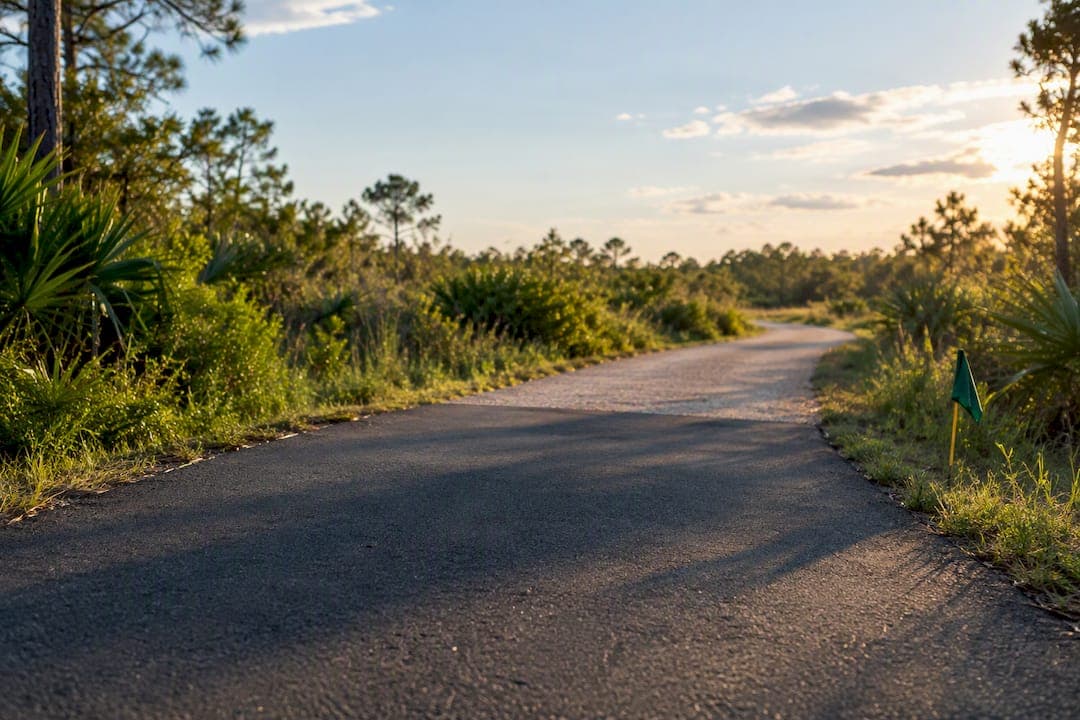
Seven surface families cover nearly every park trail project: asphalt, concrete, permeable pavements, crushed or stabilized aggregate, resin-bound gravel, rubberized surfacing, and boardwalk systems. None of them work well without the right subbase and drainage design underneath, and none satisfy ADA firmness and stability requirements by accident. Pick the family based on user type and site hydrology first; pick the specific product second.
TL;DR:
- Asphalt remains the most suitable surface for high-volume, multi-use trails, with a lifespan of 7 to 15 years and requires proper drainage and subbase design.
- Concrete offers durability over 25 years but is more expensive upfront and can be tough on runners' joints over long distances.
- Rubberized surfacing works well in hot or flood-prone areas due to its slip resistance, permeability, and low maintenance, despite higher initial costs.
- Proper site preparation, including adequate subbase depth, drainage planning, and addressing tree roots, is critical to prevent early trail failure across all surfaces.
- Lifecycle costs favor durable materials like concrete or rubberized paving when maintenance expenses over 10 to 20 years are considered, especially in moist or flood zones.
Table of Contents
- What Are the Main Park Trail Surfacing Options?
- How Do You Evaluate Firmness, Drainage, and Maintenance Needs?
- Which Surface Fits Which Trail Setting?
- What Installation Practices Prevent Trail Surface Failures?
- How Should Lifecycle Cost Drive Your Surfacing Decision?
- What Accessibility Factors Matter Beyond ADA Firmness?
- How Do Traction and Temperature Affect Trail Safety?
- A Practitioner's Quick-Start Workflow
- When Rubberized Paving Makes Sense for Your Trail
- Sources
- FAQ
What Are the Main Park Trail Surfacing Options?
Every surfacing family trades durability against cost, comfort, and installation complexity. Here's how the common options actually perform once they're in the ground.
Asphalt (HMA) remains the workhorse for shared-use paths. It typically lasts 7 to 15 years before needing an overlay, and it handles cyclists, strollers, and micromobility devices well. Trail-specific HMA mix and layer design should be adapted for pedestrian loading and drainage rather than borrowed straight from highway specs, according to NAPA guidance.
Concrete costs more upfront but lasts 25 years or longer with routine joint maintenance. It's the most durable hard surface available, though the rigid, high-traction texture is tough on runners' joints over long distances.
Permeable pavements solve stormwater problems that asphalt and concrete create, but they demand specialized installation and higher capital investment.
Crushed stone and bonded aggregates are the cheapest option to install. They only meet accessibility standards when properly compacted and mixed with fines, the fine particles that lock coarse stone into a stable, walkable surface.
Resin-stabilized and bonded gravel surfaces split the difference: better looks than raw crushed stone, moderate durability, and a natural aesthetic parks departments often want near sensitive habitats.
Rubberized surfacing, including systems like Rubberway®, offers a pervious, resilient surface with low ongoing maintenance once installed, at a higher initial cost than gravel or asphalt.
Boardwalks and wood decking are the only real answer for wetlands and flood-prone corridors, but they carry the highest maintenance burden of any surface on this list.
- Asphalt: 7 to 15 year lifespan, best for bikes and wheeled traffic
- Concrete: 25 plus year lifespan, best for high durability corridors
- Permeable pavement: strong drainage, higher installation cost
- Crushed/stabilized aggregate: low cost, needs fines for ADA compliance
- Resin-bound gravel: natural look, moderate durability
- Rubberized surfacing: pervious and low maintenance, higher upfront cost
- Boardwalk/wood: only practical choice for standing water or wetlands
How Do You Evaluate Firmness, Drainage, and Maintenance Needs?
Firmness and stability aren't abstract design goals. The National Trail Surfaces Study from the U.S. Access Board and National Center on Accessibility found that firmness measures how much a surface deforms under load, while stability measures how well it resists shifting under repeated foot or wheel traffic. A surface can be firm the day it's installed and unstable within a season if the base was never designed for local hydrology.
Run every candidate surface through the same short checklist:
- Does the subbase and drainage plan match this surface family's requirements?
- Does the finished surface meet ADA firmness and stability thresholds under wet and dry conditions?
- What's the realistic maintenance cadence, crack sealing for asphalt, joint repair for concrete, replenishment for aggregate or wood?
- Who uses this trail most, wheelchair users, road cyclists, gravel riders, dog walkers, and what do they need from the surface?
Maintenance patterns diverge sharply by material. Asphalt needs periodic crack patching. Concrete needs joint and spall repair. Wood boardwalks need board replacement on a cycle measured in years, not decades. Loose aggregate needs regular regrading or it migrates and creates ruts that fail firmness tests within a year or two.
Pro Tip: Test firmness and stability at the wettest point of your trail, not the driest. A surface that passes ADA thresholds on a sunny inspection day can fail after a week of rain if the base drains poorly.
Which Surface Fits Which Trail Setting?
The same material that performs beautifully on one trail can fail within a season on another. Match the surface to the setting, not the other way around.
- Urban shared-use paths: Asphalt or concrete handles high volumes of bikes, strollers, and pedestrians. Where stormwater capacity is a stated project goal. Permeable pavement is worth the added installation cost, since VDOT guidance flags it as situational rather than universal.
- Natural or low-impact corridors: Stabilized crusher fines or resin-bound aggregate keep a rustic look while still meeting firmness standards, at a lower cost than paved alternatives.
- Wet or flood-prone sites: Boardwalks or raised structures are the practical answer. Permeable pavements are not built for repeated inundation and will clog with sediment fast in these conditions, a point VDOT's design guidance makes explicitly.
- High-traffic corridors: Full-depth asphalt or concrete over a properly engineered base holds up best. On corridors where runners, cyclists, and equestrians share space, a dual-tread design, a hard primary tread next to a softer adjacent tread, keeps everyone comfortable without sacrificing accessibility on the main path.
Site hydrology usually settles the argument before budget does. A material that performs well in a dry inland park can fail within one wet season on a coastal or floodplain site if drainage wasn't part of the original design.
What Installation Practices Prevent Trail Surface Failures?
Most trail surface failures trace back to the base, not the surface material itself, as demonstrated in the Atlas Paving project case study that highlights pavement project delivery challenges and solutions. The US Forest Service's standard trail specifications treat trailbed preparation and materials testing as the foundation every other decision depends on.
- Specify subbase depth and material by soil type, not by habit. Skimping on base depth is the single most common cause of early trail failure, regardless of which surface goes on top.
- Use geotextiles and confinement systems in soft or saturated soils. These keep the base from mixing with subgrade soil and losing load-bearing capacity over time.
- Design edge restraints and joints deliberately. Unrestrained edges let asphalt and aggregate migrate outward under traffic and weather.
- Manage tree roots proactively. Root barriers or structural soil cells prevent the heaving that cracks pavement and creates ADA-noncompliant trip hazards within a few years.
- Set an inspection cadence. Catching a small crack or a washed-out shoulder early costs a fraction of a full section rebuild later.
Site analysis has to happen before material selection, not after. A surface that works in a dry climate can fail quickly in a moist one if drainage wasn't engineered for local conditions from day one.
How Should Lifecycle Cost Drive Your Surfacing Decision?
The cheapest surface to install is rarely the cheapest surface to own. Bark mulch and unstabilized crushed stone cost the least upfront but often need annual replenishment, and that recurring cost can exceed the lifetime cost of a more durable surface over a 10 to 20 year window. Concrete and rubberized surfacing sit at the other end: higher capital outlay, lower annual maintenance spend.
The math planners miss: a trail that needs regrading or resurfacing every one to two years can cost more over two decades than a surface installed once at three times the initial price, once labor and material replacement are counted.
Build lifecycle thinking directly into procurement documents rather than treating it as an afterthought:
- Expected user volume and type over the trail's design life
- A maintenance budget line, not just a construction budget line
- A defined renewal or resurfacing period for the chosen material
- A documented lifecycle-cost comparison between at least two candidate surfaces
Funding requests that include this comparison tend to survive budget review better than ones that only show construction-day pricing.
What Accessibility Factors Matter Beyond ADA Firmness?
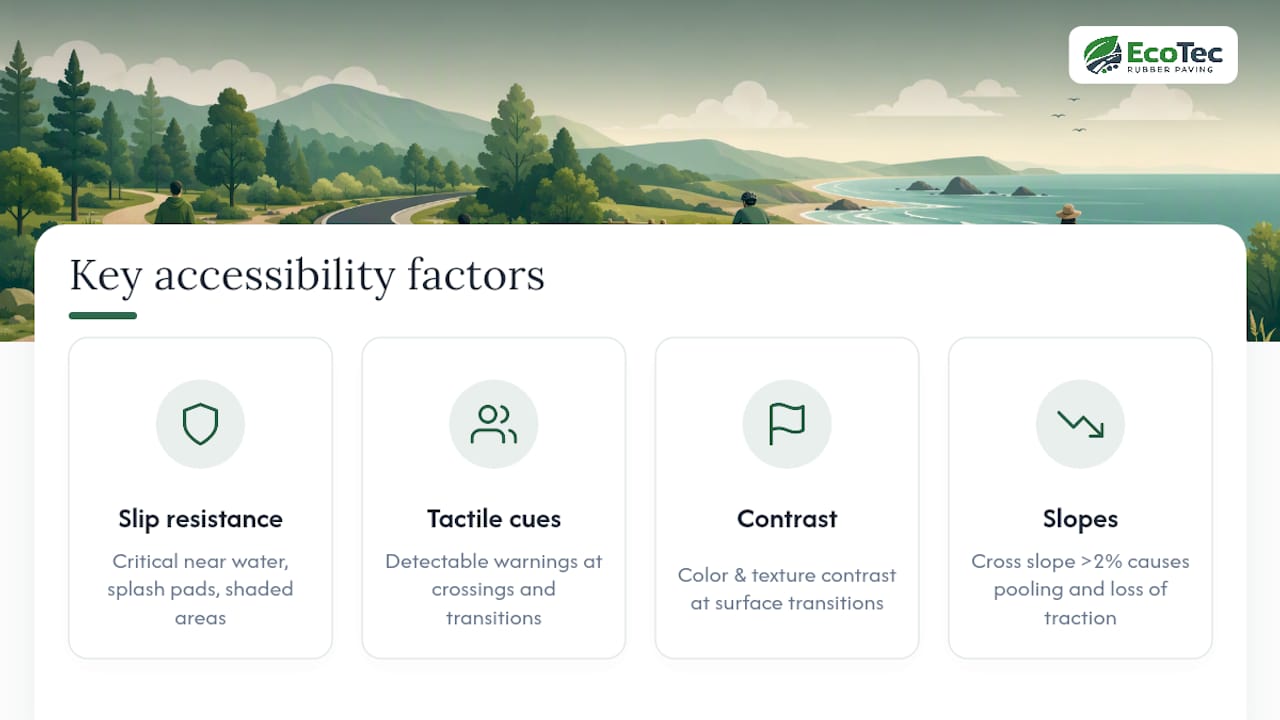
Firmness and stability get most of the attention, but they're not the whole accessibility picture. Slip resistance matters just as much, particularly on rubberized surfaces, resin-bound aggregate, and any material near water features, splash pads, or shaded areas where moss and algae build up.
Tactile guidance is often overlooked on park trails entirely, even though it's standard practice on sidewalks and transit platforms. Detectable warning surfaces at trail crossings, intersections with vehicle traffic, or transitions between surface types (asphalt to boardwalk, for example) give low-vision users a physical cue that a hazard or decision point is ahead. Color and texture contrast at these transitions helps everyone, not just users with visual impairments.
Cross slope and running slope compound firmness problems. A surface that tests firm and stable on flat ground can still fail ADA usability if the cross slope exceeds 2%, since water pools instead of sheeting off, softening the surface exactly where wheelchair users need traction most.
Width matters too. A firm, stable, slip-resistant surface that's only four feet wide still creates a bottleneck where wheelchair users, strollers, and cyclists have to negotiate passing space. Most accessible shared-use paths need a minimum of eight feet of clear width, wider on higher-traffic corridors.
None of these factors show up in a basic material spec sheet. They show up in a site walk, a slope survey, and a materials test plot, done before construction, not after a complaint.
How Do Traction and Temperature Affect Trail Safety?
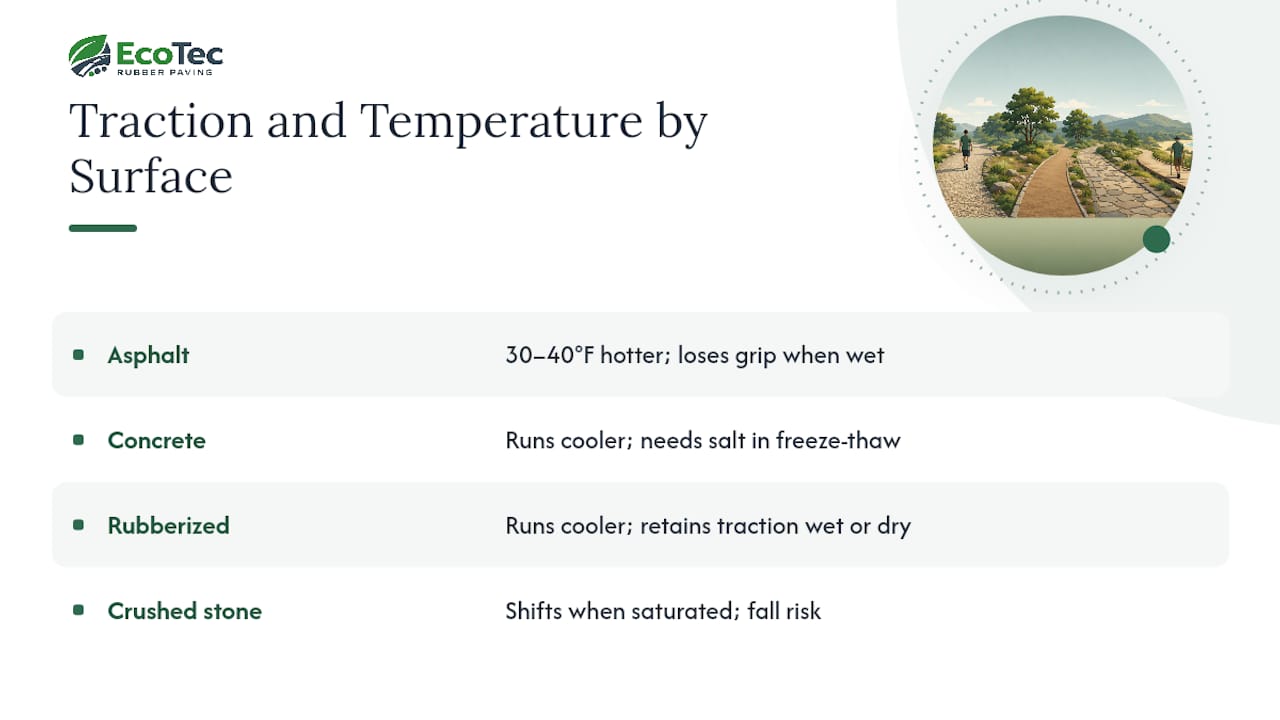
Surface temperature swings more than most planners expect, and it changes user safety in ways that aren't obvious from a materials data sheet. Dark asphalt can run 30 to 40 degrees Fahrenheit hotter than ambient air on a sunny summer day, a real concern for barefoot pets, young children, and anyone using the trail in bare or minimally protected feet. Rubberized surfacing and lighter-colored concrete run cooler under the same conditions, which matters in southern and southwestern climates where trail use peaks in hot months.
Traction changes with weather in ways specific to each material. Asphalt and concrete lose grip when wet, especially where algae or leaf litter accumulates in shaded sections. Rubberized surfaces generally hold traction better wet or dry because the material itself has some give, which is part of why rubberized paving shows up more often near pools, splash pads, and playground perimeters where wet feet are a given, not an exception. Crushed stone and gravel surfaces can shift underfoot when saturated, creating a fall risk that firmness testing on a dry day won't catch.
Ice is the wildcard in colder climates. Concrete and asphalt need salt or sand treatment in freeze-thaw regions, which adds a maintenance cost and an environmental consideration that doesn't apply to warm-climate installations at all. Any surface selection made without accounting for the local freeze-thaw calendar is incomplete, even if every other spec checks out on paper.
A Practitioner's Quick-Start Workflow
Three mistakes cause most trail failures: a base built too thin, crushed stone chosen without fines, and drainage treated as an afterthought. The fix is a simple sequence: define user types, assess soils and drainage, short-list materials against your criteria, then specify maintenance and monitor results. Pilot a test panel before committing to any unfamiliar material at scale.
— Roger
When Rubberized Paving Makes Sense for Your Trail
Rubberized surfacing earns its place on this list when a project needs pervious drainage, crack resistance in a hot climate, and low long-term maintenance in the same package, without giving up ADA-compliant firmness.
A company specializes exclusively in rubber paving using the Rubberway® system, built from recycled materials, and works fully licensed and insured on municipal, HOA, and commercial projects in Florida. The Rubberway® line includes Rubberway® Pervious Pavement, Rubberway Rubberrock 6000, and Rubberway EVOLUTION, each suited to different combinations of traffic, color, and drainage requirements, plus a dedicated Rubberway Sidewalk System for pedestrian corridors. Areas that flood after storms, get punished by summer heat cracking, or need a surface that stays cool and slip-resistant near water features are strong candidates for rubberized paving over standard asphalt or concrete.
If your project fits that profile, the next step is straightforward: request technical specs, ask for reference installations, and review performance documentation before writing it into a bid. Start that conversation through Ecotecrubber's project team and get a clear picture of whether rubberized paving fits your site and budget.
Sources
- Surfaces - Rails to Trails Conservancy | Rails to Trails Conservancy
- VDOT Trail Type and Surface Selection Guidelines
FAQ
What Is the Most Durable Park Trail Surface?
Concrete lasts the longest among common trail surfaces, typically 25 years or more with routine joint maintenance. Rubberized surfacing and full-depth asphalt follow, with asphalt needing crack repair every few years to stay within its 7 to 15 year lifespan.
Are Rubberized Trail Surfaces ADA Compliant?
Rubberized systems like Rubberway® are designed for ADA-compliant firmness and stability while adding pervious drainage that reduces standing water. Compliance still depends on correct base preparation and slope control at installation, the same as any other surface family.
How Much Does Rubberized Trail Paving Cost Compared to Asphalt?
Rubberized paving generally carries a higher installation cost than asphalt but lower ongoing maintenance, since it resists cracking and drains without added infrastructure. Ecotecrubber does not publish flat pricing since project scope drives cost, current pricing is available by requesting a quote through Ecotecrubber's site.
What Type of Crushed Stone Is Best for ADA-Compliant Trails?
Crushed stone needs fines, the fine particles that bind coarser aggregate into a compacted surface, to meet ADA firmness and stability standards. Washed or clean stone without fines commonly shifts underfoot and fails accessibility testing within a season.
Can Permeable Pavement Be Used on Flood-Prone Trails?
Permeable pavement is not appropriate for trails with frequent flooding or heavy sedimentation, since VDOT guidance notes it needs specialized installation and clear water paths to function. Boardwalks or raised structures are the more reliable choices for wetlands and low-lying, flood-prone corridors.