
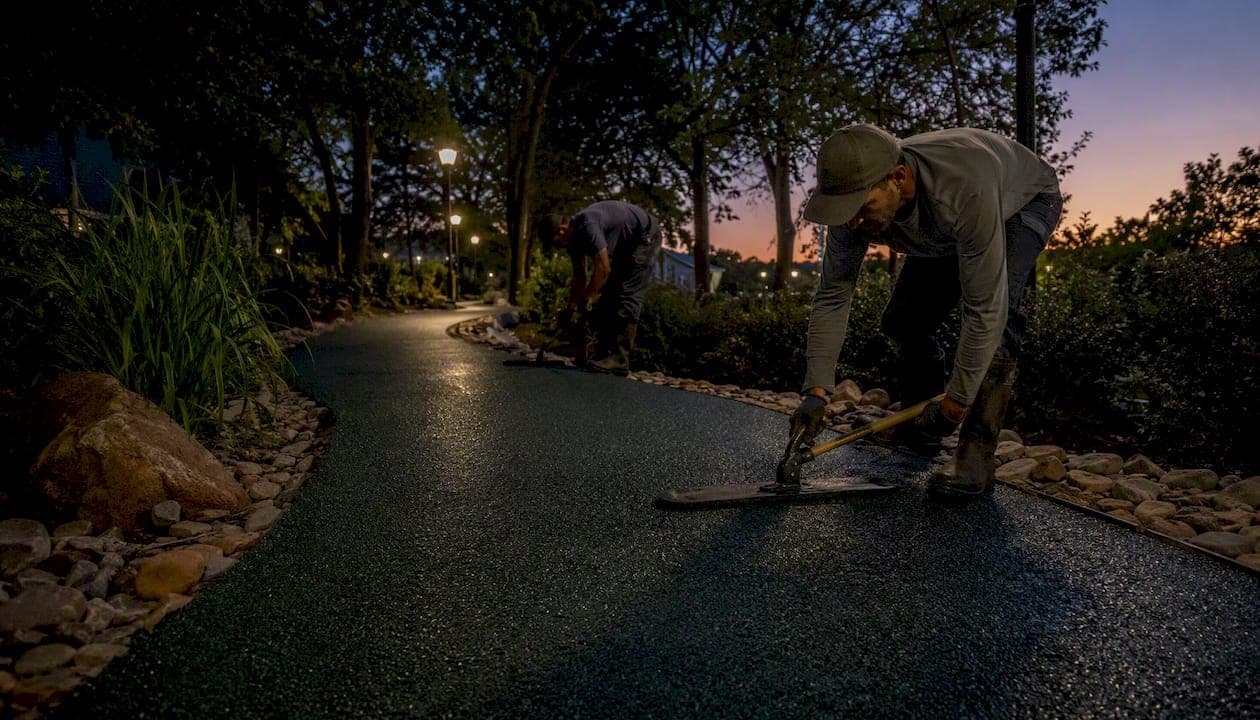
For community walkways, the most effective slip-resistant surface categories are rubber paving systems, textured concrete finishes, resin/epoxy/MMA coatings, interlocking pavers, textured natural stone, stabilized gravel and permeable systems, and anti-slip metal gratings. Each category suits a different project context: rubber paving and textured concrete handle high-traffic ADA primary routes well; resin coatings work for refurbishment and pool decks; natural stone and stabilized gravel fit lower-traffic amenity and trail settings; metal gratings belong in drainage-critical service areas.
For the most common community scenarios, here is where to start:
- HOA and municipal sidewalks: Broom-finished or exposed-aggregate concrete, or a rubber paving system like Rubberway®, for firm, stable, ADA-compliant surfaces that hold up under foot traffic and Florida heat.
- Pool decks and splash zones: Rubber paving or a resin/MMA coating with broadcast aggregate, both of which maintain grip when wet and drain quickly.
- Natural trails and low-traffic amenity paths: Stabilized decomposed granite or compacted gravel where ADA primary-route compliance is not required.
Pro Tip: Surface selection is a design-phase decision, not a retrofit afterthought. Specifying slip resistance before construction is always cheaper than patching a liability problem after the fact.
Key Takeaways
Rubber paving, textured concrete, and resin/MMA coatings are the strongest choices for primary ADA-compliant community routes, with surface selection driven by wet-condition performance, drainage, and long-term maintenance capacity.
| Point | Details |
|---|---|
| Specify for wet conditions | Require wet-surface COF or PTV data from contractors, not dry-only test results. |
| ADA routes need hard surfaces | Stabilized gravel and most permeable pavers do not meet ADA firmness and stability requirements for primary accessible routes. |
| Subbase determines lifespan | An engineered, compacted aggregate subbase (commonly 8–12 inches) prevents settlement that undermines surface performance. |
| Retrofit treatments are temporary | Broadcast grit sealers and anti-slip tapes last 2–4 years; repeated applications often cost more than a proper resurfacing. |
| Ecotecrubber for Florida routes | Ecotecrubber's Rubberway® system delivers permeable, ADA-compliant, crack-resistant rubber paving suited to Florida's climate. |
Table of Contents
- Why slip resistance matters on community walkways
- What actually makes a walkway surface slip-resistant
- Standards, testing, and spec guidance to reference
- Slip-resistant community walkway types at a glance
- 1. Rubber paving systems: performance and tradeoffs
- 2. Concrete finishes: what to specify for durable slip resistance
- 3. Resin, epoxy, and MMA coatings for walkway refurbishment
- 4. Interlocking pavers and textured brick: specification and maintenance
- 5. Natural stone with textured finishes: pros, cons, and cautions
- 6. Stabilized gravel, decomposed granite, and permeable pavers: when they work
- 7. Anti-slip metal gratings, treads, and industrial solutions
- How to choose the right slip-resistant surface for your community walkway
- Retrofit and low-cost non-slip treatments for existing walkways
- Maintenance, expected lifespan, and cost considerations
- Why professional installation matters and what to require from contractors
- The tradeoffs most community projects get wrong
- Ecotecrubber's rubber paving for Florida community walkways
- Sources
Why slip resistance matters on community walkways
Slip-and-fall incidents are among the most common causes of injury on community property, and they carry real financial exposure for HOAs, municipalities, and property managers. A single incident can trigger insurance claims, litigation, and reputational damage that far outweighs the cost of specifying the right surface from the start. Rubber paving reduces liability risk for property owners precisely because it addresses the wet-surface problem at the material level rather than relying on signage or periodic maintenance alone.
Walking surfaces on accessible routes must be firm, stable, and slip-resistant. This is not a design preference — it is a legal requirement under ADA design standards that applies to any public accommodation or commercial facility.
Beyond the legal floor, there is a practical one. Older adults, children, wheelchair users, and pedestrians carrying loads are all more vulnerable to surface failures than a healthy adult walking at a steady pace. A surface that performs adequately in dry conditions can become genuinely dangerous when wet, contaminated with leaves or algae, or degraded by freeze-thaw cycles. Specifying for the worst expected condition, not the average one, is what separates a safe community path from a liability waiting to happen.
State shared-use path guidance reinforces this point: paved hard-surface materials are generally recommended for high-use and snow-cleared paths, with slope and cross-slope limits that must be respected regardless of the surface material chosen.
What actually makes a walkway surface slip-resistant
Slip resistance comes down to friction, and friction depends on four interacting factors: the surface's coefficient of friction (COF), its texture at both macro and micro scales, how well it drains, and what contaminants are present during use.
- Coefficient of friction (COF): The ratio of the force needed to slide an object across a surface to the object's weight. Higher COF means more grip. The ASTM F3132-20 standard recommends evaluating available friction under expected wet or contaminated conditions, not just dry lab results.
- Macrotexture: Large-scale surface roughness (broom lines, aggregate exposure, tile profile) that channels water away and provides mechanical grip for shoe soles.
- Microtexture: Fine surface roughness at the grain level that maintains friction when a thin water film is present. Polished stone loses microtexture over time, which is why it becomes slippery even when it looks intact.
- Drainage: Water sitting on a surface reduces friction dramatically. Permeable surfaces and cross-slopes of 1–2% that direct runoff off the path are both effective strategies.
- Pendulum Test Value (PTV): A field-measurable friction index used alongside COF. A PTV below 36 is generally considered high-risk for pedestrian surfaces in wet conditions.
Wet and contaminated conditions, not dry performance, should drive surface specification. A surface that scores well dry but poorly wet is the wrong choice for an outdoor community path.
Higher macrotexture improves wet grip but can trap grit and organic debris, making cleaning harder. Specifying texture with maintenance capacity in mind is not a secondary concern — it directly affects how long the surface stays safe between service visits.
Standards, testing, and spec guidance to reference
Knowing which standards to cite in a procurement document is what separates a defensible specification from a vague one. Here are the primary references:
- ASTM F3132-20 covers walkway surface selection for pedestrian safety. It recommends proactive, design-phase surface selection and specifies evaluating friction under wet or contaminated conditions. It also references tribometer practices under ASTM F2508, which governs which tribometer models produce comparable, reliable readings. Require test reports that name the tribometer model used.
- ADA Design Standards (ADA.gov) are the legal baseline for accessible routes in the United States. Any primary pedestrian route serving a public accommodation must meet these requirements for firmness, stability, and slip resistance.
- FHWA and State DOT shared-use path guidance (such as MassDOT's Chapter 11) addresses slope limits, surface material selection, and subbase requirements for paths that may carry cyclists, pedestrians, and occasional maintenance vehicles. These documents are useful when writing specs for multi-use community paths.
- R-class ratings (R9 through R13) are a practical industrial classification for anti-slip performance. Staco's guidance on anti-slip products notes that class selection requires a risk analysis of usage, contamination, slope, and footwear — not a one-size-fits-all pick.
Procurement checklist items to require from contractors and manufacturers:
- Friction test report naming the tribometer model and test protocol (ASTM F2508-referenced)
- Wet-condition COF or PTV results, not dry-only data
- Material batch IDs and product data sheets
- Maintenance schedule and expected lifespan documentation
- Warranty terms, including exclusions for subbase failure or improper installation
- Cure window and temperature limits for coatings or bonded systems
Pro Tip: If a contractor cannot provide a tribometer test report with the model named, treat that as a red flag. Vendor-supplied friction data without a referenced test method is not a specification — it is marketing copy.
Slip-resistant community walkway types at a glance
The seven major slip-resistant surface categories for community paths, with their primary use-cases:
- Rubber paving systems (poured-in-place, bonded rubber, rubber tiles): Best for pool decks, HOA paths, ADA primary routes, and municipal parks. Permeable, crack-resistant, and comfortable underfoot.
- Textured concrete finishes (broom-finish, exposed aggregate, overlays): Best for high-traffic urban sidewalks, connectors, and snow-cleared routes. The default accessible surface for most commercial and municipal applications.
- Resin/epoxy/MMA coatings: Best for refurbishing existing concrete or asphalt, pool surrounds, and covered walkways. Tailored texture, rapid cure, and seamless finish.
- Interlocking pavers and textured brick: Best for amenity plazas, low-to-medium-traffic paths, and aesthetic community spaces. Requires careful joint control for ADA compliance.
- Natural stone with textured finishes (thermal, sandblasted, flamed): Best for low-to-medium-traffic amenity areas where aesthetics are a priority. Requires careful finish specification and long-term maintenance planning.
- Stabilized gravel, decomposed granite, and permeable pavers: Best for natural trails and low-traffic settings where ADA primary-route compliance is not required.
- Anti-slip metal gratings and treads: Best for drainage-critical ramps, service corridors, and maintenance access routes. Not suitable as primary pedestrian surfaces.
The sections below cover each category in depth, with performance notes, installation guidance, and maintenance expectations.
1. Rubber paving systems: performance and tradeoffs
Rubber paving systems, including poured-in-place rubber, bonded rubber mulch, and interlocking rubber tiles, deliver inherent slip resistance through their textured, slightly yielding surface. The material's open-cell or porous structure allows water to pass through rather than pool, which is one of the most reliable ways to maintain grip in wet conditions. For Florida's combination of heavy rain, intense UV, and heat-induced surface expansion, rubber paving is one of the strongest-performing options available.
Pros:
- Permeable design eliminates standing water on the surface
- Textured finish maintains grip when wet
- Crack-resistant under thermal expansion and contraction
- Made from recycled tire material, reducing landfill waste
- Comfortable underfoot, reducing fatigue on long community paths
- Available in a range of colors for wayfinding or aesthetic integration
Cons:
- Higher upfront cost than basic broom-finished concrete
- Requires proper substrate preparation; bonding to a compromised base shortens lifespan
- Some rubber tile systems can shift if edge restraints are inadequate
Installation note: Substrate must be clean, structurally sound, and properly sloped before installation. Typical warranties for professionally installed rubber paving systems last several years depending on the product and application. Poured-in-place systems generally outperform tile systems in longevity on high-traffic routes.
Maintenance:
- Rinse with water and a mild detergent; avoid petroleum-based cleaners
- Inspect annually for edge lifting, joint separation, or surface wear
- Patch small damaged areas without full resurfacing
- Compatible with standard winter maintenance; avoid sharp metal snow removal tools on poured systems
The Rubberway® product line from Ecotecrubber is specifically engineered for Florida's climate, combining permeability, recycled content, and crack resistance in a single system.
Pro Tip: For pool decks and splash zones, specify a poured-in-place rubber system rather than rubber tiles. Tile joints can allow water infiltration under the surface layer, which accelerates delamination in wet-zone applications.
2. Concrete finishes: what to specify for durable slip resistance
Broom-finished concrete is commonly cited as the default accessible, slip-resistant surface for most commercial and municipal walkways in the United States, and for good reason. The parallel ridges left by a stiff broom create macroroughness that channels water and provides mechanical grip for shoe soles. ADA-compliant commercial walkway guidance confirms that broom-finished concrete commonly meets accessibility requirements when joints and surface tolerances are properly controlled.
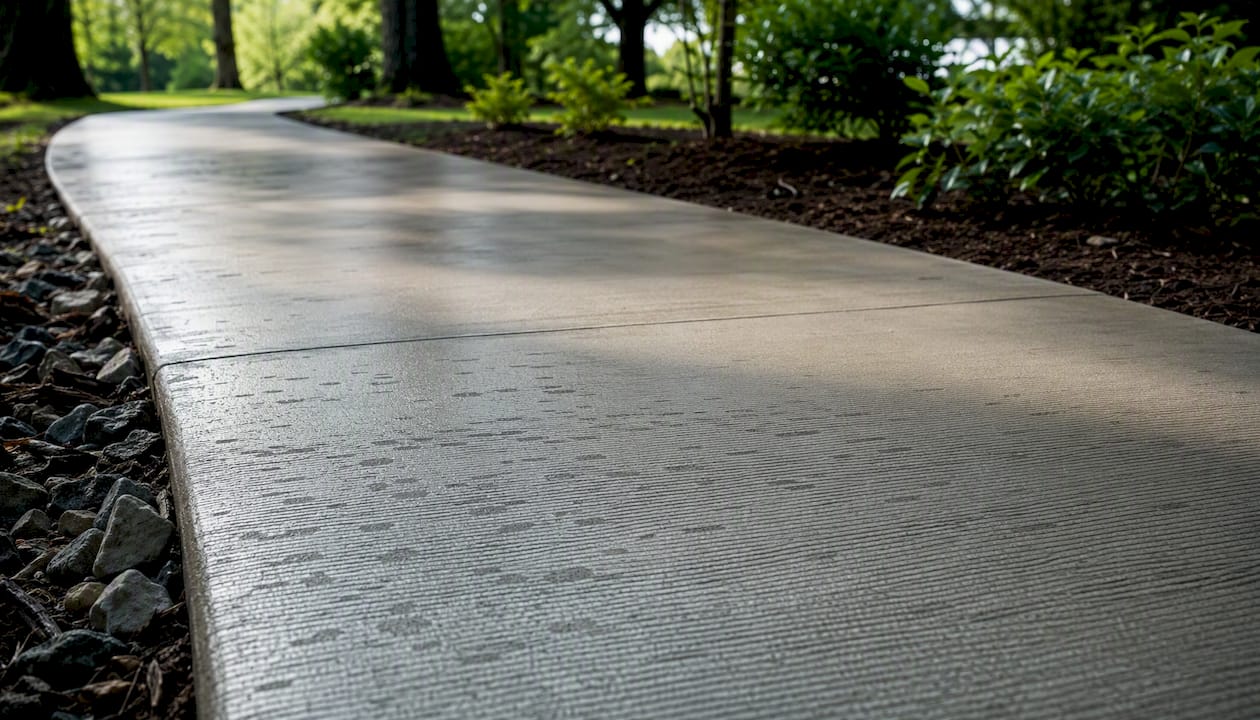
Exposed-aggregate concrete goes further: by removing the cement paste from the surface and exposing the aggregate, it creates a more pronounced texture that holds up well in wet conditions and resists the polishing effect of heavy foot traffic over time.
Use-case examples:
- Urban sidewalks and high-traffic connectors: broom-finish or exposed aggregate
- Snow-cleared routes: concrete handles plowing well; specify control joints at 10–15 feet to prevent cracking
- ADA primary routes: both finishes meet firmness and stability requirements when properly installed
Installation notes: Cross-slope must not exceed 2% on accessible routes. Surface tolerances matter: a 3/8-inch deviation over 10 feet can create a tripping hazard regardless of the surface texture. Sealants can improve stain resistance but reduce surface friction if they fill the texture profile; specify a non-film-forming penetrating sealer if sealing is required.
Maintenance:
- Pressure wash annually to remove algae and organic buildup
- Inspect and re-caulk control joints every 3–5 years
- Resurface with a textured overlay when the surface polishes smooth from wear
Textured overlays applied to existing concrete can restore slip resistance without full replacement. Costs for overlays are generally lower than full replacement, though surface preparation is critical to bond strength.
3. Resin, epoxy, and MMA coatings for walkway refurbishment
Coated systems make the most sense when the existing substrate is structurally sound but the surface has lost its slip resistance, or when a seamless, waterproof finish is required for a pool surround or covered walkway. The key advantage of coatings is that slip resistance is engineered into the system: aggregate broadcast into the wet coating creates a controlled texture profile that can be specified to a target COF.
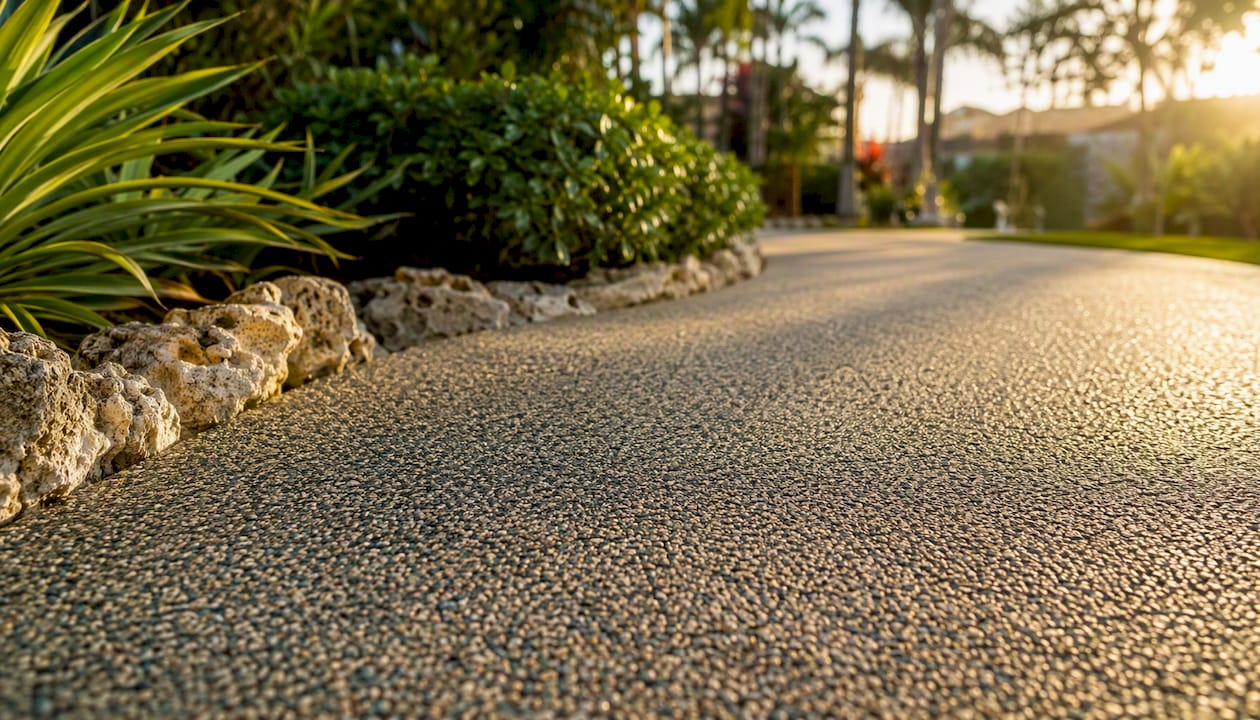
MMA (methyl methacrylate) systems are particularly well-suited to outdoor community applications. Technical data for MMA walkway systems shows they can cure fully within two hours and resist UV, weathering, and temperatures up to 80°C, which matters for Florida installations where surface temperatures on exposed walkways regularly exceed ambient air temperature.
Best applications:
- Refurbishing pool decks and splash zones
- Covered walkways and parking structure pedestrian areas
- Existing concrete or asphalt paths that need a slip-resistant upgrade without full replacement
Pro Tip: When specifying a broadcast-aggregate coating, require the contractor to document the aggregate type, size, and broadcast rate in the spec. The same base coating with different aggregate produces very different COF results, and verbal assurances are not a substitute for a written specification.
Warranty and lifespan: Properly installed MMA and epoxy systems on well-prepared substrates typically last 8–15 years with routine maintenance. The most common failure mode is delamination from inadequate surface preparation, not coating wear. Require a minimum surface profile (CSP 3 per ICRI guidelines) in the spec.
Maintenance:
- Clean with pH-neutral detergent; avoid harsh solvents
- Inspect annually for delamination, bubbling, or aggregate loss
- Spot-repair worn areas before they expand
4. Interlocking pavers and textured brick: specification and maintenance
Interlocking concrete pavers and textured brick offer aesthetic flexibility and good slip resistance when specified and installed correctly. The texture of the paver face provides grip, but joint width and jointing material are equally important: wide or unstable joints create tripping hazards and can fail ADA compliance requirements for accessible routes.
Specification checklist:
- Specify a paver face texture appropriate for wet conditions (tumbled or shot-blasted finishes outperform smooth-faced pavers).
- Joint width on accessible routes should not exceed 1/2 inch, and joints must be filled with a stable, compacted jointing sand or polymeric sand.
- Edge restraints are non-negotiable: without them, pavers migrate and joints open over time.
- Specify a compacted aggregate base of adequate depth for the expected load; for pedestrian-only paths, a 4–6 inch compacted base is typical.
- Cross-slope must not exceed 2% on accessible routes.
Maintenance:
- Re-sand joints every 2–3 years or after significant rainfall events wash out jointing material
- Inspect for settled or raised pavers annually; re-level before the height differential becomes a trip hazard
- Apply a polymeric sand stabilizer to reduce weed intrusion in joints
- Pavers can be lifted and reset individually, which simplifies utility access and spot repair
The main limitation of pavers on primary accessible routes is long-term settlement. Without a properly engineered subbase, individual pavers shift and create uneven surfaces that fail ADA tolerances even if the original installation was compliant.
5. Natural stone with textured finishes: pros, cons, and cautions
Textured natural stone can be a strong performer in the right application, but it requires more careful specification than manufactured surfaces. The finish matters enormously: a polished granite surface is genuinely dangerous when wet, while the same stone with a thermal, sandblasted, or flamed finish provides useful macroroughness.
Finish options that improve slip resistance:
- Thermal (flame) finish: Exposes aggregate by rapid heating; produces a rough, open texture
- Sandblasted finish: Creates uniform surface roughness; good for moderate-traffic areas
- Bush-hammered finish: Mechanical texturing that produces a deeply pitted surface; durable but harder to clean
Natural stone microtexture degrades over time under foot traffic. A stone that meets slip-resistance requirements at installation may not meet them five years later without periodic re-texturing or surface treatment.
Installation warnings:
- Natural stone varies in density, porosity, and surface hardness even within a single quarry batch; require test reports for the specific batch, not just the stone type
- Joint control is critical; wide or open joints create tripping hazards
- Slope drainage must be designed into the layout; stone does not self-drain the way permeable rubber or gravel does
Best use-cases: Low-to-medium-traffic amenity areas, entry plazas, and paths where aesthetic integration with a landscape or architectural context is a high priority. Natural stone is generally not the right choice for primary ADA routes that carry heavy daily foot traffic, because long-term microtexture maintenance is difficult to guarantee.
6. Stabilized gravel, decomposed granite, and permeable pavers: when they work
Stabilized gravel and decomposed granite (DG) are appropriate for natural trail settings and low-traffic community paths where a natural aesthetic is the priority and ADA primary-route compliance is not required. They are not appropriate for primary accessible routes.
Where they work:
- Low-speed natural trails and park paths with low daily foot traffic
- Amenity areas where drainage and a natural appearance are priorities
- Settings where the path is supplementary to a primary paved route
Where they fail:
- Primary accessible routes: permeable pavers and unpaved surfaces generally do not meet ADA requirements for joint width and surface stability
- Cycling corridors: loose surface material creates handling hazards for cyclists
- Areas subject to vehicle loads: compaction and washout are accelerated
Maintenance notes:
- Regrade annually or after significant storm events; washout is the primary failure mode
- Edge retention (steel, aluminum, or concrete edging) is critical to prevent lateral spread
- Stabilizer binders (polymer-based products mixed into DG) extend the interval between regrading but do not eliminate it
- Permeable pavers require periodic joint re-sanding and inspection for settlement
The permeability benefit for stormwater management is real and worth noting in project documentation, but it does not override the ADA limitation. If the path must serve as an accessible route, a paved hard surface is required.
7. Anti-slip metal gratings, treads, and industrial solutions
Anti-slip metal gratings belong in a specific set of applications: drainage-critical ramps, service corridors, maintenance access routes, and industrial walkways where heavy loads and aggressive contaminants are present. They are not a general-purpose community walkway surface.
Appropriate use-cases:
- Utility access ramps and service corridors adjacent to community facilities
- Maintenance walkways over drainage channels or mechanical equipment
- Elevated platforms and loading areas where drainage through the surface is required
Safety notes: There is an important distinction between true safety grating (serrated bar grating, perforated plate with raised edges) and decorative diamond plate. Anti-slip grating is produced with serrations or perforations specifically to provide grip; decorative diamond plate provides far less friction and should not be specified as a safety surface. Both types perform poorly in icy conditions and on slopes greater than approximately 10°, and neither is effective where grease contamination is persistent.
Pro Tip: For outdoor community ramps where ice is a seasonal concern, metal grating is the wrong primary surface. Specify a heated concrete or rubber paving system instead, and reserve grating for covered or interior service areas.
Installation and inspection notes:
- Specify hot-dip galvanizing or powder coating for corrosion protection on outdoor installations
- Inspect fasteners annually; loose grating panels are a serious safety hazard
- Verify that grating panel deflection under load meets the design specification; undersized panels flex and create uneven surfaces
How to choose the right slip-resistant surface for your community walkway
The single most useful frame for surface selection: match the surface to the intended users, the climate and contaminants, the maintenance capacity available, the drainage situation, and the ADA or municipal code obligations that apply. Every other consideration is secondary to those five.
Prioritized decision checklist:
- ADA and code compliance first. If the path is a primary accessible route, it must be firm, stable, and slip-resistant. Rubber paving, textured concrete, and resin coatings all qualify; stabilized gravel and most permeable pavers do not.
- Climate and contaminants. In Florida's wet, hot climate, permeability and UV resistance matter more than freeze-thaw resistance. In northern climates, snow-plow compatibility and freeze-thaw durability move up the priority list.
- Traffic volume and load. High daily foot traffic polishes surfaces over time; specify materials with durable macrotexture (exposed aggregate, rubber, coated systems with hard aggregate) rather than smooth-faced pavers or polished stone.
- Drainage. Cross-slope of 1–2% is the minimum; permeable surfaces add a second layer of protection. Poor drainage is the single most common cause of slip incidents on otherwise adequate surfaces.
- Maintenance capacity. A surface that requires quarterly re-sanding or annual re-texturing is only as safe as the maintenance program that supports it. Match the surface to what the property management team can realistically deliver.
Essential contractor questions:
- What tribometer model and test protocol was used for your friction data?
- What subbase depth and compaction standard are you specifying?
- What are the warranty exclusions, and does subbase failure void the surface warranty?
- What is the cure window and temperature range for installation?
- How does the system handle site-specific drainage, and what slope tolerances are you working to?
Retrofit and low-cost non-slip treatments for existing walkways
When full replacement is not in the budget, several retrofit options can meaningfully improve traction on existing surfaces.
What works:
- Broadcast grit sealers: A penetrating or film-forming sealer with aluminum oxide or silicon carbide aggregate broadcast into the wet coat. Effective on concrete and asphalt; lifespan of 2–4 years with normal traffic before reapplication is needed.
- Anti-slip tapes: Pressure-sensitive tapes with abrasive surfaces. Appropriate for steps, ramps, and short transition zones; not practical for full walkway coverage and prone to edge lifting in wet climates.
- Abrasive coating systems: Epoxy or polyurethane coatings with aggregate, applied to existing concrete. More durable than tape or sealer; requires surface preparation for adhesion.
What to avoid:
- Loose grit applied without a binder: it sheds quickly and creates a new slip hazard as it accumulates at path edges
- Incompatible sealants applied over existing coatings: delamination is rapid and creates a worse surface than the original
- Smooth film-forming sealants applied to textured concrete: they fill the texture profile and reduce friction
Pro Tip: Retrofit treatments are a bridge, not a solution. If a surface requires a third round of abrasive coating in five years, the cost of repeated applications has usually exceeded the cost of a proper resurfacing. Run the numbers before committing to another temporary fix.
When a full resurfacing is the right investment: if the substrate has structural cracks, significant settlement, or drainage failures, no surface treatment will hold long-term. Address the substrate first.
Maintenance, expected lifespan, and cost considerations
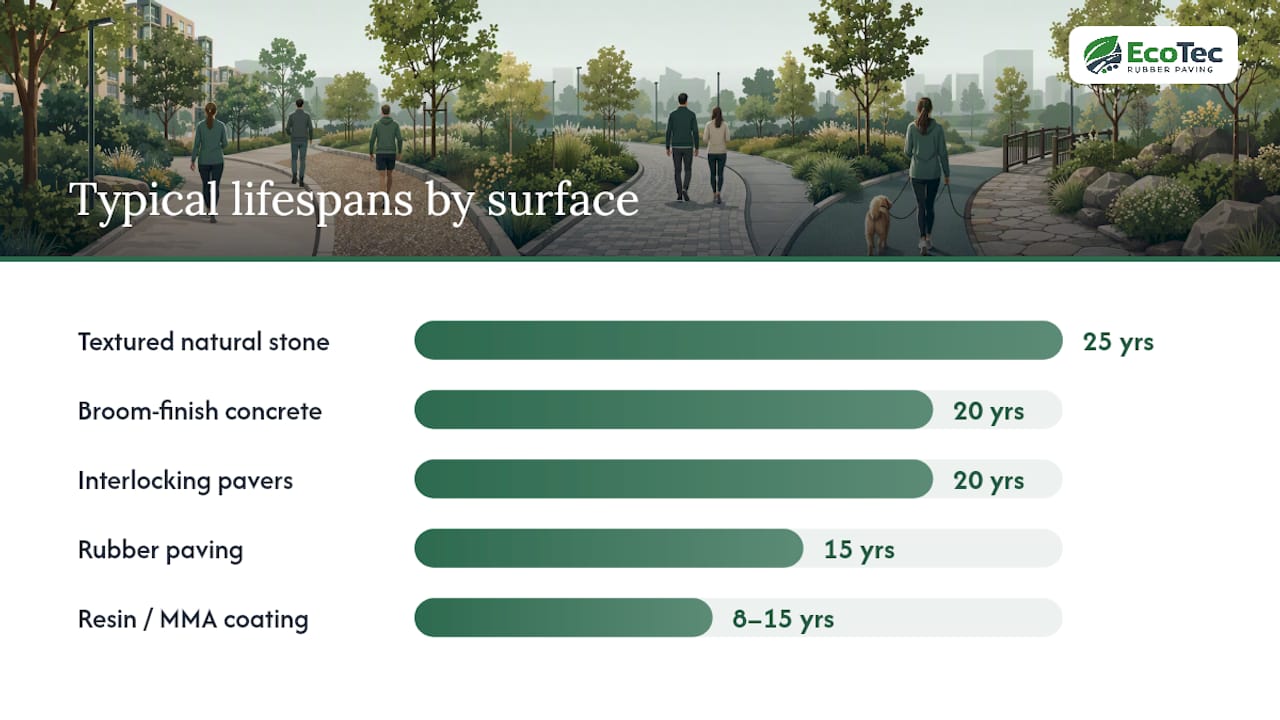
Lifespan and maintenance requirements vary significantly across surface types. The table below maps each category to typical lifespan ranges and primary maintenance actions.
| Surface Type | Typical Lifespan | Primary Maintenance Actions |
|---|---|---|
| Rubber paving (poured-in-place) | 15 years | Annual inspection, rinse cleaning, edge restraint check, spot patching |
| Broom-finish / exposed-aggregate concrete | 20 years | Joint re-caulking every 3–5 years, pressure washing, overlay at wear |
| Resin / MMA coating | 8–15 years | Annual inspection for delamination, spot repair, periodic recoat |
| Interlocking pavers | 20 years | Joint re-sanding every 2–3 years, annual leveling inspection |
| Textured natural stone | 25 years | Periodic re-texturing, joint maintenance, algae treatment |
| Stabilized gravel / DG | 3–7 years (between regrading) | Annual regrading, edge retention inspection, binder reapplication |
| Anti-slip metal grating | 15 years | Annual fastener inspection, corrosion treatment, panel replacement |
Budgeting notes: The most common cause of premature surface failure across all categories is an inadequately engineered subbase. A properly compacted aggregate subbase, commonly 8–12 inches deep for paths that may carry maintenance vehicle loads, is not optional. Skipping it to reduce upfront cost reliably produces settlement, cracking, and surface failure within a few years, at a replacement cost that far exceeds the original subbase investment.
Annual safety-first maintenance priorities:
- Inspect all slopes and transitions for settlement or heaving that creates trip hazards
- Check joint integrity on pavers and concrete; re-caulk or re-sand before the gap exceeds 1/2 inch
- Test friction on high-traffic sections after any surface treatment or seasonal cleaning
- Clear organic debris (leaves, algae, moss) from path surfaces before it degrades traction
Every 3–10 years: full friction assessment, subbase condition check via core samples on older paths, and overlay or resurfacing decision based on surface wear and COF data.
Why professional installation matters and what to require from contractors
Surface selection is only half the equation. A correctly specified rubber paving system or textured concrete finish installed on a poorly prepared substrate, at the wrong slope, or without adequate drainage detailing will fail faster and perform worse than a simpler surface installed correctly.
Pre-bid checklist:
- Require subbase engineering documentation: depth, compaction standard, and drainage layer specification
- Request drainage details: how does the design handle runoff at path edges and low points?
- Ask for friction test reports from comparable completed projects, with tribometer model named
- Require materials batch IDs and product data sheets for all surface materials
- Confirm cure window and temperature limits for coatings or bonded systems
- Request a traffic control plan for installation and curing periods
- Verify contractor licensing, insurance, and warranty terms in writing before signing
Post-install inspection list:
- Conduct a friction test on the completed surface before accepting the work
- Visually inspect texture uniformity across the full surface area
- Check edge restraints for secure seating and correct height relative to the surface
- Verify joint tolerances on pavers or concrete; measure cross-slope at multiple points
- Confirm warranty paperwork is received and filed, including any maintenance obligations that affect warranty validity
Contract language to include: Specify acceptance criteria (minimum COF or PTV on wet surface), a remedy timeline for deficiencies found within the warranty period, and a performance test at handover. A contractor who objects to a wet-surface friction test at handover is telling you something important about their confidence in the installation.
The tradeoffs most community projects get wrong
Most community walkway projects spend the majority of their decision-making energy on aesthetics and upfront cost, and not nearly enough on wet-condition performance and long-term maintenance capacity. That ordering is backwards.
A surface that looks good on day one but requires quarterly maintenance to stay safe is a liability for any property management team that operates with limited staff and seasonal budget constraints. The surfaces that hold up best in practice are the ones that were specified for the worst expected condition, installed on a properly engineered subbase, and matched to a maintenance program the team can actually execute.
For primary accessible routes, the answer is almost always a paved hard surface: rubber paving, textured concrete, or a resin coating on sound concrete. These are not exciting choices, but they are defensible ones. For amenity paths and natural trail settings, the calculus shifts: a stabilized DG path that fits the landscape and gets regraded once a year is a better outcome than a concrete path that looks out of place and never gets maintained.
The one thing I would push back on in most community planning conversations is the assumption that aesthetics and safety are in tension. Rubber paving systems, in particular, have come a long way in color range and finish quality. A Rubberway® installation can match a community's color palette while delivering ADA compliance, permeability, and a 15-plus-year lifespan. That is not a compromise — it is a better outcome than most traditional surfaces deliver.
Ecotecrubber's rubber paving for Florida community walkways
Florida's combination of heavy rainfall, intense UV, and high ambient temperatures creates a specific set of demands that most standard paving materials handle poorly. Standing water on impermeable surfaces is a daily slip hazard. Heat-induced cracking shortens concrete and asphalt lifespans. And the aesthetic expectations of HOA communities and municipal parks are high.
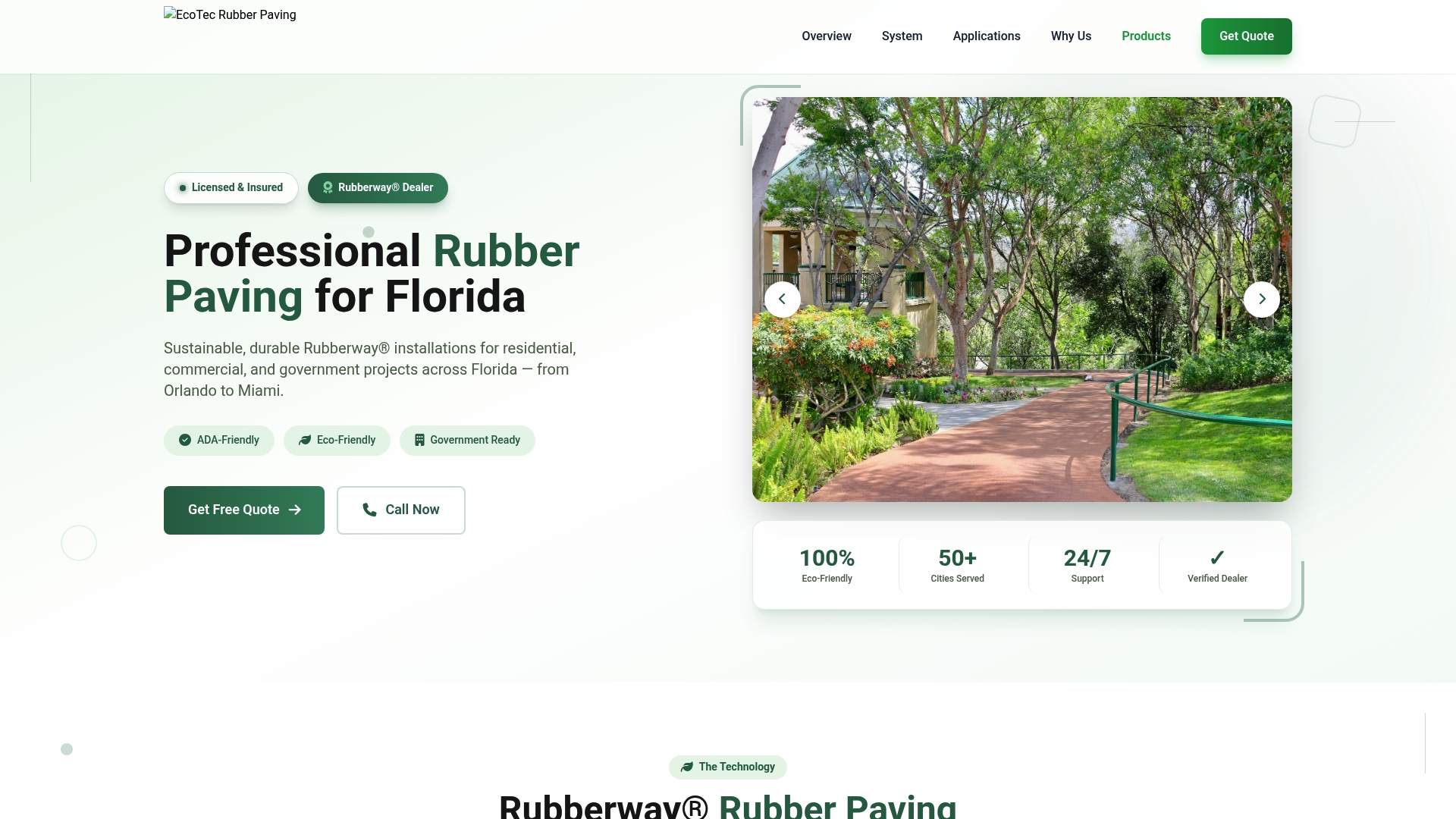
Ecotecrubber installs the Rubberway® rubber paving system across Florida, specifically for these conditions. The system uses recycled tire material in a porous, crack-resistant surface that drains rapidly, meets ADA compliance requirements, and holds its texture and color under sustained UV exposure. Ecotecrubber is licensed and insured, and every project is coordinated by a team focused exclusively on rubber paving, not a general contractor fitting it between other work. For HOA boards, property managers, and municipal planners who want a durable, low-maintenance, and code-compliant walkway surface, request a consultation with Ecotecrubber to discuss your specific project.
Sources
When writing specifications or vetting contractor proposals, reference these primary sources directly. Citing them in your procurement documents signals to contractors that you expect documented, testable performance, not verbal assurances.
- Ada
- Mass
- Anti-slip for gratings and steps: standards, choices and advice | Staco
- Anti-slip grating - Wikipedia