
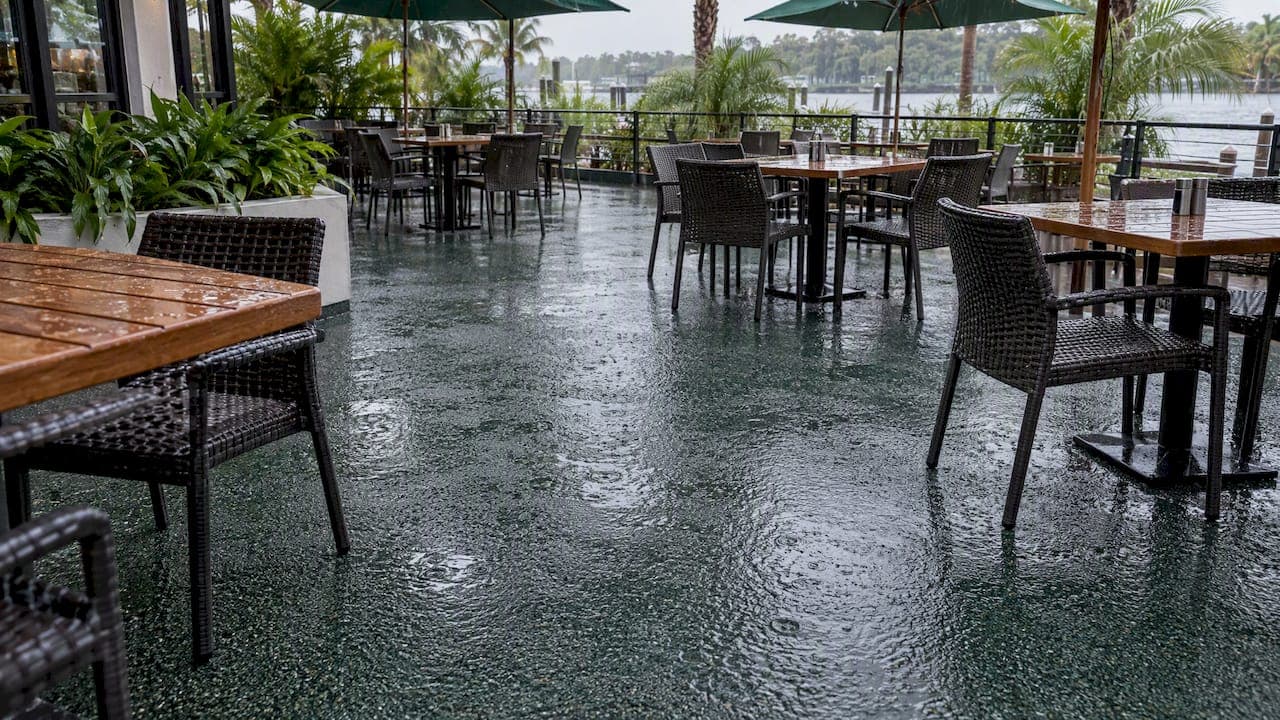
For most restaurant patios, a pervious rubber overlay like a Rubberway® system outperforms a standard concrete overlay because it drains faster, stays slip-resistant when wet, and tolerates heavy foot and furniture traffic without resealing. A traditional cementitious overlay still makes sense on a sound, well-sloped slab with a tighter budget. Either way, start with a slab inspection and a written scope before anyone signs a contract.
TL;DR:
- A sound, properly sloped slab suits a cementitious overlay at $3 to $7 per square foot; replace only for heaving, severe spalling, or structural failure.
- Keep finished level changes below 1/4 inch at routes and seating zones, and require written ADA routing confirmation before approving the contractor’s scope.
- Ask contractors for drainage test results tied to the product, slip resistance when wet, a written warranty, and proof of licensing and insurance.
- Decorative concrete costs $7 to $20 per square foot and needs careful cleaning, while rubber can cost more upfront but can reduce resealing.
Table of Contents
- What resurfacing has to solve on a working patio
- Patio resurfacing options worth comparing
- How to choose the right system for your patio
- Preparing the slab and installing the new surface
- Maintenance, lifespan, and realistic cost ranges
- How the Rubberway® system fits restaurant requirements
- What matters most when picking a patio surface
- How EcoTec Rubber Paving can help with your patio project
- FAQ
- Sources
What resurfacing has to solve on a working patio
Standing water after a rain shower or a dropped tray of drinks is not just a cleanup problem. It is a liability the moment a server or guest crosses it, and a surface that pools water will eventually crack from freeze-thaw cycling or heat stress.
"Slip-resistant" in a dining context means the surface stays stable and predictable when wet with rain, condensation, or spilled drinks, not just when it is dry and clean. "Firm and stable" means furniture legs, wheelchairs, and rolling carts do not sink, rock, or catch.
A restaurant patio surface needs to handle:
- Daily chair and table dragging without scuffing through the finish
- Grease, wine, and sauce stains without permanent discoloration
- Direct sun and heat without softening, fading, or cracking
- Level changes kept under 1/4 inch, since the 2010 ADA Standards treat larger transitions as barriers unless beveled
Patio resurfacing options worth comparing
Cementitious overlays, including stamped and decorative concrete, give owners the widest range of colors and patterns at a moderate cost. They need a sound, properly profiled slab underneath, and the pigment should be built into the cementitious base rather than just the sealer, since color mixed into the topcoat alone tends to peel faster than color carried in the base layer.
Acrylic and epoxy coatings go down quickly and come in many finishes, but UV exposure and standing moisture can degrade them faster outdoors, and some finishes turn slick once wet, which is a real concern around a drink station or bar patio.
Pervious rubber overlays, like the Rubberway® system, use a porous structure that lets water pass through rather than pool on the surface. That design also tends to hold up well against staining and gives installers more flexibility in meeting ADA slope and level requirements without a secondary beveling step.
Interlocking pavers or tile deliver a strong look and are easy to replace piece by piece, but grout lines and joints need regular cleaning and resealing, and uneven joints create a trip hazard that is hard to justify in a space full of servers carrying trays.
Full slab replacement only makes sense when the concrete is heaving, badly spalled, or structurally compromised. If the base is sound, resurfacing is almost always the faster, less disruptive route.

How to choose the right system for your patio
Walk through these criteria before comparing bids:
- Slab condition: cracking, heaving, or spalling beyond minor surface wear changes the whole scope.
- Drainage capacity: how fast water needs to clear during a busy dinner rush in wet weather.
- ADA impact: whether the new surface depth creates a level change at doorways or seating zones.
- Slip-resistance rating: does the finish stay stable wet, not just dry.
- Traffic and furniture load: daily chair drags, cart wheels, and foot count near entrances.
- Cleaning and chemical resistance: exposure to grease, wine, bleach-based cleaners, and sunscreen.
Budget ranges tell you what you are actually buying. A plain overlay typically runs $3 to $7 per square foot, while decorative or stamped finishes run $7 to $20 per square foot. Rubber overlays land in a comparable or higher range depending on depth and how much prep the existing slab needs, which buys drainage and slip performance a plain cementitious coat does not offer.
Before signing anything, ask contractors for:
- A written warranty covering adhesion and wear
- Drainage test results or flow-rate data for the specific product
- ADA documentation showing slope and level compliance
- Proof of license and insurance coverage
Pro Tip: Ask any contractor proposing a rubber or pervious system for their actual flow-rate test data, not a general marketing claim; a real number tells you how the surface performs in your specific rainfall conditions.
Preparing the slab and installing the new surface
A slab with vertical displacement, visible heaving, flexing underfoot, or spalling across more than 30% of the surface usually needs structural repair or replacement before any overlay goes down. Resurfacing over a failing slab just hides the problem temporarily.
The typical workflow looks like this:
- Pressure wash and chemically strip grease, oil, and old sealers from the surface.
- Profile the concrete through etching, grinding, or sandblasting to a rough texture the overlay can bond to, with commercial coatings often targeting a CSP 1 to 3 profile for proper adhesion, according to project case studies on restaurant patio coatings.
- Patch cracks and spalled sections, and address expansion joints so level transitions stay within ADA limits.
- Apply the resurfacer or overlay in thin lifts, typically 1/8 to 1/4 inch per pass, then cure and seal if the system calls for it.
Cure times matter for planning around service. Expect light foot traffic in 6 to 8 hours, full foot traffic at 24 hours, furniture back at 48 to 72 hours, and full cure around 28 days.
Maintenance, lifespan, and realistic cost ranges
Budgeting for resurfacing means looking past the install price to what the surface costs you over the following years.
- Plain concrete overlays run $3 to $7 per square foot and generally need resealing every few years.
- Decorative or stamped finishes run $7 to $20 per square foot and need more careful cleaning to protect the color layer.
- Rubber overlays cost more upfront depending on depth and prep but cut down on resealing cycles.
A 10-foot by 10-foot patio resurfaced with a plain overlay lands around $300 to $700, a useful benchmark for scaling larger dining areas.
Routine upkeep across most systems includes periodic power washing, spot repairs on high-traffic zones, and stain treatment near bar or kitchen doors. Failure usually shows up first as surface staining, then cracking at expansion joints, then delamination if the original prep was weak. Prep extent, drainage corrections, and finish complexity are the three factors that move a project from the low end of a range to the high end.
How the Rubberway® system fits restaurant requirements
We provide rubber paving installations coordinated under one scope rather than split across multiple trades.
- Rubberway® installations are designed around high-flow drainage, with documented performance figures the system is built to achieve, reducing the standing-water risk that pools near entrances and bar service areas.
- The surface resists staining from grease, wine, and sauce without needing a resealing cycle, which cuts down on the maintenance windows a busy patio can rarely spare.
- Because the overlay profile can be managed precisely, it supports the firm, stable, slip-resistant surface the ADA accessible-route standards call for while keeping level changes within the 1/4 inch threshold.
- During a proposal, ask us for drainage performance data, a written warranty, project references, and an ADA routing review specific to your patio layout.
Readers comparing drainage performance across resurfacing options and stain-resistant surface claims can see how a pervious rubber system stacks up against the cementitious and coating options covered above.
What matters most when picking a patio surface
If I had to rank the criteria for a restaurant patio, drainage and wet slip resistance would sit above appearance every time. A beautiful stamped pattern that turns slick in a rain shower is a liability wearing a nice finish, and a surface that cannot clear water fast enough will eventually crack from the moisture sitting in it.
The practical next step is the same regardless of which system wins on paper: get a qualified site inspection, a written scope, and explicit confirmation that the finished surface meets ADA routing requirements at every entrance and seating zone.
— Roger
How EcoTec Rubber Paving can help with your patio project
We install rubber paving systems designed to withstand heat, rain, and heavy outdoor dining traffic, and a consultation includes a slab assessment, drainage review, and ADA routing check before we write a scope.
- Request a quote or schedule a site visit through our installation services page
- Compare system options including Rubberway® Pervious Pavement and related products
- Work with a team that handles ADA-aware paving from start to finish
FAQ
How much does it cost to have a patio resurfaced?
A plain concrete overlay typically runs $3 to $7 per square foot, while decorative or stamped finishes run $7 to $20 per square foot. Rubber overlays can cost more depending on depth and slab prep, but they often reduce long-term maintenance spending.
How can I make a restaurant patio look better?
Decorative cementitious overlays with color built into the base layer, rather than just the sealer, hold their appearance longer under heavy cleaning and sun exposure. A pervious rubber overlay also comes in a range of colors and finishes while adding drainage and slip performance that plain coatings do not offer.
Can an old concrete patio be resurfaced?
Yes, as long as the slab is structurally sound, with no major heaving, flexing, or spalling across a large portion of the surface. Resurfacing involves cleaning, profiling, patching cracks, and applying a polymer-modified overlay in thin layers, which is faster and less disruptive than full replacement.
How much would a 20x20 concrete patio cost to resurface?
A plain overlay typically runs $3 to $7 per square foot, while decorative finishes run $7 to $20 per square foot. Rubber overlay pricing depends on depth and prep needs, so a site-specific quote gives the most accurate number.
Sources
- Chapter 4: Accessible routes — U.S. Access Board
- How Much Does Concrete Resurfacing Cost? — HomeGuide
- How to Resurface a Concrete Patio: A Complete DIY Guide — FixUpFirst