
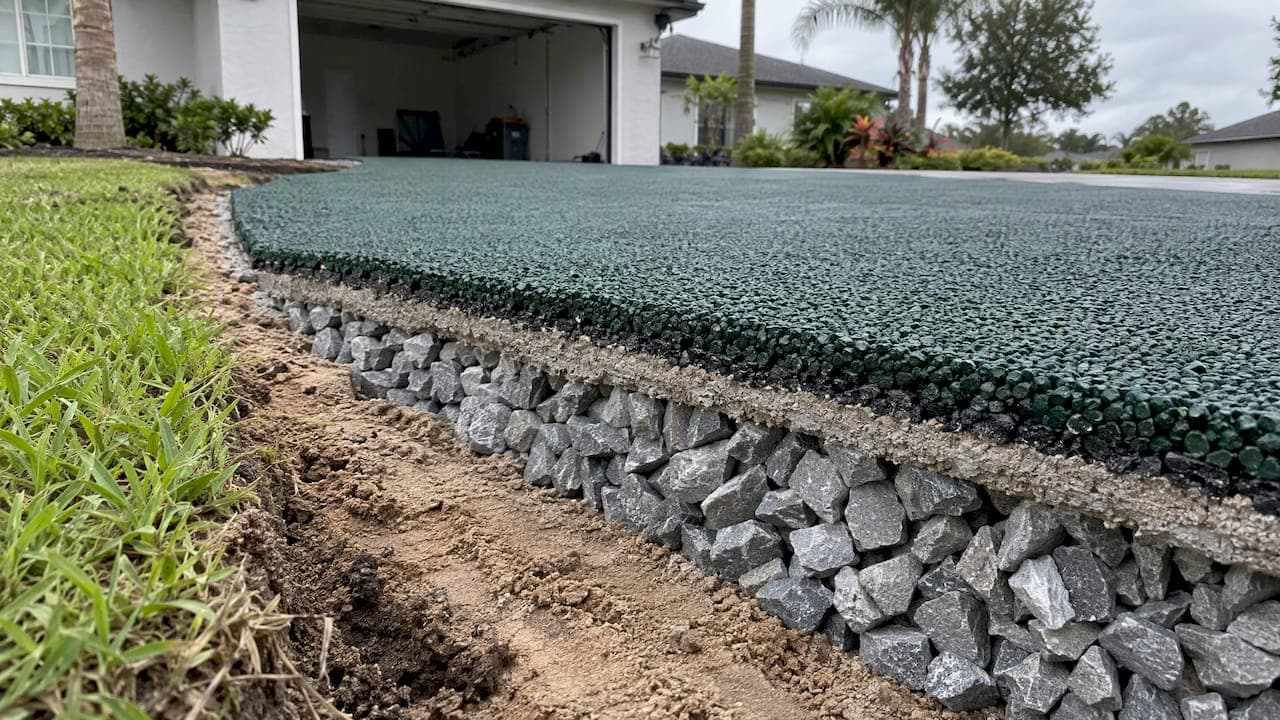
Yes, a properly designed porous driveway reduces surface runoff and manages stormwater on-site, but real-world performance depends on soil infiltration rate, sub-base design, and maintenance habits. Without a soil check or an engineered stone reservoir, these surfaces often clog or underperform within a few seasons. They also are not a fit for every lot: sites with poor infiltration, high contaminant exposure, or heavy truck traffic usually need a different drainage plan.
TL;DR:
- Get a written soil infiltration test before design; slow draining soil may require an underdrain, while very poor infiltration can favor another drainage plan.
- For sloping sites above roughly 2% to 3%, request terraced stone or cross slope underdrains and an overflow path; confirm crews preserved soil infiltration.
- Plan to sweep or vacuum the surface one to four times a year; never use traction sand, which can clog its open pores.
- Gravel and grid systems cost the least but need frequent upkeep and edge restraints; pavers handle heavier point loads and allow individual repairs.
- Compare bids by excavation depth, stone volume, and underdrain details rather than surface material alone, and check local stormwater rebates before setting your budget.
Table of Contents
- Quick takeaways before you commit to a porous driveway
- What a porous driveway is and how it actually drains
- Comparing porous driveway materials: which one fits your site
- Why the sub-base matters more than the surface you pick
- What a porous driveway actually costs
- How installation works and the red flags to watch for in bids
- Keeping the drainage working: maintenance that actually matters
- Troubleshooting: why isn't my driveway draining?
- Is a porous driveway right for your property?
- My take after walking through the research
- Consider Rubberway® pervious paving for your driveway project
- FAQ
- Sources
Quick takeaways before you commit to a porous driveway
Before you call a contractor or start digging, these points will save you from the most common mistakes homeowners make with permeable surfaces.
- A porous driveway only works as well as the stone reservoir underneath it, not just the surface material you choose.
- Get a soil infiltration test before finalizing design; a licensed geotechnical tester or an experienced installer can run one.
- Budget for maintenance: most systems need sweeping or vacuuming one to four times a year to stay functional.
- Cost swings more with excavation depth and stone volume than with the surface material itself.
- Call a professional when your site has slopes over 2% to 3%, nearby foundations, or signs of a high water table.
What a porous driveway is and how it actually drains
A porous or permeable driveway lets rainwater pass through the surface instead of running off into the street or your yard. Conventional asphalt and poured concrete are essentially solid lids over the soil, which is why they generate runoff in the first place. Porous systems swap that lid for a layered structure: an open surface (asphalt, concrete, pavers, or rubber), a bedding layer, a stone reservoir base, and the native soil below.
Water moves through this system in a cycle: it infiltrates the surface, drops into the stone reservoir where it is temporarily stored, then either soaks into the soil below or exits through an underdrain if the soil cannot absorb it fast enough. Both halves of that equation matter. A surface with excellent infiltration sitting on an undersized reservoir will overflow during heavy rain. A deep reservoir over soil with poor infiltration will stay saturated and eventually back up.

This is why a site infiltration test matters more than brochure specs. According to FHWA's design guidance for pervious concrete, designers frequently add underdrains specifically to meet drawdown time targets when native soils cannot keep pace with surface infiltration. Skip the soil test and you are guessing at the one number that determines whether your driveway will actually drain.
Comparing porous driveway materials: which one fits your site
Each permeable material handles water, weather, and traffic differently, and the right choice depends on your climate, budget, and how much upkeep you're willing to do.
Porous asphalt uses an open-graded mix that lets water pass straight through to the stone reservoir below. FHWA's technical brief on porous asphalt notes it is a recognized stormwater practice among many state agencies, with the caveat that construction sequencing matters: building the surface late in the project schedule and protecting the subbase from compaction and sediment during construction dramatically lowers early clogging risk. It handles moderate traffic well and holds up reasonably in cold climates because the open stone base drains faster than a solid section would, reducing water retention that drives freeze-thaw damage.
Pervious concrete performs similarly but with a stiffer surface and different mix-design sensitivities. The same FHWA guidance on permeable concrete pavements points out that pervious concrete and porous asphalt each carry their own durability tradeoffs, so the choice often comes down to local installer experience and climate.
Permeable interlocking concrete pavers (PICP) store water in the joints between units rather than through the material itself. They tolerate heavier point loads and are easier to spot-repair since a cracked or stained paver can be swapped out individually.
Gravel and grid systems are the lowest-cost permeable option and the most DIY-friendly, but they need frequent upkeep to control material migration and typically require edge restraint to keep gravel from spreading into lawns or walkways.
Rubber and resin-bound systems are a newer category built from recycled materials. Our Rubberway® pervious pavement, for example, is built with recycled rubber for an open, porous structure designed for drainage while resisting the cracking that heat and freeze cycles cause in rigid surfaces.
Cold-climate properties and driveways near foundations need extra scrutiny regardless of material: any surface sitting on a reservoir that cannot drain fast enough will hold water against a foundation wall or heave under repeated freeze-thaw cycles.

Why the sub-base matters more than the surface you pick
The visible surface gets all the attention, but the layers underneath are what determine whether your driveway drains for 20 years or clogs in two.
- Choker or bedding layer: a thin layer of small aggregate that sits directly under the surface, leveling it and preventing fines from migrating upward.
- Filter or base layer: a graded stone layer that further filters sediment and distributes load before water reaches the main reservoir.
- Subbase or stone reservoir: the main storage zone, built from open-graded, washed stone. Per EPA's permeable pavement maintenance guidance, this layer's thickness depends on how much storage you need and how much traffic it supports, and can exceed 24 inches in some designs.
- Optional underdrain and geotextile: an underdrain pipe gives water a planned exit route when the native soil can't absorb it fast enough, and geotextile fabric wraps the reservoir to keep soil fines from migrating in and clogging the stone.
For driveways with slopes above roughly 2 to 3 percent, EPA guidance recommends terracing the subbase or adding cross-slope underdrain trenches, since water can otherwise migrate laterally through the base and potentially undermine a nearby foundation. When reviewing a contractor's design, confirm three things yourself: the stated reservoir depth matches your soil's measured infiltration rate, there's a clear overflow path for storms that exceed design capacity, and the subgrade was not compacted with heavy equipment before the stone went in, which destroys the soil's natural infiltration capacity.
What a porous driveway actually costs
Material choice matters less to your final bid than most homeowners expect. The real cost drivers are excavation depth, stone volume, disposal of excavated soil, edge restraint, and whether an underdrain is needed.
Rough cost bands, which vary significantly by region and site conditions, generally run from low to high in this order: DIY gravel or grid systems sit at the bottom, permeable pavers and porous asphalt or pervious concrete sit in the middle, and rubber systems with full professional installation sit toward the higher end, reflecting labor and material costs. Our detailed breakdown of permeable driveway costs walks through typical line items in more depth if you want to compare bids against real numbers.
A few line items to watch for on any bid:
- Excavation and disposal: deeper reservoirs and poor soil conditions mean more material to remove and haul away, which adds up fast.
- Stone volume: a thicker reservoir costs more upfront but reduces the risk of overflow in heavy storms.
- Edge restraint: concrete curbing, metal edging, or plastic restraint systems keep loose materials like gravel or pavers from spreading.
- Underdrain installation: adding pipe, fittings, and an outlet point increases labor and material costs but is often cheaper than repairing a chronically saturated base later.
Before you finalize a budget, check with your municipality or utility district: some offer stormwater credits or rebates for permeable surfaces that reduce runoff into public systems. This is worth a phone call even if it feels like a long shot, since the potential savings can offset a meaningful share of installation cost.
How installation works and the red flags to watch for in bids
A porous driveway installation follows a fairly consistent sequence, whether you're hiring a crew or supervising closely.
- Site survey and permits: confirm setbacks, utility locations, and any local stormwater permitting requirements.
- Infiltration test: measure how fast your native soil absorbs water; this number drives every design decision that follows.
- Excavation to design depth, based on the stone reservoir thickness your infiltration test calls for.
- Subgrade preparation without over-compaction, since compacting the native soil defeats the purpose of a permeable system.
- Geotextile fabric placement to separate soil from stone and prevent fines migration.
- Base and reservoir stone placement, compacted in lifts per design specs.
- Surface installation: asphalt, concrete, pavers, or a rubber system like Rubberway®.
- Edge restraint and overflow path installation to contain materials and handle storms beyond design capacity.
- Final inspection, ideally with a walk-through during or after a rain event.
Pro Tip: Ask any contractor bidding on your project to show you the infiltration test results in writing before they finalize a design; a verbal estimate of "it should drain fine" is not a design.
Red flags in a bid include no mention of a soil infiltration test, a stone reservoir that seems thin relative to your climate and soil type, no overflow or cleanout provision, and missing edge restraint on gravel or paver systems. If your site has steep slopes, a high water table, or sits close to a foundation, insist on an engineered design rather than a standard template, and consider a licensed installer with direct experience in permeable systems. For more technical background on how engineers approach these designs, our stormwater paving guide for engineers covers the calculations in more depth.
Keeping the drainage working: maintenance that actually matters
The single biggest mistake homeowners make with porous driveways is treating them like conventional pavement: install once, ignore forever. Sediment, leaves, and fine debris settle into the surface voids over time, and once those voids clog, the whole system stops draining the way it was designed to.
- Sweep or vacuum the surface one to four times a year, depending on nearby trees and how much sediment runoff reaches the driveway.
- Regenerative-air vacuuming lifts trapped fines more effectively than standard brooming for larger permeable surfaces.
- Occasional jet-hosing can restore infiltration between deeper cleanings, per EPA's operational maintenance guidance.
- Never apply sand for traction. It clogs the surface voids almost immediately and is difficult to remove completely.
Winter care looks different from a standard driveway. Sand is off the table entirely, and de-icing chemicals should be used sparingly since heavy salt use can affect both the surface material and nearby vegetation. Snow should not be piled onto the permeable surface for storage, since compacted snow restricts infiltration and can drive sediment into the voids as it melts. For homeowners dealing with persistent winter drainage issues, guidance on resources for outdoor drainage problems covers broader seasonal troubleshooting. When routine cleaning no longer restores drainage, it's time to call a professional for deeper cleaning or joint aggregate replacement.
Troubleshooting: why isn't my driveway draining?
Start with the simplest explanation first. If water sits on the surface but drains within a day, that's usually surface clogging from sediment, which a thorough vacuuming or jet-hosing often fixes. If water pools near an underdrain outlet or doesn't recede at all, check for a blocked or crushed outlet pipe before assuming the whole system has failed.
Puddling in a consistent low spot, especially on sloped driveways, often points to inadequate terracing or cross-slope drainage in the base rather than surface clogging. A surface clean won't fix that; it needs base rework. For quick diagnostic steps you can run yourself before calling in help, this guide to fixing driveway puddles walks through common causes. When standing water persists after cleaning and the base appears intact, bring in a geotechnical or stormwater professional, since the issue may be a rising water table or a reservoir that was undersized from the start.
Is a porous driveway right for your property?
Run through this short checklist before committing:
- Infiltration rate: if your soil test shows very slow infiltration, you'll need an underdrain or a different drainage plan.
- Contributing impervious area: roof runoff or neighboring pavement draining onto your driveway increases the load it must handle.
- Traffic expectations: heavy trucks or frequent delivery vehicles may rule out some materials.
- Groundwater or contamination risk: a high water table or nearby fuel storage can make infiltration unsafe.
- Maintenance willingness: if you won't commit to annual sweeping, reconsider.
- Budget: match your material choice to what you can realistically spend on excavation and base depth.
If most answers favor a porous system, proceed with a qualified installer. If soil or groundwater conditions are marginal, ask for an engineered design. If several factors work against you, a conventional surface with a separate drainage fix may serve you better.
My take after walking through the research
The driveway material gets the headlines, but the stone reservoir and your willingness to maintain it decide whether the system works in year five, not just year one. If you remember one thing from this guide, get the soil infiltration test done first, commit to a maintenance routine before you sign a contract, and get at least two written bids so you can compare reservoir depth and underdrain details side by side, not just surface material.
— Roger
Consider Rubberway® pervious paving for your driveway project
If you want the drainage benefits of a porous surface without taking on the upkeep burden of loose gravel or the cracking risk of rigid pavement, our pervious pavement is built from recycled rubber materials designed for strong drainage performance and resistance to heat and freeze-related cracking. Installations are also designed to meet ADA compliance where required.
Rubberway® works well for most residential driveways and pool decks, though sites with very slow soil infiltration or steep slopes still benefit from an engineered sub-base or underdrain, which our team can incorporate into your design. Before requesting a quote, have ready: your driveway's approximate dimensions, any known slope or drainage issues, and photos of the current surface. Start with our Rubberway® product pages to see the available systems, or reach out through our main site to schedule a site evaluation.
FAQ
What are the downsides of porous asphalt?
Porous asphalt can clog if construction sequencing or ongoing maintenance is neglected, since sediment entering the open-graded surface reduces infiltration over time. It also requires careful protection during installation, since compacting the subbase or allowing sediment runoff during construction undermines performance before the driveway is even finished, according to FHWA's porous asphalt brief.
What is the best material for driveway drainage?
There isn't one universal best choice since it depends on your soil, climate, and traffic needs. Porous asphalt, pervious concrete, permeable pavers, and rubber systems like Rubberway® all drain effectively when paired with a properly sized stone reservoir and matched to your site's infiltration rate.
What is the cheapest permeable driveway option?
Gravel and grid systems are generally the lowest-cost permeable driveway option and the most suitable for DIY installation. They require more frequent upkeep to control material migration and typically need edge restraint to stay contained.
What are the disadvantages of porous concrete?
Pervious concrete requires precise mix design and placement, and mistakes during installation can reduce both durability and drainage capacity. Like porous asphalt, it depends on a properly designed stone reservoir and underdrain in low-infiltration soils, per FHWA's permeable concrete guidance.
Sources
For design tables, construction specs, and maintenance protocols beyond what fits here, start with the EPA's permeable pavement demonstration findings and winter care guidance from UNH's stormwater resources. Homeowners comparing contractor bids may also find practical value in Divine Landscaping's permeable paver cost guide and AsphaltWorkX's DIY paving guide.
- Tech Brief: Permeable Concrete Pavements (FHWA)
- NPDES: Stormwater Best Management Practice—Permeable Pavements (EPA)