
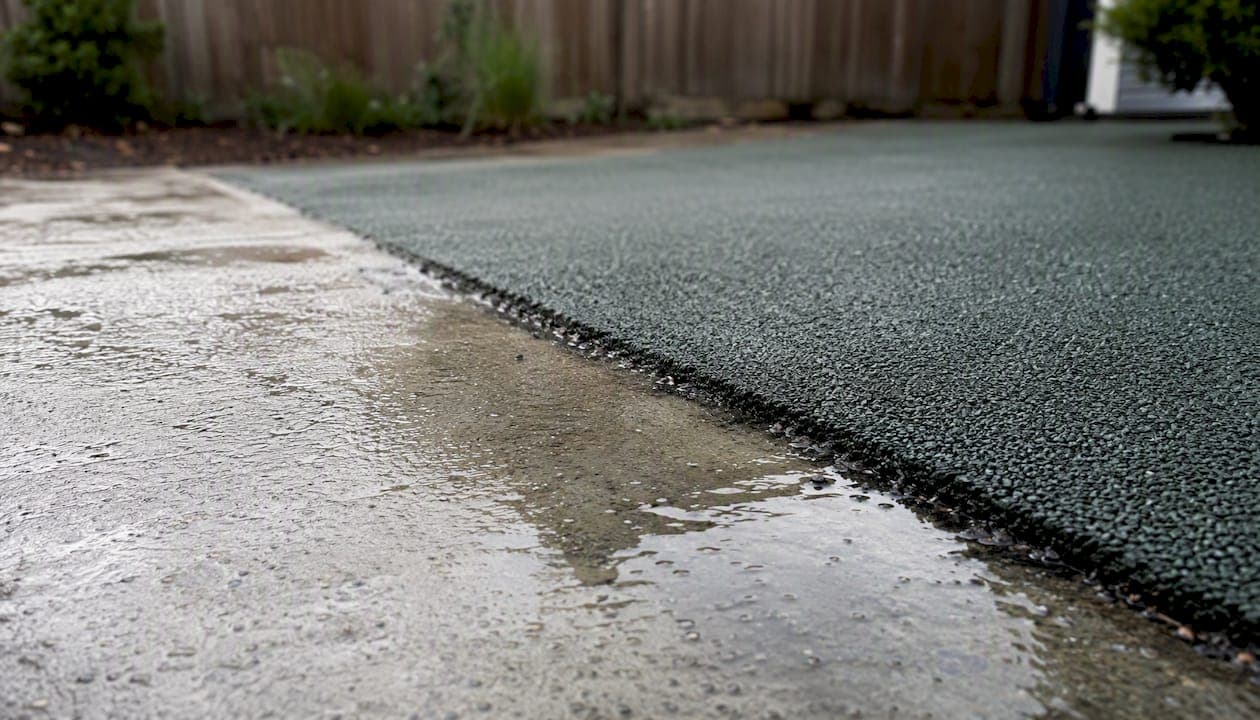
The fastest reliable fix for most driveway puddles is one of two things: correct the slope so water flows away from the house, or install a targeted drain at the low spot where water collects. If you can see the dip, feel the surface flex under your feet, or notice water sitting more than 24 hours after rain, you already know enough to act.
Here's where to start, ordered by speed and cost:
- Clear runoff paths first (free, 30 minutes): unblock drains, redirect downspouts, remove soil berms or debris that redirect water onto the slab.
- Regrade loose gravel ($50–$200 in materials): add slope and compact; works immediately for unpaved driveways.
- Install a channel drain at the garage apron or lowest point ($500–$1,500 installed): the go-to fix when slope correction isn't practical.
- Add a French drain or catch basin ($800–$3,000+): for edge runoff or concentrated low spots that a channel drain can't handle alone.
- Full structural repair or replacement ($3,000–$15,000+): when the base has failed.
Call a contractor now if you see any of these: water entering the garage or creeping toward the foundation, alligator (spiderweb) cracking in the pavement, soft or spongy spots that flex when you walk on them, or puddles that return within days of patching. Those are signs of base failure, and a surface fix will not hold.
Pro Tip: Persistent pooling accelerates pavement deterioration significantly. According to Nathan Paving, small drainage fixes often cost under $1,000 and can prevent much larger foundation or full-replacement costs down the road. Acting early is almost always cheaper.
Key Takeaways
Fixing driveway puddles permanently requires matching the fix to the root cause: slope, base failure, or blocked drainage.
| Point | Details |
|---|---|
| Start with runoff, not the slab | Clear drains and redirect downspouts first; many puddles disappear without any structural work. |
| Slope is the standard | Driveways need at least 1/8 inch per foot of slope; the garage apron should have 1/4 inch per foot. |
| Base failure needs structural repair | Alligator cracking and soft spots mean surface patches will fail; mudjacking or replacement is required. |
| Retrofit drains fill the gap | Channel drains ($500–$1,500) and French drains ($800–$2,500+) solve most puddle problems that regrading can't. |
| Rubberway® eliminates runoff at the source | Ecotecrubber's permeable Rubberway® system is the recommended long-term option when replacement is already on the table. |
Table of Contents
- How do you diagnose why puddles form on your driveway?
- What low-cost fixes can you do today to reduce driveway puddles?
- Which retrofit drainage solution is right for your driveway?
- What are your options for structural driveway repairs?
- Why is permeable rubber paving worth considering as a long-term fix?
- How do you choose the right fix and hire the right contractor?
- What seasonal maintenance prevents puddles from coming back?
- How do climate and soil type affect driveway puddle formation?
- What environmental rules apply to driveway drainage modifications?
- The case for doing less, but doing it right
- Ecotecrubber's Rubberway® system: get a site evaluation and eliminate the problem
- Sources
How do you diagnose why puddles form on your driveway?
Before spending a dollar, spend 20 minutes with a level, a tape measure, and your phone camera. Most homeowners skip this step and end up fixing the wrong thing.

Step-by-step diagnostic checklist
Step 1: Map where the puddles appear. Note whether water collects at the garage apron, in the middle of the slab, along the edges, or at the street end. Each location points to a different cause.
Step 2: Measure the slope. Lay a 4-foot level on the driveway surface and measure the gap at the low end. Concrete driveway drainage guidance recommends a minimum of 1/8 inch per foot of run, with 1/4 inch per foot near the garage apron to keep water moving away from the house. Less than that, and water stalls.
Step 3: Check puddle depth and persistence. A puddle shallower than 1/4 inch that drains within a few hours is usually a surface finish issue. One that sits 24–48 hours or longer points to a slope problem, a blocked drain, or a sunken sub-base.
Step 4: Inspect surrounding features. Walk the perimeter. Are downspouts dumping water onto or toward the driveway? Is the lawn or landscaping graded toward the slab? Is there a clogged drain grate nearby?
Step 5: Press and listen. Walk slowly across the wet surface. Any flex, hollow sound, or crumbling at the edges signals sub-base failure, not just a surface dip.
Symptom-to-cause map:
- Puddle at garage apron only: insufficient apron slope or missing channel drain
- Puddle in the middle: settled sub-base or low spot from freeze-thaw heaving
- Puddle along edges: landscape runoff redirected onto the slab, or no edge drainage
- Puddle near downspout: downspout discharge landing on or near the driveway
- Multiple puddles across the surface: overall grade is too flat or the slab has shifted
Pro Tip: Before calling any contractor, photograph each puddle from three angles: straight down, from the street end, and from the garage. Time-stamp the photos. This gives a contractor real evidence to work from and protects you if there's a dispute about scope.
What low-cost fixes can you do today to reduce driveway puddles?
Start simple. A surprising number of driveway puddles trace back to blocked runoff paths or misdirected downspouts, not structural failure. Trade guidance consistently recommends clearing runoff paths and checking downspouts before any excavation or structural work.
1. Clear debris and restore runoff paths
- Remove leaves, soil, and debris from drain grates, channel openings, and driveway edges.
- Cut back any grass or soil that has crept over the edge of the slab and is blocking sheet flow.
- Check that the driveway edges slope slightly away from the center so water sheds to the sides.
- Confirm no soil berms or mulch beds are directing landscape water onto the driveway.
This costs nothing and takes under an hour. If the puddle disappears after the next rain, you're done.
2. Extend downspouts and add a simple swale
If a downspout is dumping water within 3 feet of the driveway, add a flexible downspout extension ($10–$25 at any hardware store) to carry discharge at least 6 feet away. For sloped yards, a shallow rock-lined swale (a gravel-filled trench, 6 inches wide and 4 inches deep) can redirect surface flow away from the slab. Materials run $50–$150 for a typical residential swale.
3. Regrade a loose gravel driveway
For unpaved or gravel driveways, you can restore slope yourself:
- Rake existing gravel to the edges to expose the base.
- Add compactable gravel or crushed stone to the center crown, building a slight peak (roughly 1/4 inch per foot of width) so water sheds to both sides.
- Compact with a hand tamper or plate compactor (rentable for $50–$75/day).
- Rake gravel back evenly over the crowned base.
This works well for driveways where the base is still firm. If the base feels soft or muddy after raking, stop and call a contractor.
4. Temporary surface patches (use carefully)
Cold-patch asphalt filler or hydraulic cement can fill a small dip temporarily. These products cost $15–$40 per bag and take 30 minutes to apply. They are not permanent. Sealants do not fix ponding either; sealing over a low spot traps moisture and accelerates pavement breakdown. Use a patch only to buy time while you plan a proper fix, and only when the surrounding pavement is structurally sound.
Stop DIY and call a pro when:
- The base feels soft or spongy underfoot
- Cracks radiate in a spiderweb pattern from the puddle area
- The same puddle returns within a week of patching
- Water is moving toward the garage floor or house foundation
Which retrofit drainage solution is right for your driveway?
When simple fixes don't solve the problem, a retrofit drainage system is the next step. These range from a single channel drain to a full French drain network, and the right choice depends on where water collects and how much volume you're dealing with.
Channel/trench drains are the most common retrofit for garage aprons and single low points. A linear grate set flush with the surface catches sheet flow and routes it into buried piping. Typical installations run $500–$1,500 depending on driveway width and how far the discharge pipe must run. Most municipalities require the outlet to connect to a storm system or daylight on your own property, not a neighbor's.

French drains handle edge runoff and subsurface seepage well. A perforated pipe wrapped in filter fabric sits in a gravel-filled trench along the driveway edge. French drains and catch basins are among the most common retrofit solutions for residential driveways, with costs varying widely by length and depth. A permit is often required when tying into a municipal storm system.
Catch basins and dry wells work where there's a concentrated low spot and no easy outlet. A catch basin collects surface water through a grated inlet; a dry well disperses it into the surrounding soil. When a dry well is failing or sinking, proper repair requires compaction in lifts to prevent resettlement. These systems need annual inspection and periodic cleaning to stay functional.
Swales are the lowest-cost option for broad sheet flow. A shallow graded channel, sometimes lined with gravel or sod, redirects surface water around the driveway. A homeowner with basic grading skills can build one in a weekend.
Culverts apply when a driveway crosses a natural drainage channel. This is almost always a permitted project requiring a licensed contractor and sometimes an engineering review.
What are your options for structural driveway repairs?
When the base has failed or the slope is fundamentally wrong, drainage add-ons won't hold. You need a structural fix. The three main paths are slab lifting, bonded overlay, and full replacement.
Mudjacking vs. polyurethane foam leveling
Both methods inject material under a sunken slab to raise it back to grade. Mudjacking pumps a cement-sand slurry through drilled holes; polyurethane foam injection uses an expanding two-part foam. This Old House documents both techniques and notes that proper compaction in lifts is critical to prevent the slab from sinking again.
- Mudjacking: typically $3–$6 per square foot; best for large concrete slabs with stable surrounding soil; heavier material, longer cure time.
- Polyurethane foam: typically $5–$12 per square foot; faster cure (often same-day use), less invasive drilling, lighter material that won't add load to a weak sub-base.
Neither method works when the sub-base is actively eroding or when alligator cracking and soft spots indicate the base has fully failed. In those cases, lifting the slab just delays the inevitable.
Bonded overlays
A bonded concrete or asphalt overlay adds thickness and can correct minor slope deficiencies, but it has real limits. The overlay must bond to a structurally sound base; applying it over a failing sub-base produces a new surface that cracks within a season or two. Minimum overlay thickness is typically 1.5–2 inches for asphalt and 2–4 inches for concrete, and the added height can create a trip hazard at transitions. An overlay is a reasonable fix when the base is solid but the surface slope is slightly off.
Pro Tip: Ask any contractor proposing an overlay to show you a compaction test result for the existing base before they pour. If they can't produce one, that's a red flag. An overlay over a compromised base is money spent twice.
Full replacement
When the base has failed across a significant portion of the driveway, full replacement is the only fix that lasts. Scope includes excavating the existing slab, rebuilding the gravel base in compacted lifts, and installing a new surface with correct slope. Ballpark costs range from $4,000 to $15,000+ for a typical residential driveway depending on size, material, and regional labor rates. Timeline from contract to completion is typically 3–7 days of active work, plus cure time.
What to ask contractors about warranties:
- What is the warranty on base compaction and materials?
- Does the warranty cover drainage performance, or only surface cracking?
- Is the contractor licensed and insured in your state?
- Will they provide a written workmanship guarantee?
Why is permeable rubber paving worth considering as a long-term fix?
When repeated repairs haven't solved the problem, or when a full replacement is already on the table, permeable surfacing is worth a serious look. Rubberway® rubber paving, installed by Ecotecrubber, is one of the strongest options for homeowners who want to eliminate surface runoff rather than just redirect it.
How Rubberway® works
Rubberway® is a porous rubber surface made from recycled tire material. Water passes through the surface layer and into a prepared permeable base, rather than pooling on top. This means a properly installed Rubberway® driveway doesn't need a channel drain at the apron or a French drain along the edge to handle normal rainfall. The drainage is built into the surface itself.
Key benefits for homeowners dealing with puddles:
- Permeability: water infiltrates through the surface, eliminating sheet flow and standing water under normal rain conditions.
- Recycled material: made from recycled tires, reducing landfill waste.
- Crack resistance: the rubber composition flexes rather than fracturing under heat and freeze-thaw cycles, a significant advantage in Florida's climate.
- ADA compliance: the surface meets ADA slip-resistance and firmness standards.
- Color options: available in multiple colors for curb appeal.
For a deeper look at how permeable surfaces compare to traditional materials, this guide to eco-friendly driveway options covers the tradeoffs clearly.
When permeable rubber paving makes financial sense
If you've patched the same low spot twice and the puddle keeps coming back, the math shifts. Two rounds of cold patch plus a channel drain installation can easily reach $2,000–$3,000 with no guarantee the underlying grade issue is solved. A Rubberway® installation addresses the drainage problem at the surface level, eliminating the need for most retrofit drainage work. When replacement is already necessary, the cost difference between a conventional pour and a permeable rubber surface is often smaller than homeowners expect, especially when you factor in avoided drainage infrastructure.
Pro Tip: Request a site evaluation before committing to any permeable surface. Ecotecrubber provides a drainage assessment as part of the estimate process, which tells you whether your sub-base needs preparation before installation. That step separates a lasting fix from a cosmetic one.
For homeowners who want to understand the full cost model, this overview of permeable paving benefits and costs is a useful starting point.
How do you choose the right fix and hire the right contractor?
Getting the diagnosis right is half the job. The other half is making sure the contractor you hire actually solves the problem rather than patches over it.
Questions to ask every contractor
- Are you licensed and insured in this state? (Ask for the license number and verify it.)
- What is your plan for the sub-base? Will you test compaction before and after?
- How will you tie drainage into the existing storm system, or where will discharge go?
- What slope will you build into the finished surface, and how will you verify it?
- What is the timeline from start to finish, including cure time?
- What does your written warranty cover, and for how long?
- Can you provide references from similar driveway drainage projects in this area?
Red flags to watch for
- Verbal quotes only, no written scope of work
- Unwillingness to pull permits or claim "it's not required" without checking local rules
- No mention of base compaction or sub-grade inspection
- Pressure to decide same-day or lose the price
- No references or online reviews you can verify independently
Permit checklist
A permit is likely required when you:
- Tie a new drain into a municipal storm sewer
- Install a culvert under a driveway at a road crossing
- Disturb more than a threshold area of impervious surface (varies by municipality; check with your local building department)
- Perform work in a flood zone or near a wetland
Engineering sign-off may be required for catch basin systems that discharge to a public right-of-way or for any work in a regulated drainage easement.
Comparing bids fairly
Get at least three written bids. Compare scope first: does each bid include the same base preparation, compaction testing, drainage tie-in, and surface material? A bid that's $1,500 lower may simply exclude base work. Unit costs (price per square foot for surface, price per linear foot for drain pipe) are the clearest way to compare apples to apples. Warranty terms are part of the price, not a bonus.
What seasonal maintenance prevents puddles from coming back?
The best drainage system in the world fails if it isn't maintained. Most puddle problems that return after a repair trace back to a clogged grate, a shifted downspout, or debris blocking edge flow.
Quarterly checks (15 minutes each):
- Clear all drain grates and channel openings of leaves, sediment, and debris.
- Walk the driveway perimeter and remove any soil or mulch that has migrated over the edge.
- Check that downspouts are still directed away from the driveway and discharging at least 6 feet from the slab.
- Look for new cracks or edge crumbling that could signal sub-base movement.
Before winter (freeze-thaw climates):
- Seal any open cracks before the first freeze to prevent water infiltration and ice expansion.
- Confirm all drain outlets are clear so meltwater can flow freely in spring.
- Check that the apron slope hasn't shifted; a single freeze-thaw cycle can move a slab enough to reverse drainage direction.
Before heavy-rain season (Gulf Coast and Florida):
- Flush French drains with a garden hose to confirm flow is unobstructed.
- Inspect catch basin interiors for sediment buildup; pump or vacuum if more than 6 inches of sediment has accumulated.
- Check that permeable surfaces (including Rubberway® installations) are free of compacted debris; a stiff broom or leaf blower restores surface permeability.
Longer-term maintenance:
- French drain gravel typically needs replacement or flushing every 5–10 years as fine particles clog the voids.
- Catch basin frames and grates should be inspected for corrosion or settlement annually.
- Permeable rubber surfaces benefit from an annual power wash to clear fine sediment from the pores.
Pro Tip: *Set a calendar reminder for the first week of October and the first week of April.
How do climate and soil type affect driveway puddle formation?
Where you live shapes which puddle problems you'll face and which fixes will last.
Clay-heavy soils (common across much of the Southeast, Midwest, and Mid-Atlantic) absorb water slowly and expand when wet. A driveway built over clay is prone to heaving, settlement, and edge cracking as the soil moves seasonally. French drains and catch basins in clay soils need filter fabric to prevent fine particles from migrating into the gravel and clogging the system within a few years.
Sandy soils (prevalent in Florida and coastal regions) drain quickly but offer less structural support. Sub-base compaction is especially critical in sandy conditions; a poorly compacted sandy base settles unevenly, creating the low spots that collect water. Permeable surfaces work particularly well over sandy sub-grades because the natural infiltration capacity of the soil complements the surface permeability.
Freeze-thaw climates (the upper Midwest, Northeast, and mountain regions) subject driveways to repeated expansion and contraction cycles. Each freeze-thaw event can shift a slab by a fraction of an inch; over several winters, those fractions add up to a visible low spot. Mudjacking and foam leveling are common fixes in these regions, but they need to be paired with proper drainage so water doesn't refreeze under the slab and undo the repair.
High-rainfall regions (the Gulf Coast, Pacific Northwest, parts of the Southeast) deal with volume as much as slope. A driveway that drains fine in a half-inch rain event may flood in a 2-inch event if the drainage system isn't sized for peak flow. Channel drains in these areas should be sized with a licensed contractor who knows local stormwater design standards, not just selected from a hardware store catalog.
Florida's combination of sandy soils, intense summer rainfall, and minimal freeze-thaw activity makes it a strong fit for permeable rubber paving. The surface handles high-volume rain events, the sandy sub-grade supports infiltration, and the absence of freeze-thaw cycles means the rubber's flexibility is an advantage against heat expansion rather than ice.
What environmental rules apply to driveway drainage modifications?
Drainage work isn't purely a property decision. Several layers of regulation can apply, and ignoring them creates liability.
Stormwater regulations govern where you can discharge collected water. Most municipalities prohibit routing driveway runoff directly into the street gutter or a neighbor's property. Discharge must go to an approved storm sewer connection, a dry well on your own property, or a vegetated area with sufficient infiltration capacity. Some jurisdictions require a permit for any new connection to the storm system, regardless of size.
Impervious surface limits are increasingly common in suburban and urban municipalities. Adding a new concrete or asphalt surface, or expanding an existing one, may trigger a requirement to offset the added runoff with on-site retention. Permeable surfaces like Rubberway® often qualify for credit under these rules because they reduce runoff volume rather than adding to it. For homeowners in regulated areas, choosing a permeable surface can mean the difference between a straightforward permit and a costly stormwater mitigation plan. Ecotecrubber's team can walk you through what applies in your area during the site evaluation.
Flood zone and wetland rules add another layer. Properties in FEMA-designated flood zones (check your address at the FEMA Flood Map Service Center) may need an elevation certificate or a floodplain development permit before any grading or drainage work. Work near wetlands or jurisdictional waterways may require a permit from the Army Corps of Engineers or your state environmental agency.
HOA rules are separate from municipal codes but equally binding. Many HOAs restrict surface materials, colors, and drainage modifications. Get written approval before starting any work that changes the driveway surface or redirects drainage.
For a deeper look at how engineered stormwater approaches interact with these regulations, this stormwater management resource covers the design-level considerations.
The case for doing less, but doing it right
Most homeowners who contact a contractor about driveway puddles have already patched the same spot at least once. That pattern is worth examining.
The temptation is to treat every puddle as a surface problem, because surface fixes are cheap and fast. A bag of cold patch, an afternoon, and the puddle is gone until the next heavy rain. But the puddle isn't the problem. It's a symptom. The problem is either that water has nowhere to go (a slope or drainage issue) or that the base has moved and the surface followed it (a structural issue). Patching the surface addresses neither.
The honest cost comparison looks like this: two rounds of patching plus a channel drain installation can easily reach $2,500–$3,500 over two or three years, with the puddle still returning. A properly scoped repair, done once with correct base work and drainage, typically costs more upfront but doesn't need to be repeated. The math almost always favors doing it right the first time, especially when you factor in the accelerated pavement deterioration that persistent pooling causes.
DIY makes sense for the first tier of fixes: clearing drains, redirecting downspouts, regrading gravel. Those are low-risk, low-cost, and reversible. The moment you're considering excavation, base work, or anything that touches the structural layer, a licensed and insured contractor is the right call. Not because the work is impossibly complex, but because a contractor carries liability insurance, can pull permits, and offers a warranty. If the repair fails, you have recourse. A DIY structural repair that fails leaves you with a bigger problem and no one to call.
Ecotecrubber's Rubberway® system: get a site evaluation and eliminate the problem
If you've read this far and your driveway has a recurring puddle that drainage fixes haven't solved, the surface itself may be the issue. Ecotecrubber installs the Rubberway® porous rubber paving system across Florida for homeowners, businesses, and municipalities who want to stop managing standing water and start preventing it.
Rubberway® lets rainfall pass through the surface into a prepared permeable base, eliminating the sheet flow that creates puddles in the first place. It's made from recycled tire material, meets ADA compliance standards, resists heat-induced cracking, and comes in a range of colors. Ecotecrubber is licensed and insured, and every installation includes a drainage assessment, a compaction plan, and a written workmanship warranty.
To get started, request a site evaluation. Ask for a drainage plan specific to your property, a compaction report for the sub-base preparation, and a clear warranty covering both materials and drainage performance. See the full range of Rubberway® products and material options before your estimate, so you arrive at the conversation knowing what to expect.
Sources
The following sources informed the technical claims and cost figures in this article:
- 7 Driveway Drainage Solutions for Your Excess Water Woes — BobVila
- Concrete driveway drainage — SlabCalc
- Driveway drainage solutions — Nathan Paving
- How to fix a sinking driveway — This Old House
- What causes alligator cracking in asphalt and how to solve it — LeeBoy