
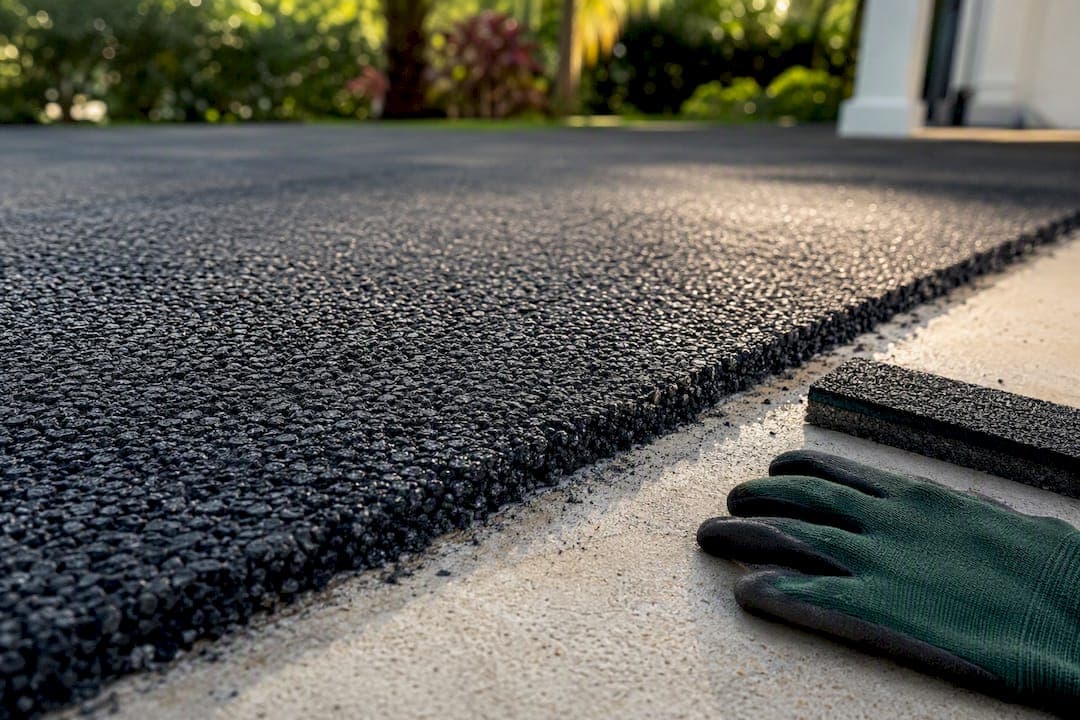
A recycled-rubber porous overlay, built on the Rubberway® system, is the best resurfacing choice when a patio needs to drain fast, resist cracking, and stay safe underfoot. It handles standing water, meets ADA slip-resistance benchmarks, and shrugs off Florida's freeze-thaw and heat cycles better than a hard concrete surface. Homeowners, HOA boards, and municipal planners choosing between concrete patio resurfacing options tend to land here once they see the drainage and safety numbers side by side.
TL;DR:
- Rubber resurfacing systems handling water transmission rates up to 56 gallons per minute per square foot outperform concrete in drainage and slip resistance, especially during heavy rain.
- Proper installation requires a stable, properly compacted permeable sub-base; neglecting this step causes early failure and voids warranties.
- The cost over a 12-year lifespan, including maintenance and repairs, generally favors rubber over concrete despite higher upfront prices.
- Dual-layer or rubber-aggregate systems are recommended for high-traffic, commercial, or multi-use spaces for durability, color retention, and firmness.
- Verify installer credentials, sub-base specifications, and warranty terms before beginning to avoid poorly executed projects or early surface deterioration.
Table of Contents
- What Are Your Concrete Patio Resurfacing Options?
- How Does Rubber Resurfacing Perform Compared to Concrete?
- What Does Rubber Overlay Installation Actually Require?
- How Much Does Rubber Patio Resurfacing Cost Over Time?
- What Should You Ask Before Hiring an Installer?
- When Does Recycled-Rubber Resurfacing Make the Most Sense?
- Ready to Resurface Your Patio the Right Way?
- Sources
- FAQ
What Are Your Concrete Patio Resurfacing Options?
Not every rubber system is built the same way, and picking the wrong one for the job is the most common mistake in patio resurfacing options. Three configurations cover almost every residential and commercial application.
Single-layer porous rubber is the simplest and most permeable system. It's a uniform recycled-rubber mat that lets water pass straight through, which makes it the default pick for patios, pool decks, and anywhere bare feet meet the surface regularly. It's soft, warm to the touch even after a swim, and forgiving on the joints.
Dual-layer systems add a colored virgin-rubber wear layer over a recycled base. The bottom layer does the structural and drainage work; the top layer handles UV exposure, foot traffic, and aesthetics. This is the system to specify for higher-traffic patios, commercial walkways, or any space where color consistency matters over the long haul, since the wear layer resists fading and abrasion longer than a single-layer mix.
Rubber-aggregate blends (sometimes called rubberrock) mix rubber granules with a bonding aggregate for a firmer, denser finish. These handle light cart or vehicle traffic, which makes them suitable for HOA common areas, golf cart paths adjacent to patios, or municipal plazas that see more than foot traffic.
Quick reference for matching system to use case:
- Residential patio or pool deck: single-layer porous rubber for comfort and maximum drainage.
- Commercial walkway or high-traffic HOA courtyard: dual-layer system for durability and color retention.
- Cart paths, light-vehicle areas, municipal plazas: rubber-aggregate blend for added firmness.
- Mixed-use spaces (patio bordering a driveway apron): dual-layer system tapering into a rubber-aggregate transition zone.
How Does Rubber Resurfacing Perform Compared to Concrete?
The numbers here are the reason procurement teams keep specifying rubber over hard concrete finishes. Standing water on a patio isn't just an annoyance, it's a liability and a mosquito problem, and it's the first thing rubber porous systems solve.
By the Numbers: Rubberway-style pervious systems are rated for water transmission of up to 56 gallons per minute per square foot, and wet-surface DCOF testing commonly comes in between 0.76 and 0.99, well clear of the 0.42 minimum referenced under ADA accessibility guidance.
That drainage rate means a heavy Florida downpour disappears through the surface instead of pooling at the low corner of the patio, a problem you can read more about in a broader look at stormwater management paving solutions. The slip-resistance numbers matter just as much around pools, where wet feet and hard concrete are a bad combination.
A few more performance points worth knowing before you compare bids:
- Rubber's shock absorption can reduce fall-impact force significantly compared with harder surfacing compared with concrete, a real factor in reducing liability around pool decks and family gathering spaces.
- Lighter color options in a wear layer reduce surface heat gain, so the patio stays walkable barefoot even on a summer afternoon, a point covered in more depth in Rubberway's rubber sidewalk product line.
- Porous rubber pavements can qualify for LEED credits and reduce root heave damage near mature trees, since water and air still reach the soil beneath.
- Every installation uses recycled tire material, diverting waste that would otherwise end up in a landfill.
What Does Rubber Overlay Installation Actually Require?
Skipping the sub-base is the single most common reason a rubber overlay fails early, and it's an easy mistake to hide in a low bid. A proper installation follows a specific sequence, and any contractor who glosses over it should raise a flag.
- Excavate and grade the existing patio area to establish proper slope for drainage away from structures.
- Compact a permeable sub-base, typically 4 inches of compacted #57 stone topped with a half-inch #8 choker course, which stabilizes the surface while preserving porosity.
- Install edging or containment to hold the rubber mix in place along the perimeter, especially on patios that meet a lawn or garden bed.
- Pour the base layer at the specified thickness, usually building toward a 1.5 to 2 inch overlay depending on expected traffic.
- Apply the wear layer (if using a dual-layer system) and finish as a monolithic, seamless pour, which eliminates seam lines that trip people or crack over time.
- Cure under the right conditions, generally starting installation at 50°F and rising, with staged pours on larger commercial or municipal projects to manage material and labor logistics.
Pro Tip: Ask any contractor bidding on the job to show you the sub-base compaction spec in writing before they touch a shovel. Under-spec'd base material and poor drainage slope are the two most common causes of early rubber surface failure, and both are invisible once the finished surface goes down.
How Much Does Rubber Patio Resurfacing Cost Over Time?
Sticker price on rubber resurfacing tends to run higher than a basic concrete patch, but that comparison misses the point. The real question is cost per year of service, not cost per square foot on day one.
Major cost drivers include:
- Existing surface removal or prep, which varies depending on whether the old concrete stays as a base or needs to come out entirely.
- Edging and containment work, more involved on irregular patio shapes than simple rectangles.
- Wear-layer color and customization, since dual-layer systems with specific color-matching cost more than a standard single-layer mix.
- Site complexity, including drainage grading, tree roots, and access for equipment.
On the return side, manufacturer and field reporting puts expected service life at 12 years or longer with routine care, and the surface can be maintained with retopping or patching instead of full replacement. Maintenance is light: occasional rinsing or sweeping, with patch repairs that blend in almost invisibly rather than leaving a visible seam the way a concrete patch does. For a lifecycle comparison against a resealed or overlaid concrete patio, divide total installed cost by expected years of service, then add the concrete side's more frequent resealing and crack-repair costs. Rubber usually wins that math over a decade, even when its upfront number is higher.
What Should You Ask Before Hiring an Installer?
A rubber overlay is only as good as the crew that installs it, and the wrong contractor can turn a good material into a callback nightmare. Use this checklist before signing anything.
- Request the sub-base and drainage spec in writing, including stone size, compaction depth, and slope calculations.
- Ask for DCOF wet-test results on the exact product being installed, not a generic manufacturer average, along with the material safety data sheet.
- Confirm licensed and insured status, and ask whether the crew is manufacturer-authorized on the Rubberway system specifically.
- Get warranty terms in writing, including what's covered, for how long, and whether it covers labor or materials only.
- Ask for a realistic timeline, covering prep, cure window, and when the surface can safely handle foot traffic again.
- Request references and photos from comparable jobs, ideally pool decks or patios similar in size and traffic to yours.
Red flags worth walking away from: a bid with no mention of sub-base material at all, a "same day" cure promise on a porous system, or a contractor who can't produce a single reference photo of a finished rubber patio. If you're also weighing pool deck options specifically, this pool deck resurfacing guide covers adjacent considerations worth reading before you finalize scope.
When Does Recycled-Rubber Resurfacing Make the Most Sense?
Concrete still has its place, but if drainage, slip safety, or sustainability sits anywhere near the top of your priority list, rubber porous resurfacing is the more defensible choice, not the trendier one. The math on lifecycle cost and the ADA-relevant slip data both point the same direction.
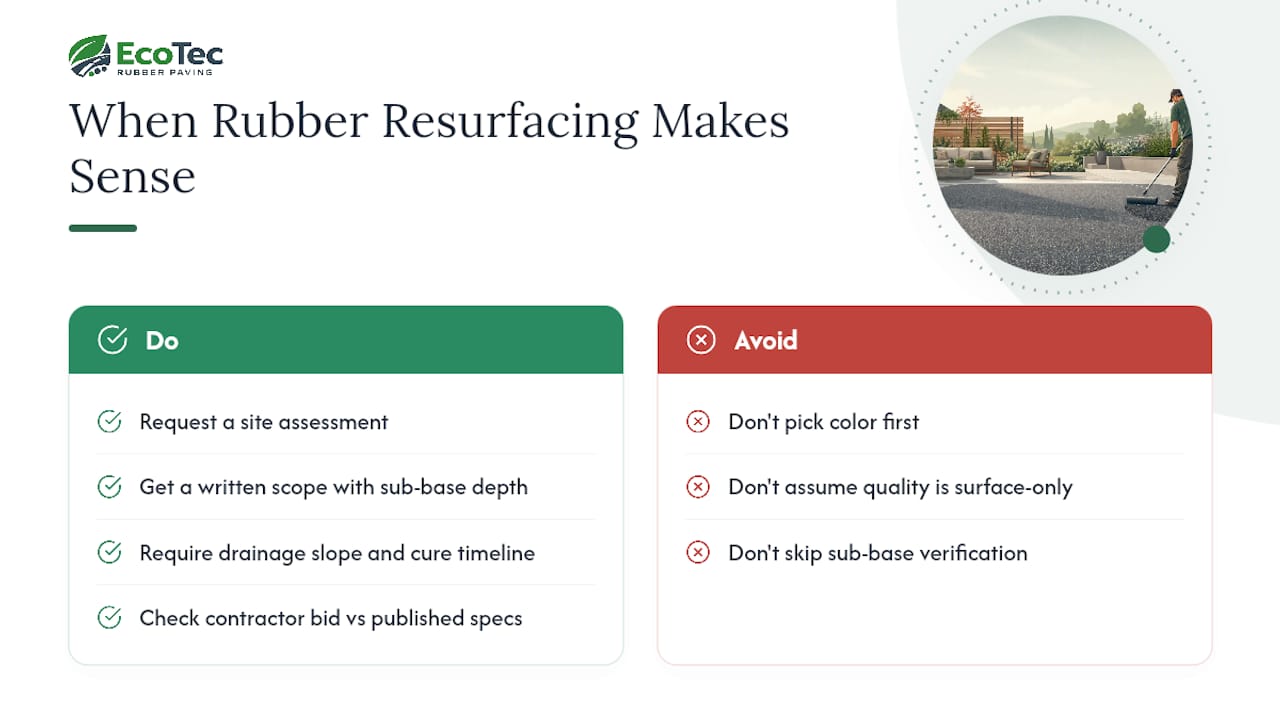
Where this gets interesting is the sub-base. Most homeowners assume the visible surface is where quality lives, but the four inches of stone underneath decide whether the patio still looks good in year ten or needs a rebuild in year three. EcoTec Rubber Paving builds every Rubberway® installation around that principle first, with published specs and homeowner guides available for anyone who wants to check a contractor's bid against the real standard before signing off.
If you're weighing a patio resurfacing project right now, the most useful next step isn't picking a color. It's requesting a site assessment and a written scope that spells out sub-base depth, drainage slope, and cure timeline before a single truck shows up.
— Roger
Ready to Resurface Your Patio the Right Way?
Rubberway® systems installation offers an advantage over patching or repouring plain concrete by providing surfaces engineered for drainage and slip resistance from the sub-base up, installed by teams specializing exclusively in rubber paving.
Whether you're resurfacing a backyard patio, a pool deck, or an HOA courtyard, the process starts the same way: a site visit to check drainage, traffic patterns, and existing surface condition. You can review Rubberway® product options to get a feel for wear-layer colors and finishes, or head straight to EcoTec Rubber Paving to request a quote and schedule that assessment.
Sources
- Rubberway pervious pavement specification (PP3000 CSI)
- Sustainability journal article on playground surfacing and safety
- Access Board guidance on floor and ground surfaces (ADA guidance)
FAQ
Is rubber patio resurfacing more expensive than concrete?
Upfront cost typically runs higher than a basic concrete patch, but with a service life of 12 years or longer and minimal maintenance, the cost per year of use often comes out lower than repeated concrete resealing and crack repair.
Does rubber resurfacing meet ADA slip-resistance requirements?
Yes. Wet DCOF testing on rubber porous systems commonly falls between 0.76 and 0.99, well above the 0.42 ADA-referenced minimum.
Can rubber overlays go directly over existing concrete?
In many cases yes, provided the existing slab is structurally sound and properly graded; otherwise removal and a fresh permeable sub-base deliver better long-term drainage performance.
How long does a rubber patio resurfacing project take?
Timelines vary with project size, but installation generally requires a base cure period before traffic returns, with larger commercial or municipal jobs staged over several days.
What's the biggest mistake homeowners make with DIY rubber resurfacing?
Under-preparing the sub-base is the most common failure point. Skipping proper compaction or drainage slope, which is why most projects benefit from a specialist installer like EcoTec Rubber Paving rather than a DIY attempt.