

Yes, when your concrete slab is structurally sound, resurfacing it with a Rubberway® recycled-rubber overlay is an effective, eco-friendly alternative to full replacement. You get better drainage, real crack resistance, and an ADA-compliant surface without the demolition bill. The catch: it only works if the slab underneath is solid, so start with a site evaluation before you assume you're a candidate.
TL;DR:
- Rubberway® overlays require a structurally sound, stable concrete slab free from active settlement or deep cracks for proper installation.
- The system is typically installed at 1.5 to 2 inches thick, with a porosity that handles up to 2,000 gallons per square foot for stormwater drainage.
- Cost varies primarily based on surface area, prep needs, thickness, and finish, with long-term savings over full removal and replacement.
- Routine maintenance includes rinsing, stain removal, and avoiding heavy stationary loads, especially in fixed parking spots.
- Proper site evaluation and preparation, including slope and drainage checks, are crucial to ensure longevity and performance of the overlay.
Table of Contents
- How Rubberway® Recycled-Rubber Overlays Work
- Is Your Existing Concrete a Good Candidate?
- What Happens During Installation and How Long It Takes
- What Does It Cost, and What's the Long-Term Payoff?
- Keeping the Surface Durable for the Long Haul
- Roger's Take: When an Overlay Makes Sense and When It Doesn't
- Ready to Get a Quote? Here's What to Prepare
- Sources
How Rubberway® Recycled-Rubber Overlays Work
A Rubberway® overlay is not paint or a thin patch coat. It's a bonded layer of recycled crumb rubber, sourced from post-consumer tires, held together with a non-toxic polyurethane binder that cures into a flexible, porous mat over your existing concrete. The polyurethane binder does the heavy lifting here. It's what determines how well the rubber grains lock together, how the surface handles Florida heat swings, and what kind of warranty an installer can honestly offer.
Thickness matters more than most homeowners expect. Rubberway® systems are typically installed at 1.5 to 2 inches, which is enough to absorb minor surface flexing and resist cracking, while staying thin enough to avoid raising your driveway grade against garage doors or drainage lines.
The porosity is the real story. Rubberway® pavement is rated to handle drainage rates up to 2,000 gallons per square foot, which is why the system qualifies as a low-impact development (LID) technology and can contribute toward LEED credits on commercial and municipal projects.
Pro Tip: If you're an HOA board or property manager chasing stormwater compliance, ask your installer for the drainage rate and LID documentation in writing before you sign. It's the paperwork that gets projects approved by municipal reviewers.
Beyond drainage, the surface delivers:
- Slip resistance well above bare concrete, wet or dry
- ADA-compliant, seamless surfacing with no expansion-joint trip hazards
- A wide range of color and finish options for HOA aesthetic standards
- Real limits: sustained extreme heat exposure and concentrated point loads are the two things that stress the material most
Is Your Existing Concrete a Good Candidate?
Not every driveway qualifies for an overlay, and that's worth knowing before you spend time collecting quotes. The slab underneath has to do its job structurally. Rubber paving can be installed directly over existing concrete when that concrete is clean, stable, and structurally sound — the overlay is a resurfacing system, not a replacement for a failing foundation.
Here's how to run a quick self-assessment before calling anyone:
- Check for structural failure signs. Deep, widening cracks, visible heaving, or sections that rock underfoot when driven over usually mean the slab has settled or lost load-bearing capacity.
- Confirm there's no active settlement. If a crack has grown noticeably in the last year, the ground beneath is still moving, and an overlay will crack right along with it.
- Evaluate slope and drainage. Water should already be shedding away from your garage or foundation. An overlay improves surface permeability, but it can't fix a slab that's pitched the wrong way.
- Assess surface condition. Oil stains, loose aggregate, and shallow surface cracks are all fixable during prep. Deep structural cracks are a different conversation.
If your slab passes those checks, prep work typically includes pressure cleaning, degreasing, patching cracks and potholes, and in some cases adding a thin aggregate leveling layer for a flatter substrate. If it fails, particularly on active settlement, full replacement is the honest recommendation.
Pro Tip: Before requesting quotes, take wide-angle photos of the whole driveway, close-ups of any cracking, and rough measurements of length and width. A trained installer or engineer should confirm structural soundness, but arriving with this information speeds up your first site visit dramatically.
What Happens During Installation and How Long It Takes
An overlay project moves through a predictable sequence, and knowing it helps you compare contractor quotes apples to apples instead of guessing at what's included.
- Site prep and repairs. Cleaning, degreasing, crack filling, and pothole patching happen first. This is also when slope and drainage patterns get verified, since installers need to confirm the porous overlay will improve on-site stormwater management rather than trap water between the rubber and the slab.
- Priming or bonding prep, if the concrete surface needs it for adhesion.
- Mixing and spreading the crumb rubber and polyurethane binder across the prepped surface.
- Troweling and compacting to the specified 1.5 to 2 inch thickness and target finish.
- Edge finishing and quality checks, including drainage verification and slope confirmation at the perimeter.
Duration depends on a few practical factors:
- Total square footage and how much repair the existing slab needs
- Crew size and equipment on site
- Weather, since binder curing is temperature and humidity sensitive
- Access constraints, like narrow driveways or limited staging space
For timing your own schedule, most installers report the surface can handle light foot traffic within about one to two days, with full vehicle-ready cure following the binder manufacturer's specific timeline. Ask your installer to spell out both numbers, since light use and full cure are not the same milestone, and treating them as interchangeable is how new driveways get damaged in week one. For a deeper breakdown of what drives cure speed, see this guide on cure time in rubber paving.
What Does It Cost, and What's the Long-Term Payoff?
Quotes for rubber overlays are built around a handful of variables, and understanding them helps you read a bid instead of just comparing bottom-line numbers.
- Surface area is the baseline driver, since materials and labor scale with square footage.
- Prep extent matters a lot. A slab that needs extensive crack repair or an aggregate leveling layer costs more to prep than one that's already flat and sound.
- Thickness choice within the 1.5 to 2 inch range affects material volume and durability.
- Finish and color selections can shift price, especially for custom HOA palettes.
- Access and removal needs, like tight staging areas or old material that needs hauling out, add labor time.
When you're comparing bids, ask specifically about binder spec and warranty terms. Two quotes that look similar on price can carry very different long-term performance if one installer is using a lower-grade polyurethane mix.
The financial case for overlays gets stronger the longer you own the property. Because the system installs over existing concrete instead of requiring demolition, rubber paving is often positioned as often less expensive than full removal and replacement, depending on the project, though actual savings vary by project and are worth confirming with local quotes rather than a national average. Beyond the dollar figures, there's real non-financial ROI: better on-site stormwater handling, potential LEED or LID credit eligibility for commercial and municipal projects, reduced surface heat compared to dark asphalt, and a slip-resistant surface that lowers liability risk for HOAs and property managers alike.
Keeping the Surface Durable for the Long Haul
Routine care is simple. Rinse the surface periodically, treat oil or fuel stains promptly so they don't work into the porous structure, and use plastic shovels rather than metal blades when clearing snow or ice, since metal edges can nick the rubber over time.
Localized damage, like a small area of compression or surface wear, is usually repairable in place rather than requiring a full re-do. Installers can typically cut out and patch a damaged section without touching the rest of the driveway.
The one real limitation worth knowing upfront: sustained, concentrated point loads, like an RV parked in the exact same spot for months, can compress crumb-rubber mixes over time. Passenger vehicles and typical SUV traffic pose no issue. If you regularly park something heavy in one fixed spot, mention it during your site evaluation so the installer can plan reinforced edges or advise on rotating parking position.
- Rinse and spot-clean stains as they happen
- Use plastic tools for snow and ice removal
- Watch fixed heavy-vehicle parking spots for early compression signs
- Schedule a quick visual check each season for edge lifting or surface wear
Pro Tip: Walk your driveway edges once a season and press down gently near seams. Catching early edge lifting before it spreads saves you a full-section repair later.
Roger's Take: When an Overlay Makes Sense and When It Doesn't
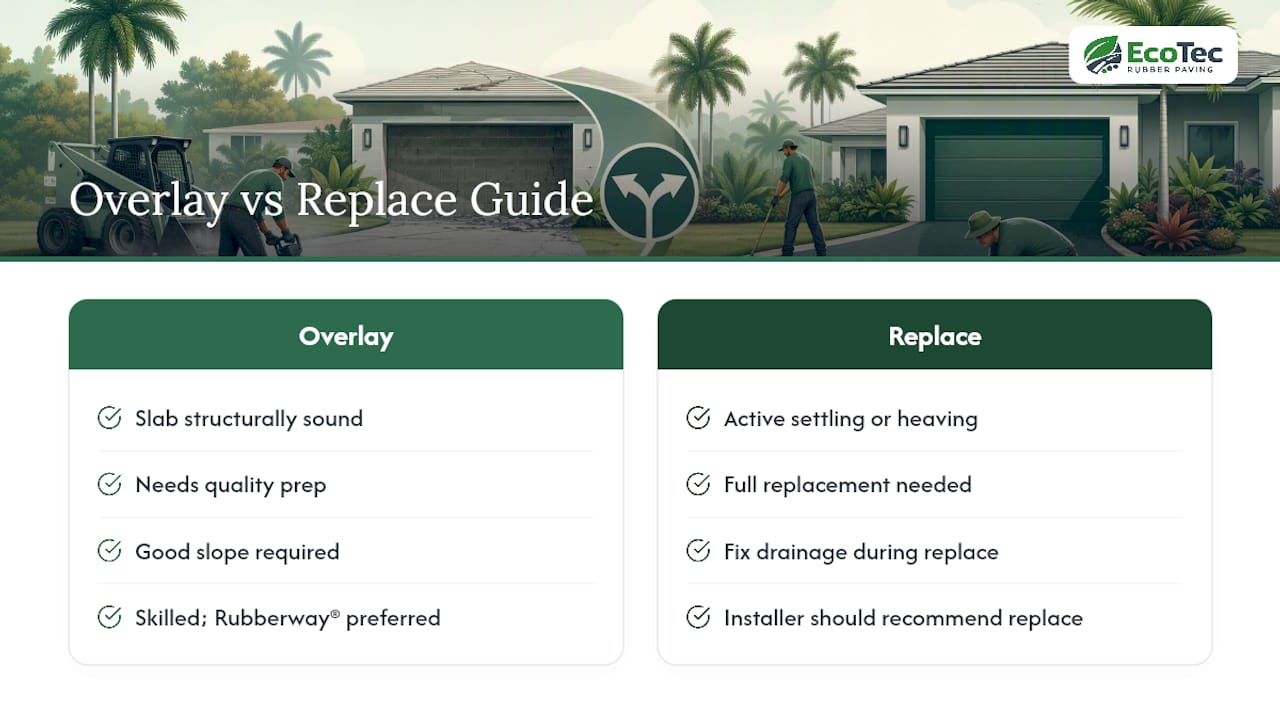
My rule is simple: if the slab is structurally sound, overlay it; if it's actively settling or heaving, replace it. Everything else is detail work. What gets overlooked is how much of the outcome depends on prep quality and drainage design, not the rubber itself. A rushed installer who skips the slope check is setting you up for trapped water and a shortened lifespan, regardless of how good the binder is.
EcoTec's focus on Rubberway® systems, combined with being licensed and insured and built specifically around Florida's heat and rain patterns, is why I'd trust the process over a generalist paving crew. But I won't oversell it: if your inspection turns up real structural failure, no overlay fixes that. Replacement is the honest answer, and a good installer should tell you so.
— Roger
Ready to Get a Quote? Here's What to Prepare
EcoTec Rubber Paving installs Rubberway® systems for driveways, pool decks, walkways, and municipal surfaces across Florida, built around ADA compliance, drainage performance, and a licensed, insured installation process from start to finish.
Getting a fast, accurate quote comes down to arriving prepared. Have these ready before you reach out:
- Rough measurements of the driveway (length, width, square footage estimate)
- Photos of the current surface, including any cracking or drainage issues
- Notes on vehicle types that regularly use the driveway, especially heavier vehicles or RVs
- Any known drainage complaints, like standing water after rain
With that information in hand, EcoTec can scope your project accurately on the first visit instead of needing a second trip. Browse the Rubberway® product and finish options to see color and specification choices, then reach out through the EcoTec Rubber Paving site to schedule your site evaluation and get a project quote started.
Sources
For technical specs on thickness, drainage rate, and material composition, the Rubberway® pervious pavement page is the primary reference. For installation workflow and prep standards, see surface prep best practices. Homeowners weighing timelines and durability may find the rubber paving FAQ the most approachable starting point.
- Pervious Rubber Pavement | Rubberway
- Rubber Driveway Pros and Cons: Is a Rubber Driveway Worth It?
- Pervious pavement technical guidance