
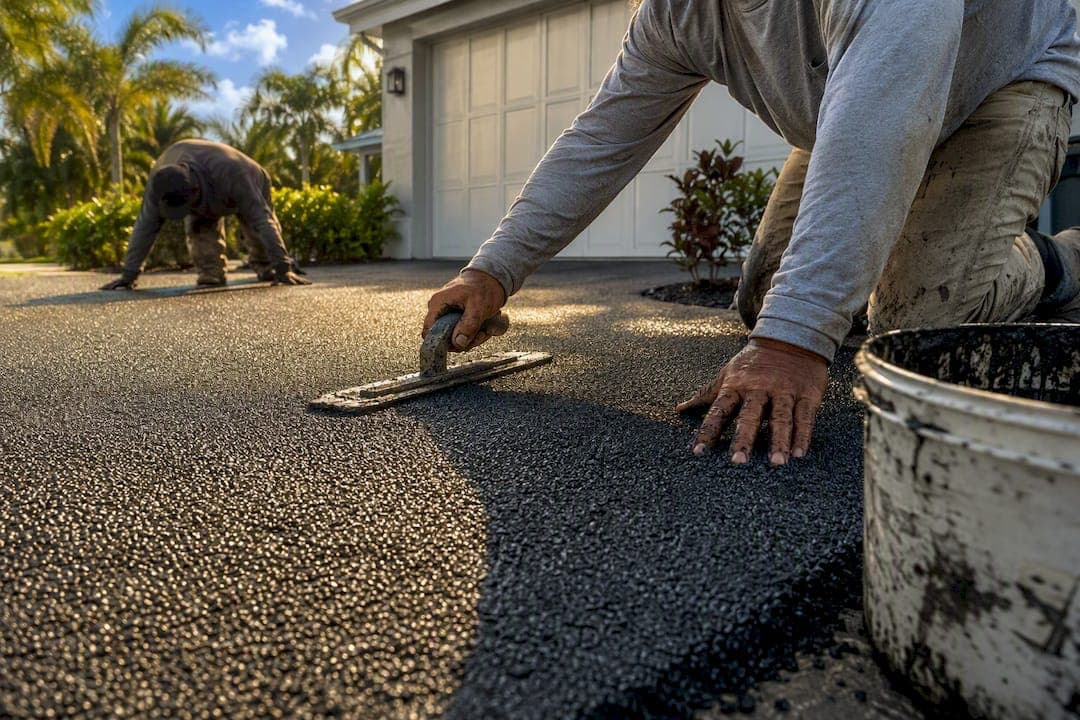
Rubberised paving is a surface material made largely from recycled tire rubber, installed as poured-in-place systems, rubberized asphalt, bonded rubber, or interlocking tiles. The right choice comes down to two questions: what will use the surface, and does the site need better drainage? A cold, highly rubberised mix tested in the field showed impact-attenuation up to six times higher than conventional asphalt, which is why it dominates playgrounds and pool decks.
- Homeowners: best for driveways, patios, and pool decks that need slip resistance and heat comfort underfoot.
- Contractors: best bid category when a client wants crack resistance and faster patch repairs over the surface's life.
- Property managers: best fit for HOA walkways and municipal trails where stormwater permeability and ADA compliance both matter.
Key Takeaways
Rubberised paving works best when project use, drainage needs, and installer expertise are matched to the right product type from the start.
| Point | Details |
|---|---|
| Match type to use | Porous poured systems suit playgrounds and ADA paths; RAC and bonded rubber suit driveways and cart paths. |
| Impact absorption is measurable | Field-tested rubberised mixes showed critical fall height up to six times higher than standard asphalt. |
| Budget for upfront cost | Rubberized surfacing can run up to $12 to $13 per square foot, offset by lower long-term maintenance. |
| Base prep decides longevity | Poor compaction and drainage design are the top causes of early failure, not the rubber material itself. |
| Choose a certified installer | Ecotecrubber installs licensed, insured Rubberway® porous systems with ADA-compliant results across Florida projects. |
Table of Contents
- What Are the Main Types of Rubberised Paving?
- Where Does Rubberised Paving Work Best?
- What Makes Rubberised Paving a Strong Choice?
- How Does Installation Actually Work?
- What Does Rubberised Paving Cost Over Its Lifespan?
- When Should You Avoid Rubberised Paving?
- What Standards and Permits Apply?
- How Do You Choose the Right Type and Installer?
- Why Certified Installation Matters
- What Are the Warning Signs a Surface Needs Repair?
- What Happens to the Rubber After Installation?
- Get a Quote for Rubberway® Installation in Florida
- Frequently Asked Questions
- Sources
What Are the Main Types of Rubberised Paving?
Four product categories cover most projects. Poured-in-place (wet-pour) systems use a two-layer build, a shock-absorbing recycled SBR rubber base topped with a colored EPDM wear layer, and can be engineered to meet ASTM F1292 impact standards. Porous Rubberway-style systems bind rubber granules into a permeable mat that lets water pass straight through instead of pooling on the surface. Rubberized asphalt (RAC) blends crumb rubber into hot-mix asphalt binder, mainly for roads and cart paths that need to carry vehicle weight. Bonded rubber or rubber stone mixes rubber aggregate with a polyurethane binder for a stone-like look, while rubber pavers and tiles are modular units you can install over existing concrete without demolition.
The single biggest technical fork in the road is permeability versus load capacity. Porous poured systems drain beautifully but aren't rated for daily truck traffic; RAC handles vehicles but doesn't drain the way a porous mat does.
A play area wants poured or tile systems for cushioning. A driveway or golf cart path usually calls for RAC or a bonded system. A trail splits the difference, favoring porous poured rubber for both cushioning and runoff control.
Where Does Rubberised Paving Work Best?
- Driveways and golf cart paths: RAC or bonded rubber stone handles daily vehicle weight without cracking under Florida heat.
- Pool decks and patios: poured-in-place rubber stays cool underfoot and resists slipping when wet.
- Playgrounds: poured rubber or interlocking tiles meet fall-height safety requirements.
- Sidewalks and ADA paths: porous poured systems provide a firm, stable, slip-resistant surface for wheelchairs and walkers.
- Trails and running tracks: porous rubber balances cushioning with drainage on unpaved or semi-paved routes.
Heavy freight loading is the one place these materials still lag behind full-depth concrete or asphalt.
What Makes Rubberised Paving a Strong Choice?
Recycled rubber doesn't crack the way asphalt does when Florida's heat cycles between scorching afternoons and sudden downpours. It flexes instead of splitting, which means fewer emergency patch jobs over a decade of ownership. The impact-attenuation data matters here too: that same field trial recorded critical fall height results up to six times greater than standard asphalt, and the mixture still performed well after 6 to 20 months of real-world use.
- Durability: flexible rubber resists the freeze-thaw and heat-cycle cracking that plagues rigid pavements.
- Safety: impact-absorbing surfaces reduce fall-related injury risk on playgrounds and bike paths.
- Drainage: porous systems let stormwater pass through instead of sheeting across a parking lot.
- Sustainability: EPA guidance confirms ground tire rubber is a common, established feedstock for construction materials, diverting old tires from landfills.
- Comfort: rubber surfaces run cooler than dark asphalt and come in a range of colors beyond basic gray or black.
How Does Installation Actually Work?
Site prep starts the same way it does for any paved surface: grading for proper slope, compacting the subbase, and confirming the soil drains the way the design assumes it will. From there, the method depends on the product.
- Grade and compact the base to the required density before any rubber goes down.
- Choose the build method: poured-in-place layers cure on site, cold rubberized mixes get applied like a modified asphalt overlay, and modular tiles snap or glue into place over an existing hard surface.
- Integrate drainage, tying porous sections into existing stormwater paths or a new gravel bed.
- Cure and cap, letting binders set (often 24 to 72 hours depending on temperature and humidity) before opening the surface to traffic.
Pro Tip: Confirm the subbase compaction and drainage slope before you bid the job, not after. A soft or poorly graded base is the single most common reason a rubberised surface fails early, and it's far cheaper to catch on a test dig than to fix after the pour.
Florida installs often need to work around summer rain windows, since some poured mixtures need dry curing time.
What Does Rubberised Paving Cost Over Its Lifespan?
Rubberised surfacing generally costs more upfront than gravel or basic asphalt, but it usually pays that back in reduced patching and longer service life. Trail-surfacing guidance puts rubberized surfaces at up to $12 to $13 per square foot, well above bark mulch's roughly $2 per square foot, though the guidance also notes rubberized options carry lower long-term maintenance demands.
- Poured-in-place: highest upfront cost, longest expected life, often 10 to 15 years or more with routine sweeping and occasional pressure washing.
- Rubberized asphalt (RAC): mid-range cost, similar lifespan to conventional asphalt but with better crack resistance.
- Bonded rubber/rubber stone: moderate cost, most vulnerable to UV fading in full-sun applications without a protective topcoat.
- Rubber tiles: fastest install, easiest single-unit replacement when a section wears out.
A cold, highly rubberised mix can also be reworked and patched using the same material, simplifying repairs compared to rigid pavement. Poor base prep, heavy vehicle loads, and constant UV exposure are what shorten any of these lifespans early.
When Should You Avoid Rubberised Paving?
No surface fits every job, and rubberised paving has real limits worth knowing before you sign a contract. Poured systems carry a higher upfront cost than plain asphalt, and installation can produce a noticeable rubber odor for a day or two as binders cure. Bright colors can fade under years of direct Florida sun. Most rubberised products also aren't rated for heavy industrial truck loading, so distribution centers and loading docks still belong to conventional concrete.
- Heavy freight and industrial vehicle traffic exceed most rubberised systems' load ratings.
- Some historic districts and municipal specs require traditional asphalt or concrete finishes.
- Poured systems need a properly cured, well-drained base or they'll delaminate early.
- Warranty terms vary widely between installers, so confirm what's actually covered before work starts.
Check local permit and load-rating requirements before committing to a rubberised surface for anything that will see delivery trucks or heavy equipment. What passes for a sidewalk won't pass for a loading zone.
What Standards and Permits Apply?
Public and funded projects typically require documentation, not just a good-looking install. ASTM F1292 governs impact attenuation for play surfaces, while ASTM F1951 covers wheelchair accessibility. Porous systems can sometimes qualify for stormwater management credit where local codes reward permeable surfacing. DOT acceptance of rubberized asphalt varies by agency and funding source, and public agencies often reference specification resources like GreenBookSpecs when writing acceptable-materials language into a bid package.
Don't assume a material approved in one county is automatically approved in the next. Always confirm current specs with the agency issuing the permit.
State resources like CalOSBA also track reuse markets for tire-derived products, reinforcing that rubberized asphalt is an established, not experimental, paving category.
How Do You Choose the Right Type and Installer?
- Define who will use the surface and whether vehicles need to cross it.
- Decide how much stormwater control the site actually needs.
- Set a color and design goal, since options span far beyond basic black.
- Confirm ADA requirements apply to the project.
- Check which materials your local permitting authority allows.
- Ask installers for warranty terms in writing, not verbally.
- Request a sample panel before committing to a full job.
- Confirm base-prep standards and binder specifications match manufacturer guidance.
- Property managers should ask about ongoing maintenance contracts and patch-repair response time.
- Contractors should verify supplier lead times before locking in a bid timeline.
Why Certified Installation Matters
A poorly compacted base or mismatched binder ratio can undercut even the best rubber product. Ecotecrubber installs Rubberway® porous systems with licensed, insured teams experienced in ADA-compliant work across Florida projects.
- Site assessment and fixed-scope proposal before work begins.
- Rubberway® porous installation for drainage-sensitive sites.
- Maintenance guidance included with every completed project.
A properly installed base is worth more than a premium topcoat on a bad foundation. Get the prep work right first.
What Are the Warning Signs a Surface Needs Repair?
Rubberised paving doesn't fail the way asphalt does, with sudden potholes. It degrades gradually, and catching the early signs saves real money. Watch for surface fading that goes beyond cosmetic color loss into a chalky, brittle texture, which usually means the UV-resistant topcoat has worn through and the rubber underneath is starting to harden.

Edge lifting or curling at seams and borders often points to a base that wasn't compacted well enough at install, or water working its way underneath through a gap in the perimeter. Left alone, lifted edges become tripping hazards and let more water intrude, accelerating the damage.
Soft spots or visible depressions signal the base has settled or eroded underneath the wear layer. This is common near downspouts or drainage outlets where water concentrates. A soft spot on a playground surface is a safety issue, not just cosmetic, since it changes the fall-height performance the surface was designed to deliver.
Cracking at seams, as opposed to the sheet-wide cracking you'd see in asphalt, usually means a specific joint failed rather than the whole surface. This is one of rubberised paving's real advantages: a cold rubberised mix can be reworked and patched with the same material rather than requiring a full-section tear-out, based on findings from the field trial on impact-absorbing rubber mixtures.

Standing water on a porous surface after rain is the clearest sign the permeable layer has clogged with debris or fine sediment. A routine rinse or vacuum sweep usually restores drainage before it becomes a structural problem. Any of these signs justify a professional inspection rather than a DIY patch, especially on ADA paths or playground surfaces where performance specs are load-bearing, not decorative.
What Happens to the Rubber After Installation?
The sustainability story behind rubberised paving starts long before installation, with the estimated hundreds of millions of scrap tires generated in the US each year that need somewhere to go besides a landfill or a stockpile fire risk. EPA guidance identifies ground tire rubber as a standard feedstock for construction products, including asphalt modifiers, playground surfacing, and other paving materials, which gives old tires a genuinely productive second life instead of an incineration pathway.
The environmental case doesn't stop at diversion, though. Porous rubberised systems reduce runoff by letting stormwater filter through the surface rather than sheeting into storm drains carrying oil, sediment, and debris from the pavement itself. That matters more in Florida than in drier climates, where heavy seasonal rain regularly overwhelms conventional storm systems.
Recyclability at end of life is more nuanced than the "made from recycled tires" pitch suggests. Poured-in-place systems bond rubber particles with a polyurethane binder, which makes the finished product durable but harder to fully separate back into raw rubber crumb for a second recycling cycle. Rubberized asphalt behaves more like conventional asphalt at end of life, meaning it can often be milled and reprocessed using standard road reclamation equipment. Buyers who care about full lifecycle impact, not just the recycled-content headline, should ask installers directly how end-of-life removal and disposal will work for the specific product going down.
None of this makes rubberised paving a perfect environmental solution. It reduces one waste stream while introducing a product that itself will eventually need disposal or reprocessing. The honest comparison is against the alternative: virgin asphalt production, which carries its own petroleum and emissions footprint with no recycled-content offset at all.
A Practical Recommendation on Balancing Cost and Sustainability
For load-bearing or public projects, hire a certified installer. For a home driveway or patio, start with an onsite estimate before comparing types. Sustainability pays off over the surface's lifespan, not on day one. See Rubberway® product options for real project examples.
Get a Quote for Rubberway® Installation in Florida
Ecotecrubber gives Florida property owners a real alternative to guessing which paving contractor understands recycled rubber systems, because it's the only thing the company installs. That focus means no juggling rubber paving as a side offering alongside conventional asphalt crews, just dedicated Rubberway® expertise from the first site visit to the final walkthrough.
A typical project starts with a site assessment covering drainage patterns, expected use, and load requirements, followed by a fixed-scope proposal so there are no surprise change orders once work begins. Every install comes from a licensed, insured team experienced in ADA-compliant surfacing, and maintenance guidance is included so property managers and homeowners know what to expect years down the road, not just on installation day. Whether the project is a residential pool deck, an HOA walkway, or a municipal trail, the same Rubberway® porous system scales to fit.
Ready to see what it costs for your property? Ecotecrubber and get a real, project-specific estimate instead of a generic per-square-foot guess.
Frequently Asked Questions
Is rubberised paving the same as rubberized asphalt? No. Rubberized asphalt (RAC) is one specific type, a hot-mix asphalt blended with crumb rubber for roads and cart paths. Rubberised paving is the broader category that also includes poured-in-place systems, porous mats, and modular tiles.
Can rubberised paving handle heavy vehicle traffic? Rubberized asphalt can carry regular vehicle loads similar to standard asphalt. Poured-in-place and porous systems are generally built for pedestrian and light-cart traffic, not heavy trucks or industrial loading.
How long does rubberised paving last? Poured-in-place systems often last 10 to 15 years or more with routine cleaning. Lifespan drops with poor base prep, constant heavy loading, or extended UV exposure without a protective topcoat.
Does rubberised paving actually help with drainage? Porous poured systems let water pass through the surface itself, reducing runoff and pooling compared to solid asphalt or concrete. Solid rubberized asphalt and bonded rubber stone don't offer the same permeability.
Is rubberised paving worth the higher upfront cost? For playgrounds, ADA paths, and high-traffic pedestrian areas, the impact-absorption and reduced patching costs generally justify the price. For simple low-traffic driveways with no drainage concerns, conventional paving may cost less overall.
Sources
- Rubber- and emulsion-based impact-absorbing paving material produced with cold and dry processes: Laboratory and in-situ study
- What's Under Foot? — trail surfacing guidance
- CalOSBA (California Office of the Small Business Advocate)
- GreenBookSpecs — order GreenBook