

A paving mix ratio is the specified proportion of each constituent material in a pavement system, and for Rubberway® recycled-rubber installations in Florida, getting those proportions right is the difference between a surface that holds up for decades and one that delaminates after two rainy seasons. The FHWA three-phase process of specifying, designing, and proportioning produces a job mix formula (JMF) that locks in those ratios before a single shovel hits the ground.
The three things to check on any Rubberway® JMF:
- Binder-to-rubber ratio: The polyurethane binder percentage controls bond strength and porosity. Demand the exact ratio, not a range.
- Recycled rubber content percentage: Verify the documented percentage of recycled crumb rubber, not just a marketing claim.
- Lab trial batch results: A signed lab report confirming the mix performed to spec under conditions similar to your site.
Table of Contents
- What does a paving mix ratio actually mean?
- Why mix proportions directly affect how your pavement performs
- How mix ratios work specifically for Rubberway® rubber paving
- Common misconceptions that lead to failed installations
- What to require from your contractor before work begins
- How the JMF gets validated before full installation
- When DIY is the wrong call for rubber paving
- Key Takeaways
- Why mix-ratio discipline matters more than most contractors admit
- Ecotecrubber installs Rubberway® with full JMF documentation in Florida
- Useful sources and further reading
What does a paving mix ratio actually mean?
A mix ratio is not a recipe card. It is a set of engineered proportions, expressed by weight or volume, that defines how much of each material goes into a pavement system. For conventional concrete, that means cement, aggregates, fines, and water. For Rubberway® rubber paving, it means recycled crumb rubber, polyurethane binder, and graded fines, each in a proportion that determines how the finished surface performs under load, weather, and time.
The FHWA three-phase framework structures this process clearly:
- Specify: Define the performance requirements, exposure class, strength targets, and durability criteria for the project.
- Design: Select materials and run laboratory trials to find proportions that meet those requirements.
- Proportion: Produce the approved JMF, the document that governs every batch poured on your project.
The water-to-cementitious materials ratio (w/cm) is the most critical single parameter in Portland cement systems. FHWA guidance sets exposure-dependent maximums, with values set based on exposure severity. For rubber paving, the equivalent is the binder-to-rubber ratio, which governs bond strength and void structure in the same way w/cm governs concrete durability.
The job mix formula is not a suggestion. It is the approved document that defines what gets poured. Any deviation, whether a material swap or a proportion change, requires documented review and re-approval before work continues.
Engineers also distinguish between nominal mixes and design mixes. A nominal mix uses fixed volume ratios as a basic starting point. A design mix is lab-tested to the specific materials available at your site. For any performance-sensitive installation, especially one with ADA requirements or municipal oversight, only a design mix qualifies.
Why mix proportions directly affect how your pavement performs
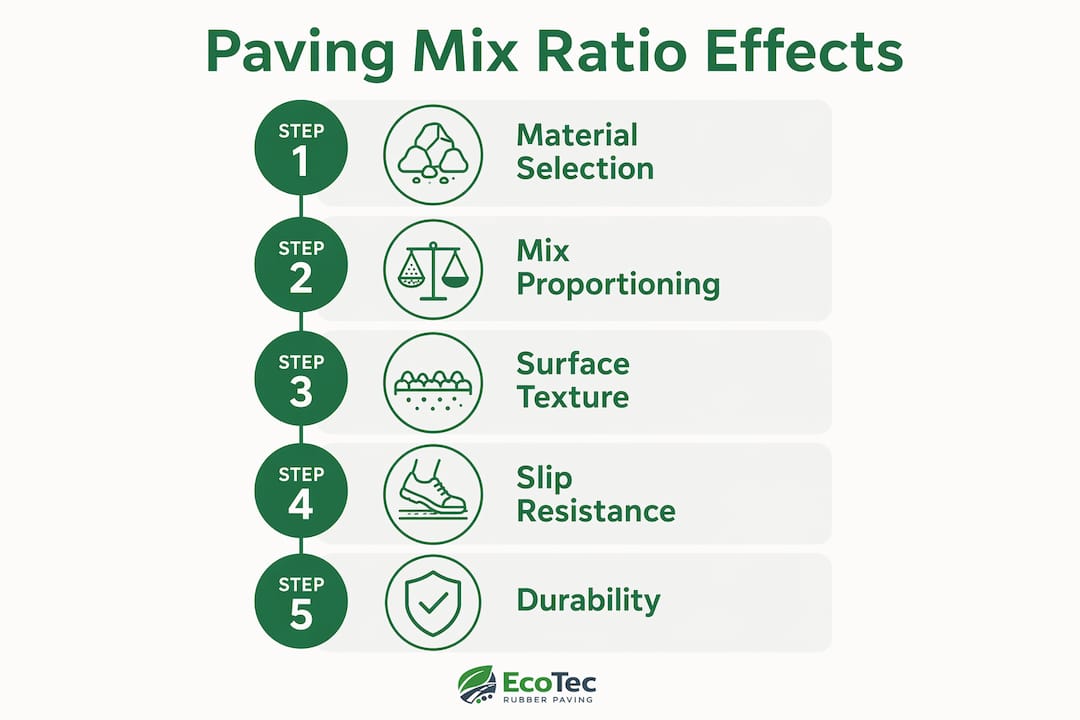
Every performance characteristic you care about, strength, drainage, crack resistance, surface texture, traces back to proportioning decisions made before installation begins.
Too much binder in a rubber paving system reduces porosity, which is the opposite of what you want in Florida where stormwater runoff is a real concern. Too little binder and the crumb rubber particles don't bond adequately, leading to surface raveling under foot traffic. The FHWA guidance on paste volume limits (targeting no more than 25% paste volume in concrete systems) reflects the same principle: excess binding material increases shrinkage and cracking risk.
Florida's climate punishes poorly proportioned pavements faster than almost any other environment in the continental U.S. Heat accelerates binder cure, UV degrades exposed surfaces, and the combination of heavy rainfall and high humidity creates conditions where a marginally adequate mix fails visibly within one to two seasons.
Florida-specific factors that influence proportioning priorities:
- Heat and UV: Accelerated curing in summer heat can cause surface checking if the binder-to-rubber ratio isn't calibrated for ambient temperature at pour time. Ecotecrubber's heat-resistant paving guidance addresses this directly for Florida installations.
- Heavy rain and drainage: Porosity targets in the JMF must account for Florida's rainfall intensity. A mix that drains adequately in a dry climate may still pond water in a South Florida downpour.
- Coastal salt exposure: Salt accelerates degradation of binder systems not formulated for marine environments. The JMF should specify a binder grade rated for coastal exposure.
- Humidity: High ambient humidity affects open time and adhesion during installation, which is why weather conditions at pour time must be part of the installation protocol.
How mix ratios work specifically for Rubberway® rubber paving
Rubberway® is a porous, recycled-rubber paving system, and its mix proportions work differently from Portland cement concrete. The primary components are recycled crumb rubber (the aggregate), polyurethane binder (the cementitious equivalent), and in some formulations, graded mineral fines that adjust density and surface texture.
The binder-to-rubber ratio controls two things simultaneously: bond strength and void content. A higher binder percentage fills more voids, increasing surface stability but reducing permeability. A lower percentage preserves drainage but requires precise application to avoid under-bonded areas. This is why the polyurethane binder specification in the JMF is not interchangeable between product lines or suppliers.
Recycled content percentage matters beyond sustainability marketing. The particle size distribution of crumb rubber varies by source and processing method. A JMF developed with one rubber supplier's crumb may perform differently with another supplier's material, even at the same stated percentage.
For ADA compliance, surface texture and slip resistance are direct outputs of the mix proportion. Void content affects surface profile, and surface profile affects wet-traction ratings. Ecotecrubber's installations target porosity levels that satisfy both ADA surface requirements and Florida's stormwater management expectations simultaneously.
Common misconceptions that lead to failed installations
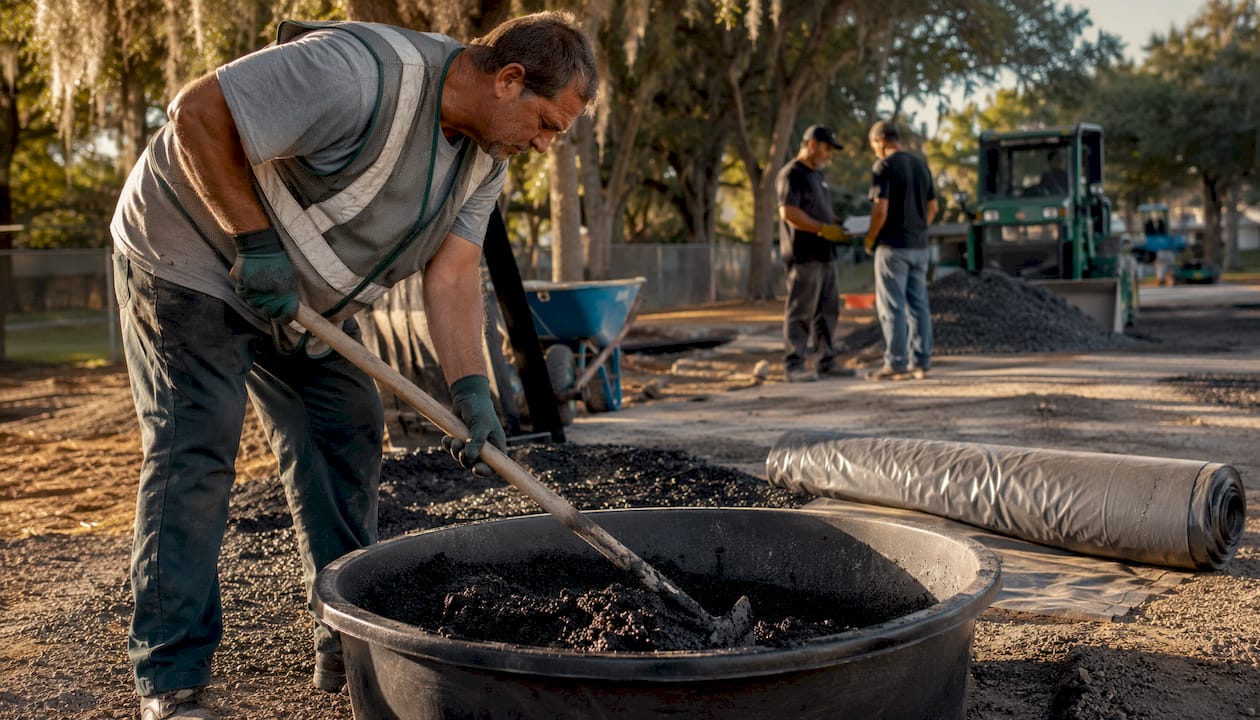
The most expensive mistake in rubber paving is treating the JMF as a starting point rather than a fixed specification. Pavement Interactive is direct on this: a mix ratio must be tailored to exposure conditions and material chemistry, not copied from a generic guide.
More binder does not mean better performance. Excess binder in a rubber paving system increases shrinkage stress at the interface between the rubber layer and the substrate, which is exactly where delamination starts. The same counterintuitive principle applies to over-specified cement content in concrete, where higher cementitious content increases drying shrinkage and cracking risk.
Three field mistakes that show up repeatedly:
- Switching rubber suppliers mid-project without retesting the JMF. The new crumb rubber's particle size and surface chemistry may be different enough to change void content and binder demand.
- Adding extra binder for workability in hot weather. This is the rubber paving equivalent of adding water to concrete: it makes the mix easier to spread and compromises the final void structure.
- Unsanctioned on-site substitutions. SCDOT guidance%20-%20FHWA%20approval.pdf) is explicit: changing material sources or proportions without documented review invalidates the approved JMF and the performance expectations that go with it. Good jobsite communication protocols prevent these substitutions from happening silently.
What to require from your contractor before work begins
A licensed, insured contractor should provide these documents before any material touches your property:
- Laboratory trial batch report with a professional seal, confirming the mix met target porosity, bond strength, and surface texture under conditions representative of your site.
- Documented binder-to-rubber ratio stated by weight, not volume, with the specific binder product name and grade.
- Recycled content percentage with source documentation, not just a claim on a brochure. For LEED or municipal projects, this needs to be verifiable.
- Permitted field adjustment rules that specify exactly what changes are allowed without triggering a re-approval requirement.
- Material source locks in the contract, so the contractor cannot substitute a different rubber supplier or binder product without written notice and your approval.
- Warranty terms tied to JMF compliance, meaning the warranty is void if the installed mix deviates from the approved document.
Pro Tip: Ask for the lab report before signing the contract, not after. A contractor who cannot produce trial batch results before mobilization has not done the design work the project requires.
For municipal buyers, the public paving procurement checklist covers the specification language that enforces these requirements in a bid document.
How the JMF gets validated before full installation
| Test | What it measures | Acceptance benchmark |
|---|---|---|
| Trial batch permeability | Drainage rate through the cured rubber layer | Meets Florida stormwater design target for the site |
| Binder adhesion pull-off | Bond strength between rubber layer and substrate | No cohesive failure below specified load |
| Surface texture / slip resistance | Wet-traction profile for ADA and safety | Meets ADA surface requirements |
| Void content / air content | Porosity of the cured mix | Within the JMF target range |
The typical sequence runs: lab mix design (1–2 weeks) → trial batch and lab results (1 week) → small demonstration pour on-site → approval → full production. Budget for mix design and testing as a line item, not an afterthought.
Field verification is not optional in Florida's climate. Lab designs developed in controlled conditions must be confirmed with a site trial pour because heat and humidity at the time of installation affect open time and binder cure rate. Adjustments must be documented and re-tested if any material changes.
When DIY is the wrong call for rubber paving
Rubberway® and comparable binder-based rubber paving systems are not DIY-friendly. The binder chemistry requires precise mixing ratios, controlled application temperature, and surface preparation that directly affects adhesion. An off-ratio mix applied to an improperly prepared substrate will delaminate, and no amount of patching fixes a failed bond layer.
The threshold for requiring a licensed installer and a third-party lab is lower than most homeowners expect. Any project with ADA requirements, municipal oversight, coastal exposure, or a surface area large enough that a failure would require full removal and replacement qualifies.
Quick decision criteria:
- Coastal location or salt exposure: Require a binder spec rated for marine environments and independent lab verification.
- ADA-required surfaces (pool decks, municipal walkways, HOA common areas): Require documented slip-resistance testing from the trial batch.
- Heavy vehicle or equipment traffic: The JMF must include load-bearing criteria beyond pedestrian use.
- Any project where the warranty matters: Warranties are only enforceable when the installation is documented against an approved JMF by a licensed contractor.
Key Takeaways
A paving mix ratio is an engineered specification, not a recipe, and for Rubberway® installations in Florida, the binder-to-rubber ratio, recycled content percentage, and lab-verified trial batch results are the three documents that determine whether your surface performs or fails.
| Point | Details |
|---|---|
| Mix ratio is a specification | Proportions are set by lab design and locked in the JMF, not adjusted on-site without approval. |
| Binder-to-rubber ratio is critical | This single parameter controls both bond strength and drainage porosity in Rubberway® systems. |
| Material source changes invalidate the JMF | Switching rubber suppliers or binder products without retesting compromises the entire performance envelope. |
| Florida climate demands site verification | Trial pours in Florida heat and humidity confirm lab designs before full production begins. |
| Ecotecrubber provides lab-backed JMFs | Ecotecrubber delivers documented recycled-content percentages, binder specifications, and installation warranties tied to JMF compliance. |
Why mix-ratio discipline matters more than most contractors admit
The rubber paving industry has a documentation problem. Plenty of contractors will install a surface that looks good on day one and hand you a warranty that is essentially unenforceable because there is no approved JMF to measure compliance against. When the surface fails at month 18, there is nothing to point to.
What separates a durable Rubberway® installation from a cosmetic one is not the product itself. It is the discipline around proportioning, the trial batch, the lab report, the material source lock, and the field verification pour. These steps exist because Florida's climate is genuinely demanding. A binder system that performs well in a temperate climate can cure too fast in August in Sarasota, leaving a surface that looks fine but has inadequate bond depth.
The counterintuitive part: the contractors most likely to skip these steps are often the ones who have installed the most rubber paving. Experience breeds shortcuts, and shortcuts in mix-ratio discipline show up as warranty claims two years later. Require the documentation regardless of how confident the contractor sounds.
Ecotecrubber installs Rubberway® with full JMF documentation in Florida
Florida homeowners and municipal buyers who want a porous, ADA-compliant, recycled-rubber surface get something specific from Ecotecrubber that most installers don't offer: a fully documented job mix formula, lab trial batch results, and a warranty tied directly to JMF compliance. Every installation uses the Rubberway® system with verified recycled crumb rubber content and a polyurethane binder specification matched to Florida's coastal and high-heat exposure conditions.
The next step is straightforward. Contact Ecotecrubber to request your project's JMF documentation, lab results, and a small demonstration pour before any commitment to full installation. See the full range of Rubberway® products and recycled-content options, or go directly to ecotecrubber.com to request a quote and get the documentation your project requires.
Useful sources and further reading
- FHWA Tech Brief: Specifying, Designing, and Proportioning Paving Concrete — The primary federal reference for the three-phase mix development process, w/cm selection, and JMF requirements. The source for exposure-class w/cm limits (0.40–0.45) and paste volume guidance cited in this article.
- SCDOT SC-M-501: PCC Pavement Mix Proportioning and Strength%20-%20FHWA%20approval.pdf) — State-level specification with FHWA approval that governs material-source locks and JMF change-approval requirements.
- Pavement Interactive: PCC Mix Design Fundamentals — Accessible technical explanation of why design mixes outperform nominal mixes and how exposure conditions must guide proportioning.
- ACI 325.14R-17: Guide for Design and Proportioning of Concrete Mixtures for Pavements — The American Concrete Institute's pavement-specific mix design guide, covering strength, durability, skid resistance, and dimensional stability criteria.
- Ecotecrubber: Polyurethane Binder in Paving — Ecotecrubber's technical overview of binder behavior, recycled-content documentation, and Rubberway® system specifications.
- Ecotecrubber: Heat-Resistant Paving Materials — Florida-specific guidance on material selection and installation protocols for high-heat and UV-exposed environments.