
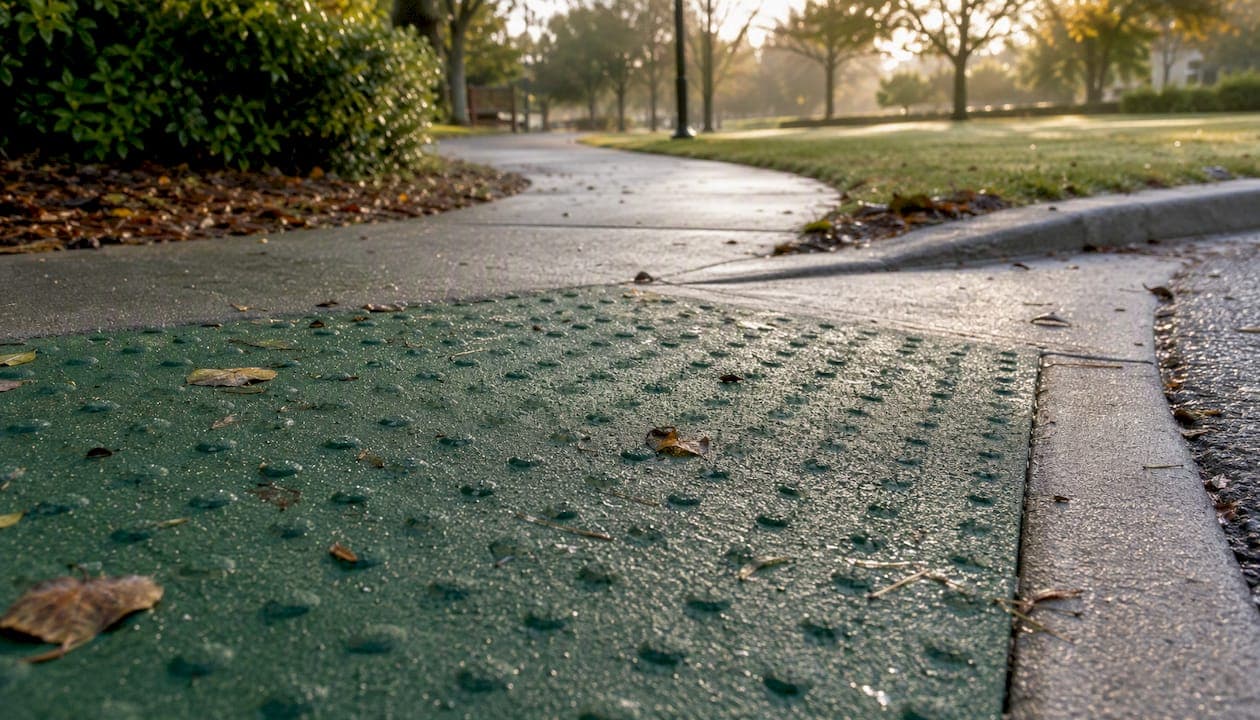
Public safety should be the primary filter for pedestrian surface selection, not an afterthought applied after aesthetics and budget are settled. The role of public safety in pedestrian surface choice comes down to a simple mechanical fact: surface condition and material performance drive most sidewalk-related falls, and those falls hit older adults and mobility-limited pedestrians hardest. The FHWA's sidewalk design guidance, the AASHTO Green Book, and ASTM slip-resistance test methods give planners a shared vocabulary for turning that principle into enforceable specs.
Those three references matter because they convert "safe surface" from a marketing phrase into something you can measure and reject a bid over. Once safety leads, procurement outcomes follow a predictable path.
- Require a documented slip-resistance threshold (wet and dry) tied to a named ASTM test method, not a vendor's word.
- Set numeric evenness tolerances for joints, settling, and cross-slope in the spec, not just "industry standard."
- Mandate drainage/porosity performance that prevents ponding at crossings and along accessible routes.
- Build ADA detectability and slope compliance into acceptance testing, not just design drawings.
Key Takeaways
Public safety determines pedestrian surface choice because slip resistance, evenness, and drainage performance directly control fall and injury rates, especially for older and mobility-limited pedestrians.
| Point | Details |
|---|---|
| Safety leads the spec | Slip resistance, evenness, drainage, and ADA detectability should be measured and required, not assumed. |
| Roughness has a ceiling | Past a certain point, added texture stops improving traction and starts creating trip hazards. |
| Concrete performs best on paper | Field data shows concrete and mortar lead on friction and smoothness but retain more heat than porous alternatives. |
| Maintenance is part of safety | Trip hazards and drainage failures develop over years, so inspection cadence and warranty triggers matter as much as initial material choice. |
| Equity should drive prioritization | Schools, transit stops, and senior facilities deserve first access to constrained repair budgets. |
| Rubber paving fits specific corridors | Ecotecrubber's Rubberway® system meets slip-resistance, drainage, and ADA criteria for park paths, pool decks, and community walkways, though rigid materials remain preferable for heavy vehicle-load corridors. |
Table of Contents
- The Role of Public Safety in Pedestrian Surface Selection
- How Common Pedestrian Surfaces Compare on Safety
- Designing Safe Pedestrian Areas Around the Surface
- Keeping Surfaces Safe After Installation
- Standards, Test Methods, and Metrics Worth Requiring
- Cost, Lifecycle Performance, and Equity in Surface Decisions
- What the Evidence Shows About Surface-Related Risk
- A Procurement Checklist for Safety-Driven Surface Selection
- Balancing Safety With Durability, Aesthetics, and Budget
- Where Rubber Paving Fits Into a Safety-First Spec
- Frequently Asked Questions
- Sources
The Role of Public Safety in Pedestrian Surface Selection
Every material decision on a sidewalk project answers a safety question first, even when nobody phrases it that way. Does this surface stay gripable when it rains? Will it stay flat after two freeze-thaw cycles? Can someone using a cane or a wheelchair detect where the sidewalk ends and traffic begins? Public safety and walkways are inseparable topics because a walkway is, functionally, a safety device before it is anything else.
That framing changes how you write a spec. Instead of starting with "what does this cost per square foot," you start with "what does this surface do to a 78-year-old pedestrian in the rain." The core safety criteria below are the practical translation of that question, and they are the same criteria that should structure every RFP a municipality issues for sidewalk or plaza work.
Slip resistance: wet, dry, and contaminated
Slip resistance is usually the first thing planners think of and often the thing they specify worst. A coefficient of friction (COF) number in isolation tells you almost nothing unless you know the test method, the contaminant, and the footwear assumption behind it. Tribological testing has found that rougher surfaces do not automatically deliver better traction. Friction performance depends on the interaction between the surface texture, whatever contaminant is present, and the shoe sole touching it, which means a surface that tests well dry can fail badly under oil, algae, or standing water.
Specify a minimum wet COF using a named ASTM method (such as ASTM C1028 or its current successor standard), and require the contractor to submit lab reports rather than manufacturer data sheets. If the corridor sees food service traffic, transit stops, or seasonal ice, require testing under a contaminated condition that matches that use case, not just a clean, dry baseline.
Evenness and trip risk
Trip hazards come from vertical displacement, not just from material choice, so evenness has to be a measured tolerance, not a general aspiration. A workable spec sets maximum allowable vertical displacement between adjacent panels or pavers (commonly a fraction of an inch, per local ADA transition standards) and a maximum longitudinal and cross-slope grade. Jointing pattern matters too: wider joints in unit pavers create more edges where a heel or cane tip can catch, especially as bedding sand settles over a few seasons.

Drainage and porosity
Ponding on a walking surface does two dangerous things at once: it hides the surface texture beneath it, and it freezes into black ice in cold climates. Specify a minimum permeability rate for porous surfaces, or a positive cross-slope (typically 1 to 2 percent) for non-porous ones, and require post-installation flow testing rather than trusting the design grade on paper.
Detectability and ADA conformance
Detectable warning surfaces, curb ramp slopes, and running/cross slopes are not negotiable design flourishes. They're the difference between a visually impaired pedestrian knowing they've reached a vehicle conflict point and finding out the hard way. Contrast ratio and truncated dome spacing should be called out by dimension, not by "ADA-compliant" as a blanket phrase, because that phrase gets misapplied constantly in bid documents.
Durability, heat, and maintenance frequency
A surface that is perfectly safe on installation day but degrades into a hazard within two years is not a safe surface. Build a maintenance interval assumption into the spec itself and hold the contractor's warranty language to it.
Pro Tip: Write every safety requirement as a testable clause with a named standard and a numeric threshold attached. "Slip-resistant surface" is unenforceable. "Wet COF of 0.6 or greater per ASTM C1028, verified by third-party lab report before final acceptance" is a clause you can hold a contractor to.
How Common Pedestrian Surfaces Compare on Safety
No single material wins on every axis, which is exactly why the selection has to start from the safety criteria rather than from habit or unit cost. A field study evaluating sidewalk pavement materials in Braga, Portugal, found that concrete and mortar surfaces performed best in a multi-parameter field assessment across friction and smoothness metrics, which tracks with why so many municipal specs default to concrete for primary pedestrian routes.
Concrete delivers consistent evenness when properly jointed and cured, and its friction performance holds up well across wet and dry conditions. Its weakness is thermal: concrete retains heat, and on unshaded corridors in Florida or the Southwest that translates into surface temperatures that are genuinely uncomfortable, sometimes unsafe, for bare feet or paws in mid-summer. Street trees and other shading measurably reduce that heat load, so the fix is a design pairing, not a material swap.
Asphalt offers decent friction when fresh and drains reasonably well when properly crowned, but it degrades faster under UV exposure and foot traffic than concrete, developing surface raveling and alligator cracking that create both trip hazards and drainage failures. It's a reasonable choice for lower-priority paths where lifecycle cost matters more than long-term evenness.
Unit pavers bring genuine drainage and aesthetic advantages, especially in permeable configurations, but they carry the highest trip-risk exposure of the common materials because joints settle unevenly over time as base material shifts. A paver walkway that passed inspection at installation can develop quarter-inch lips within two or three seasons if the base compaction wasn't done correctly.
Rubber and porous rubber surfaces hold slip resistance well in wet conditions and stay flat because they don't crack or heave the way rigid materials do, which is a meaningful advantage on tree-lined routes where root heave is a chronic problem for concrete and asphalt alike. They also don't retain heat the way concrete does. The tradeoff is upfront cost and unfamiliarity in some procurement departments, which is a process problem more than a performance one.
Permeable pavements across categories address ponding directly, and tree canopy paired with permeable surfacing measurably reduces sidewalk surface temperatures after rainfall. The catch is that permeable systems need more disciplined maintenance, since clogged voids lose their drainage benefit within a few years without periodic cleaning.
- Red flag: improper jointing. Joints wider or narrower than spec, or inconsistent sand bedding, is one of the most common causes of paver trip hazards.
- Red flag: poor base compaction. Settling that shows up as differential movement within the first year almost always traces back to inadequate sub-base compaction during installation.
- Red flag: missing slope verification. A design drawing showing correct grade means nothing if nobody field-verifies it with a level after pour.
Pro Tip: Ask every bidder for photographs of a two-year-old installation, not just the finished project photos. Fresh installations all look safe. Aged installations tell you how the material actually performs.
Designing Safe Pedestrian Areas Around the Surface
Surface choice does the least good when it's specified in isolation from the rest of the streetscape. A perfectly gripable, perfectly flat walkway still fails pedestrians if it sits four feet from moving traffic with no buffer, or if it's unlit at a crossing. Designing safe pedestrian areas means treating the surface as one component in a coordinated system.
- Traffic buffers. FHWA guidance recommends a physical or planted buffer between the walking surface and the roadway, sized to the corridor's traffic speed and volume, not a flat minimum applied everywhere.
- Shading and street trees. Trees mitigate the heat-retention drawback of durable materials like concrete, and they double as a visual buffer that slows perceived traffic speed.
- Lighting at crossings. FHWA specifically calls out lighting levels as a factor sidewalk designers must address, particularly at intersections and midblock crossings where surface visibility interacts with driver awareness.
- Curb ramps and detectable warnings. These need to be designed as part of the same drawing set as the surface, not bolted on later as an ADA compliance checkbox.
- Stormwater coordination. Surface drainage and municipal stormwater systems need to be reviewed together, since a beautifully porous sidewalk that drains into an undersized storm line just moves the ponding problem downstream.
For procurement teams, the practical fix is scope language that requires a joint design review between the paving engineer, the stormwater engineer, and whoever owns lighting design, before the project goes to bid. Siloed reviews are where buffer widths, drainage tie-ins, and lighting placement quietly fall out of sync with the surface spec.
- Require a single coordinated plan set covering paving, drainage, and lighting.
- Flag any corridor where buffer width falls below FHWA's recommended range for the posted speed.
- Confirm curb ramp detectable warning placement against the surface material's contrast performance.
Keeping Surfaces Safe After Installation
A surface spec that only governs day-one performance misses most of the safety risk, because pedestrian injuries from surface defects accumulate over years of freeze-thaw cycles, root heave, and deferred maintenance. Inspection has to be scheduled, not reactive.
- Set a routine inspection cadence. Twice-yearly walkthroughs of high-priority corridors (school routes, transit stops, downtown cores) catch most developing hazards before they become claims.
- Add trigger-based inspections. Any freeze-thaw event, major storm, or reported trip incident should generate an inspection within a set window, not wait for the next scheduled cycle.
- Define action thresholds in advance. A quarter-inch vertical displacement triggers grinding or panel replacement; standing water lasting more than a set number of hours after rainfall triggers a drainage evaluation.
Diagnostic checks don't need to be elaborate. A simple hose test at suspect low points confirms whether drainage is functioning as designed, and a straightedge or level across joints quickly flags panels that have begun to settle.
- Tie maintenance obligations to measurable outcomes in the warranty, not vague "as needed" language.
- Require a defined response time (commonly 30 to 90 days) for repair of any identified trip hazard.
- Set a resurfacing or resealing cycle in the contract, tied to material type and traffic volume, so maintenance isn't left to whoever remembers to request it.
Standards, Test Methods, and Metrics Worth Requiring
Vague safety language in a spec gets you vague safety performance in the field. The fix is naming the standard and the number every time.
- ASTM slip-resistance testing (COF measurement under wet and dry conditions) should be required as a submittal, not just referenced as an aspiration.
- AASHTO Green Book and FHWA guidance set the baseline for geometric design, buffer widths, and sidewalk placement priorities near schools and transit.
- ADA standards govern detectable warning placement, running slope (typically capped near 5 percent) and cross slope (typically capped near 2 percent), with essentially no exceptions for retrofit projects.
- Surface roughness (Ra) ranges matter more than raw roughness numbers. Research on operational roughness ranges shows that increasing roughness past a certain point produces diminishing slip-resistance returns while raising trip risk, which undercuts the instinct to just specify "textured" surfaces across the board.
A surface can be too rough for its own good. Past a certain roughness threshold, additional texture stops improving traction and starts creating a new tripping hazard, particularly for pedestrians using canes or walkers who rely on a predictable, consistent surface underfoot.
Require certified lab reports for any COF claim, and for high-priority corridors, require in-situ field verification with a tribometer after installation rather than accepting the manufacturer's lab conditions as proof of field performance.
Cost, Lifecycle Performance, and Equity in Surface Decisions
Upfront unit cost is the wrong first filter for a safety-driven procurement decision, because the cheapest surface to install is rarely the cheapest surface to own once you account for repair frequency, liability exposure, and the medical cost of falls that a defective surface contributes to.
Lifecycle thinking means asking three questions before comparing bids: how often does this material typically need grinding, patching, or resealing; what does a full-panel or full-section replacement cost when (not if) settling occurs; and how does the maintenance interval compare against the corridor's actual foot traffic and priority level.
Equity has to be explicit in the prioritization framework, not assumed. Sidewalks near schools, transit stops, senior housing, and medical facilities should sit at the top of any repair or upgrade queue, because degraded surface quality disproportionately harms older adults and pedestrians with mobility limitations, exactly the population least able to absorb a fall.
- Rank repair requests by proximity to schools, transit, senior facilities, and medical centers, not just complaint volume.
- Weight budget allocation toward corridors with documented incident history, even if the fix costs more per square foot.
- Treat a lower bid with a shorter expected safe-service-life as a higher total cost, not a savings.
Pro Tip: Build a simple triage score, weighting incident history, proximity to vulnerable-population destinations, and surface age, then let that score, not political visibility, decide which blocks get funded first.
What the Evidence Shows About Surface-Related Risk
Sidewalk-related falls are a genuinely under-recognized category of pedestrian injury, and infrastructure defects like loose pavers, slippery coatings, and uneven joints raise fall risk in ways that traffic-focused safety programs often overlook entirely. Older adults bear a disproportionate share of that risk, which is part of why surface selection deserves the same rigor municipalities already apply to crosswalk signal timing or bike lane geometry.
Concrete and mortar surfaces measured highest for friction and evenness in a multi-parameter field assessment, outperforming other common sidewalk materials on the exact two attributes that drive trip and slip incidents, even though they trade off some thermal comfort in return.
That finding from the Braga sidewalk material study lines up with tribological research showing that surface roughness and slip resistance don't move in lockstep; the interaction between texture, contaminant, and footwear determines actual traction, which is why lab COF numbers without contextual testing routinely mislead procurement teams. Separately, the TexCoMP coating research found that texture-enhancing coatings can meaningfully improve dynamic friction in damp environments, with footwear type accounting for a measurable share of the variance in friction measurements across the tested conditions.
The gap in this research area is durability data under real-world weathering. Most of the strongest studies test fresh or near-fresh surfaces, and municipalities need more longitudinal data on how coatings and textures perform after several years of UV exposure, foot traffic, and cleaning cycles, which is exactly where field inspection programs should be capturing data that academic studies aren't generating yet.

A Procurement Checklist for Safety-Driven Surface Selection
Turning everything above into an actual bid package comes down to a sequence, not a wish list.
- Run a site risk assessment. Document existing incident reports, pedestrian volume, vulnerable-population proximity, and current surface condition before shortlisting materials.
- Shortlist materials against the safety criteria. Score each candidate material on slip resistance, evenness, drainage, ADA fit, heat retention, and maintenance frequency, not on unit cost alone.
- Pilot before full rollout. Install a test section on a lower-stakes corridor and monitor it through at least one full seasonal cycle before committing budget to a full corridor.
- Require acceptance testing. Demand third-party COF verification, slope verification, and drainage flow testing before final sign-off and payment release.
- Attach maintenance triggers to the contract. Warranty language should specify response times for trip hazards and a defined resurfacing interval.
Sample clauses worth adapting directly into a spec:
- "Contractor shall provide certified third-party lab reports confirming a minimum wet COF of [threshold] per ASTM [method] prior to final acceptance."
- "Maximum allowable vertical displacement between adjacent surface units shall not exceed [tolerance] at any point along the accepted route."
- "Surface shall achieve a minimum sustained infiltration rate of [rate] where specified as permeable, verified by field infiltration testing within 30 days of installation."
- "Contractor warrants surface performance for [interval] and shall remediate any identified trip hazard within [response window] of notification."
When evaluating bids, ask contractors to demonstrate performance, not describe it: request installation photos from projects at least two years old, ask for the specific test method behind any slip-resistance claim, and ask how they verify drainage performance after installation rather than relying on design-stage modeling alone.
Balancing Safety With Durability, Aesthetics, and Budget
Elected officials rarely push back on "safety first" as a stated principle. They push back when safety-first specs cost more than the line item they budgeted, and that's the real fight most planners are actually having. The way through it isn't abandoning the safety criteria, it's sequencing them.
Pilot the higher-safety, higher-cost surface at the corridors where the risk data is strongest, schools, senior centers, transit stops, and use lower-cost repairs and maintenance elsewhere while you build the cost and performance record that justifies wider adoption. A council that sees two years of pilot data showing fewer trip complaints and lower repair frequency is a much easier audience than one being asked to take a material's performance on faith.
The one habit worth building into every procurement document, regardless of budget year: put the safety criteria and test thresholds directly into the standard spec template, not into a special addendum that gets dropped when budgets tighten. If it lives in the boilerplate, it survives turnover.
Where Rubber Paving Fits Into a Safety-First Spec
Rubberized, porous surfacing checks a specific set of boxes on the safety criteria outlined above, and it's worth being precise about where it earns a place in your material shortlist rather than treating it as a universal answer. It holds wet slip resistance well because the porous structure drains contaminants through the surface rather than letting them pool on top. It doesn't heave with root growth or crack under Florida's freeze-thaw-adjacent heat cycling the way rigid materials do, and its flexibility keeps it flat over a longer service interval than jointed pavers. ADA detectability and slope compliance are built into the Rubberway® installation process, not treated as a retrofit.
That profile makes rubber paving a particularly strong fit for park pathways, pool decks, playground surrounds, and ADA-compliant community walkways, exactly the settings where slip resistance, fall softening, and heat management matter more than raw load capacity. It is less suited to very high-load curbside corridors carrying heavy vehicle overrun, where a rigid material remains the more appropriate choice.
Ecotecrubber has installed Rubberway® systems for Florida municipalities, HOAs, and commercial properties navigating exactly this kind of safety-first specification work. If you're evaluating whether a porous rubber surface fits your next pedestrian corridor or park project, review the Rubberway® product performance details and reach out for an installation consultation before you finalize your material shortlist.
Frequently Asked Questions
Why should public safety be the primary factor in pedestrian surface choice rather than cost or appearance? Surface condition and material performance directly drive fall and trip injury rates, particularly for older adults and mobility-limited pedestrians. Cost and appearance matter, but a surface that fails on slip resistance or evenness creates liability and injury costs that outweigh any upfront savings.
What is the most important safety metric to specify for a pedestrian surface? Wet-condition slip resistance, tested under a named ASTM method with certified lab or field verification, is the single most consequential metric, since most falls happen on wet or contaminated surfaces rather than dry ones.
Does a rougher surface always mean better slip resistance? No. Research on surface roughness shows performance gains from added texture level off past a certain point, and excessive roughness can itself create a tripping hazard for canes, walkers, and wheeled mobility devices.
How often should municipalities inspect pedestrian surfaces for safety issues? A twice-yearly cycle for high-priority corridors, plus trigger-based inspections after major storms or freeze-thaw events, catches most developing hazards before they generate incidents or claims.
Where does rubber paving fit into a safety-first material shortlist? Porous rubber surfacing performs well on wet slip resistance, drainage, and ADA detectability, making it a strong option for park paths, pool decks, and community walkways. Rigid materials like concrete remain preferable for corridors carrying heavy vehicle loads.
Sources
- Engineering-Based Evaluation of Sidewalk Pavement Materials: Implications for Pedestrian Safety and Comfort
- Tribological approach for the safety assessment of flooring/walkway surfaces: Application for the prevention of pedestrian fall incidence
- Development and validation of the TexCoMP model: A nonlinear framework for optimising slip-resistant walkway coatings in diverse environments | PLOS One
- FHWA lesson: sidewalk design and pedestrian spaces
- PMC article on surface roughness operational ranges and slip risk