
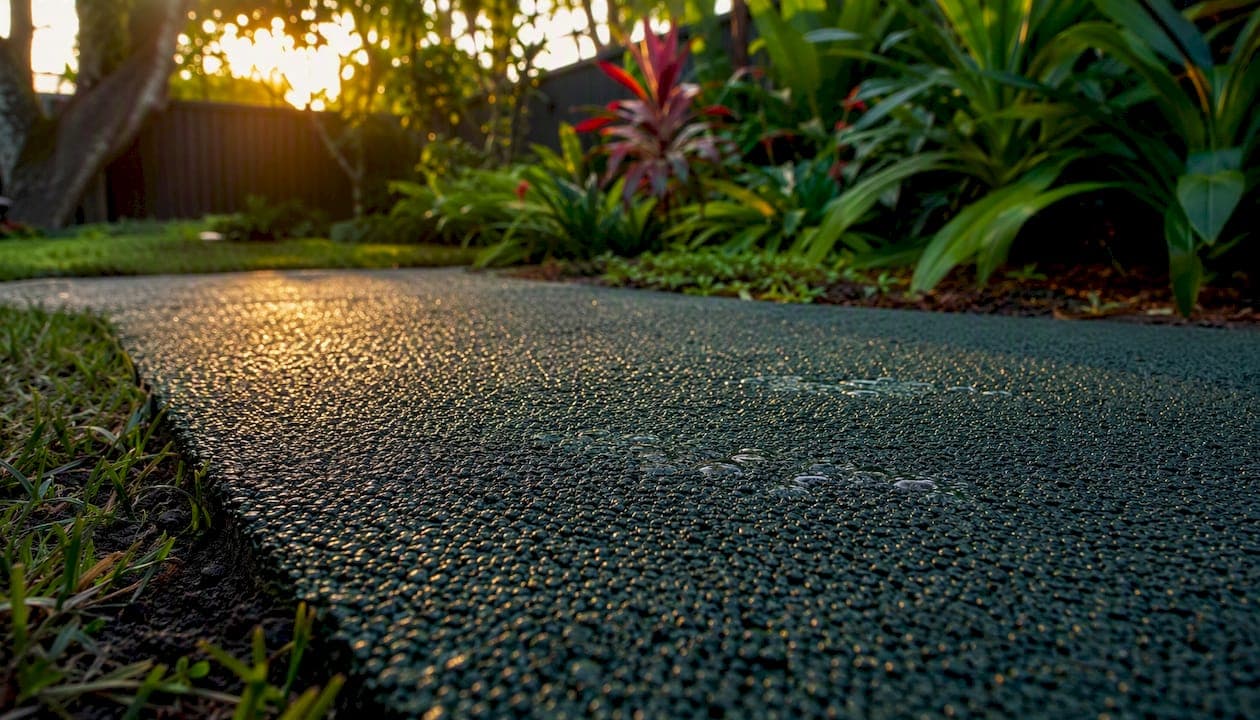
Stormwater ordinances treat permeable paving as a direct compliance path for impervious-area limits, pollutant control, and groundwater recharge requirements. The NJDEP's Chapter 9.6 sets an 80% total suspended solids (TSS) removal target for properly designed pervious systems treating the full Water Quality Design Storm. Standards like ASTM C1701, ASTM C1781, and ACI 522.1 define the infiltration tests reviewers expect in your submittal. New Orleans Ordinance 32,933 requires the Department of Public Works to use permeable paving where practical as a flood-resilience measure. The role of stormwater ordinances in paving choices is not advisory. They set the floor.
Key ordinance levers to track on any project:
- Impervious-area limits: Maximum percentage of a lot that can be covered by non-permeable surfaces
- TSS removal targets: Numeric pollutant reduction thresholds (80% under NJDEP guidance)
- Sequencing/alternatives analysis: Requirement to evaluate and document why permeable paving was or was not used
- BMP acceptance lists: Which surface types count as approved Best Management Practices
- Maintenance covenants: Recorded easements or agreements binding future owners to upkeep
- Designer and installer qualifications: PE or LA stamp, certified installer documentation
Pro Tip: Before budgeting a single paving option, pull the local stormwater management ordinance and check whether it contains an impervious-area cap or a sequencing clause. Those two provisions, more than any other, will determine whether permeable paving is optional or mandatory on your site.
Key Takeaways
Stormwater ordinances directly determine which paving materials are compliant, what tests must be submitted, and what maintenance commitments bind the property owner after construction.
| Point | Details |
|---|---|
| TSS removal target | NJDEP requires high total suspended solids (TSS) removal for pervious systems treating the full Water Quality Design Storm. |
| Volume reduction range | EPA data shows permeable pavements achieve a broad range of stormwater reduction depending on design and site. |
| Maintenance frequency | Vacuum sweep 2–4 times per year and conduct annual ASTM infiltration tests to maintain ordinance compliance. |
| Permitting essentials | Submit field infiltration data, alternatives evaluation, maintenance covenant, and a PE or LA stamp together. |
| Ecotecrubber option | Rubberway® is engineered for drainage and can be specified with reservoir and drawdown design to meet local ordinance requirements. |
Table of Contents
- How stormwater ordinances determine what you must submit and specify
- What permeable paving types are ordinance-acceptable, and what are the tradeoffs?
- How to check site feasibility before committing to a permeable design
- What design metrics and tests permitting authorities typically require
- What the permit package must include to get approved
- Realistic lifecycle costs and the maintenance commitments ordinances expect
- What to do when permeable paving is not feasible
- The case for treating paving as part of the drainage system
- Rubberway® and stormwater-ordinance compliance in Florida
- Sources
How stormwater ordinances determine what you must submit and specify
Ordinances translate policy goals into specific design and documentation requirements. The mechanism varies by jurisdiction, but the pattern is consistent.
Impervious-area limits force the math. Once a site exceeds a threshold, the designer must either reduce impervious cover or demonstrate equivalent stormwater management through an approved BMP. Permeable paving counts as reduced impervious cover in most codes, which is why it shows up in alternatives analyses.
Sequencing and alternatives requirements are the clause most likely to force a paving change on a renovation. Wyomissing Borough, for example, requires projects of one acre or more to document why LID practices were or were not used before proposing conventional detention. If you skip that step, the reviewer sends the package back.
BMP acceptance lists define which surface types satisfy the ordinance. Kitsap County's Ordinance 540-2016 explicitly encourages permeable pavement where feasible in private and access roads, integrating LID requirements across multiple code titles. The City of Royal Oak permits porous asphalt and permeable systems for parking and driving areas when stormwater ordinance requirements are satisfied.
Maintenance covenants and recorded easements are increasingly non-negotiable. Projects without a binding operations and maintenance commitment often fail technical review before the engineering drawings are even evaluated.
Ordinances increasingly demand designer qualifications and recorded maintenance agreements. A submittal that lacks a signed PE or LA stamp and a maintenance covenant template is almost always returned before substantive review begins.
Pro Tip: On renovation projects, the sequencing clause is the single provision most likely to require a paving change. Read it before schematic design, not after.
What permeable paving types are ordinance-acceptable, and what are the tradeoffs?
Construction professionals evaluating stormwater management paving solutions have five main surface categories to work with.
Porous asphalt (PAP) with a stone reservoir is a recognized LID technology that manages and treats stormwater while providing structural pavement, per FHWA guidance. It handles standard traffic loads well and is widely accepted on BMP lists. Maintenance requires vacuum sweeping, not standard street sweeping.
Pervious concrete (PCP) meets ACI 522.1 standards and is accepted broadly for parking and low-speed applications. Upfront cost runs higher than conventional concrete, but it can reduce or eliminate detention infrastructure, partially offsetting that premium.
Permeable interlocking concrete pavers (PICP) offer the highest structural load ratings among permeable options and are repairable section by section. They suit heavy-use parking and commercial drives. The jointing aggregate requires periodic replenishment.
Open-grid concrete or plastic grids work well for overflow parking, fire lanes, and low-frequency-use areas. They support vegetation in the cells, which adds TSS treatment. Load ratings vary by product.
Engineered porous rubber systems such as EcoTec Rubber Paving's Rubberway® use recycled tire rubber in a porous matrix that drains effectively and resists heat-induced cracking. Where soils or geometry limit conventional pervious pavements, a rubber system with an appropriate reservoir and drawdown design can still meet ordinance drainage goals. Rubberway® is suitable for driveways, pool decks, sidewalks, and municipal paths.

| Surface type | Treatment capability | Traffic rating | Typical maintenance | Upfront cost |
|---|---|---|---|---|
| Porous asphalt | Medium-high | Medium-high | Vacuum sweep 2–4x/year | Medium |
| Pervious concrete | Medium-high | Medium | Vacuum sweep, annual test | Medium-high |
| PICP | Medium | High | Aggregate replenishment | High |
| Open-grid systems | Low-medium | Low-medium | Sediment removal | Low-medium |
| Porous rubber (Rubberway®) | Medium-high | Low-medium | Periodic inspection | Medium |
Pro Tip: Permeable pavements can earn LEED and Green Globes credits under EPA green infrastructure guidance. If your project is pursuing certification, document the surface type and infiltration rate in the credit narrative.
How to check site feasibility before committing to a permeable design
Run this checklist before the SWM Site Plan goes to a designer. It saves weeks.
- Field infiltration rate: Measure in inches per hour using ASTM C1701 (in-place surface test) or a double-ring infiltrometer. Minimum thresholds vary; guidance documents cite ranges from 0.27 in/hr to 0.5 in/hr as practical minimums.
- Depth to seasonal high groundwater: Most codes require 2–3 feet of separation between the bottom of the reservoir and the seasonal high-water table.
- Proximity to wells or sensitive receptors: Setback requirements vary by jurisdiction; confirm with the local health department and stormwater authority.
- Slope: Slopes above 5% typically require additional engineering; slopes above 8–10% usually disqualify infiltration-based systems.
- Contributing drainage area ratio: Some codes cap the ratio of contributing impervious area to permeable surface at 3:1. Exceeding it requires an underdrain or overflow structure.
- Traffic and load category: Confirm the design vehicle and frequency. PICP handles heavy loads; porous rubber and open-grid systems are better suited to pedestrian and light-vehicle use.
- Pollutant hotspot status: Gas stations, vehicle maintenance areas, and industrial loading docks are typically classified as hotspots. Infiltration-based systems are usually prohibited without a full treatment train.
The two factors that most commonly kill permeable systems at feasibility: high groundwater and hotspot pollutant loads. The practical fix for both is an underdrain paired with a treatment train (pretreatment filter strip or sediment forebay before the permeable surface).
Pro Tip: Run infiltration tests at the design stage and keep the raw data in the SWM submittal. Caltrans guidance recommends ASTM C1701 and C1781 specifically for this purpose, and many municipal reviewers now expect to see test results, not just assumed rates.
What design metrics and tests permitting authorities typically require
Ordinance language translates into measurable targets that must appear in engineering drawings and calculations.
That target drives reservoir sizing and surface selection.
Drawdown time: Guidance documents recommend 12–72 hours for the reservoir to drain after a design storm. Systems that hold water longer risk anaerobic conditions and structural damage.
Volume reduction: EPA BMP data shows permeable pavements achieve roughly 25–100% stormwater reduction depending on design and site conditions. That range reflects the difference between an underdrained system (lower end) and a fully infiltrating system on sandy soils (upper end).
Standards and tests to reference in plans:
- ASTM C1701: Field infiltration rate of in-place pervious concrete
- ASTM C1781: Surface infiltration rate of permeable unit pavement systems
- ACI 522.1: Specification for pervious concrete
- ASTM D3385: Double-ring infiltrometer for native soil
| Design input | Typical source | Notes |
|---|---|---|
| Infiltration rate (in/hr) | Field ASTM test | Do not use assumed values |
| WQDS volume (cubic feet) | Local design manual | Varies by jurisdiction |
| Contributory area ratio | Site survey | Cap at 3:1 without underdrain |
| Groundwater separation (ft) | Soil boring or monitoring well | Minimum 2–3 ft typical |
Subsurface reservoir sizing is as critical as surface material selection. An undersized or contaminated reservoir is the most common reason permeable surfaces fail to meet detention or TSS targets after installation.
What the permit package must include to get approved
Reviewers follow a checklist. Match it exactly and you avoid the back-and-forth that adds weeks to a project.
- Pre-application meeting: Confirm the jurisdiction's BMP list, designer qualification requirements, and whether a maintenance covenant is required before submittal.
- Site feasibility report: Include field infiltration test data, soil boring logs, groundwater depth, slope survey, and hotspot determination.
- Alternatives evaluation: Document the sequencing analysis. If permeable paving was considered and rejected for part of the site, explain why and show how the proposed alternative meets the same volume and quality targets.
- Engineering drawings: Detail surface layer, aggregate reservoir, underdrain (if used), overflow structure, and connection to the storm system. Include layer thicknesses and aggregate gradation.
- Maintenance plan: Specify vacuum sweeping frequency, annual infiltration testing, inspection log format, and responsible party. AEN-108 guidance recommends vacuuming 2–4 times per year and annual inspections.
- Maintenance covenant or easement: Recorded document binding current and future owners to the O&M plan. Many jurisdictions require this before issuing a certificate of occupancy.
- Designer stamp and installer certification: PE or LA signature on drawings; installer qualification documentation when the ordinance requires it. Model ordinance templates commonly require both.
Pro Tip: Include the maintenance covenant template in the initial submittal, not as a follow-up item. Reviewers who see it upfront treat the package as complete; those who have to request it often place the application in a lower-priority queue.
Realistic lifecycle costs and the maintenance commitments ordinances expect

Pervious pavements typically cost more to install than conventional surfaces, but they can reduce or eliminate the need for detention basins and underground storage, which offsets a significant portion of that premium on larger sites.
Maintenance obligations that matter to ordinance compliance:
- Vacuum sweeping 2–4 times per year (routine street sweeping alone does not prevent clogging)
- Annual infiltration testing using ASTM C1701 or C1781 to confirm the system still meets design criteria
- Inspection logs documenting each maintenance event, kept on file for municipal review
- Sediment forebay or filter strip maintenance where pretreatment is part of the design
- Recorded easement or maintenance agreement on file with the local government
A maintenance checklist for O&M plans and contracts:
- Schedule vacuum sweeping events in spring and fall at minimum
- Inspect surface for sediment accumulation, cracking, or joint displacement after major storm events
- Conduct annual ASTM infiltration test; document results against the design target
- Clear any inlet or overflow structures of debris
- Replenish jointing aggregate in PICP systems as needed
- Submit annual inspection report to the municipality if required by the maintenance covenant
The FHWA porous asphalt brief specifically calls out construction-phase protection as a maintenance precursor: sediment tracked onto the surface during grading can clog the matrix before the first rain event. Protecting the surface during adjacent earthwork is not optional.
What to do when permeable paving is not feasible
Site constraints or ordinance restrictions sometimes rule out infiltration-based paving. That does not mean the project is out of compliance options.
- Detention basins: Provide volume control and some water quality treatment; require land area and ongoing maintenance
- Bioretention cells and rain gardens: High TSS removal, suitable for smaller contributing areas, work well adjacent to paved surfaces
- Vegetated filter strips: Low-cost pretreatment for sheet-flow runoff from parking and drives
- Underdrained pervious systems with treatment train: Allows permeable surface where native infiltration is insufficient; treats runoff before discharge
- Targeted permeable areas: PICP in parking aisles combined with conventional pavement in drive lanes, directing runoff to permeable zones
- Retrofit infiltration cells: Subsurface chambers installed beneath existing pavement to add storage capacity on constrained sites
When proposing a non-permeable mitigation, the alternatives evaluation must show two things: why permeable paving was infeasible (test data, groundwater depth, hotspot status), and how the proposed alternative achieves equivalent volume reduction and TSS removal. Reviewers who see both in the same document approve faster. For practical stormwater drainage solutions on constrained sites, combining approaches often produces the best result.
Pro Tip: Combining PICP in parking aisles with bioretention swales for roof runoff is one of the most cost-effective hybrid strategies. Each element handles the load it is best suited for, and together they often satisfy ordinance targets without a detention basin.
The case for treating paving as part of the drainage system
Most permit delays and post-construction compliance failures trace back to the same decision: the paving material was chosen before the drainage design was started. Surface selection and subsurface design have to happen together, not sequentially. A pervious concrete surface over an undersized reservoir fails the same TSS test as a conventional surface with no treatment at all.
The projects that move through permitting cleanly are the ones where a civil engineer or landscape architect sized the reservoir, confirmed the infiltration rate, and specified the maintenance covenant before the surface material was even discussed. EcoTec Rubber Paving's Rubberway® system fits that integrated approach: it is engineered for drainage, uses recycled tire rubber, and can be specified with the reservoir and drawdown design the ordinance requires. That is not a marketing claim. It is a design sequence.
Rubberway® and stormwater-ordinance compliance in Florida
Rubber paving that actually drains is a different product category than decorative surfacing. Ecotecrubber's Rubberway® system is engineered for drainage performance using recycled tire rubber, making it a practical fit for driveways, pool decks, sidewalks, municipal paths, and HOA common areas where ordinance-driven drainage requirements apply.
Ecotecrubber provides site feasibility assessments, specification-ready design packages, installer-certified installation, and maintenance plan documentation. For Florida property owners and contractors working under local stormwater ordinances, that means one point of contact from feasibility through recorded covenant. Request a feasibility review to find out whether Rubberway® fits your site's ordinance requirements.
Sources
Attach relevant excerpts (TSS targets, required tests, drawdown guidance) from these documents directly to your permit packet.
- Chapter 9.6 Pervious Paving Systems
- Tech Brief: Porous Asphalt Pavements with Stone Reservoirs
- Council Supports Stormwater Management and Resiliency Efforts with Approval of Permeable Paving Ordinance