

A polymer overlay runs $3 to $7 per square foot, decorative resurfacing climbs toward $12, and full concrete replacement lands between $6 and $25+ per square foot depending on finish and site conditions. Small patch repairs are cheaper still, typically $450 to $3,000 for isolated slab issues. Before calling anyone, do three things:
- Measure the exact square footage of the affected area
- Photograph and note problem spots — cracks, heaving, standing water
- Get 2 to 3 written quotes that spell out permit costs separately
Those three steps alone will save you from the single biggest budgeting mistake homeowners make: comparing quotes that aren't actually quoting the same scope of work.
Key Takeaways
Sidewalk resurfacing costs $3 to $12 per square foot while full replacement runs $6 to $25+, but the surface that solves the root cause always outperforms the cheapest fix.
| Point | Details |
|---|---|
| Resurfacing vs replacement | Overlay $3 to $7/sq ft for cosmetic issues; replacement $6 to $25+/sq ft for structural damage. |
| Root heave changes everything | A surface-only overlay over active root movement typically fails within a few seasons. |
| Permits add hidden cost | ADA and inspection requirements vary by city and are easy to miss in DIY budgets. |
| Get itemized quotes | Separate materials, labor, demo, disposal, and permits before comparing contractor bids. |
| Rubberway® fits root and drainage problems | Ecotecrubber's Rubberway® system costs more upfront but resists root heave and drains standing water that causes repeat concrete failures. |
Table of Contents
- Sidewalk Resurfacing Cost by Square Foot, Linear Foot, and Total Project
- What's Actually in a Sidewalk Repair Estimate
- Should You Resurface or Replace the Sidewalk?
- Concrete Resurfacing vs. Rubberway® Rubber Resurfacing
- DIY Repairs vs. Hiring a Licensed Contractor
- Getting an Accurate Sidewalk Quote
- Three Sample Sidewalk Projects With Real Numbers
- The Real Trade-Off Nobody Budgets For
- Get a Rubberway® Estimate From Ecotecrubber
- Sources
Sidewalk Resurfacing Cost by Square Foot, Linear Foot, and Total Project
Not every job gets priced the same way, and that trips up a lot of first-time buyers.
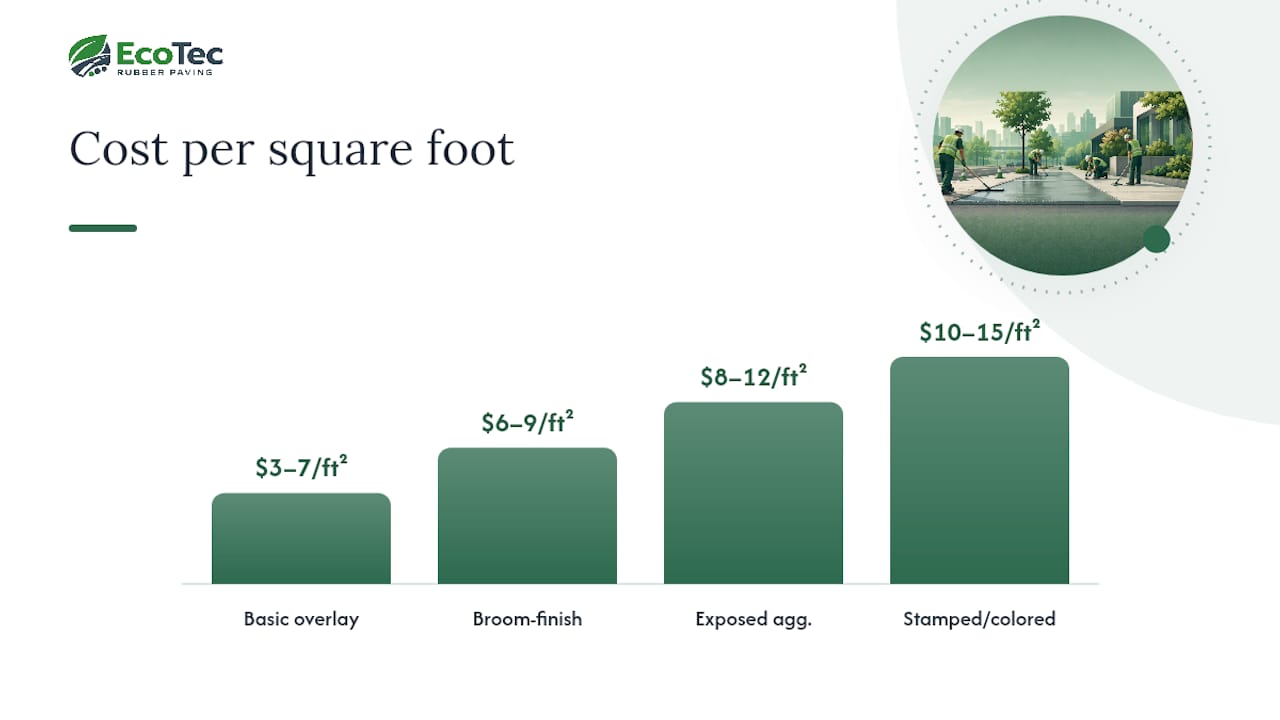
- Basic polymer overlay: $3 to $7 per sq ft. This resurfaces existing concrete without tearing it out, provided the slab underneath is structurally sound.
- Broom-finish replacement: $6 to $9 per sq ft, the standard for most municipal and residential walkways.
- Exposed aggregate: $8 to $12 per sq ft, popular for pool decks and front entries where texture matters.
- Stamped or colored concrete: $10 to $15+ per sq ft, priced for looks rather than function.
- Rubber surfacing systems: generally higher upfront, covered in detail below.
Linear-foot pricing shows up mainly on narrow municipal paths, where contractors quote a standard 4-foot width rather than measuring irregular shapes. A 50-linear-foot stretch at 4 feet wide is 200 square feet, so multiply your per-square-foot number accordingly.
Here's how that plays out in real numbers: a 20-foot front walk (80 sq ft) with a basic overlay runs roughly $280 to $560. A 100-square-foot overlay job lands between $300 and $700. A 500-square-foot full replacement, assuming a broom finish, comes in around $3,000 to $4,500 before permits.
What's Actually in a Sidewalk Repair Estimate
A basic sack of concrete mix costs relatively little; the bigger material costs come from overlay bonding agents, fiber reinforcement, and sealers applied after the pour cures.
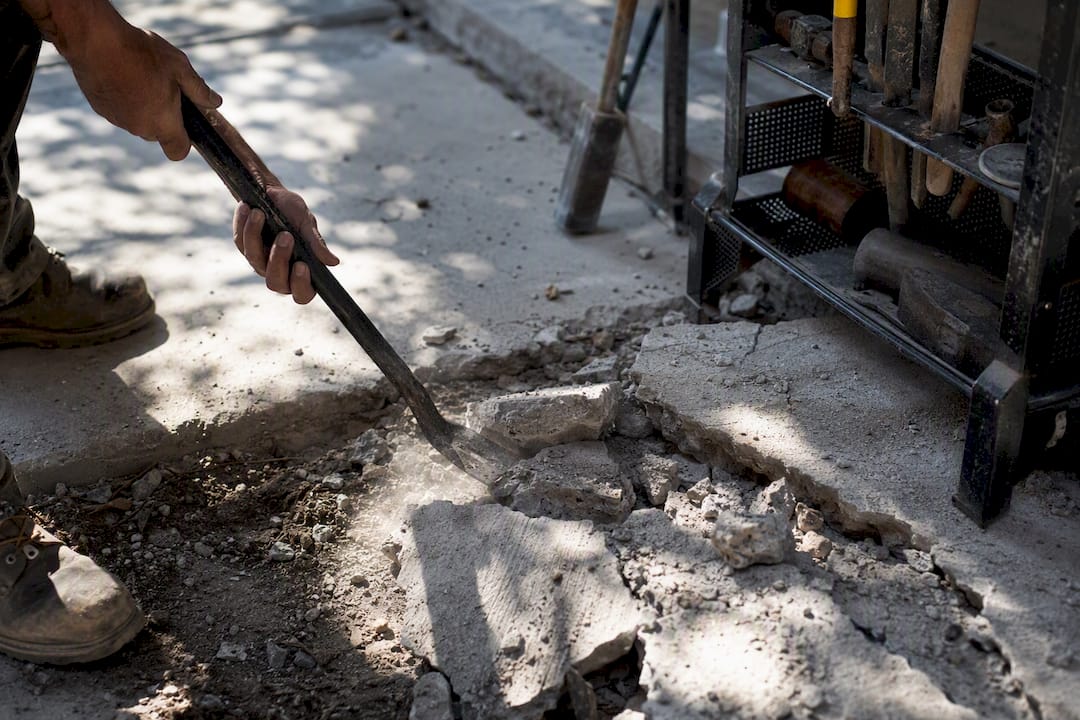
Demolition and disposal are where budgets often get blown. Removing an old slab, hauling debris, and disposing of it at a landfill can add $2 to $5 per square foot on top of the resurfacing price, especially if the old concrete is reinforced with rebar or wire mesh. If the subgrade underneath is soft, waterlogged, or contains old tree roots, expect additional excavation and compacted fill costs before any new surface goes down.
Then there's the paperwork. Permit fees, inspection requirements, and ADA compliance checks vary heavily by city, and they can materially add to what looks like a simple homeowner project.
Quick math: national average repair costs commonly cited fall between $794 and $2,887, a range wide enough that scope, not location, usually explains the difference.
- Materials: 30% to 40% of total cost
- Labor: 60% to 70% of total cost
- Demo and disposal: $2 to $5 per sq ft when required
- Permits and inspections: varies by municipality, often overlooked in DIY budgets
Should You Resurface or Replace the Sidewalk?
An overlay only works if the problem is cosmetic. Surface spalling, minor pitting, and hairline cracks that don't shift with the seasons are good overlay candidates. Structural problems are different: if a slab has heaved more than half an inch, if you see cracks running clean through the depth of the concrete, or if water pools against the walk instead of draining off it, resurfacing won't hold.
Root heave is the most common reason overlays fail early. If a tree root is pushing the slab from underneath, a surface-only fix typically cracks again within a few seasons unless you address the root itself or switch to a surface built to flex with ground movement.
- Overlay candidates: surface wear, minor cracking, cosmetic damage, stable subgrade
- Replacement required: root heave, slab settlement, drainage failure, multiple failing sections
A well-installed overlay lasts 8 to 12 years; a full concrete pour can last 25 to 30 years with normal maintenance. That gap matters more than the upfront price when you're budgeting per year of use rather than per project.
Pro Tip: Push a garden hose against the base of any cracked section before calling a contractor. If water pools instead of running off, you likely have a drainage problem that will undercut any resurfacing job you pay for.
Concrete Resurfacing vs. Rubberway® Rubber Resurfacing
Concrete and rubber solve the same problem differently, and the difference shows up over time, not on day one.
Rubberway®, the system Ecotecrubber installs, uses a high percentage of recycled tire rubber in a porous surface designed for drainage, slip resistance, and ADA compliance. Because water passes through the surface instead of pooling on top of it, standing water and ice patches are far less common than on solid concrete. The material also flexes rather than cracks when tree roots push against it from below, which sidesteps the single most common cause of concrete sidewalk failure.
Industry comparisons put rubber surfacing in the range of $8 to $12 per square foot installed against $22 to $25 for some concrete replacement projects, though actual figures vary widely by region and scope. The upfront number often runs higher for rubber, but the maintenance frequency drops substantially once roots or drainage stop forcing repeat repairs.
- Best for tree-lined streets, HOA common areas, and municipal parks with mature root systems
- Strong fit for pool decks and ADA-sensitive paths where slip resistance and permeability matter
- Worth the premium where drainage failures have already caused repeat concrete repairs
DIY Repairs vs. Hiring a Licensed Contractor
Some sidewalk maintenance is genuinely within reach for a handy homeowner. Cleaning, resealing, and filling small surface cracks with a polymer filler are reasonable weekend projects. Everything past that, overlays, releveling sunken slabs, full replacement, or root mitigation, calls for equipment and expertise most homeowners don't have on hand.
- DIY-safe: pressure washing, sealant application, hairline crack fillers under a quarter inch.
- Hire a pro: overlays, mudjacking or slab leveling, full demolition and pours, any job touching tree roots or utility lines.
- Check licensing and insurance before signing anything. An uninsured crew that damages a gas line or utility conduit leaves you holding the liability.
- Get warranties in writing, including scope of work, materials specified, project timeline, and who pulls the permit.
Getting an Accurate Sidewalk Quote
Contractors price faster and more accurately when you hand them real information up front instead of a vague description.
Measure the exact length and width of the area, photograph every crack or heaved section, and flag anything nearby, tree roots, drainage grates, utility covers, that could complicate the work. Ask each contractor for a line-item estimate that separates materials, labor, demolition, disposal, permits, and warranty terms rather than a single bundled number.
Watch for red flags: no proof of license or insurance, a scope described only as "sidewalk repair" with no detail, or a steep discount offered only for cash payment.
- Bring photos and measurements to every walkthrough
- Insist on itemized, not bundled, pricing
- Confirm who handles permit filing and inspection scheduling
Pro Tip: Schedule your city inspection before the crew shows up on install day. Waiting until after the pour can force a costly rework if the inspector flags slope or drainage issues.
Three Sample Sidewalk Projects With Real Numbers
Rough math helps more than a single average ever will.
- Small patch repair (20 sq ft): One heaved section near a driveway, no root involvement. Expect $450 to $900 for a mudjack-and-patch approach, assuming no permit is required.
- Front-walk overlay (80 to 100 sq ft): Cosmetic cracking only, stable subgrade. A polymer overlay runs $300 to $700; full replacement of the same area would run $600 to $1,800 depending on finish, with the overlay lasting roughly a third as long.
- 500-sq-ft full replacement: Includes demo ($1,000 to $2,500), subgrade repair ($500 to $1,200), broom-finish pour ($3,000 to $4,500), and permits ($100 to $400), landing the full project around $4,600 to $8,600.
The Real Trade-Off Nobody Budgets For
Most sidewalk cost guides stop at price per square foot, and that's the mistake. The number that actually matters is cost per year of usable surface, and concrete quietly loses that math more often than people expect.
A cheap overlay at $4 per square foot sounds like the obvious choice next to an $10 rubber installation. But if a maple tree root sits six inches under that walkway, the overlay is a temporary patch on a problem that hasn't gone anywhere. You'll repay that "savings" in a callback within three years, plus the demolition cost of tearing out a slab that's already failed once.
The conventional advice, "get three quotes and pick the middle one," ignores what's under the concrete entirely. Before comparing dollar figures, figure out whether your problem is cosmetic or structural. Root heave, chronic standing water, or a slab that's failed more than once in the same spot are signals that a flexible, permeable surface will outperform another concrete pour, not just financially but in how many times you'll have to deal with this again.
Budget for the actual cause, not just the visible crack.
— Roger
Get a Rubberway® Estimate From Ecotecrubber
If tree roots, drainage, or repeat cracking are the actual problem, another concrete pour just resets the clock on the same failure. Ecotecrubber installs Rubberway® surfacing, a porous, root-flexible system built specifically for Florida's heat, storms, and root-heavy landscaping, as a direct alternative to another short-lived concrete patch.
A quote from Ecotecrubber includes an on-site visit to assess drainage and root conditions, a breakdown of material specs and color options from the Rubberway® product line, and warranty terms in writing before any work starts. The team is licensed and insured, and every project is coordinated end to end rather than subcontracted piecemeal. Service currently covers Florida, including Sarasota and Tampa Bay. If drainage is part of your problem, a drainage assessment alongside your paving quote can save a second round of repairs down the line.
Compare at least two bids before deciding, and request a Rubberway® estimate to see how the lifecycle numbers stack up against another concrete replacement.
Sources
- How Much Does a Concrete Sidewalk Cost in 2026? Full Pricing Guide
- 2026 Sidewalk Repair Cost: Prices & Factors