
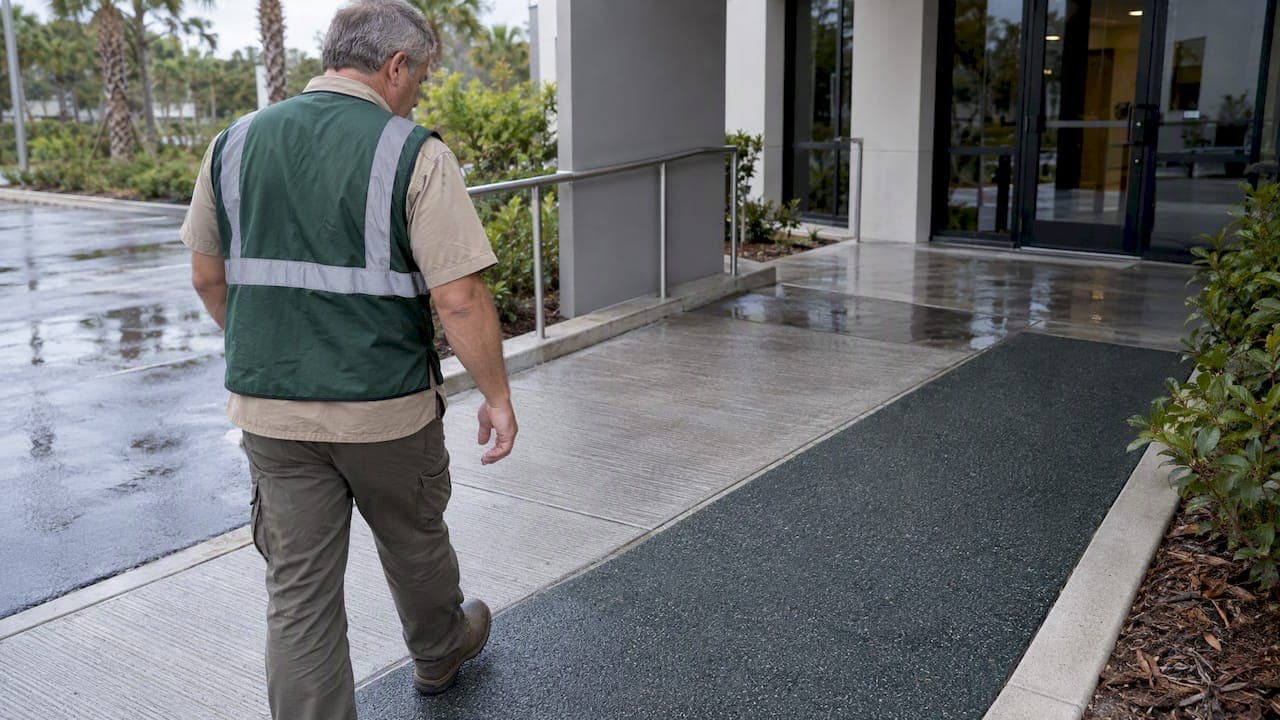
Under the 2010 ADA Standards, accessible floor and ground surfaces must be "stable, firm, and slip resistant," but the standards do not set a single numeric coefficient of friction. Compliance comes from specifying the right materials, naming a test method, and documenting maintenance, not from hitting one magic number. The practical path is straightforward: choose a material suited to the site, require lab and on-site testing against a stated protocol, and keep records that show you did both.
TL;DR:
- Choosing slip-resistant surfaces requires specifying a named test method and maintaining documentation, rather than relying on unverified COF numbers.
- Advisory guidance suggests a static COF of 0.6 for level surfaces and 0.8 for ramps, but these are not enforceable standards and depend on testing conditions.
- Regular on-site testing, material-specific standards, and documented maintenance are essential for defensible ADA compliance over the lifespan of the surface.
- Concrete and asphalt with proper finishing and regular upkeep remain the most reliable materials for accessible pathways in various climates.
- Pool decks and wet areas require more aggressive drainage, textured surfaces, and frequent maintenance to ensure consistent slip resistance.
Table of Contents
- What the ADA actually requires for floor and ground surfaces
- Where the 0.5, 0.6, and 0.8 numbers actually come from
- How to specify slip resistance for a real project
- Materials and finishes that hold up in practice
- Testing, field checks, and documentation that hold up
- What actually matters on the ground
- FAQ
- Sources
- Keep your rubber paving project ADA-ready from the start
What the ADA actually requires for floor and ground surfaces
Section 302.1 of the 2010 ADA Standards states that ground and floor surfaces along accessible routes must be stable, firm, and slip resistant. That is the entire numeric content of the rule: there is no COF threshold written into the regulation itself. The Access Board's own guidance explains why. No test method has reached national consensus, so writing a single number into a federal standard would lock designers into one measurement protocol while locking out others that may be just as valid for a given surface.
That gap does not mean "anything goes." Inspectors and accessibility reviewers look for evidence that a surface was chosen and maintained with slip resistance in mind, not just whether a number appears on a cut sheet. A few related rules shape how this plays out on real projects:
- Accessible routes and paths of travel must stay stable and firm along their full length, not just at entry points.
- Alterations trigger path-of-travel obligations, though cost-based disproportionality limits can apply to older or historic properties.
- Ramps and changes in level carry their own slope and surface requirements layered on top of the general slip-resistance rule.
Reading the standard this way shifts the question from "what number do I need" to "what evidence proves this surface is appropriate."
Where the 0.5, 0.6, and 0.8 numbers actually come from
Property owners often ask for a specific coefficient of friction because contractors and product sheets throw around numbers resembling 0.5, 0.6, and 0.8. Those figures are referenced in advisory guidance but are not legal requirements. OSHA's standard interpretation on walking and working surfaces references 0.5 static COF as a guide drawn from nonmandatory materials, and OSHA is explicit that it has no enforceable COF standard of its own.

The Access Board's advisory guidance references research suggesting roughly 0.6 for level surfaces and steps and 0.8 for ramps, but these figures are explicitly framed as advisory, not legal thresholds. They come out of research into what some wheelchair users and people with mobility disabilities need on ramped or inclined surfaces, where gravity adds to the force a surface has to resist.
The bigger issue is test-method dependency. Static COF and dynamic COF measure different things: static COF is the resistance to starting movement, while dynamic COF measures resistance once something is already sliding. Different devices, different speeds, and different surface conditions (wet versus dry, clean versus contaminated) can produce meaningfully different readings on the identical floor.
- A tile that tests at 0.6 static, dry can test well below that wet or with a different tester.
- A number without a named test method and surface condition is close to meaningless in a contract dispute.
- Anchoring any numeric spec to a specific, named test protocol is what makes the number defensible later.
How to specify slip resistance for a real project
Converting a non-numeric legal requirement into something a contractor can bid on and an inspector can verify takes a few concrete steps.
- Name the test method in the spec. Require manufacturer test data tied to a specific, named protocol rather than a bare COF figure with no method attached.
- Require on-site acceptance testing. Lab numbers describe the product; they do not guarantee how it performs once installed, cured, and exposed to site conditions. Define pass criteria tied to the same method used in step one.
- Specify materials, textures, and limits for the actual site conditions. A pool deck, a loading dock with oil exposure, and a shaded walkway that stays damp each need different answers, and carpet on accessible routes should generally keep pile height at or below 1/2 inch with firm backing rather than thick cushioned pad.
- Build maintenance into the contract. Anti-slip treatments wear off, coatings degrade, and textured finishes can fill in with dirt or sealant over time; the contract should state a reapplication schedule and periodic re-testing, not just a one-time install standard.
- Document everything. Specs, lab reports, on-site test logs, dated photos, and maintenance receipts are what turn "we picked a good material" into proof.
Pro Tip: Write the test method and surface condition into the spec line itself, not just the COF number, so a dispute later has something concrete to point back to.
Facility managers who treat this as a one-time install decision tend to be the ones facing the most expensive callbacks a few years later.
Materials and finishes that hold up in practice
Concrete and asphalt remain the default for accessible routes because they are predictable: properly finished and sloped for drainage, they stay stable and firm across most climates. The finish matters as much as the material. A heavily troweled, glass-smooth concrete surface can be harder to walk on wet than one with a light broom finish.

Carpet on accessible routes needs more care than most spec sheets give it. Pile height should stay low, backing should be firm, and thick cushioned pad should generally be avoided because it increases wheelchair roll resistance even when the surface feels fine underfoot.
Coatings and textured overlays, acid-etching, and anti-slip treatments can all improve an existing surface, but every one of them has a maintenance clock attached. Some wear down in months on a high-traffic entrance; others last years on a lightly used walkway.
- Pervious and rubber paving systems add drainage to the slip-resistance equation, which matters because wet surfaces are the most common real-world slip hazard.
- Rubber surfacing systems such as Rubberway are one illustrative example of a U.S.-available product built around porous drainage and a consistently textured, stable surface for pool decks, walkways, and ramps.
- Any of these systems should still come with manufacturer test data and a stated maintenance plan rather than a bare slip-resistant claim.
Testing, field checks, and documentation that hold up
A defensible compliance file rests on knowing what to test, when to test it, and what to keep. The Access Board's research methodology for accessible exterior surfaces used tools like the Rotational Penetrometer to measure firmness and stability and a Wheelchair Work Measurement method to quantify how much effort a surface demands from a wheelchair user, alongside dynamic pendulum testers for slip resistance.
- Request manufacturer lab data tied to a named test method before purchase.
- Run on-site acceptance testing after installation, since curing, grading, and real foundations change performance.
- Re-test periodically and after any resurfacing, sealing, or coating treatment.
- Keep dated lab reports, on-site test logs noting wet or dry and contaminant conditions, maintenance receipts, and photos in one file.
What actually matters on the ground
Chasing a single "non-slip" marketing number is the wrong starting point. The standard asks for stable, firm, slip-resistant surfaces, and the smarter approach is designing for the site you actually have: a shaded walkway that stays damp, a pool deck that sees sunscreen and bare feet, a loading area exposed to oil drips. Pick materials and test methods that answer those specific conditions rather than hunting for a figure that sounds impressive on a spec sheet.
Documentation is not paperwork for its own sake. A dated lab report, an on-site acceptance test log, and a maintenance schedule are what separate a defensible project from a guess when a complaint or an inspection comes along years later. Coordinating early with manufacturers and independent testing labs, before pouring concrete or ordering material, saves far more time than retrofitting a fix after a surface fails a review.
— Roger
This article is general information, not a substitute for advice from a qualified lawyer. Consult a qualified legal professional about your own circumstances before acting on anything here.
FAQ
What is the 20% rule for ADA?
The ADA alteration requirements include a disproportionality cap on path-of-travel improvements based on cost limits, and this applies under the 2010 ADA Standards' path-of-travel provisions.
What is the ASTM standard for slip resistance?
There is no single ASTM standard that the ADA requires for slip resistance testing, since the 2010 ADA Standards do not name a mandatory test method. Various dynamic and static COF test protocols exist in the industry, which is exactly why specifications should name the chosen method, rather than relying on a bare COF number.
What are the ADA requirements for 2026?
The core floor and ground surface requirement remains unchanged from the 2010 ADA Standards: surfaces along accessible routes must be stable, firm, and slip resistant, with no numeric coefficient of friction written into the federal rule. Owners and contractors should still specify materials, test methods, and maintenance plans rather than wait for a numeric update, since Access Board guidance continues to frame specific COF figures as advisory.
What are the ADA requirements for sliding doors?
Sliding doors on accessible routes need to meet the same stable, firm, slip-resistant surface standard at thresholds and approaches as the rest of the path of travel. Threshold height is a related and frequently cited compliance issue, and guidance on ADA threshold height rules covers the maximum allowable height and detailing for accessible entry transitions.
Do pool decks need a different slip resistance approach than walkways?
Pool decks face near-constant wet conditions, sunscreen residue, and bare feet, which makes drainage and surface texture more important than on a typical dry walkway. The same "stable, firm, slip resistant" standard from the 2010 ADA Standards applies, but material choice and maintenance frequency usually need to be more aggressive around pools than on interior routes.
Sources
- Guide to the ADA Accessibility Standards — Chapter 3: Floor and Ground Surfaces
- Static coefficients of friction for walking/working surfaces | OSHA
Keep your rubber paving project ADA-ready from the start
We build every Rubberway installation around the same standard this article walks through: a stable, firm, porous surface designed for wet decks, heat-cracked walkways, and heavy-use municipal paths, backed by documentation you can hand to an inspector without scrambling. Because we specialize in rubber paving, our crews coordinate the whole project, material selection, drainage design, and ADA-relevant documentation, instead of treating it as one line item on a bigger paving job.
We provide government-ready documentation for municipalities, HOAs, and commercial property managers who need a paper trail as much as a finished surface. Whether you're resurfacing a pool deck, a community walkway, or a commercial entrance, our Rubberway product lines, including Rubberway® Pervious Pavement, Rubberway Rubberrock 6000, and Rubberway EVOLUTION, are built for Florida's heat and rain cycles with custom color options to match your site.
Get a quote on your next paving project at EcoTec Rubber and start the conversation with a team that treats ADA compliance as part of the installation, not an afterthought.