
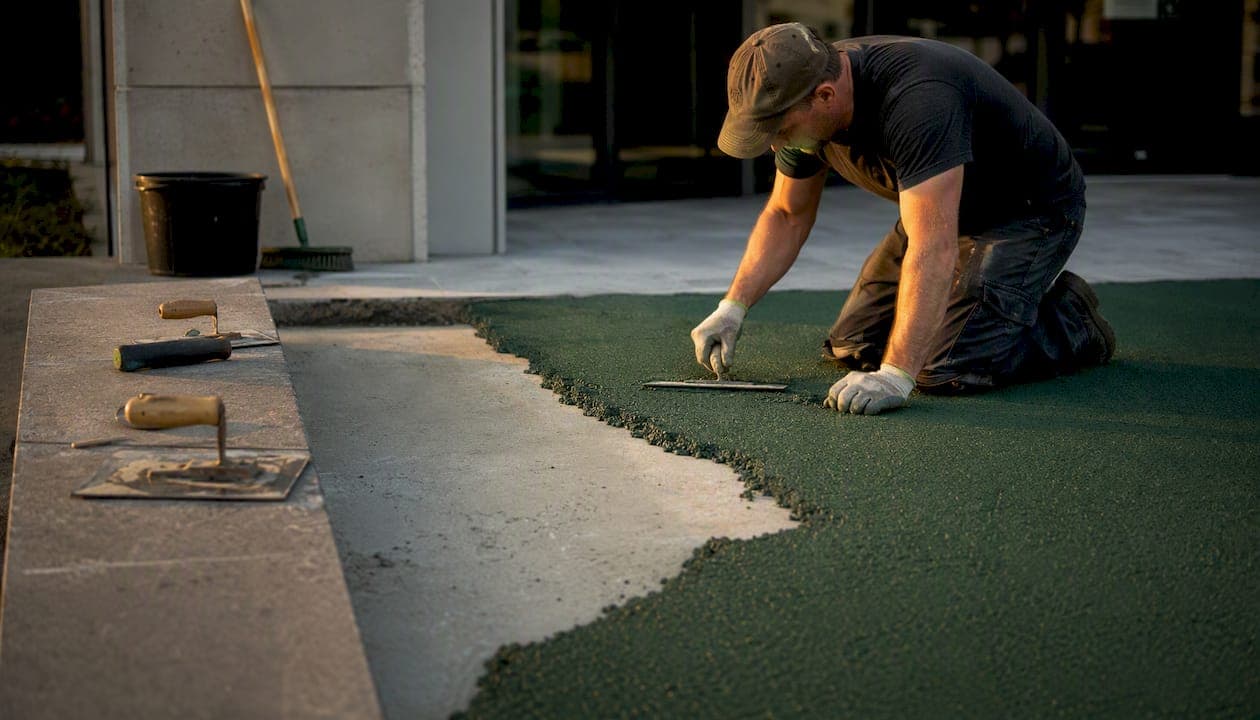
For most commercial entrances, the right starting point is a recessed mat system set in a properly built matwell for vestibules, or a poured-in-place unitary rubber surface like EcoTec Rubberway® for exterior, high-exposure thresholds. Surface-mounted adhesive mats work well for retrofits where cutting a recess is not feasible. Three factors should drive your selection before anything else: weather exposure (exterior vs. sheltered), daily traffic volume and type (wheeled carts, mobility devices, foot traffic), and whether existing threshold heights create ADA compliance problems.
Before you write a spec or issue an RFP, confirm your system against three standards. The Americans with Disabilities Act requires firm, stable, and slip-resistant surfaces at accessible routes, with changes in level no greater than ½ inch at thresholds (beveled above ¼ inch). ASTM F1951 tests firmness and stability for wheelchair and mobility device access on surfacing materials. For unitary rubber systems, ASTM F1292 covers impact attenuation performance, and the CPSC recommends requesting producer test data for critical performance attributes when specifying these systems. Any bid that cannot supply test reports against these standards should not advance.
- Exterior, high-exposure entrances: Poured-in-place or unitary rubber (Rubberway® style), textured concrete, or anti-slip coatings rated for outdoor COF values.
- Vestibule/interior transition zones: Recessed mat in a matwell, or modular matting systems with aluminum edge framing.
- Retrofit/surface-mount situations: Adhesive-backed rubber or modular mats with beveled edges meeting ADA threshold limits.
Key Takeaways
Slip-resistant entrance surface installation succeeds when substrate preparation, system selection, ADA compliance verification, and documented acceptance testing are treated as non-negotiable steps, not optional add-ons.
| Point | Details |
|---|---|
| Match system to exposure | Recessed mats suit vestibules; unitary rubber (Rubberway®) suits exterior, high-exposure entrances. |
| Require test documentation | Demand ASTM F1951 and COF tribometer reports from bidders before award, not after installation. |
| Substrate prep is the critical path | Flatness, moisture, and contamination control determine adhesive bond success and long-term mat flatness. |
| Install late, protect always | Schedule mat installation after wet trades finish; protect with board until final acceptance. |
| Ecotecrubber for exterior entries | Ecotecrubber's Rubberway® system provides porous drainage, ADA compatibility, and licensed installation documentation for exterior and high-exposure commercial entrances. |
Table of Contents
- What entrance surface types work best for slip resistance?
- Which standards must you reference in your slip-resistance spec?
- How do you assess the site and prepare the substrate?
- How do you install slip-resistant entrance surfaces correctly?
- How often should you inspect and maintain entrance surfaces?
- What on-site testing and acceptance criteria should you require?
- What do timelines and costs look like for entrance surface projects?
- What should you ask vendors and bidders before awarding?
- Why EcoTec Rubberway® is worth specifying for exterior entrances
- An experienced installer's perspective on what actually matters
- Ecotecrubber installs Rubberway® where other systems fall short
- Sources
What entrance surface types work best for slip resistance?
Choosing the right family of systems depends on where the entrance sits, what it drains, and who uses it. Here is a practical breakdown of the six most common options.
Recessed mat in a matwell is the gold standard for vestibules and covered entries. The mat sits flush with the finished floor, eliminating trip hazards at the threshold. Drainage is built into the well. ADA compatibility is straightforward when the recess depth and mat height are matched correctly. Maintenance burden is moderate: the mat lifts out for cleaning, but the well itself collects debris and needs regular clearing.
Surface-mounted mats are the retrofit workaround. They go down fast, cost less upfront, and require no structural work. The trade-off is the beveled edge, which must stay within ADA's ½-inch change-in-level limit. In high-traffic zones, edges lift over time, creating both a trip hazard and a warranty conversation you do not want.
Modular matting systems (interlocking tiles or click-together panels) give facility teams flexibility in sizing and replacement. Individual sections can be swapped without pulling the whole installation. Slip resistance depends heavily on the tile surface profile and the COF value the manufacturer can document.
Unitary/poured-in-place rubber (the Rubberway® approach) is the strongest performer for exterior, exposed entrances. The surface bonds directly to the substrate, drains through a porous structure, and does not shift or lift. Unitary rubber surfaces provide consistent long-term slip resistance and generally require lower maintenance than loose-fill alternatives, which need frequent replenishment and raking. For canopy entries, pool deck thresholds, and municipal walkways, this is the system that holds up.

Textured concrete is durable and low-maintenance but requires a broom finish, exposed aggregate, or applied texture to achieve adequate COF values. Plain concrete gets dangerously slick when wet. Anti-slip coatings can be applied over existing concrete but wear unevenly under heavy traffic and need reapplication on a schedule most facilities underestimate.
Anti-slip coatings are the lowest-cost entry point and the highest-maintenance option. They work in low-to-moderate traffic areas where budget is the primary constraint.
| System | Best application | ADA compatibility | Drainage | Maintenance burden | Durability |
|---|---|---|---|---|---|
| Recessed mat/matwell | Vestibule, covered entry | High (flush install) | Built-in well | Moderate | 10–15 years |
| Surface-mounted mat | Retrofit, low-traffic interior | Moderate (edge limits) | Surface runoff | Low-moderate | 3–7 years |
| Modular matting | Flexible interior/exterior | Moderate | Tile gaps | Low (swap tiles) | 5–10 years |
| Unitary rubber (Rubberway®) | Exterior exposed, pool deck, municipal | High (firm, stable) | Porous drainage | Low | Long-term durability |
| Textured concrete | High-traffic exterior | High with proper finish | Surface slope | Low | Long-term durability |
| Anti-slip coating | Low-traffic, budget-constrained | Moderate | Surface slope | High (reapply) | 1–3 years |

For healthcare facilities, the recessed mat or unitary rubber combination is worth the upfront cost. Retail lobbies with high cart traffic do well with modular systems. Exterior canopy entries at municipal buildings or HOA common areas are where Rubberway® earns its specification. For a broader look at slip-resistant surfacing options for commercial walkways, the system families above map directly to those use cases.
Which standards must you reference in your slip-resistance spec?
Get these four references into every specification document before you issue a bid.
- ADA Standards for Accessible Design (2010), Section 4.5: Requires surfaces on accessible routes to be firm, stable, and slip-resistant. Changes in level must not exceed ¼ inch vertical or ½ inch beveled. This governs mat edge heights, threshold transitions, and recessed mat flush tolerances.
- ASTM F1951: The test method for determining accessibility of surfacing under a wheelchair or mobility device. Request the manufacturer's F1951 test report for any mat or unitary system you specify. A system without this report cannot be verified as ADA-accessible under load.
- COF/tribometer results: Require a minimum static COF of 0.6 for level surfaces and 0.8 for ramps, per the general guidance historically associated with ADA technical assistance. Ask for third-party tribometer reports, not just manufacturer claims.
- ASTM F1292: Relevant for unitary rubber systems. The CPSC guidance recommends using producer test data tied to this standard for impact attenuation performance, which also speaks to the material's structural consistency under load.
- Local building codes: IBC and state amendments may add requirements for slip resistance in specific occupancy types. Check your jurisdiction before finalizing the spec.
For a detailed breakdown of how rubber paving meets ADA standards, the firmness and stability requirements map directly to what ASTM F1951 measures.
Pro Tip: Avoid writing "non-slip surface required" in your spec without a test method attached. That phrase is unenforceable. Instead, write: "Surface shall achieve a minimum static COF of 0.6 when tested per ASTM C1028 or equivalent tribometer method, with third-party test report submitted prior to acceptance." Bidders cannot argue with a number.
How do you assess the site and prepare the substrate?
Substrate condition is the single biggest determinant of whether an adhesive bond holds and whether a mat stays flat for its full service life. Assess these before you finalize the installation method.
Flatness: Most mat manufacturers require a substrate flatness tolerance of 3/16 inch over a 10-foot straightedge. Ridges, high spots, or settled cracks outside that tolerance need grinding or patching before installation. The Plastex recessed system datasheet specifies precise recess depth and calls for cleaning the recess and fitting aluminum edge sections before the mat goes in. That sequence matters: frame first, mat second.
Moisture: Test substrate moisture before any adhesive application. A moisture meter reading above the adhesive manufacturer's threshold (commonly 3–5 lbs per 1,000 sq ft per 24 hours using a calcium chloride test) means you wait or apply a moisture mitigation primer. Skipping this step is the most common reason adhesive bonds fail within the first year.
Contamination: Oil, grease, and old adhesive residue all compromise bond strength. Use a degreaser to clean the substrate, but rinse thoroughly and allow the surface to dry completely before applying any adhesive-backed mat. Degreaser residue left on the surface can be just as damaging to adhesion as the original contamination. For a deeper look at substrate prep for rubber paving systems, the same principles apply whether you are installing a mat or a poured-in-place surface.
Drainage and threshold heights: Confirm that the matwell or surface drain is functional before installation. A clogged drain under a recessed mat creates standing water that accelerates mat degradation and defeats the purpose of the slip-resistant surface. Measure existing threshold heights against ADA limits before specifying mat thickness.
Sequencing: Install entrance mats and unitary surfacing as late in the construction sequence as practical. The Nystrom blog guidance and the ActivArc installation instructions both emphasize this point: installing late reduces the risk of construction traffic soiling or mechanically damaging the finished surface before acceptance.
Pro Tip: Schedule your substrate moisture test at least 48 hours before the planned installation date. If the slab was recently poured or exposed to rain, that window may need to extend to 72 hours or longer. Build this buffer into the project schedule, not as a contingency.
How do you install slip-resistant entrance surfaces correctly?
The steps below apply to the two most common commercial scenarios: recessed mat installation and glue-down rubber surface installation. Field quality at each step determines long-term slip performance.
Recessed mat and matwell installation
- Protect the work area. Lay protection board over adjacent finished flooring before any cutting or framing work begins.
- Build or verify the matwell. The recess depth must match the mat manufacturer's specification exactly. For systems requiring a mortar bed, set the aluminum frame level with the finished floor surface. The ActivArc EM700/EM800 guide specifies setting frames in mortar beds where required and keeping the recess clean and protected until the mat is installed.
- Install aluminum edge framing. Fit R, U, T, or H sections per the manufacturer's layout drawing. Allow for thermal expansion gaps at frame joints as specified. Secure frame to substrate per manufacturer anchoring method.
- Acclimatize mat sections. Unpack mat rolls or sections and allow them to reach ambient temperature for the period specified by the manufacturer (commonly 24 hours). The Gradus Mat-in-a-Box installation sheet stresses acclimatization, substrate flatness, and careful cutting for seamless joins.
- Cut and fit mat sections. Trim to fit within the frame, leaving the expansion allowance specified. Use a straight edge and sharp blade. Seams should not fall over grout lines or substrate joints.
- Set mat in frame. Lower sections into the well. Confirm the mat surface sits flush with the finished floor. Any proud edge above the floor surface is an ADA threshold violation and a trip hazard.
- Protect until acceptance. Cover with protection board or heavy paper until final cleaning and sign-off.
Glue-down rubber surface installation
- Apply adhesive per manufacturer trowel specification. Trowel size controls adhesive coverage and open time. The Summit Flooring glue-down guide specifies adhesive working time and trowel practice, and recommends a 72-hour setting period before heavy traffic or aggressive cleaning.
- Lay material within open time. Work in manageable sections. Roll the surface with a 100-lb roller after placement to ensure full contact.
- Treat seams and edges. Seams should be tight, with no gap. Apply seam sealer per manufacturer instructions. Beveled edge trim must be secured and meet ADA height limits.
- Allow full cure before traffic. Do not allow heavy equipment or mechanical cleaning within the cure window.
Common failure modes to avoid:
- Adhesive contamination from degreaser residue (rinse and dry thoroughly before applying)
- Missing expansion gaps at frame joints (rubber expands; gaps prevent buckling)
- Edge lift at corners (use 45° corner cuts on adhesive-backed mats to reduce lifting)
- Heavy equipment crossing the mat before adhesive cure is complete
Pro Tip: Glue-down is the required method for square-edge mats in areas with significant temperature or humidity swings, or where surface moisture is persistent. If your entrance sees seasonal weather variation, do not rely on pressure-sensitive adhesive alone.
How often should you inspect and maintain entrance surfaces?
Slip resistance degrades before it becomes visible. A mat that looks fine can have edge lift, compressed drainage channels, or surface wear that has reduced its COF below safe thresholds. Build inspection into the facility maintenance calendar, not just the reactive work order queue.
Inspection cadence:
- Weekly visual checks in high-traffic sites: look for edge lift, seam separation, debris accumulation in drainage channels, and any surface damage.
- Quarterly formal inspections: measure threshold heights, check anchoring, probe for soft spots under modular tiles, and document findings.
- Annual COF testing or after any major event (flooding, heavy construction traffic, chemical spill): commission a tribometer test to confirm the surface still meets the specified COF value.
What to inspect:
- Edge lift and seam separation (primary trip hazard indicators)
- Drainage channel or matwell drain blockage
- Surface wear patterns concentrated in the center of the mat (the highest-traffic zone wears fastest)
- Settlement or compression in modular or loose-fill systems
- Adhesive bond integrity at perimeter edges
Maintenance actions: Clean with methods that do not leave residue. Avoid solvent-based cleaners on adhesive-backed systems. For unitary rubber, routine maintenance is substantially lower than for loose-fill alternatives, which require regular replenishment and raking to maintain performance. Schedule partial replacement when wear patterns reduce surface texture depth below the manufacturer's minimum. Full replacement is warranted when COF testing falls below the specified threshold and cleaning or surface treatment cannot restore it.
Failure to follow manufacturer installation and maintenance instructions may void the product warranty. The ActivArc EM700/EM800 documentation states this explicitly. Keep installation records, cleaning logs, and inspection reports on file for the life of the installation — they are your evidence if a warranty claim or liability dispute arises.
What on-site testing and acceptance criteria should you require?
Do not accept a slip-resistant entrance installation based on visual inspection alone. Require documented evidence before signing off.
Acceptance checklist:
- Manufacturer's COF or tribometer test report submitted prior to acceptance (lab-tested, third-party preferred)
- No edge lift at any perimeter or seam location (check with a straightedge and by hand pressure)
- ADA threshold height compliance confirmed by measurement (change in level ≤ ¼ inch vertical, ≤ ½ inch beveled)
- Drainage functional: pour water at the mat or surface and confirm it drains without pooling
- Seams sitting flat with no gap or proud edge
- Anchoring confirmed: frame fasteners tight, adhesive bond tested at perimeter by attempting to lift edge
- Any contractually required COF value confirmed by on-site field tribometer test where specified
Who performs field COF testing: Specify in the contract whether the installer, a third-party inspector, or the facility's own qualified staff performs the field test. Third-party testing is the most defensible for high-liability locations (healthcare, public buildings, exterior entries with weather exposure). Document the test with the tribometer model used, test date, location, and result.
Documentation: Require a signed acceptance form, dated photographs of all edge conditions and seam locations, and a copy of the manufacturer's installation datasheet with the installer's confirmation that the installation followed it. File these with the project closeout documents.
| Point | Details |
|---|---|
| COF test report | Require third-party tribometer results before acceptance, not just manufacturer claims. |
| ADA threshold check | Measure every threshold transition; ¼-inch vertical and ½-inch beveled are the hard limits. |
| Drainage verification | Confirm drainage is functional at installation, not assumed from design drawings. |
| Signed acceptance form | Require dated photos and installer confirmation that manufacturer instructions were followed. |
What do timelines and costs look like for entrance surface projects?
Timeline and cost vary more than most facility managers expect, and the surprises almost always come from substrate condition.
Typical timeline by phase:
- Site survey and substrate assessment: 1–2 days
- Substrate remediation (crack repair, grinding, old adhesive removal): 1–5 days depending on condition
- Matwell construction or repair (for recessed systems): 2–5 days including mortar cure
- Mat or surface installation: 1–3 days for most commercial entrances
- Adhesive cure and traffic restriction: 72 hours minimum for glue-down systems per manufacturer guidance
- Final acceptance testing and sign-off: 1 day
Total project duration for a straightforward vestibule mat installation runs 5–10 business days from mobilization to acceptance. Exterior poured-in-place rubber adds weather dependency: installation cannot proceed on wet substrates or in rain, which can extend the schedule unpredictably.
Cost drivers to budget for:
- Material type (unitary rubber costs more upfront than surface-mounted mats but carries lower lifecycle maintenance cost)
- Recessed vs. surface-mount (matwell construction or repair adds labor and material cost)
- Substrate remediation scope (the most common source of budget overruns; always include a contingency line)
- Specialized adhesives for wet or humidity-variable environments
- Traffic control and temporary access provisions during installation
- Third-party COF testing at acceptance
Build a substrate contingency of at least 10–15% into any bid for an existing building. Slab conditions revealed during demolition of old mats routinely require more remediation than a pre-bid visual survey suggests.
What should you ask vendors and bidders before awarding?
Use this checklist when evaluating proposals. Any bid missing these items should be returned for clarification before award.
- Provide the manufacturer's installation datasheet for the specified product, confirming the installer will follow it.
- Submit COF or tribometer test reports from a third-party lab for the specified surface.
- Provide an ADA compliance statement confirming the system meets firmness, stability, and threshold height requirements.
- Detail the substrate remediation scope: what conditions trigger additional work, and how is that priced?
- State warranty scope and exclusions explicitly: what voids the warranty, and is installer certification required?
- Provide references for at least two similar projects (same system type, similar traffic volume).
- Confirm sequencing: when in the project schedule is mat installation planned, and how will finished work be protected?
- Identify who performs on-site COF testing at acceptance and what documentation they will provide.
Questions to ask in the bid interview:
- How do you handle substrate conditions that exceed the flatness tolerance after demolition of the existing surface?
- What is your process for protecting installed mats from subsequent trades?
- If the adhesive cure window falls during a period of high humidity or temperature, how do you manage that?
Red flags in bids:
- Acceptance language that says "non-slip surface provided" with no COF value or test method cited
- No site verification plan or field testing commitment
- Missing manufacturer installation instructions from the submittal package
- Warranty conditional on installer certification that the bidder cannot document
Why EcoTec Rubberway® is worth specifying for exterior entrances
For exterior, high-exposure entrances, EcoTec Rubberway® addresses the failure modes that other systems struggle with: standing water, heat-induced cracking, and surface degradation from UV and freeze-thaw cycling. The porous structure drains through the surface rather than across it, which means water does not pool at the threshold where pedestrian traffic is heaviest. The recycled rubber composition resists cracking under thermal expansion, a particular advantage in climates with significant temperature swings.
From a specification standpoint, Ecotecrubber provides licensed, insured installation with project-specific documentation. That matters for acceptance: you get an installer who can supply the installation record, not just a product that arrived on a pallet. The Rubberway® product line covers exterior entries, canopy areas, pool deck thresholds, municipal walkways, and HOA common areas. Projects where Rubberway® is particularly well suited:
- Exterior building entries with direct weather exposure
- Pool deck and aquatic facility thresholds (porous drainage is critical here)
- Municipal park and trail entry points
- HOA community area entries with high pedestrian volume
For facility managers weighing liability risk alongside slip resistance, the combination of documented COF performance, ADA compatibility, and professional installation with warranty backing is the specification argument that holds up in a claims conversation.
An experienced installer's perspective on what actually matters
The sequencing advice in manufacturer guides is correct, and most installers know it. The problem is that project schedules push back. A general contractor wants the entrance mat in before the punch list walk, which means it goes in while other trades are still working. That is how you get adhesive contamination, mat damage from equipment, and edge lift from foot traffic before the adhesive has cured. The mat that fails its first inspection was usually installed two weeks too early.
My bottom line: install matting last. Verify substrate cure and adhesive compatibility before you open the adhesive container. If the substrate moisture test fails, stop and document it. That documentation protects you when the warranty conversation happens.
- Coordinate with the GC to schedule mat installation after all wet trades are finished and the HVAC system is running (temperature and humidity stabilized).
- Acclimatize mat sections on-site for the manufacturer-specified period before cutting and fitting.
- Protect installed mats with protection board until the final cleaning walk. Remove protection only for the acceptance inspection.
- Document the COF test result, the adhesive lot number, the substrate moisture reading, and the installation date. Keep copies.
- Never allow mechanical cleaning equipment on a glue-down surface within the 72-hour cure window. That single action voids more warranties than any other field error.
Ecotecrubber installs Rubberway® where other systems fall short
Facility managers specifying exterior entrance surfaces in Florida face a specific set of conditions: heat, humidity, standing water, and UV exposure that accelerate the failure of mat systems not designed for outdoor use. Ecotecrubber installs the Rubberway® system for exactly these conditions, providing porous drainage, crack-resistant recycled rubber, and ADA-compliant surfaces with professional installation documentation.
Every project includes substrate assessment, licensed installation, and the paperwork your acceptance checklist requires: manufacturer datasheets, installation records, and warranty documentation. If you are specifying an exterior entry, a pool deck threshold, or a municipal walkway and need a system that holds up and holds its COF value, contact Ecotecrubber for a project consultation or specification package.
Sources
Attach these to your RFP or bid package as required submittals.
- Public Playground Safety Handbook | U.S. CPSC
- Non-Slip Floor Mat Adhesive Back Installation Guide | Absorbents Online
Required RFP attachments: manufacturer installation datasheet, third-party COF lab report, ADA compliance statement, and installer warranty with explicit exclusions listed.