
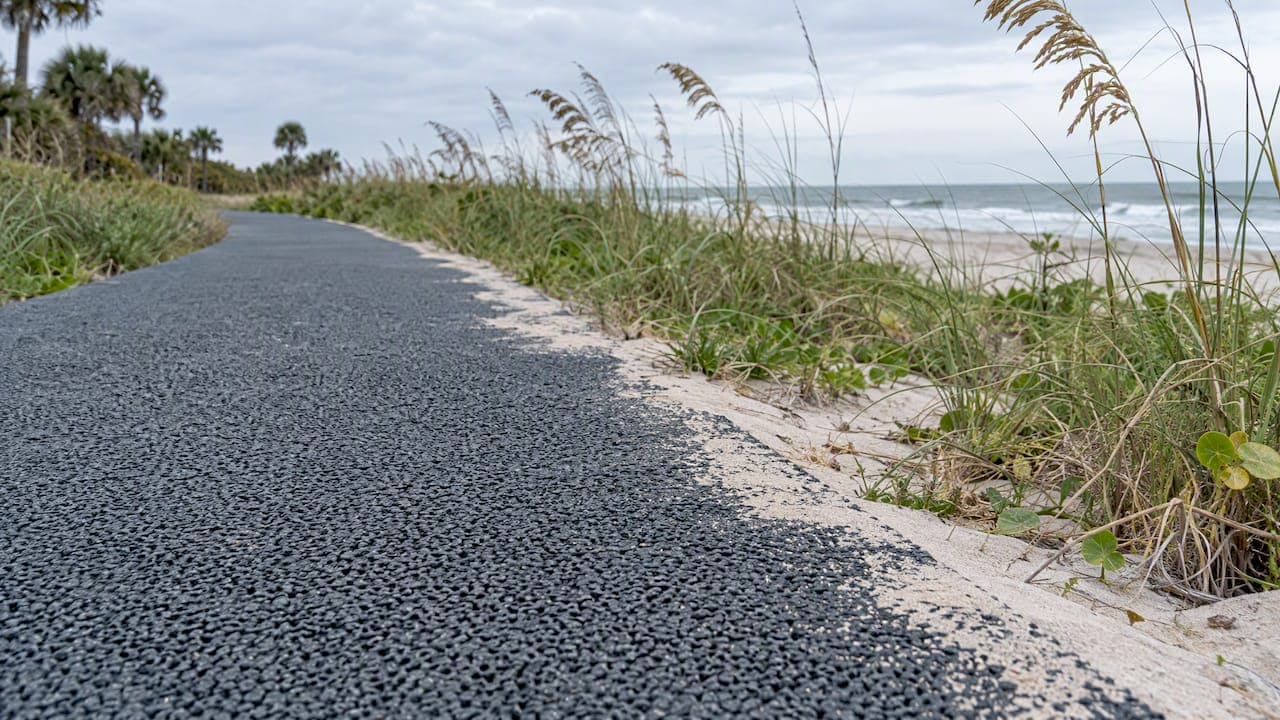
The best coastal walkway surfacing strategies are permeable: pervious concrete, permeable interlocking concrete pavement (PICP), and porous rubberized systems. All three let water pass through instead of pooling or sheeting toward dunes and shorelines. A drainage-first approach protects the surface, the adjacent ecology, and the budget, since centralized stormwater infrastructure near the coast is often expensive or physically impossible to add.
TL;DR:
- A seasonal water table within about 2 feet of the subgrade calls for a shallow reservoir or impermeable liner, not a standard permeable installation.
- Underdrains should be sized for a 48 to 72 hour drawdown, with calculations documented before construction to establish a baseline for later inspections.
- Require a test slab on site before full production to confirm the mix, finishing method, and pressure washing settings for future cleaning.
- Vacuum sweep twice yearly; pressure wash at about 2,000 psi for minor clogging and 3,000 to 3,500 psi for moderate buildup to avoid raveling.
- Porous asphalt has the lowest upfront cost, but salt air accelerates raveling; compare installed price with expected maintenance frequency instead of choosing by initial cost.
Table of Contents
- Comparing material options for coastal walkways
- Getting drainage and site design right from the start
- Construction practices that prevent early coastal failures
- Building a maintenance schedule that protects your investment
- U.S. projects and the rules driving permeable choices
- Rubberway® porous rubber as a coastal walkway option
- Why rubberized surfacing outperforms traditional materials environmentally
- How rubber paving costs compare over a walkway's lifespan
- Designing for safe, comfortable footing on hot coastal days
- Fitting Rubberway® into existing coastal sites and landscaping
- Meeting ADA requirements on coastal pedestrian routes
- Choosing materials that actually survive salt air
- Practical next steps for people making this decision
- Get a site assessment for your coastal walkway project
- FAQ
- Sources
Comparing material options for coastal walkways
Every material behaves differently once salt spray, heat, and constant foot traffic enter the picture.
- Pervious concrete handles structural loads well and resists salt better than untreated metal or wood, making it a strong fit for boardwalk replacements and park entry plazas.
- PICP (permeable interlocking concrete pavement) uses open-graded joints between concrete units, giving designers flexibility for curves and ADA-compliant routes while keeping infiltration high.
- Porous asphalt costs less upfront but tends to absorb heat and is more prone to raveling, where loose aggregate breaks free at the surface, especially under salt-air weathering.
- Porous rubber surfaces, made from recycled tire material, flex rather than crack under thermal movement and offer consistent slip resistance even when wet.
- Composite approaches, pairing a rigid base with a flexible wear layer, show up in low-traffic promenades where crack resistance matters more than maximum load capacity.
Asphalt's heat retention makes it uncomfortable underfoot on bright coastal afternoons, and raveling accelerates where salt-laden spray contacts the binder repeatedly. Concrete and rubber systems hold their structure longer under that same exposure, which is why most coastal park authorities lean toward one of those two categories for high-visibility pedestrian routes.
Getting drainage and site design right from the start
Permeable surfacing only works when the ground underneath is designed to accept water. Skipping this step is the most common reason permeable walkways fail early.
Before specifying any surface, walk through:
- Groundwater depth: a seasonal water table within about 2 feet of the subgrade requires a shallow reservoir design or an impermeable liner, since FHWA guidance warns against standard permeable installations in that condition.
- Sediment sources: nearby dune grass, mulch beds, or unpaved parking can clog pores faster than normal use would.
- Permitting constraints: many coastal municipalities tie permeable pavement approval to stormwater or MS4 permit requirements, so confirm local rules early.
Underdrains set into a stone reservoir layer are typically sized for a 48 to 72 hour drawdown period, per FHWA's permeable interlocking concrete pavement guidance, which also notes PICP systems can accept flow rates up to 1,000 inches per hour at the surface. That capacity is what lets a coastal walkway shed a heavy afternoon storm without ponding.
Pro Tip: Ask your designer to document the drawdown calculation in writing before construction, not after; it becomes the baseline for every future maintenance inspection.
Permeable surfacing can also count toward a municipality's green infrastructure or MS4 compliance targets, cutting the need for separate detention basins. Our piece on stormwater ordinances walks through how local rules shape which materials pass review.
Construction practices that prevent early coastal failures
Most permeable walkway failures trace back to shortcuts during construction, not the material itself.
- Build a test slab on site before full production. The New Jersey porous concrete study recommends this step specifically to confirm mix design, finishing technique, and the pressure-washing settings that will later be used for cleaning.
- Install geotextile fabric between the subgrade and the stone reservoir layer to stop fines from migrating upward and clogging pores from below.
- Set firm edge restraints so vehicle loads or foot traffic at the perimeter don't push aggregate out of alignment over time.
- Grade slopes carefully, since excessive pitch on permeable surfaces can wash fines toward low points faster than the system can infiltrate them.
Skip untreated timber and galvanized steel for any structural components exposed to salt air. Both corrode or rot faster near the coast than inland. Fiber-reinforced polymer (FRP) resists that corrosion and needs less upkeep over the life of a structure.
Building a maintenance schedule that protects your investment
A permeable walkway is only as good as the maintenance plan behind it. Clogged pores behave like impervious pavement, defeating the entire purpose of the system.
- Vacuum sweep twice per year as a baseline. The New Jersey DOT final report identifies this as the most effective single maintenance practice for porous concrete sidewalks, and the same cadence applies broadly to PICP and porous rubber.
- Pressure wash at calibrated settings: around 2,000 psi for minor surface clogging, stepping up to 3,000 to 3,500 psi for moderate clogging, according to the same report. Going beyond that range risks raveling the surface rather than cleaning it.
- Run periodic infiltration tests using a simple ring infiltrometer or observation wells to confirm the system still drains at or near its design rate.
One finding worth planning around: twice-yearly vacuuming is the maintenance method the New Jersey DOT study found most effective at keeping porous concrete sidewalks functional long term.
Budget for localized panel repairs rather than full resurfacing when infiltration drops in isolated spots. That approach keeps whole-life costs well below what a full tear-out and replacement would run.
U.S. projects and the rules driving permeable choices
A handful of U.S. projects show what permeable coastal surfacing accomplishes in practice. New York City's reconstruction of the Beach 108th corridor in Rockaway installed over 11,000 square feet of porous concrete, designed to let nearly 1.3 million gallons of stormwater infiltrate annually instead of overloading the sewer system and stressing nearby Jamaica Bay.
National park authorities have applied similar thinking at Yellowstone, where eco-paving projects incorporating recycled content serve the same dual purpose: handling heavy seasonal foot traffic while limiting runoff into sensitive watersheds.
- Local stormwater and MS4 permit requirements are frequently the real driver behind a permeable spec, not aesthetics.
- EPA's coastal green infrastructure handbook lists permeable pavement as a recognized best management practice for municipalities managing coastal runoff.
Rubberway® porous rubber as a coastal walkway option
Porous rubber built from recycled tire material checks the same boxes mainstream permeable pavement guidance calls for: open void structure for drainage, flexibility that resists thermal cracking, and a surface texture that holds traction when wet. The Rubberway® system applies that structure to ADA-capable coastal routes, pool decks, and municipal walkways where flexibility under thermal movement matters as much as drainage capacity.
Before signing off on any vendor, including us, ask for:
- A test slab or mock-up installed on site, matching the practice FHWA and state DOT studies recommend for permeable systems generally.
- Documented drawdown performance, typically in the 24 to 72 hour range depending on soil and reservoir depth.
- A written installation and maintenance plan, including who handles vacuum sweeping and pressure washing after year one.
We install Rubberway® with licensed, insured crews, and our product pages carry technical specs for each system variant.
Why rubberized surfacing outperforms traditional materials environmentally
Porous rubber surfacing is manufactured from recycled tire material, diverting tires from landfill rather than relying on newly quarried aggregate the way concrete and asphalt do. That difference matters most in coastal zones, where protecting nearby dunes, wetlands, and water bodies from runoff pollutants is often the entire reason a permeable spec gets chosen in the first place.
Because the surface stays porous rather than cracking into impervious patches over time, it continues infiltrating stormwater on-site for years rather than redirecting it toward storm drains and, eventually, the ocean. That keeps pollutants like oil residue and sediment out of the water column instead of concentrating them at a single outfall.
Rubber's flexibility also means fewer full-depth replacements. Concrete and asphalt panels that crack under thermal stress or root intrusion typically get torn out and re-poured, generating demolition waste. A surface that bends instead of fracturing avoids that cycle more often, which lowers the material volume headed to landfill over a walkway's service life.

How rubber paving costs compare over a walkway's lifespan
Upfront, porous asphalt tends to be the least expensive option per square foot, with pervious concrete and PICP landing in the middle, and rubberized systems often priced closer to premium concrete installations. Judging only by day-one cost misses the bigger picture for a coastal path, though.
Asphalt's tendency to ravel in salt air and crack under UV exposure shortens its service interval, meaning more frequent resurfacing. Concrete holds up longer but is rigid, so settling or root movement can crack panels that then need individual replacement. Rubberized surfacing flexes with ground movement and resists UV degradation, which tends to push routine costs toward scheduled cleaning (vacuuming and pressure washing) rather than structural repair.
For a specific project, request a written quote so you can compare installed cost against anticipated maintenance frequency rather than relying on list pricing alone. We provide quotes based on site conditions and scope rather than a flat per-square-foot rate, since coastal subgrade work varies site to site.
Designing for safe, comfortable footing on hot coastal days
Slip resistance and surface temperature both affect how a coastal walkway actually gets used, especially by families with small children walking barefoot from beach to parking lot.
Open-pore surfaces like porous rubber and PICP drain standing water almost immediately after rain, which removes one of the most common slip hazards on coastal paths. Smooth troweled concrete, by contrast, can hold a thin water film that turns slick underfoot until it evaporates.
Surface temperature matters just as much in Florida's climate. Dark asphalt and dark-pigmented concrete absorb heat and can become uncomfortably hot to bare feet by midafternoon. Rubberized surfacing, available in lighter custom colors, reflects more solar radiation and stays cooler to the touch, a detail that matters directly at pool decks, boardwalk connectors, and beach access points where people frequently walk barefoot.
Fitting Rubberway® into existing coastal sites and landscaping
Most coastal walkway projects aren't blank slates. They connect to existing boardwalks, dune crossovers, parking areas, and landscaped buffers that already have their own grading and drainage patterns.
Rubberway® installs as a surface layer over a properly prepared base, which lets it tie into existing concrete aprons, timber boardwalk transitions, or paver edges without requiring a full regrade of the surrounding site. Because the system is poured and cured in place rather than assembled from rigid panels, it can follow curved paths around existing landscaping, root zones, or drainage swales more easily than precast units can.
That flexibility matters for HOA common areas and municipal parks where mature trees or protected dune vegetation sit close to the path edge. Integration planning still starts with the same site assessment steps covered earlier, groundwater depth, slope, and adjacent sediment sources, so the new surface drains correctly into whatever stormwater system already serves the property.
Meeting ADA requirements on coastal pedestrian routes
Coastal walkways carry the same ADA obligations as any other public pedestrian route, and surface choice affects compliance more than people expect. Running slope, cross slope, and a firm, stable, slip-resistant surface are the core requirements a coastal path has to meet regardless of material.
Loose sand, gravel, or unbound aggregate paths fail the "firm and stable" standard outright, which is part of why so many coastal parks move toward bound permeable surfaces for accessible routes. Rubberway® and properly placed PICP both provide a continuous, stable surface while still draining, letting a single path serve as both the accessible route and the primary pedestrian connector rather than requiring a separate ADA detour.
Grade transitions at boardwalk connections or dune crossovers deserve particular attention, since abrupt elevation changes are one of the most common ADA violations found during coastal park audits. Specifying a flush, beveled transition at these joints during design avoids a costly retrofit later.
Choosing materials that actually survive salt air
Coastal exposure changes the selection math compared to an inland walkway. Three properties matter more here than almost anywhere else.
Salt tolerance comes first. Reinforcing steel, galvanized fasteners, and untreated timber all degrade faster once salt spray reaches them, which is why fiber-reinforced polymer (FRP) has become the preferred substitute for structural components near the shoreline. UV resistance comes second: constant sun exposure near open water accelerates binder breakdown in asphalt and can fade or chalk some concrete sealers faster than the same material would weather inland.
Flexibility is the third factor, and it's often underweighted during specification. Coastal subgrades shift more than inland soils due to tidal influence, seasonal groundwater swings, and sandy, less-consolidated base material. A rigid surface that can't accommodate that movement cracks; a flexible one, like porous rubber, absorbs it. Matching all three properties, salt tolerance, UV resistance, and flexibility, to your specific site conditions does more to extend service life than choosing based on upfront cost alone.

Practical next steps for people making this decision
If there's one lesson across coastal walkway projects, it's that the surface everyone judges on day one isn't the surface that matters five years later: applying best practices for hurricane construction for new homes in Tampa can guide coastal walkway resilience and long-term performance. Run the site assessment and the test slab before locking in a spec; skipping either is where most early failures start. Put maintenance commitments in the contract itself, not as a verbal promise, and compare whole-life cost rather than just the installed price. When salt exposure is heavy or the footprint is tight, lean toward permeable or flexible systems over rigid ones.
— Roger
Get a site assessment for your coastal walkway project
If you're weighing pervious concrete, PICP, or porous rubber for a coastal path, rubber paving can provide a flexible, ADA-capable surface built from recycled material, installed by licensed and insured crews. We handle the drainage-first design work covered throughout this piece, from test slab review to a documented maintenance plan, so the walkway keeps draining the way it was specified to.
Browse our Rubberway® product line for technical specs on Pervious Pavement, Rubberrock 6000, and EVOLUTION, or reach out through our installation page to schedule a site visit and request a quote.
FAQ
What is the cheapest walkway material?
Porous asphalt is typically the lowest upfront cost among permeable options, though it tends to need more frequent resurfacing in salt-air environments due to raveling and heat exposure. Factoring in maintenance and replacement frequency, a mid-range option like PICP or rubberized surfacing often costs less over the full life of the walkway.
Are sidewalks asphalt or concrete?
Most municipal sidewalks in the United States are built from concrete rather than asphalt, largely because concrete holds a stable, even surface longer under foot traffic. Coastal sidewalks increasingly use permeable concrete or rubberized surfacing specifically to manage stormwater while keeping that same stability.
What is the best material for a sidewalk?
For coastal sidewalks, permeable concrete, PICP, or porous rubber are generally the strongest choices because they drain stormwater on-site, resist salt exposure better than untreated wood or steel, and meet ADA stability requirements. The right pick depends on traffic load, groundwater depth, and how much flexibility the site's soil movement demands.
What is the best material for a walkway?
The best walkway material balances drainage, salt tolerance, and slip resistance, which for most coastal settings points toward pervious concrete, PICP, or porous rubber rather than standard asphalt. A site assessment and test slab, as FHWA guidance recommends, confirms which of those fits a specific location best.
Sources
- Implementation of Porous Concrete in Sidewalks in New Jersey Final Report
- City Completes Reconstruction of Rockaway Corridor with Dramatic Safety Upgrades and Improved Drainage
- Permeable Pavements: Design, Construction, and Maintenance (FHWA)