
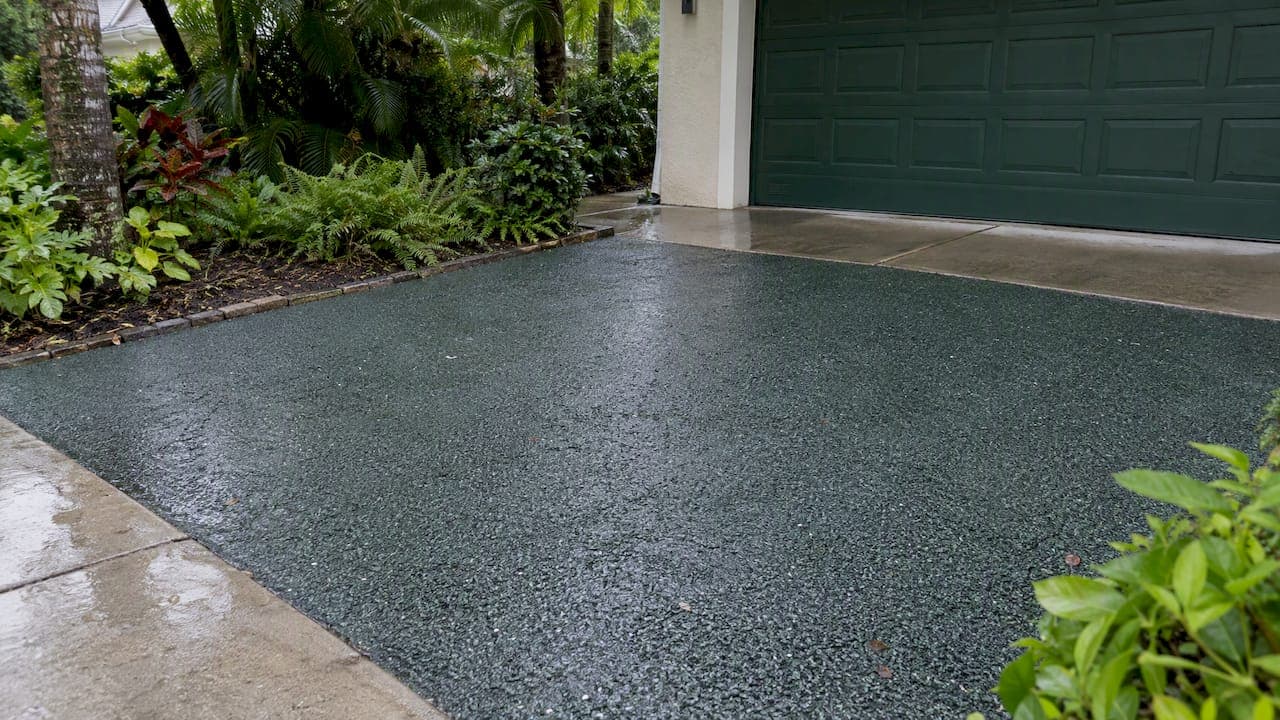
The best eco-friendly driveway resurfacing options are permeable pavements, pervious concrete, porous asphalt, permeable interlocking pavers, gravel grid systems, and pervious rubber paving such as Rubberway®. Permeable systems suit homeowners who need maximum infiltration, while pervious rubber works well where crack resistance, ADA compliance, and heat tolerance matter most. Correct sub-base design and routine maintenance determine how long any of these surfaces keep draining properly.
TL;DR:
- A USGS study lasting 24 months found porous asphalt, pervious concrete, and permeable pavers reduced suspended solids by about two thirds to four fifths.
- Vacuum sweep permeable surfaces in spring and late fall; avoid winter sand, which contributed to clogging within the first year in a USGS field study.
- Before signing, require an infiltration test and written subbase plan; poor drainage may require a deeper stone reservoir or an underdrain, raising project cost.
- Choose gravel or grass grids for lightly used driveways and low upfront cost; select interlocking pavers when modular repairs and reuse matter.
- Pervious rubber such as Rubberway suits driveways exposed to heat and accessible shared routes because it resists cracking through temperature swings and meets ADA requirements.
Table of Contents
- Quick overview: eco-friendly resurfacing options at a glance
- Permeable systems explained: how each technology manages runoff and where it performs best
- How resurfacing works: site evaluation, sub-base design, and a homeowner's timeline
- Maintenance, winter care, and longevity: keep the system draining for decades
- Cost and lifespan: budgeting and choosing based on site and priorities
- Case studies in rubber driveway installations across Florida
- Author perspective: when homeowners should prefer a permeable resurfacing solution
- How EcoTec Rubber Paving can help with your resurfacing project
- FAQ
- Sources
Quick overview: eco-friendly resurfacing options at a glance
Every option below reduces stormwater runoff by letting water pass through the surface instead of sheeting off into storm drains. The right choice depends on your traffic load, budget, and how much upkeep you're willing to handle.
- Pervious concrete: best for homeowners wanting high infiltration rates and a clean, uniform look.
- Porous asphalt: best for budget-conscious drainage with a stone reservoir base.
- Permeable interlocking pavers (PICP): best for modular repairs and attractive, varied finishes.
- Gravel and grass grid systems: best for low-cost retrofits on lightly used driveways.
- Pervious rubber (Rubberway®): best for crack resistance, ADA-compliant surfacing, and heat-prone climates.
All five categories filter pollutants before water reaches local waterways, according to EPA guidance on permeable pavement. Maintenance needs vary widely, so match your pick to how much seasonal upkeep you want to commit to.
Permeable systems explained: how each technology manages runoff and where it performs best
Pervious concrete typically achieves 15% to 25% void content, which lets water pass directly through the slab into the stone base below. FHWA's pervious concrete technical brief notes that flow rates depend heavily on mix design and that careful placement and curing are necessary to meet both structural and hydraulic goals. It works best on driveways with moderate traffic and a contractor experienced in pervious mixes.
Porous asphalt relies on a stone reservoir beneath the surface layer to store and slowly release water. According to FHWA's porous asphalt guidance, this is a recognized low-impact development technique, and properly maintained installations can last 20 years or more.
Permeable interlocking concrete pavers (PICP) offer a different advantage: individual units can be lifted, repaired, and reused, which keeps life-cycle costs down and simplifies joint maintenance through vacuum sweeping.
- Gravel paired with a plastic or grass grid system offers the lowest upfront cost and works well for lightly trafficked driveways.
- Reinforced grass grids protect root zones while still supporting occasional vehicle weight.
- Recycled asphalt and pervious rubber options, including Rubberway®, use reclaimed materials and resist cracking from heat and freeze-thaw cycles, with Rubberway® also offering ADA-compliant surfacing for accessible routes.
A 24-month USGS study found that porous asphalt, pervious concrete, and permeable pavers reduced total suspended solids by approximately two-thirds to four-fifths, with some bacterial indicators dropping by about 80%. For homeowners, that means less sediment and bacteria reaching storm drains and nearby waterways, not just less standing water in the driveway.
How resurfacing works: site evaluation, sub-base design, and a homeowner's timeline
A contractor should start with a site evaluation before recommending any resurfacing material. This step determines whether your soil can handle infiltration or whether you'll need an underdrain.
- Infiltration testing measures how quickly water moves through your existing soil.
- Slope and drainage mapping identifies where water currently pools or flows off the property.
- Sub-base design sizes the stone reservoir to match your soil's infiltration rate, sometimes adding an underdrain or liner on clay-heavy sites.
- Installation proceeds differently by material: pervious concrete and porous asphalt require specialized placement crews, PICP and gravel grids install faster with fewer curing constraints, and rubber systems like Rubberway® typically install over a prepared base with shorter cure times.
- Permit and stormwater-credit review should happen before work begins, since some municipalities offer credits for permeable surfaces.
Pro Tip: Ask your installer for a written sub-base plan and infiltration test result before signing a contract, not just a surface material recommendation.
Check with your local building or stormwater authority directly on permit requirements and any available credits, since rules vary by jurisdiction. For deeper design detail, our guide to stormwater-ready paving systems covers sub-base sizing in more depth.
Maintenance, winter care, and longevity: keep the system draining for decades
Permeability declines gradually unless you stay ahead of debris and sediment buildup. Most permeable surfaces need vacuum sweeping twice a year, typically in spring and late fall, to clear pores before heavy rain or snow season.
- Vacuum sweep in spring and late fall to remove leaves, grit, and organic debris.
- Avoid sand for winter traction since it clogs pores quickly; use gravel-free de-icers sparingly instead.
- Test infiltration periodically using methods like ASTM C1781 to confirm the surface still drains as designed.
- When drainage slows, try restorative vacuuming or selective power washing before assuming the surface has failed.
A USGS field study in Madison, Wisconsin found that winter sanding contributed significantly to clogging within the first year across three permeable pavement types. Pervious concrete and porous asphalt need the most consistent sweeping schedules, while pervious rubber and PICP tend to tolerate longer intervals between cleanings. If sweeping and testing don't restore flow, it's worth bringing in a paving professional to inspect the stone reservoir underneath.
Cost and lifespan: budgeting and choosing based on site and priorities
Sub-base sizing and soil correction usually drive cost more than the surface material itself. A site with poor natural drainage needs a deeper stone reservoir or an underdrain, which adds labor and material before the top layer goes down.
- Pervious concrete and porous asphalt sit in similar cost ranges, with porous asphalt often cheaper to install but requiring more frequent sweeping.
- PICP carries a higher per-unit material cost but lower long-term repair costs since individual pavers can be replaced.
- Gravel and grass grids are the least expensive upfront, suited to driveways with light use.
- Pervious rubber (Rubberway®) offers crack resistance in freeze-thaw and heat cycles, which can reduce repair frequency over the surface's life.
Properly maintained porous asphalt can last two decades or longer according to FHWA guidance, and maintenance intensity directly affects how long any permeable surface keeps performing. Some municipalities offer stormwater fee credits for permeable installations, which can offset part of the upfront cost over time.
Case studies in rubber driveway installations across Florida
Florida's combination of intense heat, heavy seasonal rain, and sandy or clay-variable soils makes driveway material choice more consequential than in milder climates. Standard asphalt and concrete are prone to heat-induced cracking and standing water during Florida's wet season, which is why pervious systems get specific attention in the state.
Rubberway® installations are designed around this climate profile. The porous structure handles Florida's intense downpours by letting water pass through rather than pool on the surface, while the rubber composition resists the expansion and contraction cracking that plagues rigid pavements during temperature swings between hot pavement surfaces and sudden storms.
For residential driveways, pool decks, and HOA community areas, the surface also needs to meet accessibility requirements. Rubberway® systems are built to ADA-compliant specifications, which matters for shared community spaces, municipal walkways, and any residential project where a smooth, non-slip, step-free surface is required.
Municipal and HOA projects in Florida tend to favor rubber paving for trails and sidewalks specifically because it combines drainage performance with a surface that stays cooler underfoot than traditional asphalt. Homeowners considering a similar upgrade for a driveway or walkway can review the Rubberway® product line to see which system fits residential versus higher-traffic applications.

Author perspective: when homeowners should prefer a permeable resurfacing solution
Homeowners with small lots and recurring runoff problems benefit most from engineered permeable pavements, since every square foot of infiltration counts when there's little room for drainage infrastructure. Pervious rubber earns its place specifically on heat-exposed driveways where crack resistance and ADA-compliant surfacing matter more than material cost alone.
— Roger
How EcoTec Rubber Paving can help with your resurfacing project
We specialize exclusively in rubber paving, which means every project we take on uses the same Rubberway® system engineered for Florida's climate: recycled materials, porous drainage, and crack resistance built for heat and heavy rain. We provide coordinated attention from a team focused solely on rubber paving projects.
When you request a quote from us, ask for these five things so you can compare it fairly against other options:
- An infiltration test result for your specific site.
- A written sub-base plan showing reservoir depth and drainage design.
- Confirmation of ADA compliance if the surface serves a shared or accessible space.
- A maintenance guide specific to your installed Rubberway® system.
- An itemized project timeline from site prep to final surface.
Before resurfacing begins, you'll likely need to deal with removing the old driveway material. If that's part of your project, Pinky's Junk Removal's concrete disposal guide covers permit-compliant options for clearing old concrete and construction debris.
Ready to see what a Rubberway® driveway looks like for your property? Visit Ecotecrubber to start a quote request.
FAQ
How long does recycled asphalt last on a driveway?
Recycled asphalt driveways typically perform similarly to standard porous asphalt when properly maintained, often lasting two decades or more according to FHWA guidance on porous asphalt systems. Lifespan depends heavily on routine sweeping and avoiding sand-based de-icers, which clog pores and accelerate wear.
What are some alternatives to pavers for a driveway?
Alternatives to interlocking pavers include pervious concrete, porous asphalt, gravel with a reinforcing grid, reinforced grass systems, and pervious rubber surfaces like Rubberway®. Each offers a different balance of cost, drainage performance, and maintenance needs, so the right pick depends on your soil, budget, and traffic load.
What are the downsides of permeable tarmac (porous asphalt)?
Porous asphalt requires regular vacuum sweeping, ideally in spring and late fall, to prevent pore clogging from debris and sediment. A USGS field study found that winter sanding was a leading cause of reduced permeability within the first year, so de-icing practices need adjustment compared to standard asphalt.
How can I resurface my driveway with eco-friendly materials?
Start with a site evaluation that includes infiltration testing and slope mapping, then choose a permeable material suited to your soil and traffic load, such as pervious concrete, porous asphalt, PICP, or pervious rubber. A qualified installer will size the sub-base and stone reservoir to match your site's drainage capacity before placing the surface layer.
Sources
- Experimental Permeable Pavement Parking Lot and Rain Garden Stormwater Management — U.S. EPA
- Hydraulic, water-quality, and temperature performance of three types of permeable pavement — USGS (2018)
- Pervious Concrete (TechBrief) — Federal Highway Administration