
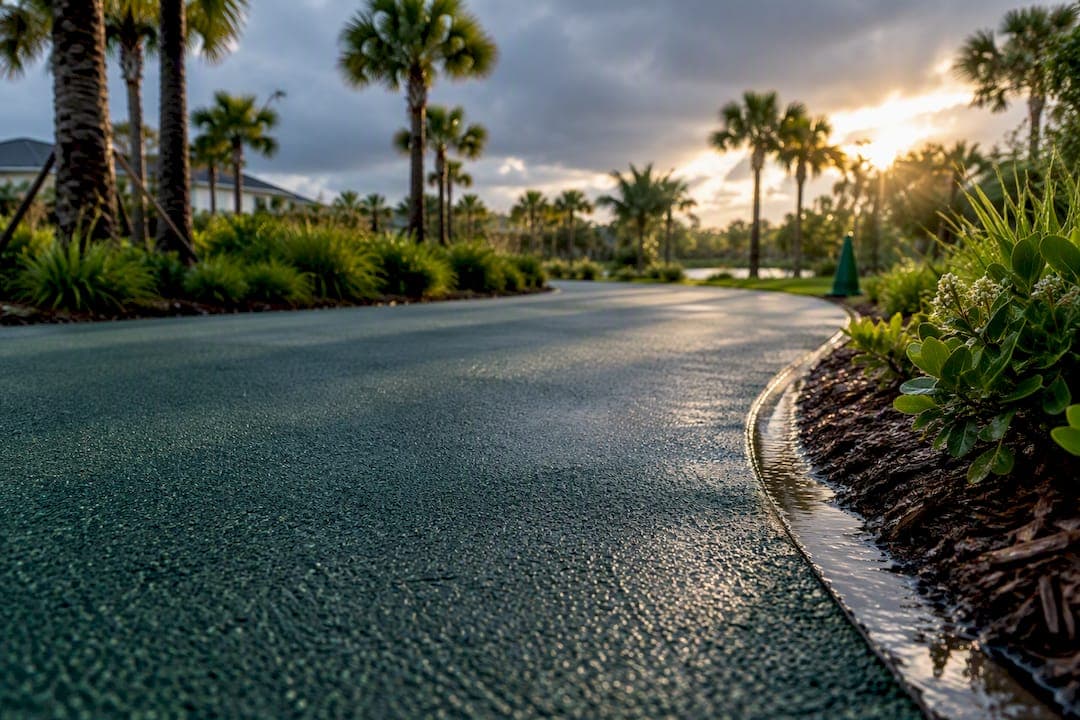
Yes. Most HOAs can require board or architectural committee approval before you install, replace, or resurface a walkway, and they can dictate the material, color, and finish through the CC&Rs. Concrete, brick, natural stone, and unit pavers usually clear review without a fight. Loose gravel as a primary surface and, in many communities, asphalt tends to get rejected outright. Before you order materials, pull your governing documents and confirm what your specific association allows.
TL;DR:
- Most HOA boards prefer standard materials like pavers, brick, or natural stone that demonstrate durability and aesthetic consistency.
- Rubber paving systems are increasingly approved due to their slip resistance, permeability, and ability to withstand climate-related stress.
- Detailed technical submissions, including drainage plans and contractor documentation, are essential for first-time approval and can reduce review times.
- Responsibility for walkway repairs varies by ownership category, with HOA-maintained common areas, homeowner-owned lots, and public sidewalks falling under different jurisdictions.
- Gravel and asphalt are often rejected for primary walkways, but poured concrete with proper base preparation remains a cost-effective choice in most communities.
Table of Contents
- Who Actually Controls Your Walkway: CC&Rs, the ARC, or the City?
- Which Walkway Materials Pass ARC Review (And Which Get Rejected)
- What Boards and Homeowners Should Actually Evaluate
- Building an ARC Submission That Gets Approved the First Time
- Who Pays When the Walkway Cracks?
- Why Rubber Paving Clears ARC Review More Often Than You'd Expect
- What Boards Actually Ask Me Before Approving a Walkway
- Ready to Submit a Rubber Paving Proposal Your ARC Will Approve
- Sources
- FAQ
Who Actually Controls Your Walkway: CC&Rs, the ARC, or the City?
Your association's authority comes from its recorded covenants, conditions, and restrictions, plus whatever architectural guidelines the board has adopted under them. Most CC&Rs include a clause requiring prior written approval for any exterior modification, walkways included, and give the architectural review committee (ARC or ARB) discretion over material, color, and finish. OurHOA's guidance on driveway and walkway materials confirms this is standard practice: associations can regulate these details as long as the governing documents grant that power.
But not every walkway falls under the same authority. Three ownership categories matter here:
- HOA common-area walkways run through shared land and typically fall under the association's maintenance and material rules.
- Homeowner lot walkways sit on your property but still usually require ARC sign-off before you change them.
- Public right-of-way sidewalks often belong to the municipality's jurisdiction, even when they front your lot, and city code can override or supplement HOA preferences.
If your walk touches a public right-of-way, check with your city or county before assuming the HOA's rulebook is the final word. Permits sometimes apply even when the ARC has already approved your plan.
Which Walkway Materials Pass ARC Review (And Which Get Rejected)
Boards tend to favor materials with a track record of holding up, staying level, and matching the community's aesthetic. Here's how most ARC standards break down:
- Unit pavers. Concrete or clay pavers are almost universally accepted because individual units can be replaced without redoing the whole path.
- Brick. A classic choice for older or historic-style developments, and rarely flagged during review.
- Flagstone and natural stone. Popular for a higher-end look, though boards may ask for color samples since stone varies piece to piece.
- Poured concrete. Broadly accepted, but some associations restrict long, unbroken concrete runs or require a specific finish rather than plain gray slab.
- Stabilized or aggregate-concrete surfaces. Often conditionally approved, meaning you will likely need to submit a spec sheet showing the aggregate mix and binder.
- Engineered permeable pavers. Increasingly welcomed where local stormwater rules favor them, but plan on submitting engineering details up front.
- Loose gravel. Generally prohibited as a primary walking surface. Brambleton HOA's 2024 walkway standards explicitly bar it, and that language is common across similar covenants.
- Asphalt. Prohibited in many residential schemes, particularly where it wasn't part of the original streetscape plan.
- Untreated wood decking. Discouraged for front walkways in most communities because it weathers unevenly and creates a tripping hazard over time.
- Stamped or stained concrete. Usually approvable, but treated as conditional since color and texture need board sign-off first.
Worth knowing: replacing a walkway with the same material it already had often does not require a fresh approval cycle, according to Brambleton's standards. Swapping materials is what triggers full review.
What Boards and Homeowners Should Actually Evaluate
Picking a walkway material isn't just about what the ARC will approve on paper. It's about what performs once it's down. Five factors decide whether a material earns its place in a community for the next 15 years.
Firmness and ADA access. Any walkway serving wheelchairs, walkers, or carts needs a stable, even surface. This is where unit pavers, poured concrete, and rubber paving systems consistently outperform loose or textured materials. Our ADA compliance breakdown for rubber surfaces covers the specific slip and firmness benchmarks reviewers ask about.
Drainage and stormwater. Impermeable concrete slabs push water toward drains and gutters, which can overwhelm older stormwater systems. Permeable pavers, porous concrete, and porous rubber surfaces let water pass through the surface itself. Some municipalities now favor this, as covered in our piece on permeable paving and HOA stormwater rules.
Durability against climate. Freeze-thaw cycles crack rigid concrete over a few seasons in northern climates. Heat and UV exposure do similar damage in the South, where slabs expand, contract, and eventually split.
Maintenance and lifecycle cost. Gravel needs regular replenishment. Paver joints need occasional weeding or sand top-ups. Concrete needs full-panel replacement once it cracks, since spot repair rarely blends in.
- Compacted crushed-stone base depth typically runs 4 to 6 inches depending on material and soil.
- Edge restraint keeps pavers and gravel from creeping outward under foot traffic.
- Non-woven geotextile fabric under poor soils prevents base material from mixing into subsoil over time.
Pro Tip: Include your base and drainage cross-section in the initial submission, not as a follow-up request. ARCs deny more applications for missing technical detail than for material choice itself.
Building an ARC Submission That Gets Approved the First Time
A denial almost always comes down to a missing document, not a bad material choice. Submit these together and you'll cut your review time in half:
- Site photo showing the current walkway or bare ground.
- Dimensioned plan with exact width, length, and placement relative to property lines.
- Material samples or color swatches, especially for stone, pavers, or stamped concrete.
- Contractor license and insurance documentation.
- Cross-section drawing showing base depth, drainage path, and edge restraint.
- Proposed installation schedule with a start and completion window.
- Warranty information from the installer or manufacturer.
Most denials trace back to three issues: a color that clashes with the streetscape, a loose material proposed where the covenants require a fixed surface, or no drainage plan at all. Preempt each one by matching your material to neighboring homes and including engineering detail up front.
Expect review timelines to run anywhere from two to six weeks depending on how often your board meets. If the walkway touches a public sidewalk, confirm separately whether the city requires its own permit, since ARC approval doesn't substitute for municipal sign-off.
Who Pays When the Walkway Cracks?
Responsibility depends entirely on ownership. Common-area sidewalks are usually the HOA's job to maintain, per Meadowwood HOA's sidewalk repair guidance. Homeowner-installed lot walkways stay the homeowner's responsibility. Public sidewalks often fall to the abutting property owner under municipal ordinance, separate from anything the HOA governs, according to this HOA sidewalk maintenance breakdown.
Boards limit their liability with a few practical tools:
- Scheduled inspections that catch heaving or cracking before someone trips.
- Slab leveling or grinding as a cheaper alternative to full replacement.
- Reserve fund allocations earmarked specifically for walkway repair cycles.
Homeowners should document every approval request and keep insurance information on file, especially if a contractor caused any incidental damage during installation.
Why Rubber Paving Clears ARC Review More Often Than You'd Expect
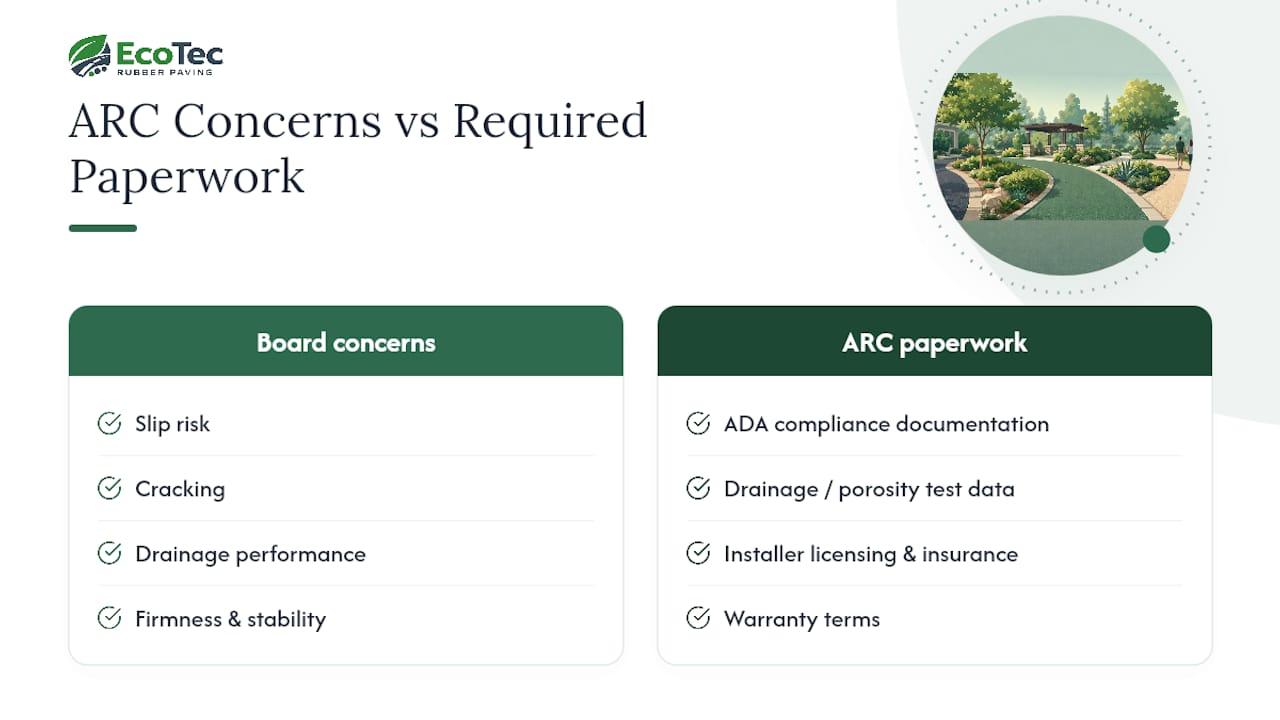
Boards worry about three things: slip risk, cracking, and drainage. A porous, resilient surface addresses all three at once, which is part of why rubber paving has become a serious contender in wet or heat-prone climates. Firmness, stability, and slip resistance top most safety criteria boards apply, and textured, porous surfaces reduce slip risk better than smooth impermeable slabs.
ARCs reviewing a rubber-paving proposal typically ask for ADA compliance documentation, drainage or porosity test data, installer licensing and insurance, and warranty terms. Our guide on slip-resistant walkway types for community planners covers what reviewers look for. A licensed, insured Rubberway® installer supplying spec sheets and past project references generally moves through committee faster than a proposal missing that paperwork.
What Boards Actually Ask Me Before Approving a Walkway
Most boards get stuck weighing appearance against permeability against what the reserve fund can absorb. Three things speed approval every time: submit color samples that match existing hardscape, include drainage calculations even when not explicitly required, and get contractor insurance certificates on file before the meeting, not after.
Cheap upfront materials that need replacing in five years cost boards more than durable materials that cost more today. I've seen associations relearn that lesson the hard way, usually after a gravel path washes out during the first heavy storm season.
— Roger
Ready to Submit a Rubber Paving Proposal Your ARC Will Approve
Ecotecrubber is the practical alternative to rigid concrete or gravel walkways for communities dealing with Florida's heat cracking and drainage headaches. Where concrete splits under UV stress and gravel washes out in heavy rain, the Rubberway® system uses recycled rubber to deliver a porous, ADA-compliant surface built specifically for that climate.
Licensed and insured crews who specialize in rubber paving can provide ARC submissions with the documentation boards commonly request: spec sheets, drainage details, and installer credentials ready to attach to your application. Product lines include several rubber paving systems suited to different traffic and drainage needs. If your community is weighing options for a common-area path, HOA sidewalk, or homeowner walkway, request a spec sheet or site visit to see which system fits your ARC's requirements before your next submission deadline.
Sources
- WALKWAYS / STEPPING STONES — Brambleton HOA (2024 standards)
- Can an HOA restrict driveway or walkway materials? — OurHOA
- HOA Sidewalk Repair Info — Meadowwood HOA
- HOA Sidewalk maintenance FAQ — Free HOA legal help
FAQ
What is the best material for a walkway?
There's no single best material. It depends on foot traffic, climate, and your ARC's rules, but unit pavers, poured concrete, and porous rubber paving consistently score well on firmness, ADA access, and long-term maintenance. Rubber paving systems like Rubberway® hold an edge in wet or heat-prone climates because they resist the cracking that plagues rigid concrete.
What is the most affordable material for a walkway?
Gravel and decomposed granite carry the lowest upfront cost, but most HOAs prohibit loose gravel as a primary surface, and it needs regular replenishment that adds up over time. Poured concrete usually offers the best balance of low cost and ARC acceptance for communities that don't restrict it.
What is the cheapest way to make a walkway?
Compacting a crushed-stone base and topping it with basic poured concrete or unit pavers keeps material and labor costs down while still meeting most ARC standards. Skipping proper base preparation to save money almost always backfires, since settlement and cracking cost more to fix later than doing it right the first time.
What is the best base material for a paver walkway?
A compacted layer of crushed stone, typically 4 to 6 inches deep depending on soil conditions, forms the standard base for paver walkways. A non-woven geotextile fabric underneath prevents the base from mixing into softer subsoil, and proper edge restraint keeps the pavers from shifting under regular foot traffic.