
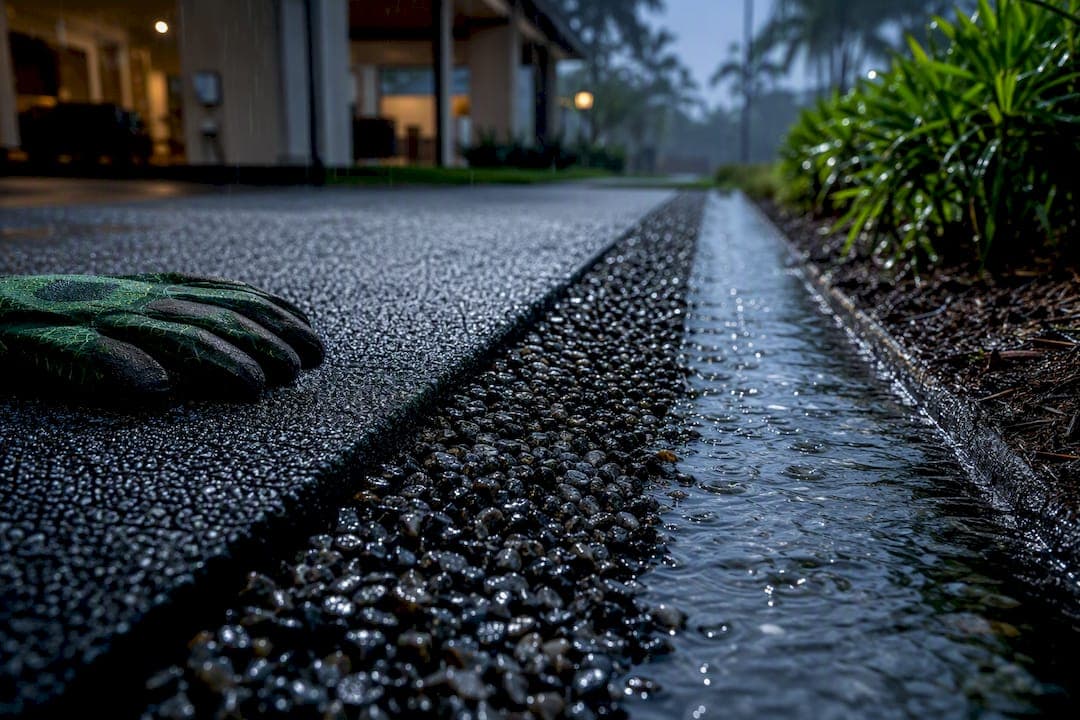
The best wet climate walkway material choices share one trait: they move water away from the surface instead of trapping it. Permeable pavers, textured natural stone, gravel or decomposed granite, textured concrete, and rubber surfacing all handle rain well, but none of them work without a properly engineered sub-base and drainage plan underneath. The right pick depends on whether you're building a pool deck, a garden path, or an ADA-accessible route.
TL;DR:
- Proper drainage and a well-engineered sub-base are critical to prevent walkway failure in wet climates, regardless of surface choice.
- Permeable pavers, textured stone, gravel, and rubber surfacing perform best when installed with correct slope, joint design, and adequate base depth.
- Combining surface drainage solutions like channel drains with subsurface French drains effectively manages surface and soil saturation issues.
- Maintenance, proper installation timing, and regular debris clearing are essential to keep wet climate walkways algae-free and safe.
- Rubber surfacing made from recycled tire material offers flexibility, crack resistance, and permeability, suitable for pool decks and ADA-compliant routes.
Table of Contents
- What Are the Best Materials for a Wet Climate Walkway?
- How Do You Choose the Right Wet Climate Walkway Material?
- Why Does Drainage Matter More Than the Walkway Surface?
- Keeping a Wet Climate Walkway Safe and Algae-Free
- Where Does Rubber Surfacing Fit in a Wet Climate?
- Is Rubber Paving an Environmentally Sound Choice for Rainy Regions?
- What Should You Budget for a Wet Climate Walkway?
- What Installation Steps Matter Most in Wet Climates?
- How Do Seasons Affect a Wet Climate Walkway's Performance?
- Why Drainage Beats Surface Selection Every Time
- How Ecotecrubber Solves Wet Climate Walkway Problems
- Sources
What Are the Best Materials for a Wet Climate Walkway?
Every material on this list can perform well in the rain. Whether it actually does depends on installation quality, joint design, and how much slope the site allows. Here's how each one behaves once the storms start rolling in.
Permeable interlocking pavers rely on open joints filled with small aggregate, sitting over a gravel reservoir that lets rainwater soak straight through instead of sheeting across the surface. That structure is why permeable pavements often outperform poured concrete in rainy climates, reducing standing water and the freeze-thaw cracking that comes from moisture trapped under a solid slab. A cracked or sunken paver is also easy to pop out and replace without tearing up the whole path, which is not true of a poured surface.
Textured natural stone like flagstone, bluestone, or slate offers a rougher walking surface that grips better underfoot when wet, and when set with sand or gravel joints instead of tight mortar lines, it drains between the stones rather than pooling on top. The tradeoff is irregular surfaces can be harder to keep level over time, especially in soil that shifts with seasonal moisture.
Gravel and decomposed granite drain about as fast as any surface you can put down, and they cost less per square foot than almost anything else on this list. They need solid edging to keep material from washing out during heavy storms, and loose or compacted decomposed granite doesn't meet accessibility standards for wheelchairs or walkers, so it's a poor fit for any route that needs to be ADA-compliant.
Poured concrete with a broom or acid-etched finish adds traction that smooth-troweled concrete lacks, which matters the moment the surface gets wet. Concrete's weakness in rainy regions is ponding. Without the right slope, water sits in low spots, and repeated freeze-thaw cycles will eventually spall the surface. It's a durable, budget-friendly choice, but only when a contractor grades it correctly the first time.
Composite and wood decking deserve a caution flag. Many composite boards use wood-fiber fillers inside a plastic shell, and once that shell is scratched, drilled, or worn through, the core absorbs moisture and can develop mold or algae in shaded, damp spots. That same source notes that precast concrete boardwalks hold slip-resistant texture and need far less long-term upkeep than timber or composite decking in wetland-style settings.
Rubber surfacing, whether poured-in-place or installed as interlocking tiles, gives you a textured, flexible walking surface that resists cracking under freeze-thaw stress and can be engineered for permeability. Rubber surfacing traction in wet weather tends to beat rigid materials specifically because the surface flexes instead of splitting, and it can go directly over a repaired substrate rather than requiring full demolition.
Porcelain and outdoor tile can work outdoors, but only with a slip rating built for wet exposure and an adhesive system rated for exterior, high-moisture installation. Ask any installer for the specific traction rating before you sign off on tile near a pool or shaded walkway.
How Do You Choose the Right Wet Climate Walkway Material?
Picking a surface without checking these five things first is how homeowners end up redoing a walkway two years in.
- Match the material to the use case. A high-traffic commercial sidewalk needs different durability than a quiet garden path, and a pool deck has different slip requirements than either one.
- Ask for slip and permeability numbers. Reputable suppliers can point to ASTM slip-resistance testing or published permeability rates. A vague "it's not slippery" is not an answer.
- Confirm the drainage plan before the base goes in. Ask specifically whether the project includes a French drain, channel drain, or dry well, and where the water goes once it leaves the site.
- Budget for the full lifecycle, not just installation day. Cheaper materials often carry higher resealing, regrouting, or replacement costs over ten years.
- Watch for red flags. A vague warranty, no drainage plan on paper, or a contractor who won't share references are all reasons to keep looking.
Pro Tip: Ask every bidder the same question: "What's the engineered base depth for this specific soil, and how does water leave the site?" A contractor who can't answer specifically probably hasn't planned for it.
Why Does Drainage Matter More Than the Walkway Surface?
A properly engineered sub-base, usually open-graded aggregate, is the leading factor preventing walkway failure in wet climates. Surface choice matters far less than what's happening six to twelve inches below it. Skip the base work and even premium stone or rubber will heave, rut, or settle within a few wet seasons.
Professionals commonly specify an open-graded aggregate base and drainage layer under permeable systems, because insufficient base depth is the single most common cause of long-term settlement failure. Standard design guidance calls for a slight surface slope, generally around 1 to 2 percent, so rain sheets off instead of collecting in low spots.
For flat grades where water runs across a paved surface rather than soaking straight down, channel drains and trench drains intercept that sheet flow before it pools. Permeable pavers handle infiltration on their own; channel drains handle surface runoff that has nowhere else to go. Most wet-climate walkways need some combination of both.
- Retrofitting a struggling walkway usually starts with adding a surface-level channel drain at the spot where water visibly sheets.
- Perimeter French drains solve subsurface saturation that channel drains miss.
- Combining a channel drain with perimeter French drains often fixes both surface pooling and the soil saturation that causes heaving, according to NDS installation guidance.
- Downspout extensions and dry wells, moving roof runoff away from the walkway edge, prevent the most common source of localized flooding near a home.
Ecotecrubber's drainage integration approach for engineered surfaces treats the sub-base as the actual product, with the surface layer as the visible finish on top of it.
Keeping a Wet Climate Walkway Safe and Algae-Free
Damp conditions grow algae and moss fast, and both turn a walkway into a slip hazard within weeks if ignored. A biannual cleaning schedule, spring and fall, catches most buildup before it becomes dangerous, though shaded or north-facing paths often need a mid-season check too.
- Pressure wash porous surfaces like gravel, stone, or rubber at low to moderate pressure to avoid dislodging joint material.
- Use an oxygen bleach or specialized outdoor cleaner rather than chlorine bleach near landscaping, since chlorine kills nearby plants and soil microbes.
- Skip rock salt on stone or concrete walkways in freezing regions. Calcium chloride or sand-based traction products cause far less surface pitting.
- Re-sand paver joints and re-grout tile every two to three years, sooner in heavy shade where moisture lingers longest.
Pro Tip: If moss returns to the same spot every year, that's usually a drainage signal, not just a cleaning problem. Standing water in one area means the grade or base needs a second look, not another scrub.
Where Does Rubber Surfacing Fit in a Wet Climate?
Rubber surfacing solves a specific set of wet-climate problems: it flexes instead of cracking, it can be engineered for permeability, and its texture holds traction even when the surface is soaked. Ecotecrubber's Rubberway® system builds on those properties using recycled tire material, a porous design intended to move water through rather than across the surface, and a finish built to resist the cracking that heat and moisture cycling cause in rigid materials.
Rubber surfacing tends to shine on pool decks, playground borders, and ADA-compliant routes where slip resistance and a forgiving, cushioned surface both matter. A gravel garden path or a low-traffic backyard trail may not need that level of engineering. A simpler material could be the more practical call there.
Before hiring anyone for rubber paving, ask for documented slip-resistance data, a written warranty, and references from completed projects. ADA compatibility is worth confirming directly if the walkway needs to meet accessibility requirements, since not every rubber product on the market is engineered to that standard.
Is Rubber Paving an Environmentally Sound Choice for Rainy Regions?
Every walkway material carries an environmental cost somewhere in its lifecycle, from quarrying stone to manufacturing concrete to producing plastic composite boards. The differences show up in three places: what the material is made from, how much water it lets return to the ground instead of running off into storm systems, and how long it lasts before it needs to be replaced.
Rubber surfacing built from recycled tire material diverts waste that would otherwise sit in a landfill for decades, since tire rubber doesn't break down quickly on its own. Permeable pavers and rubber systems designed for infiltration also reduce the volume of stormwater a property sends into municipal drainage systems, which matters in regions where heavy, frequent rain already strains local infrastructure.
Concrete production carries a heavy carbon footprint at the manufacturing stage, though a well-installed concrete walkway can last decades with minimal replacement waste. Gravel and decomposed granite require the least processing of any material here, but they also need periodic replenishment as material washes away or compacts, which adds up in truck trips and quarried material over time.
The most sustainable choice for a wet-climate walkway is usually whichever one lasts the longest without needing full replacement, paired with a drainage design that keeps runoff on-site rather than pushing it downstream. A ten-year concrete slab that needs full removal beats a fifteen-year permeable system in upfront cost, but not in total material use or landfill impact.

What Should You Budget for a Wet Climate Walkway?
Material cost is only part of the number that matters. Drainage work, base preparation, and long-term upkeep often add more to a project's real cost than the surface finish itself.
Gravel and decomposed granite sit at the lower end of the price range but carry ongoing costs for edging repair and periodic material top-off. Poured concrete and interlocking pavers land in a middle range, with pavers typically costing more upfront because of the labor involved in individual placement, offset by lower repair costs since damaged sections can be swapped without disturbing the rest of the path. Natural stone and engineered rubber surfacing tend to sit toward the higher end of the spectrum, reflecting either the cost of quarried material or the engineering that goes into a porous, flexible rubber system.
The line item homeowners most often skip is drainage, and it's the one that determines whether the rest of the budget was money well spent. A French drain, channel drain, or engineered sub-base adds real cost at installation, but skipping it means paying twice: once for the original surface, and again in a few years when heaving or pooling forces a redo.
Ask any contractor for a line-item quote that separates surface material, base preparation, and drainage components. A bid that bundles everything into one number makes it hard to tell whether the base got the attention it needs, and that's usually where corners get cut first.
What Installation Steps Matter Most in Wet Climates?
Installation sequencing changes when the site stays wet most of the year. Skipping steps that matter less in a dry climate causes real problems here.
Excavation depth needs to account for the full base system, not just the surface material, and that means digging deeper than a dry-climate install would require to fit an open-graded aggregate layer thick enough to handle infiltration. Compaction has to happen in lifts, meaning the base gets compacted in stages rather than all at once, since a wet or saturated sub-base compacts unevenly and creates soft spots that show up as sinking within a year or two.
Timing matters more than most homeowners expect. Installing over saturated soil, or during an active rain event, traps moisture under the surface layer before it has a chance to escape. Ecotecrubber's guidance on weather-related installation timing covers how curing schedules shift around humidity and rainfall, which applies broadly to any surface that needs to bond or cure on-site.
Joint and edge detailing deserves particular attention on permeable systems. Improperly compacted joint material or missing edge restraints are the most common reasons permeable pavers fail early, since loose edges let the whole system shift under foot traffic and rain. A well-installed sub-base with correctly detailed edges, following documented installation best practices for sustainable paving, is what separates a walkway that lasts fifteen years from one that needs patching after three.
How Do Seasons Affect a Wet Climate Walkway's Performance?
Walkways in wet regions face a different stress pattern across the year than those in dry climates, and each season tests a different weakness. Spring rain saturates ground that's still recovering from winter, which is when poorly draining sites show standing water first. Summer heat, especially paired with humidity, accelerates surface wear on materials without UV-stable finishes and speeds up algae growth in shaded areas.
Fall brings leaf debris that clogs permeable joints and channel drain grates, quietly reducing drainage capacity until the first hard rain reveals the problem. Winter, where freezing occurs, is the season that actually breaks things: water trapped in concrete cracks or under a poorly compacted base expands as it freezes, widening cracks and heaving sections that looked fine in October.
Clearing debris from drains and joints before the wet season peaks prevents most of the damage homeowners deal with reactively. A five-minute check of channel drain grates after a storm costs nothing and catches clogs before they cause pooling. Walkways built with the drainage-first approach outlined earlier in this guide tend to show far less seasonal damage, because the water causing the freeze-thaw cycle and the saturation never accumulates in the first place.

Why Drainage Beats Surface Selection Every Time
After looking at how these materials actually fail, one pattern stands out: almost every walkway problem traces back to water that had nowhere to go, not to the surface material itself. Homeowners fixate on color, texture, and price, and installers spend their time worrying about slope, base depth, and where the water exits the site. Both are right to care about their piece, but only one of those decisions determines whether the walkway survives ten wet seasons.
If there's one lesson worth taking from this, it's to ask about the base and drainage plan before falling in love with a surface. A qualified installer should be able to explain exactly where water goes once it leaves your walkway, and if they can't, that's worth treating as a warning sign rather than a minor gap.
— Roger
How Ecotecrubber Solves Wet Climate Walkway Problems
The Rubberway® system is used for driveways, pool decks, patios, walkways, and municipal or HOA spaces, using recycled rubber material engineered for drainage, crack resistance, and ADA-compliant surfaces. The porous design addresses the two problems that ruin most walkways in wet, hot climates: standing water and heat-driven cracking.
Working with a licensed and insured team that specializes solely in rubber paving means the crew understands the material's engineering, not just general concrete or paver installation. That focus shows up in warranty conversations and reference calls, both of which any homeowner should ask for before signing a contract. If a vague drainage plan or an unwillingness to share past projects is a red flag, a team that builds nothing but rubber surfacing has less reason to hedge on either.
If your current walkway pools water, cracks under heat, or fails an accessibility check, request a site assessment through the Rubberway® product page or start with a quote at Ecotecrubber to see how the system fits your specific site.
Sources
For deeper technical detail beyond this guide, Penn State Extension's roadside guide covers porous paving design, PermaTrak's boardwalk comparison breaks down timber versus composite versus concrete, and NDS's drainage guidance walks through channel drain and French drain installation basics. For a broader look at permeable paving tradeoffs, Atlas Kings' patio comparison is a useful third-party read.
- Roadside guide to clean water: porous and permeable paving materials — Penn State Extension
- Comparing wetland boardwalk materials: Timber, composite & concrete — PermaTrak
- Sidewalk and walkway drainage systems — ABT Trench Drains
- Water on Walkway — NDS (installation guidance)
- Weatherproof rubber walkway design tips — SafeStep Surfacing